14 Bathroom Storage Ideas: A Concealed Cistern Gives a Free Shelf

Add us as a preferred source to see more stories on Google.
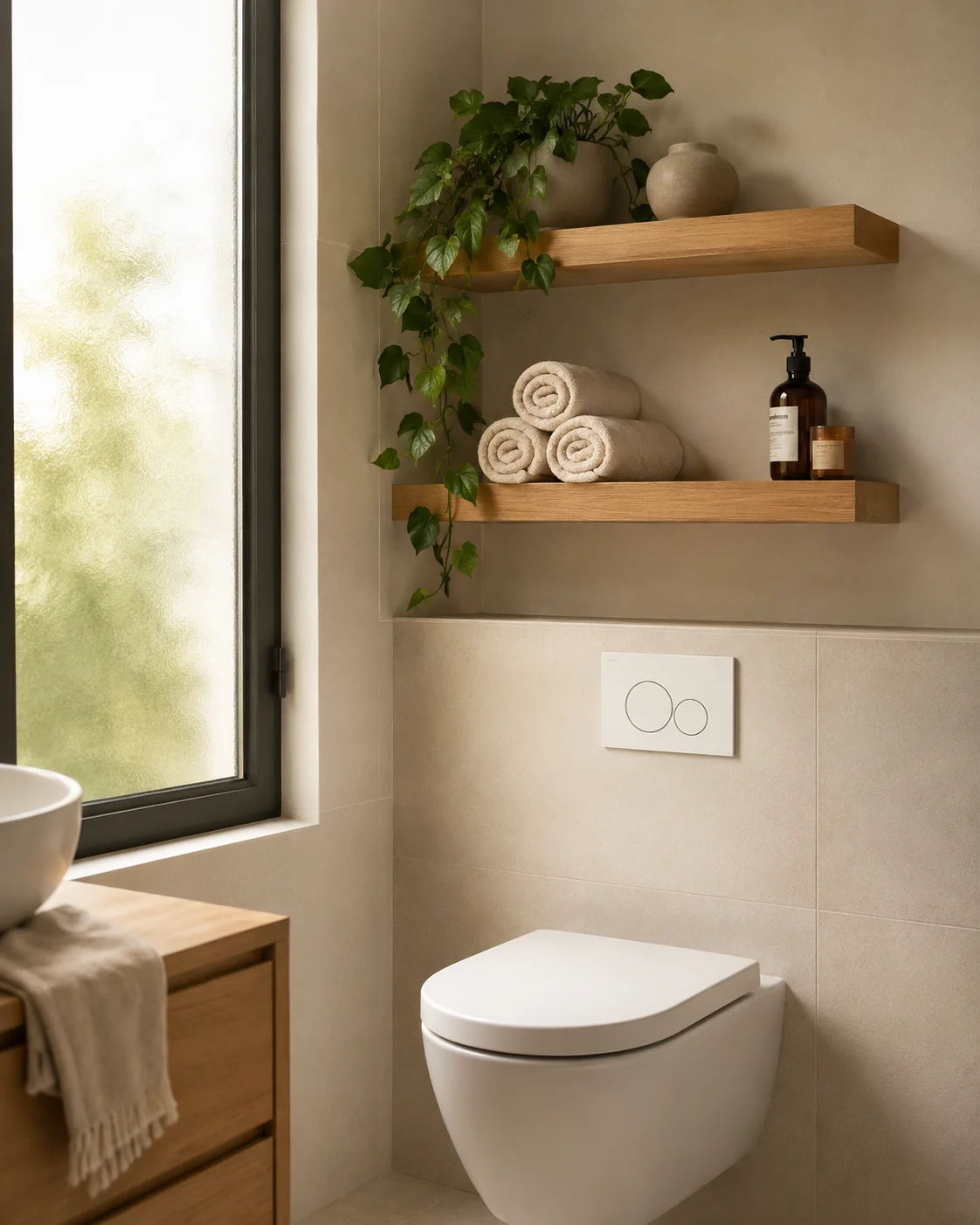
The storage in the bathroom below is all in the wall build-up, and none of it cost floor space.
The toilet is wall-hung with the cistern concealed behind that tiled panel. A concealed frame needs roughly 200mm of depth, so the boxing has to be built regardless, and the top of it is a ledge.
Above that, two oak shelves on the only wall in a small bathroom that is otherwise doing nothing. Between them they hold towels, bottles, a candle and a plant, and the floor is still completely clear.
The ledge, and making it useful
Standard concealed frames from Geberit, Grohe and VitrA are around 200 to 230mm deep. Most installers box exactly to that, which gives a lip too narrow to stand anything on.
Ask for 250 to 280mm instead. The extra 50mm costs a few pounds of timber and plasterboard and turns a decorative line into a working shelf that takes a bottle of hand wash, a small plant and a candle without anything overhanging.
Tile the top rather than leaving it as painted plaster, and specify a very slight fall to the front so water runs off the edge instead of pooling against the wall. The join between the top and the wall behind wants a silicone bead, not grout, because that joint moves.
Floating shelves, fixed properly
Those oak shelves are thick and unsupported, which means the fixing is hidden and doing real work.
They use concealed rod brackets: a steel plate with protruding rods screwed to the wall, with matching holes bored into the back of the shelf. On a masonry wall they go into the brick with proper anchors. On a stud wall they must land on studs or on noggins fitted before the plasterboard went up, and that is the part that has to be decided early.
Fixing a loaded oak shelf to plasterboard alone will work for about a year and then pull out, usually taking a piece of wall with it.
| Shelf | Depth | Holds |
|---|---|---|
| 140mm | Shallow | Bottles, a small plant |
| 180 to 200mm | Standard | Rolled towels, most things |
| 250mm | Deep | Folded towels, baskets |
For thickness, 40mm solid oak looks right and does not bow. Thinner than 30mm looks flimsy once loaded.
Oak in a bathroom needs finishing. Hardwax oil such as Osmo, two coats, refreshed every couple of years. Bare timber in a room that gets steamed twice a day will grey and lift at the edges.
What else the walls will give you
A recessed niche in the shower. Zero floor cost, built between studs while the wall is open. One tall niche beats three small ones.
The wall above the door. A high shelf for spare towels and toilet rolls. Nobody looks up, and it is dead space in every bathroom.
A mirror cabinet rather than a mirror. Adds 100 to 150mm of depth over the basin and is the single most efficient storage in a small bathroom. It has to be a good one, though; cheap mirror cabinets look exactly like cheap mirror cabinets.
Between the studs beside the basin. A shallow recessed cabinet, 90mm deep, holds a surprising amount and projects nothing.
If the wall is already closed
None of the above is available, and the honest alternatives are different.
A slim rolling cart in the gap beside the vanity, an over-door rail for towels, a tiered basket that hangs from the shower riser, and a single tray on the counter to corral what would otherwise spread. Those cost very little, need no fixings, and come with you when you move.
What to avoid: the over-toilet étagère that stands on legs either side of the pan. It is unstable, it makes cleaning around the toilet unpleasant, and it occupies the floor you were trying to free.
The hygiene question, briefly
Storing towels above a toilet bothers some people, and the concern is not entirely unfounded: flushing does aerosolise droplets.
Closing the lid before flushing deals with most of it, and is worth doing regardless. If it still bothers you, keep the towels in a closed basket on the shelf and the open display to bottles and a plant.
A brass frame that keeps open shelves honest
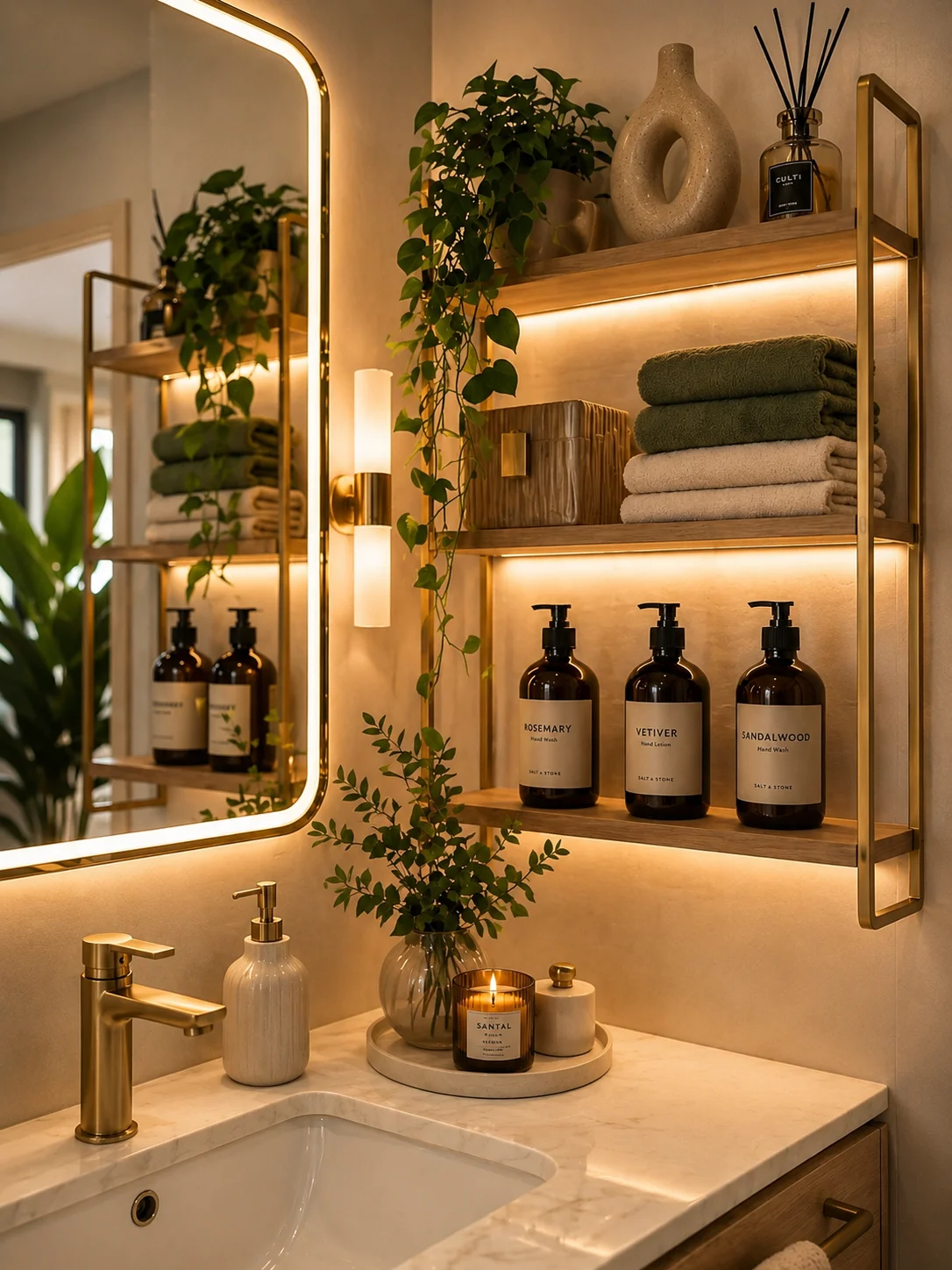
The brass uprights in this photo do two jobs at once, because they give three oak boards an edge and they repeat the tap and the mirror trim across the room. Open shelves fail when they float without relation to anything, and here the frame supplies the relation. The eye reads one unit, because the brass edge tells it where the display starts and stops.
Light under each board is doing the evening work. Bathroom shelves are used at night far more than showroom pictures admit, and a strip set into the shelf head washes the bottles and towels below instead of leaving them in shadow. That trailing pothos earns its place on the top board, where height belongs.
Steam is kind to this combination where the finishes are chosen for it. Lacquered brass wipes clean in humidity, while unlacquered brass spots and darkens within months in hard water areas. Some households like that darkening. Others read it as neglect, and they should choose lacquered. Strips in a bathroom need an enclosed profile with the driver somewhere accessible, and the oak takes the same hardwax oil treatment as the floating shelves above.
Budget £120 to £300 in 2026 for three-tier brass and oak units from Dunelm, John Lewis, or market sellers, with enclosed LED profiles adding £15 to £45 per metre in 2026. Keep the top board for leaves and height, the middle for folded textiles, and the lowest for daily pumps.
A ladder that stores without fixings
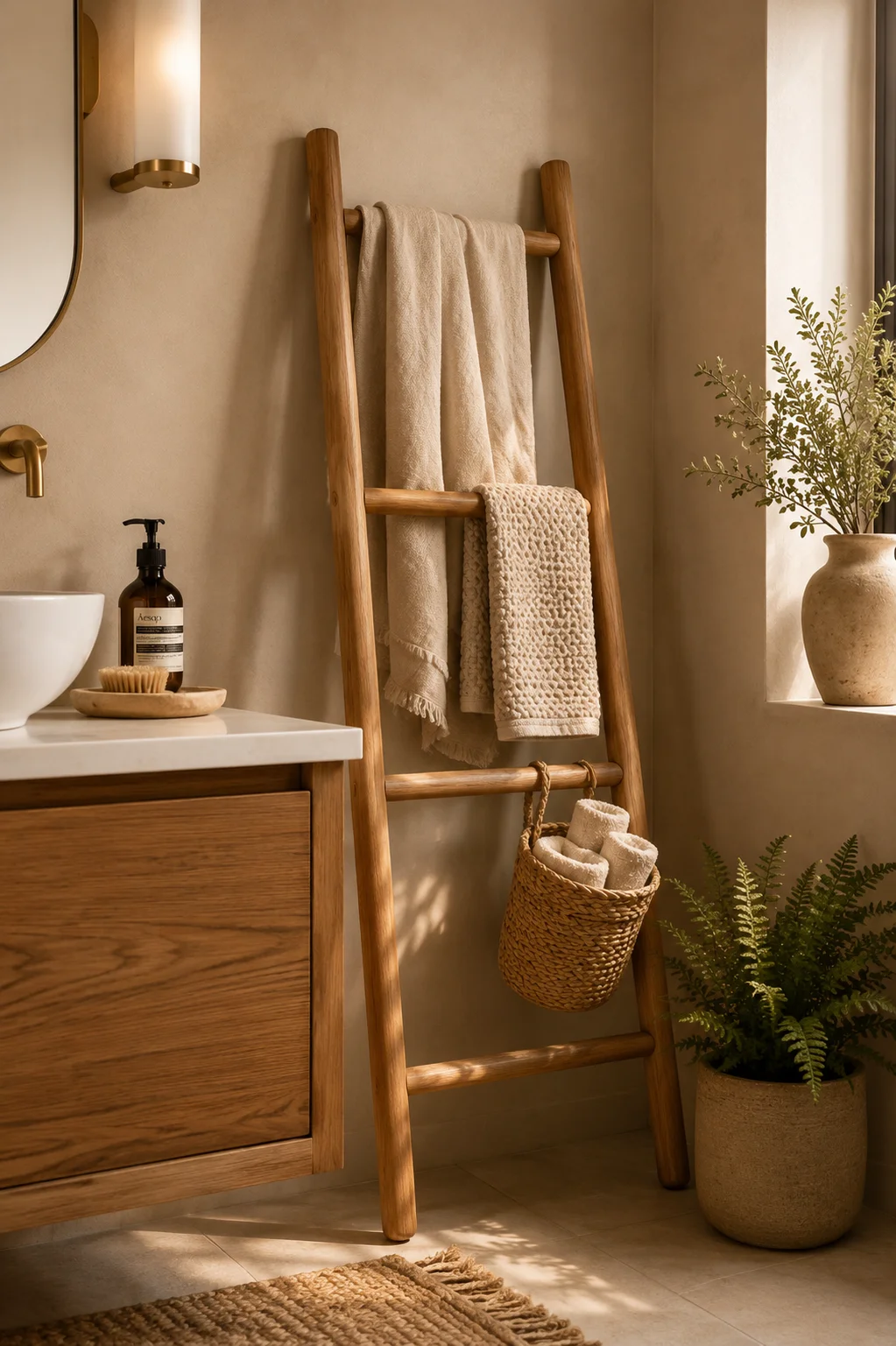
Look at where the ladder meets the floor, because that contact patch is the whole argument. Two feet on tile carry two towels, a basket of flannels, and nothing else, while the floor beneath stays visible. The eye measures storage by wall coverage, and a ladder covers wall while surrendering almost no floor, which is why small rooms accept it where a cabinet would crowd.
The rungs sort by use without anyone deciding. Long towels hang where they can drip dry, and small things sit in the hanging basket instead of colonising the vanity. Solid oak or beech tolerates this life when oiled, since the feet wick water from tile and the end grain drinks first. Felt pads under the feet and a yearly wipe of oil stop the grey creeping upward.
A hardwood ladder costs £45 to £130 in 2026 at IKEA, Dunelm, or Nkuku, while hanging seagrass baskets sit at £12 to £28 in 2026. Skip this where the ladder would stand inside the shower splash zone. Towels within reach of spray never dry, and a ladder that holds damp towels is a rack for mildew.
A tray that stops the counter spreading
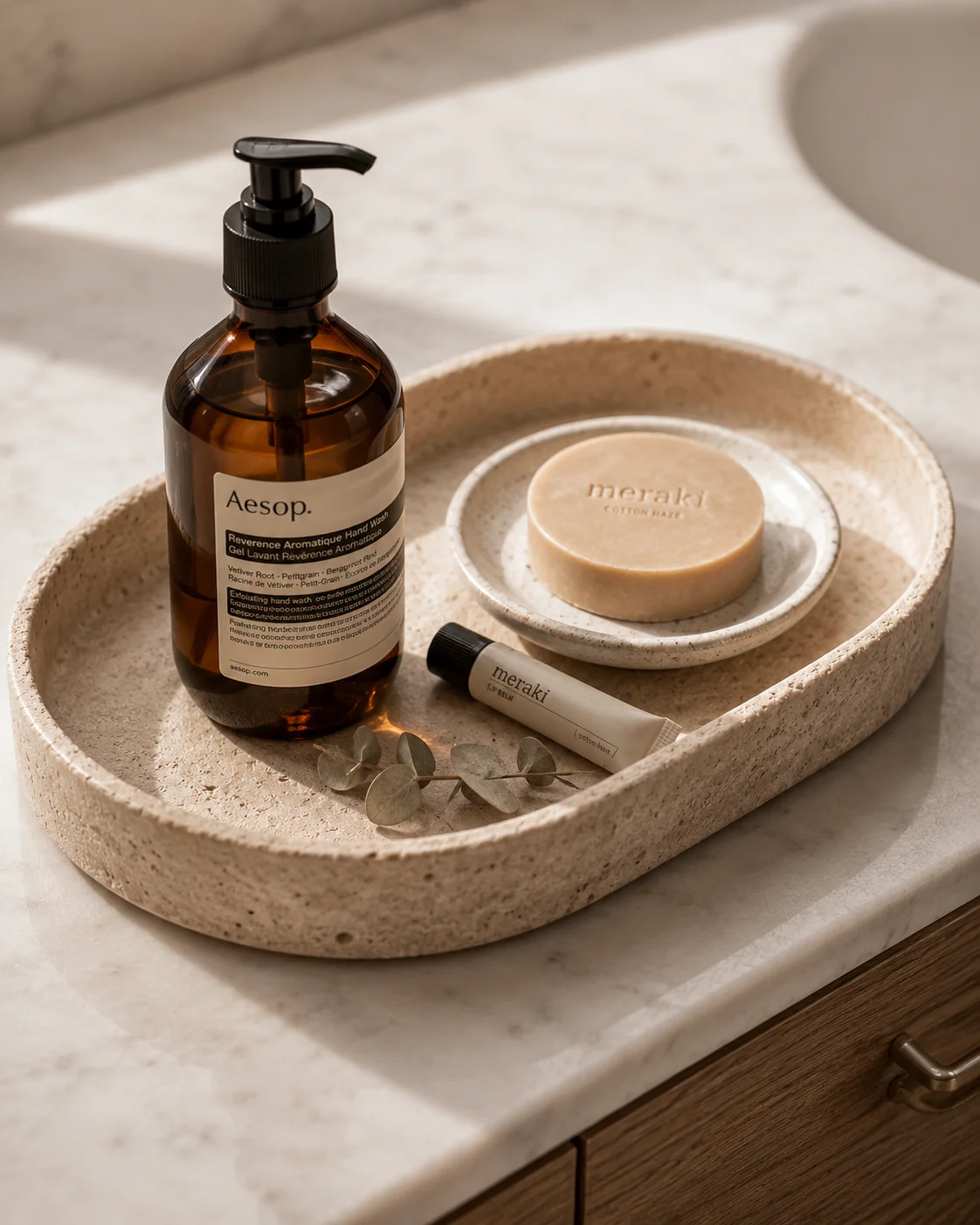
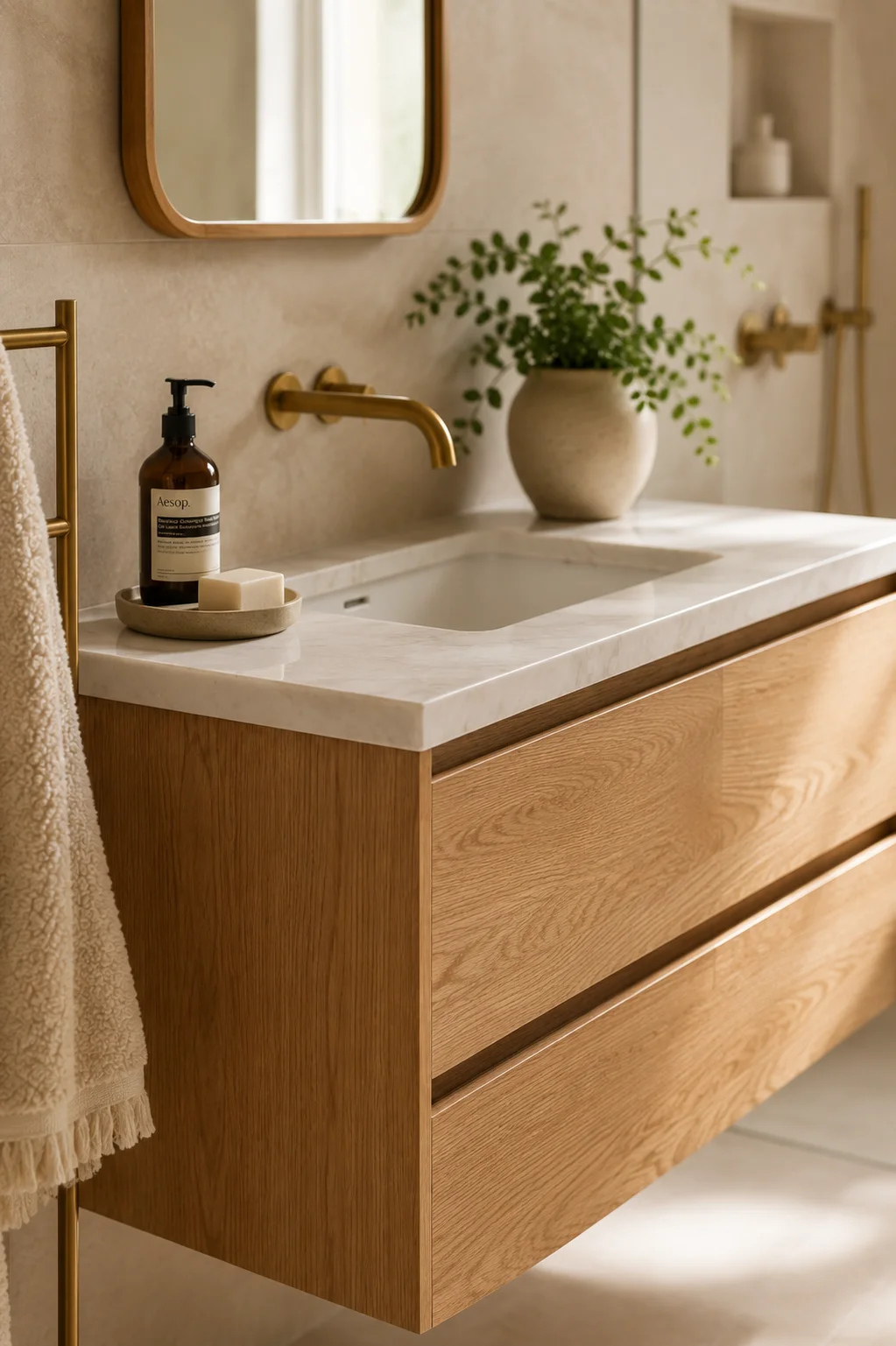
In this close frame the tray is the whole argument, because the same three objects would read as clutter on open marble and read as a set inside the rim. Loose objects each claim their own territory. Grouped objects claim one territory between them, and the boundary does the calming while the objects stay ordinary.
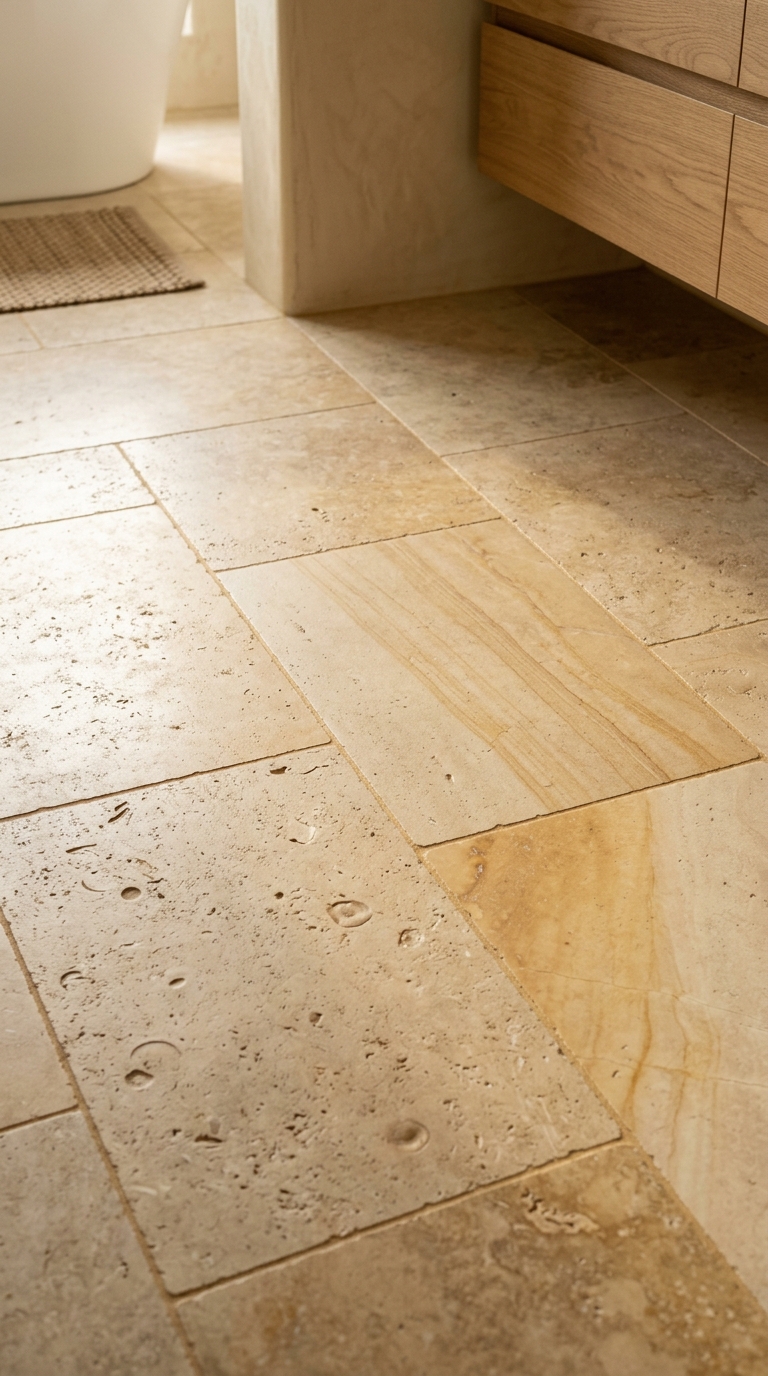
Travertine asks something in return. The stone is porous, so oils and acids spot it where glazed ceramic would shrug, which means sealing on arrival and wiping after use. Anyone who finds that tedious should choose ceramic or honed granite instead. The separate soap dish matters for the same reason, since bar soap left directly on stone melts into a ring that never quite lifts.
Expect £18 to £50 in 2026 for stone trays of this scale at H&M Home, John Lewis, or Cox & Cox; amber hand wash of that style sits between £28 and £42 in 2026. One tray per basin is the limit. Two trays divide the counter into territories again, and the spreading resumes.
Matching jars that quieten small things
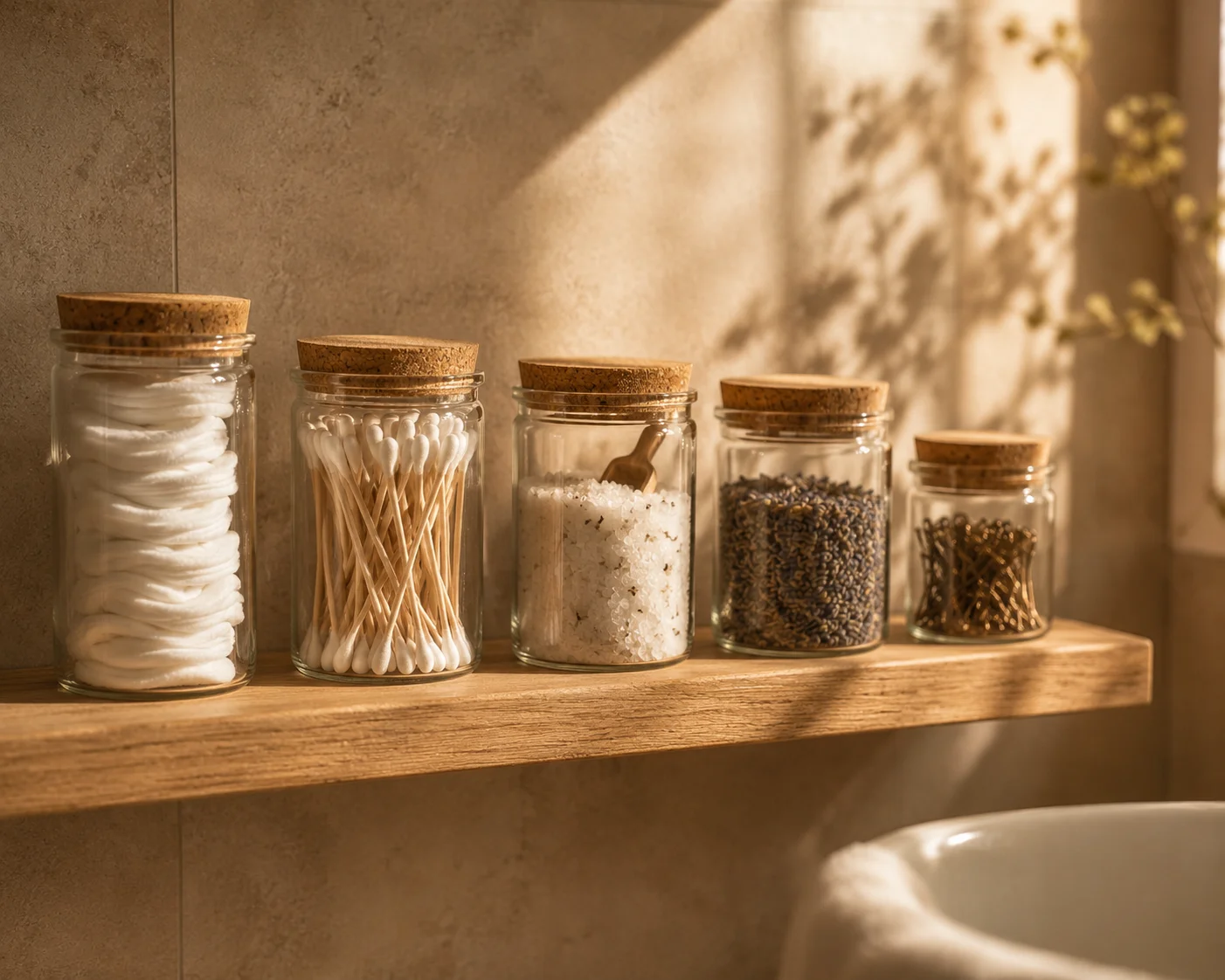
That oak board carries five jars and nothing else, which is why it works. Cotton pads, buds, salts, lavender, and pins arrive in five colours and five fonts, and decanting replaces all of that with one material. Glass suits the job because it shows the contents and tolerates steam without staining or holding odours.
Cork is the part to place carefully. The lids look warm against the glass, and on a dry shelf they behave perfectly well, but cork swells and spots in constant humidity. These belong on a dry wall outside the shower; lids of bamboo or ceramic last longer where spray lands, and salts jars need an occasional rinse since salt creeps under any lid.
Single cork-lid jars change hands for £3 to £8 in 2026, and five-piece sets for £15 to £35 at IKEA (KORKEN), H&M Home, or John Lewis. This treatment suits dry goods only. Lotions and creams should stay in their pumps, where their dates and their hygiene survive.
Baskets that make the cupboard usable
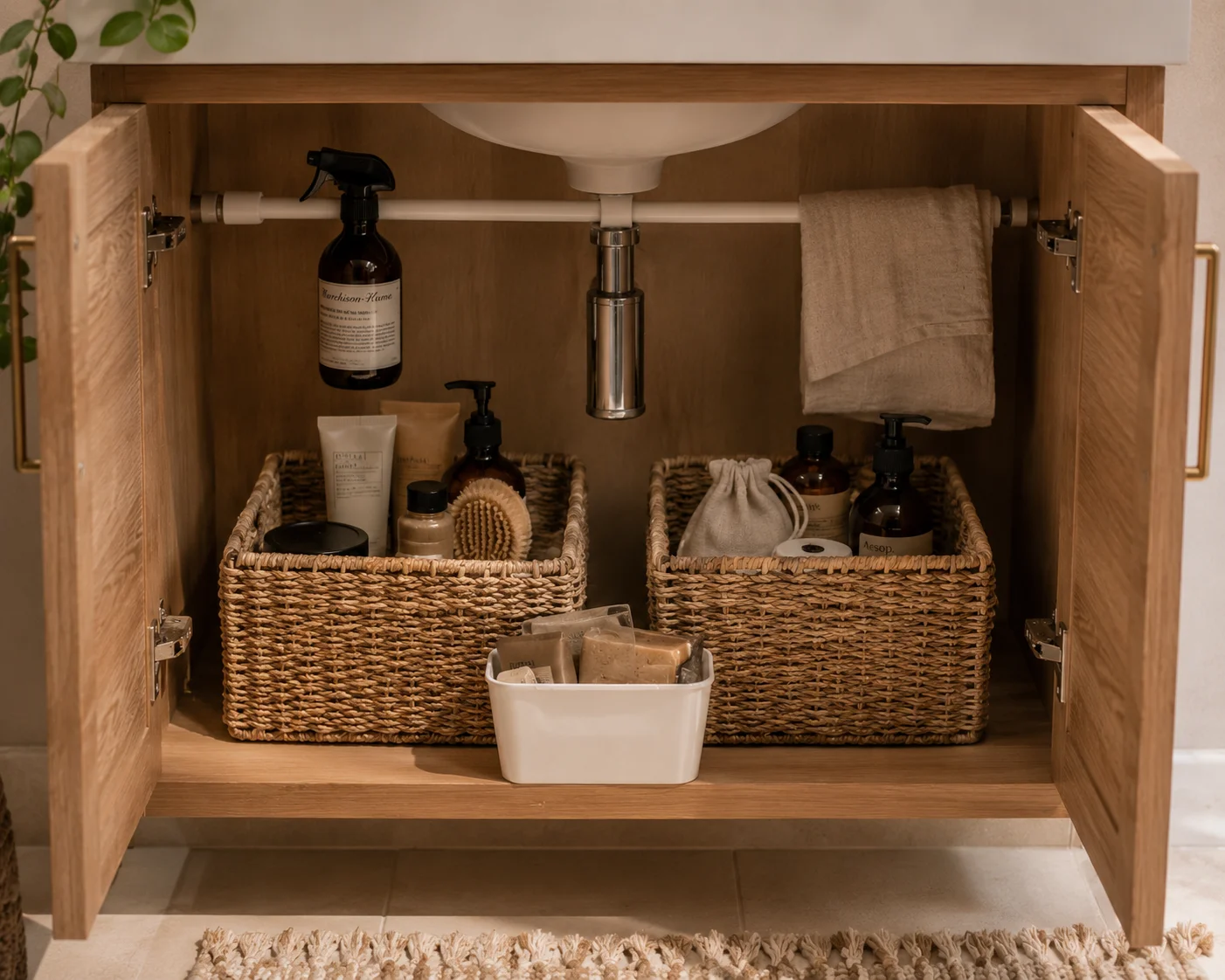
Below the basin, the cupboard is organised into groups, with each basket holding one category. Two seagrass baskets divide daily things from backup stock, a small tub holds sachets in front, and a tension rod lifts the spray off the base entirely. Dark cupboards fail on retrieval: hands cannot find the label in the dark, so grouping means a hand finds the right basket first.
The under-sink is the dampest storage in the room, because traps weep slowly and bottles drip. Seagrass tolerates humidity but not standing water, so the base needs wiping and the plumbing needs checking. A plastic tub inside one basket contains the leaks that every household gets eventually. The rod itself should be stainless, since plated steel bubbles and rusts in damp within a year.
Seagrass baskets this size list at £10 to £25 in 2026 through Dunelm and IKEA; tension rods list at £8 to £18 in 2026 through B&Q and John Lewis. Match the two baskets. Two different weaves under one basin read as clutter even with the doors closed, because the eye inventories the mismatch each morning.
A drawer divided before it fills
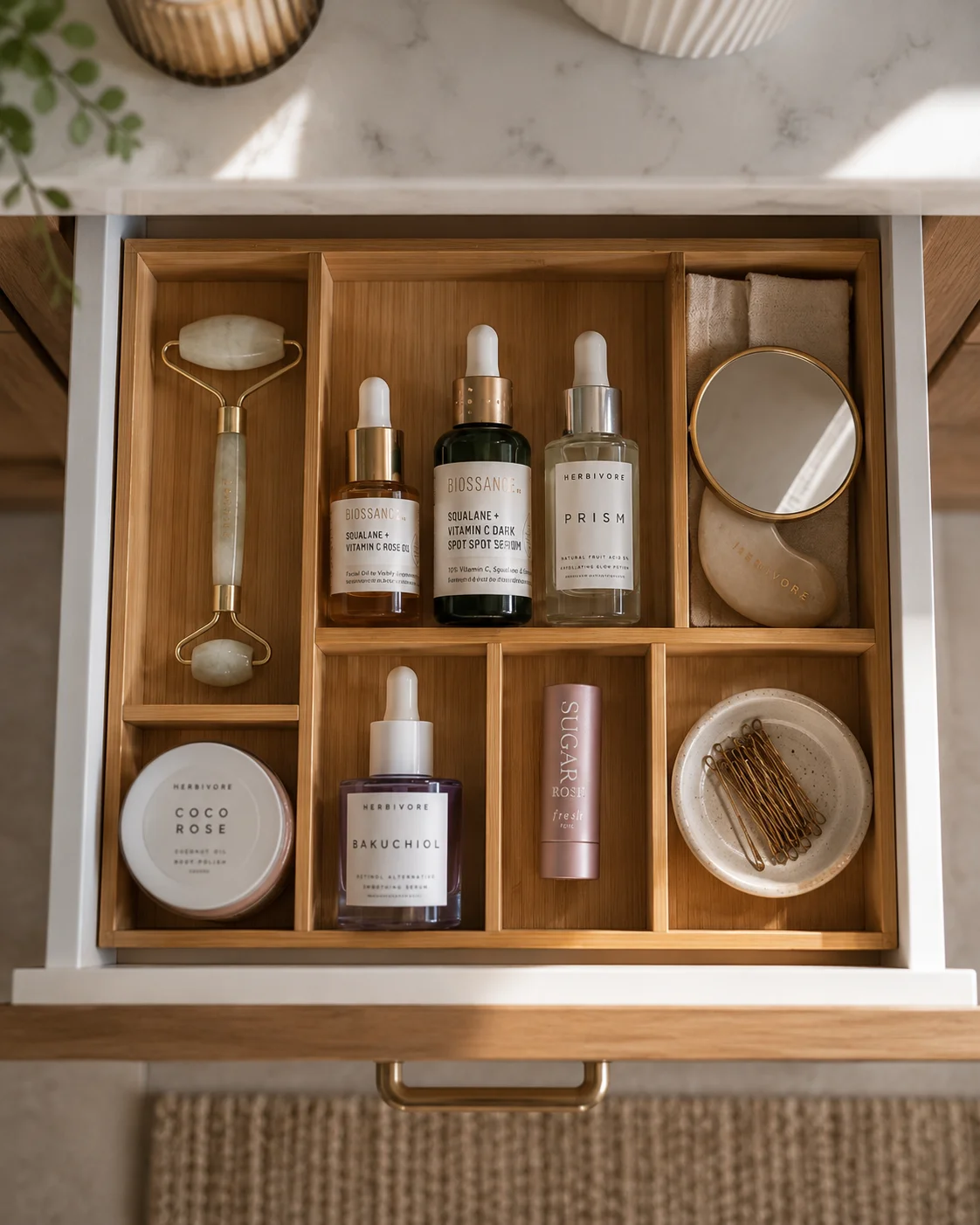
Seen from above, the drawer reads as a tray of lanes, with every small thing visible at once. Serums stand in tall compartments, the roller and mirror lie in narrow ones, and pins sit in a dish instead of drifting. Drawers become archaeology the moment small things can stack, and lanes are what stop the stacking.
Bamboo brings warmth that plastic never manages, and it brings one demand. The grass swells and sticks in constant steam, so the bathroom needs ventilating and the insert benefits from an occasional light oiling. Where the room runs permanently humid, moulded dividers from Muji or Joseph Joseph move more freely and wipe clean. Either way the top layer should stay spare, because a full drawer hides what it holds and the routine slows accordingly.
Allow £12 to £30 in 2026 for bamboo inserts stocked by IKEA, Muji, and Joseph Joseph. Measure the drawer before ordering. Inserts assume square corners, many drawers slope at the front, and the returns queue is full of grids that almost fitted.
One basket that reads as one texture
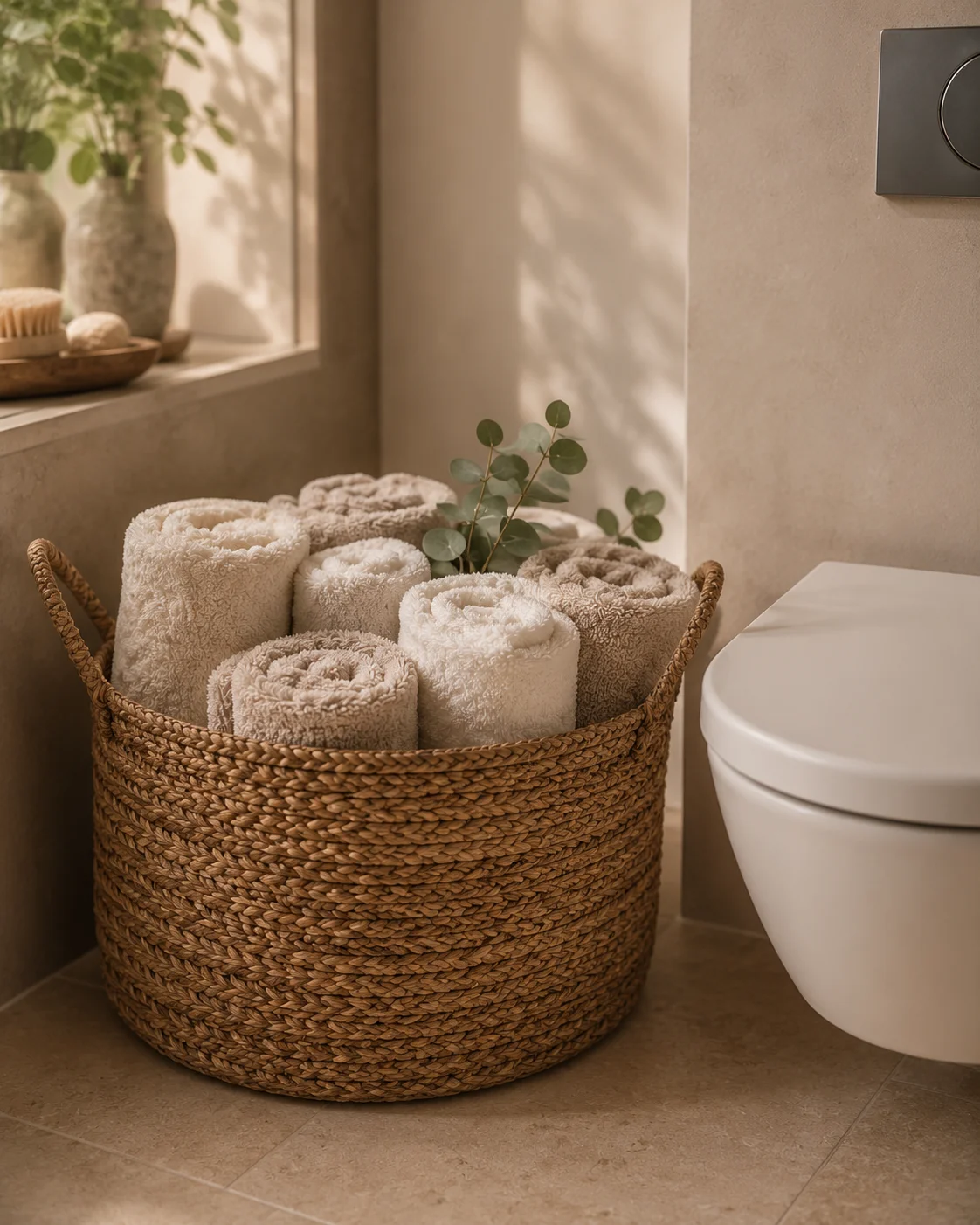
The weave shows it most clearly at the rim, where the thick braid turns six separate towels into a single pale mass. Rolling is doing half of that work, because it shows the soft edge and hides the worn fold, and keeping one palette does the other half. New cream and old cream are different colours, so wash the set together before judging whether it matches.
The floor decides this one. Seagrass wicks water steadily off tile, and a basket that sits in the mop zone or the shower run softens from the base upward. Stand it where mopping reaches around it, on feet where possible, and out of the direct splash line. The eucalyptus on top is decoration, and a sprig costs less than any other improvement on this page.
Large seagrass baskets fetch £25 to £60 in 2026 from Dunelm, John Lewis, or The White Company. One basket, one job. A second basket beside it should hold something visibly different, or the pair reads as laundry waiting to leave.
A rail that dries what it holds
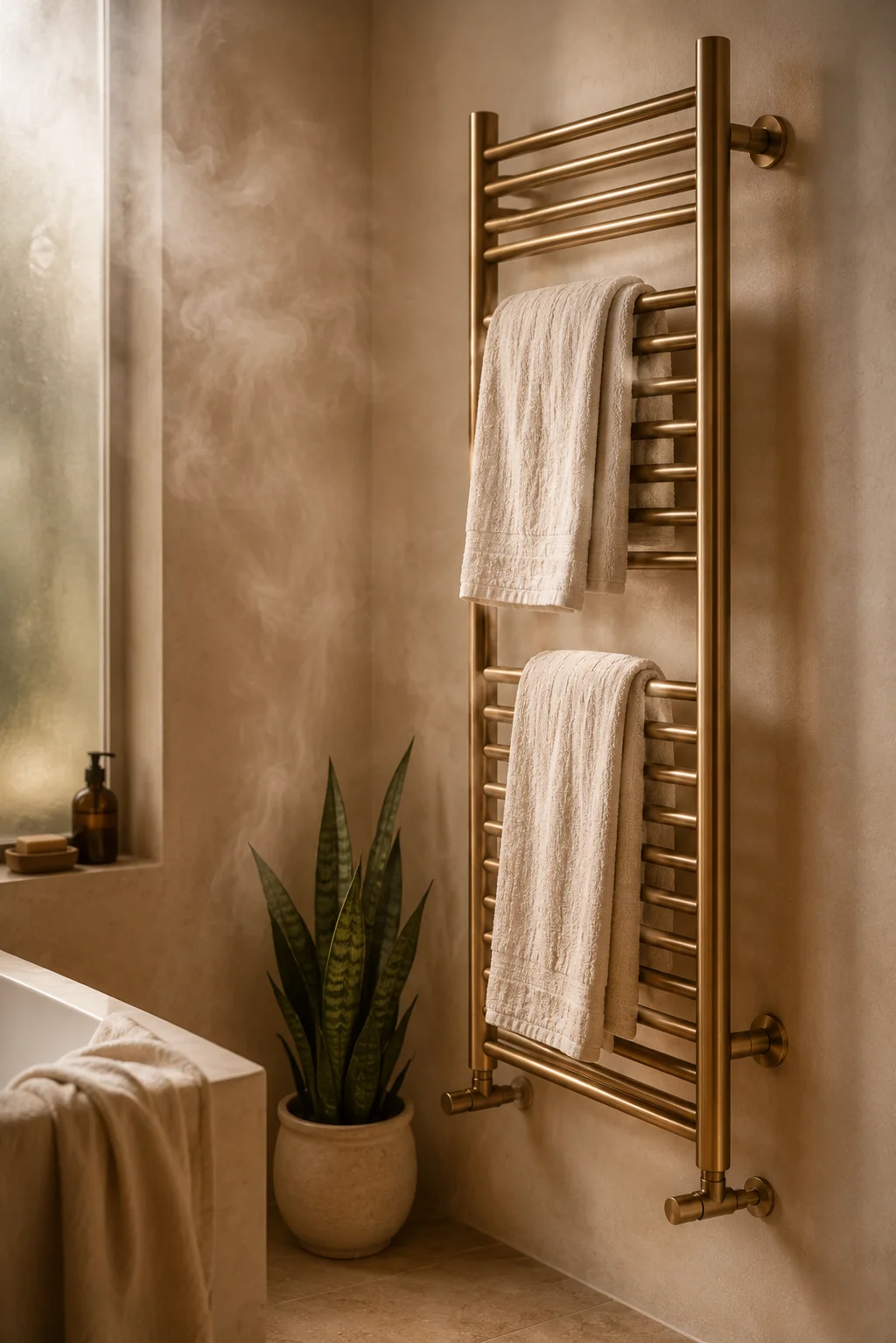
Steam is visible in this shot, which is exactly the condition the rail is answering. Towel storage fails at drying: hanging is easy, and airflow between uses is the scarce part. That airflow is why bathrooms with rails smell better than bathrooms with hooks alone in still corners. The tall format stores two towels on a narrow wall, with the lower bars left free for the hand towel.
Finish decides how this ages. Brushed lacquered brass tolerates steam and wipes clean, while unlacquered brass waterspots in hard water areas within months. That spotting is patina to some eyes and neglect to others, so the choice belongs at ordering, before the rail is on the wall. Electric rails need a fused spur outside the splash zones, which is wiring work for someone qualified, decided with the electrician.
A brass heated rail of this height is priced £250 to £700 in 2026 by Vogue, Bisque, and Crosswater. This is the piece to buy once. A cheap plated rail that lifts at the joints within two winters is the expensive thing that still reads cheap, and it cannot be hidden once fitted.
Three hooks instead of a rail
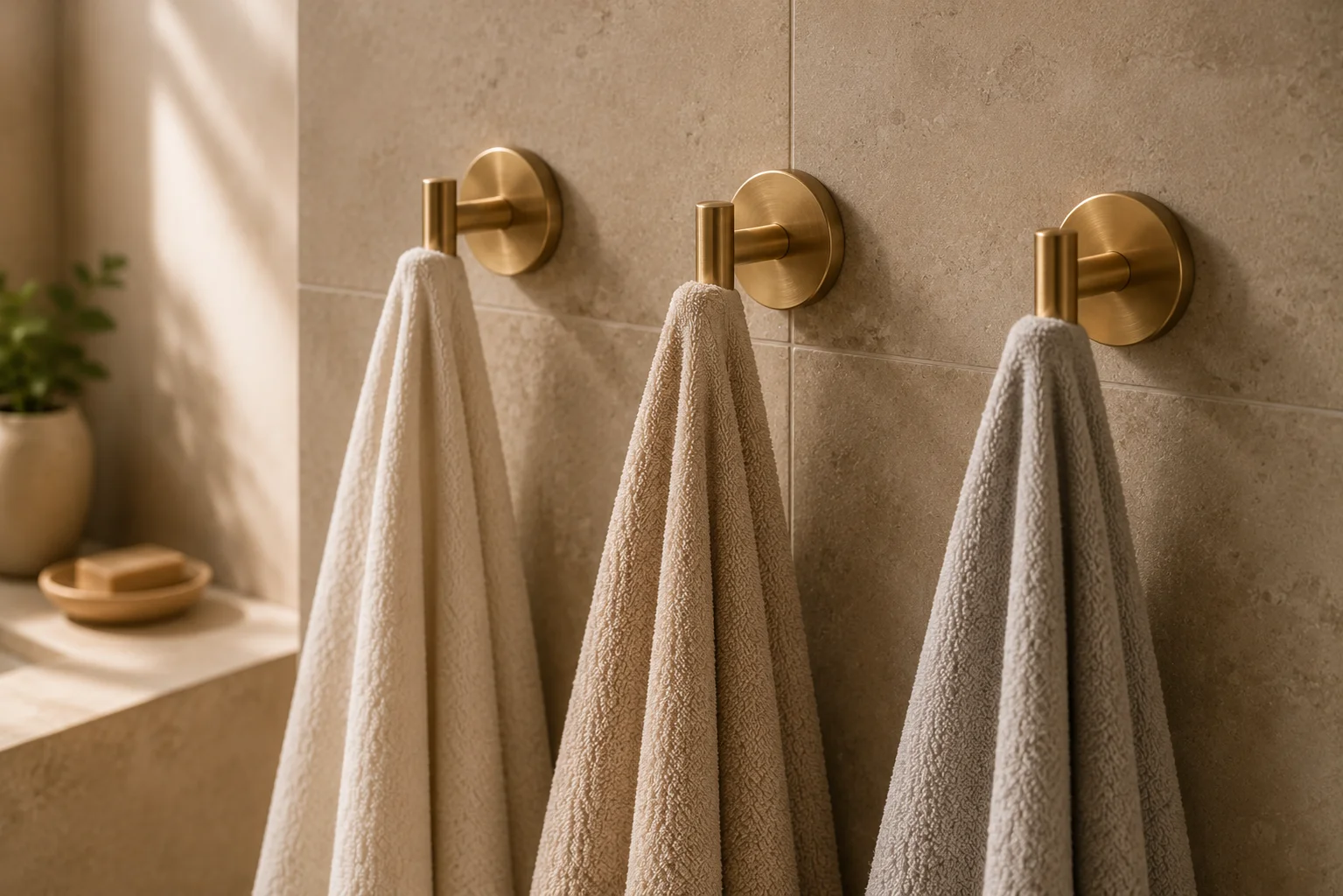
Count the fixings rather than the towels, because three solid hooks on large tile are doing quieter work than they appear. Each towel hangs with air on both sides instead of folded over a bar, so drying is faster, and the wall needed is a fraction of a rail. Spacing governs the result. Towels that touch each other never dry between uses, however good the heating.
Fixing into tile is the part to respect. Diamond drilling with each hole sealed in silicone keeps moisture out of the wall, while a cracked tile from hurried drilling costs more than the hook ever did. Solid brass survives steam for decades. Plated zinc only pretends to, since the plating lifts and bubbles where humidity reaches the base metal, so check what sits under the finish before buying.
Each solid brass robe hook is £8 to £22 in 2026 at Corston Architectural, Dowsing & Reynolds, or B&Q. Three matching hooks beat five mixed ones. The metal should repeat the tap. Two brass tones argue across a small room, so a second family of metal is a mistake.
| Material | Behaviour in steam | Typical band in 2026 |
|---|---|---|
| Solid brass, lacquered | Wipes clean with rare spotting | £8 to £22 per hook |
| Powder-coated steel | Tolerates humidity while the coating stays intact | £25 to £65 per unit |
| Teak and iroko | Oily timbers that accept direct water | £70 to £180 per stool |
| Oak with hardwax oil | Sound on dry walls, refreshed every few years | £40 to £120 per shelf |
| Glass, ceramic, and stone | Unaffected by steam, sealed where porous | £15 to £50 per tray or set |
| Seagrass and bamboo | Fine in humidity, poor in standing water | £10 to £30 per basket |
Teak that sits in the water path
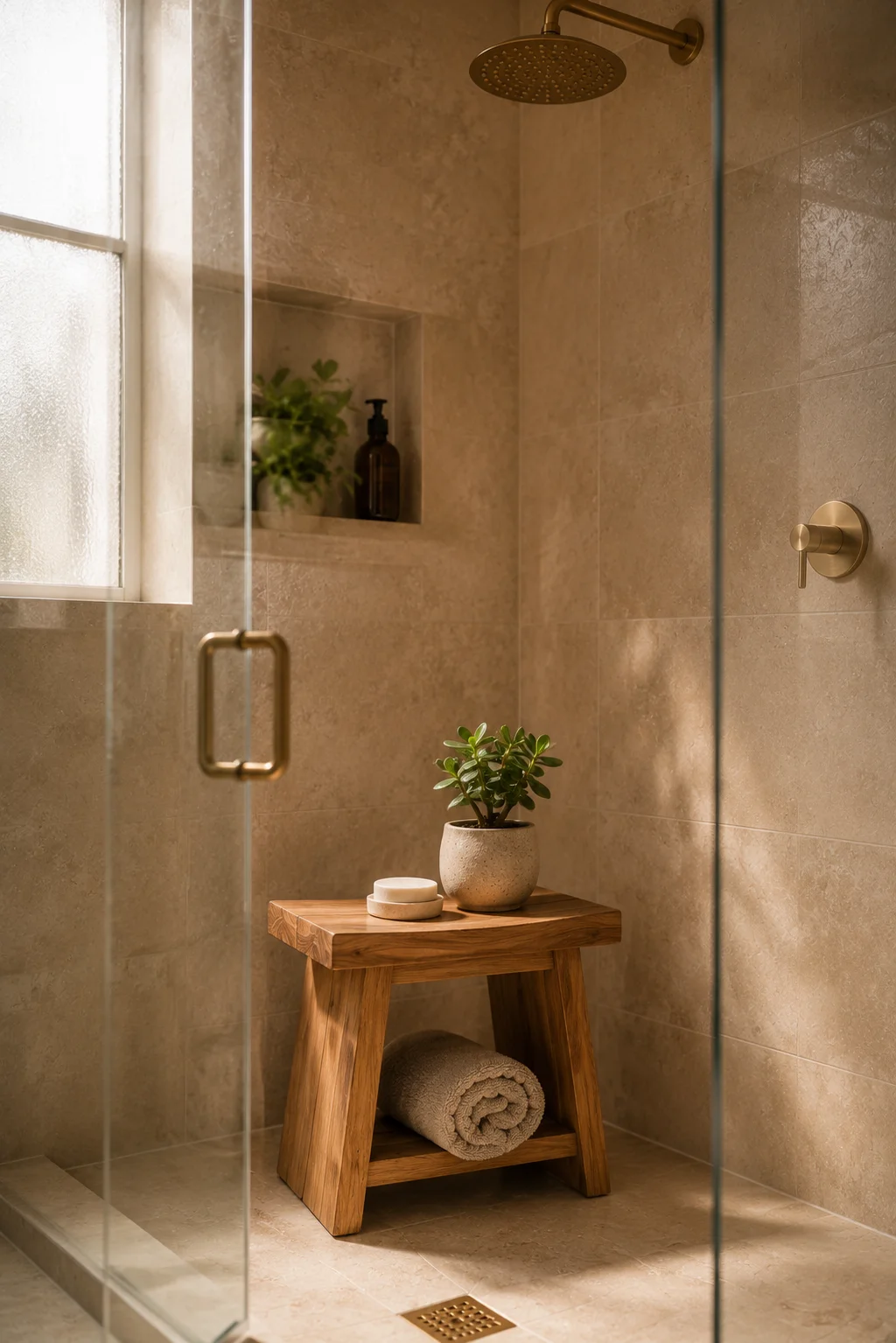
In this shower the timber sits where the water lands, which sorts the suitable woods from the unsuitable immediately. A low teak stool carries soap and a plant on top with a rolled towel on the lower slat, while the open frame drains between uses. The seat earns its floor three times over as a perch, a footrest, and a shelf, which is why a small stool beats a long bench in most rooms.
Teak and iroko tolerate this life because of their natural oils. Beech and untreated oak do not, however often they are wiped. Teak silvers within a year in a bright shower, and that grey suits stone while disappointing anyone who expected honey to last. Oil restores the colour until the next cycle, so the question is maintenance against appearance, and both answers are defensible.
Teak shower stools this size are £70 to £180 in 2026 at Neptune, Cox & Cox, or Tikamoon; Liberon teak oil is £12 to £25 a tin in 2026. Oil lightly and rarely. Thick coats peel in steam, and peeling oil looks worse than silvered timber.
A niche that stores without entering the room
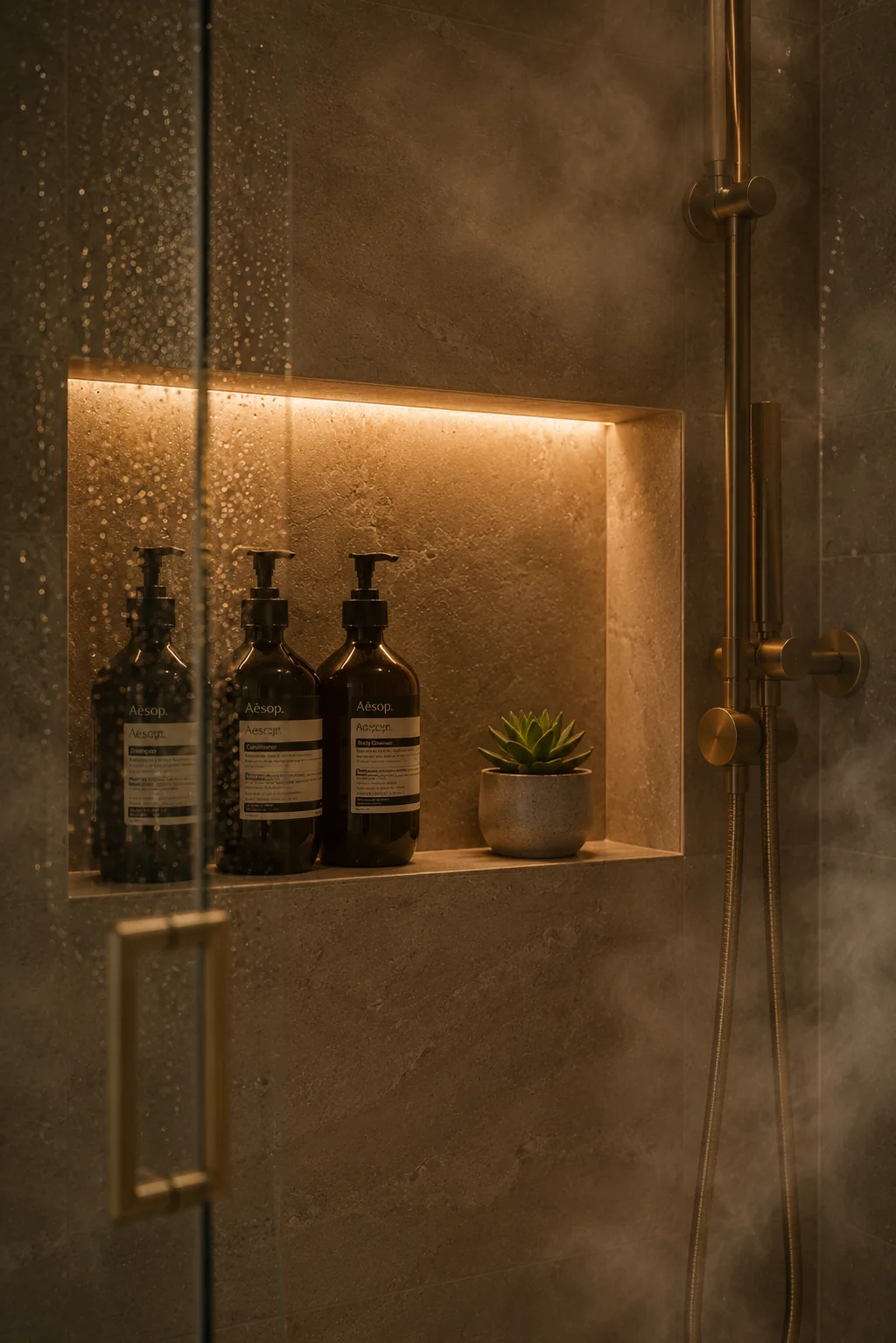
The glow in that recess shows what a niche does after dark, because the strip in the head washes three amber pumps and a succulent that would otherwise stand in shadow. Recessed storage costs no floor and no projection, which is why one long niche replaces a caddy and a shelf combined. Lining it in the surrounding tile keeps it quiet, and the strip makes it legible after dark.
Building it right matters more than styling it. The base needs a slight fall forward so water runs out instead of sitting, and the wall-to-base joint takes silicone, since grout cracks where heat and steam move the junction. Strips in a shower belong in an enclosed profile rated for wet zones, with the transformer left accessible for the day it fails. That part belongs to the electrician and is decided before the tiles go on.
Retrofit LED profiles are £15 to £45 per metre in 2026, plus an electrician visit where the circuit is new. Keep three bottles and one plant. Five bottles return the niche to the clutter it was built to remove.
A mirror that hides the daily bottles
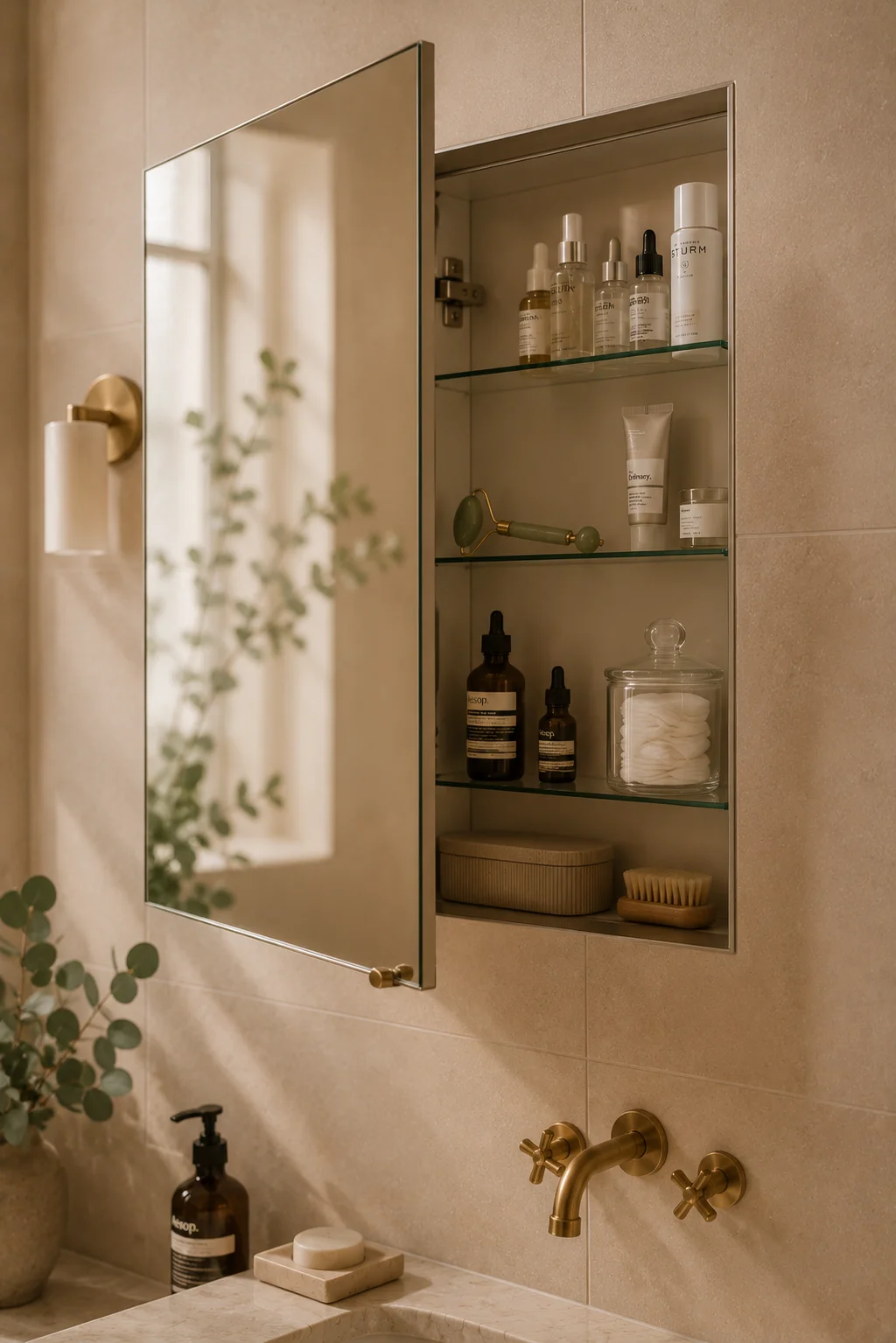
Pictured open, the cabinet gives away its depth. Three glass shelves hold serums, creams, cotton pads, and a brush within reach of the basin, and closing the mirrored door removes all of it in one movement. The most efficient storage in a small bathroom sits over the basin at eye level, because the reach is shortest and the mirror doubles whatever light exists.
Recessing removes the projection that makes surface cabinets lean into the face. That flush fit needs a stud wall with room between the uprights and no pipes in the way, which is decided before plaster, while the studs are still open. On masonry the same result means chasing the wall, which few rooms justify. Glass shelves suit steam better than timber, since they wipe clean and never swell, and the brass wall tap below matters here because it frees the counter the cabinet would otherwise duplicate.
Recessed mirror cabinets are £180 to £550 in 2026 at HiB, Roper Rhodes, or Duravit. Choose one that closes flat and fully mirrored. A framed door that stands proud of the tile reads as a box beside it, however tidy the inside.
Height beside the pan instead of width
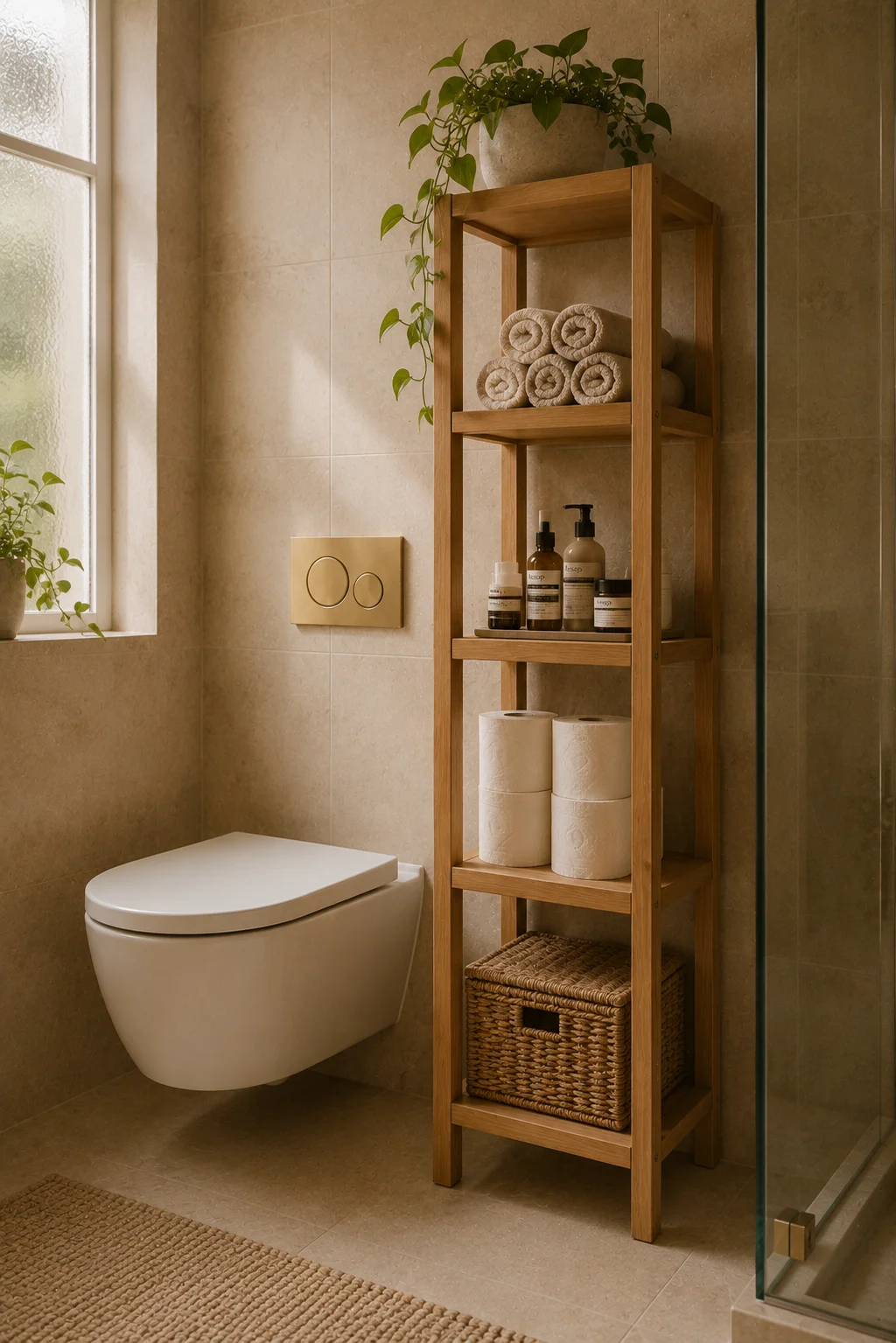
The tower beside the pan works because each tier has one job, which the photograph shows from top to bottom. Leaves and height sit above eye level, rolled towels fill the next shelf as a single texture, daily bottles stand together on a small tray, paper stacks below, and a lidded basket closes the base. Where floor width is missing, the only direction is up, and sorting by tier stops five shelves becoming five ledges for clutter.
Open oak collects humidity on every surface, so all sides need finishing with hardwax oil and the unit needs breathing room off the tile, pulled a finger forward when it is fixed. Look at the bottom tier in particular. The basket hides what should not be seen, because open towers fail exactly there, when the lowest shelf quietly becomes a cupboard. The oak repeats the palette used elsewhere in the room, which stops the tower reading as an afterthought wheeled in late.
Slim oak towers in this pattern are £90 to £250 in 2026 at IKEA (HEMNES), Tikamoon, or John Lewis. Fix the unit to the wall against tipping even where it looks stable. The freestanding appearance still needs a strap, particularly where children reach for towels.
Frequently asked
Frequently Asked Questions
Which shelf material copes best with daily steam?
Sealed hardwood, glass, stone, and powder-coated metal stand up to humidity year after year. Bare softwood, unsealed fibreboard, and natural weaves placed in the splash zone swell, spot, or soften. Put timber shelving on a dry wall and keep anything woven off the wet floor.
Do woven baskets belong in a damp bathroom?
Hung on a hook or set on a dry shelf, yes, since air moves around the weave and they group small things well. Standing in puddles or mop water, no, because the fibres drink steadily from below. Where water pools, swap weave for lidded plastic or ceramic that wipes dry.
Is a heated rail storage or heating?
Both, and the drying is the point, with the warmth only how it gets there. A rail run for an hour after washing keeps towels aired between uses, which removes the sour smell that still air sometimes leaves. Size it for two towels, since one towel on a tall rail wastes half the heat, and have the wiring done properly.
Should the shower have a niche or a shelf?
A recess where the wall allows it, because it holds bottles flush and never intrudes into elbows. Its position and any cable need agreeing before tiling. A corner shelf or hanging caddy suits finished rooms and rented ones, with teak and stainless lasting longest in the spray.
How do open shelves stay styled instead of crowded?
Give each board a single role and repeat one finish across them, so folded textiles in one palette count as one block. Leaves add height without adding clutter. When a shelf holds display and stock together, move the stock into a closed basket elsewhere.
What fixings do bathroom shelves need?
Into studs or masonry with the correct anchors, never into plasterboard alone. On tiled walls, drill with a diamond bit and seal each hole with silicone so moisture stays out of the wall. For tall open units, add an anti-tip strap even where they look entirely stable.
Before the wall closes
- Ask for cistern boxing 50mm deeper than the frame requires.
- Specify noggins where floating shelves will go, before plasterboarding.
- Use 40mm shelves on concealed rod brackets, finished with hardwax oil.
- Add a recessed niche in the shower while the studs are open.
- Consider a mirror cabinet over a plain mirror; it is the best storage per millimetre.
- Corral the counter in one tray and decant dry goods into glass.
- Put brass, sealed timber, and stone where steam lands, and keep weave dry.
This article may contain affiliate links. We may earn a commission at no extra cost to you.