10 Bathroom Colour Ideas: Your Wall Colour Decides the Brass

Add us as a preferred source to see more stories on Google.
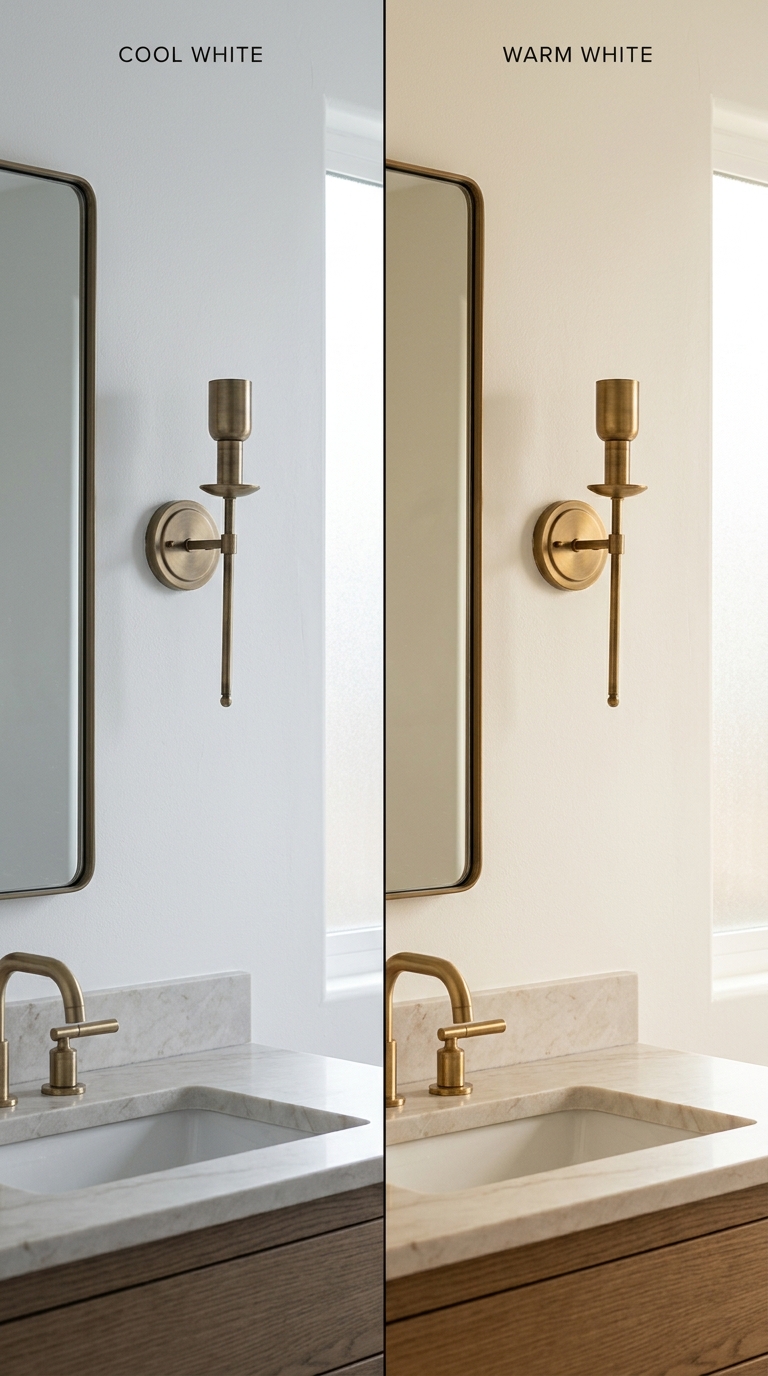
The two halves of the picture below are the same bathroom, the same fittings and the same marble. Only the wall colour changed.
Look at the sconce. On the left it is a dull grey-brown, the sort of finish you would describe as tarnished. On the right the identical fitting is warm gold.
Now look at the marble. Grey on the left, cream on the right. And the oak vanity, muted on one side and honeyed on the other.
Nobody changed anything except the paint, and every material in the room changed with it.
Why it happens
Colour is not a property of an object so much as a relationship between objects. The eye judges everything by comparison with what surrounds it, and in a small room the walls are most of what surrounds everything.
Put brass against a blue-leaning white and the eye reads the brass as duller and browner, because the wall is supplying the cool reference. Put the same brass against cream and the eye reads it as more golden.
This is why fittings that looked wonderful in a showroom, which is usually lit warm and set against timber, can look disappointing at home against a cool grey-white wall.
Matching the white to the metal
| Fittings | Suits | Avoid |
|---|---|---|
| Unlacquered or aged brass | Warm whites, cream, soft greige | Blue-greys, brilliant white |
| Polished brass or gold | Warm whites, soft clay | Cool greys |
| Chrome | Cool whites, blue-greys, true white | Cream, which makes it look green |
| Polished nickel | Almost anything; slightly warm | Nothing much |
| Matt black | Almost anything | Nothing much |
| Copper | Warm whites, terracotta, clay | Cool greys and blues |
Chrome catches people out in the other direction.
It is a cool metal, and against a cream wall it can look faintly green and slightly cheap, which is the opposite of the problem brass has. If the fittings are chrome and already fitted, a cooler white genuinely suits them better, and choosing a warm white on principle will make an expensive tap look like a budget one.
Nickel and matt black are the forgiving ones, which is a reasonable argument for choosing them in a room where the paint is not yet decided.
Whites worth testing
| Budget | Warm side | Cool side |
|---|---|---|
| Premium | Farrow & Ball Pointing, School House White | Farrow & Ball Strong White, Blackened |
| Mid | Benjamin Moore White Dove OC-17 | Benjamin Moore Chantilly Lace |
| Mid | Little Greene Slaked Lime | Little Greene Loft White |
| Trade | Dulux Natural Calico | Dulux Polished Pebble |
Two practical notes on testing in a bathroom specifically.
Sample on card instead of on the wall, so each colour can travel from tap to tile to stone in turn. A sample painted beside the mirror tells you how it looks beside the mirror and nothing else.
And look at it with the light you will actually use. Bathrooms are used at seven in the morning and eleven at night, under bulbs, far more than they are used in daylight. A white chosen at noon on a Saturday is chosen under conditions you will rarely repeat.
Beyond white
The same principle runs through any colour, and it is more forgiving than people expect.
Deep colours in a small bathroom work well, particularly in a room with no window, because a dark room stops announcing its own boundaries. Greens and clay tones sit beautifully with brass. Blues and greys sit with chrome and nickel.
What rarely works is a mid-tone cool grey. It is the default choice, it flatters nothing, and in artificial light it goes slightly purple.
Where the rule bends
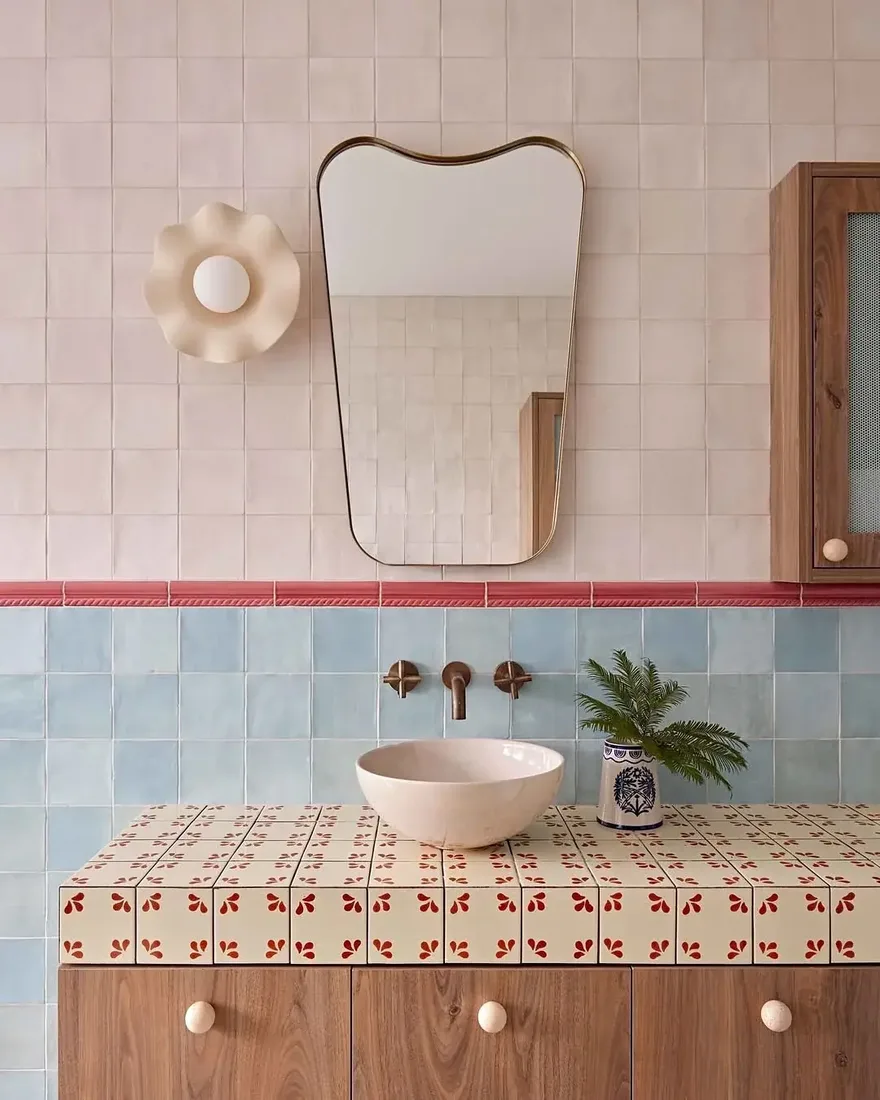
Rooms with a strong colour already in them, such as a patterned tile or a coloured stone. There, the wall should answer to the tile, not the tap, since the tile is the larger area and the thing you cannot change.
And genuinely dark rooms, where any white will read grey after four in the afternoon. In those, choosing a colour deliberately is usually a better answer than chasing the brightest white.
Cream all over, when daylight does the work
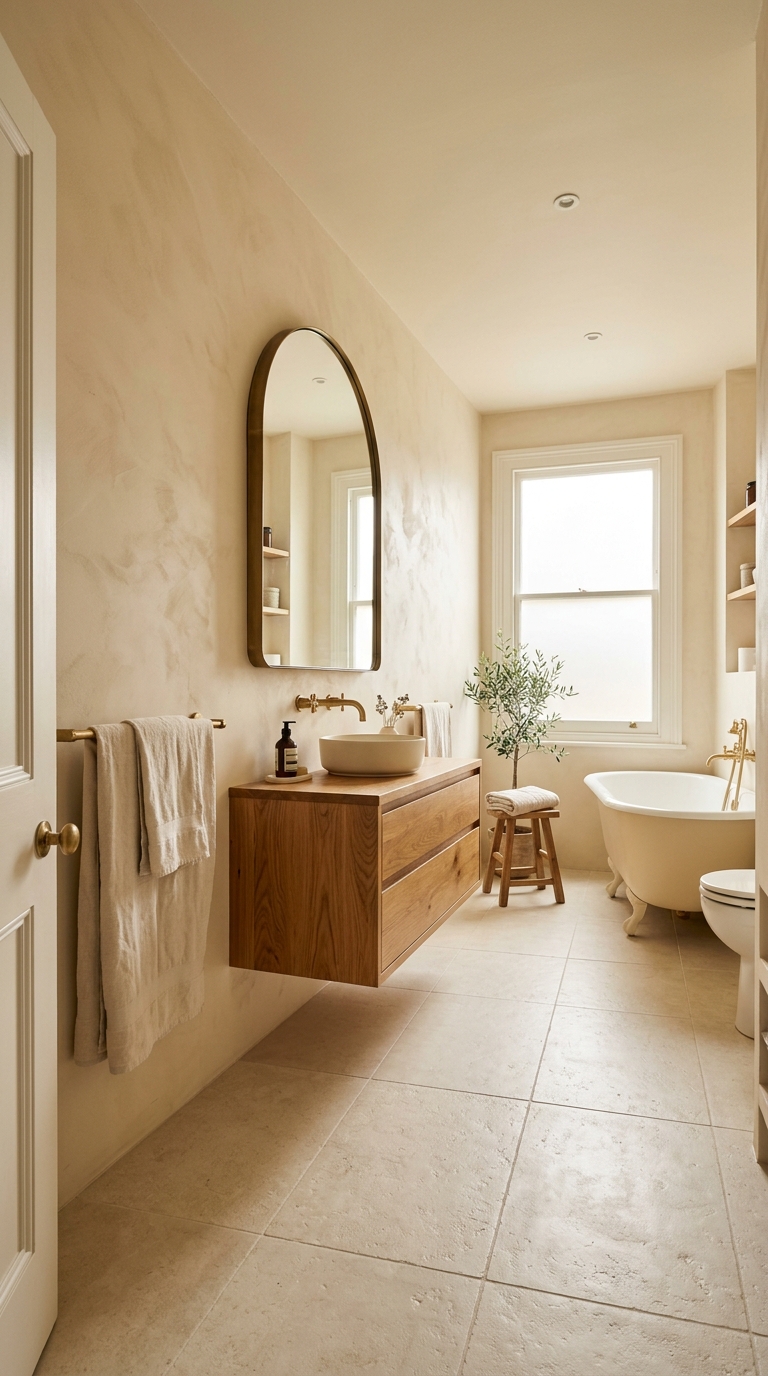
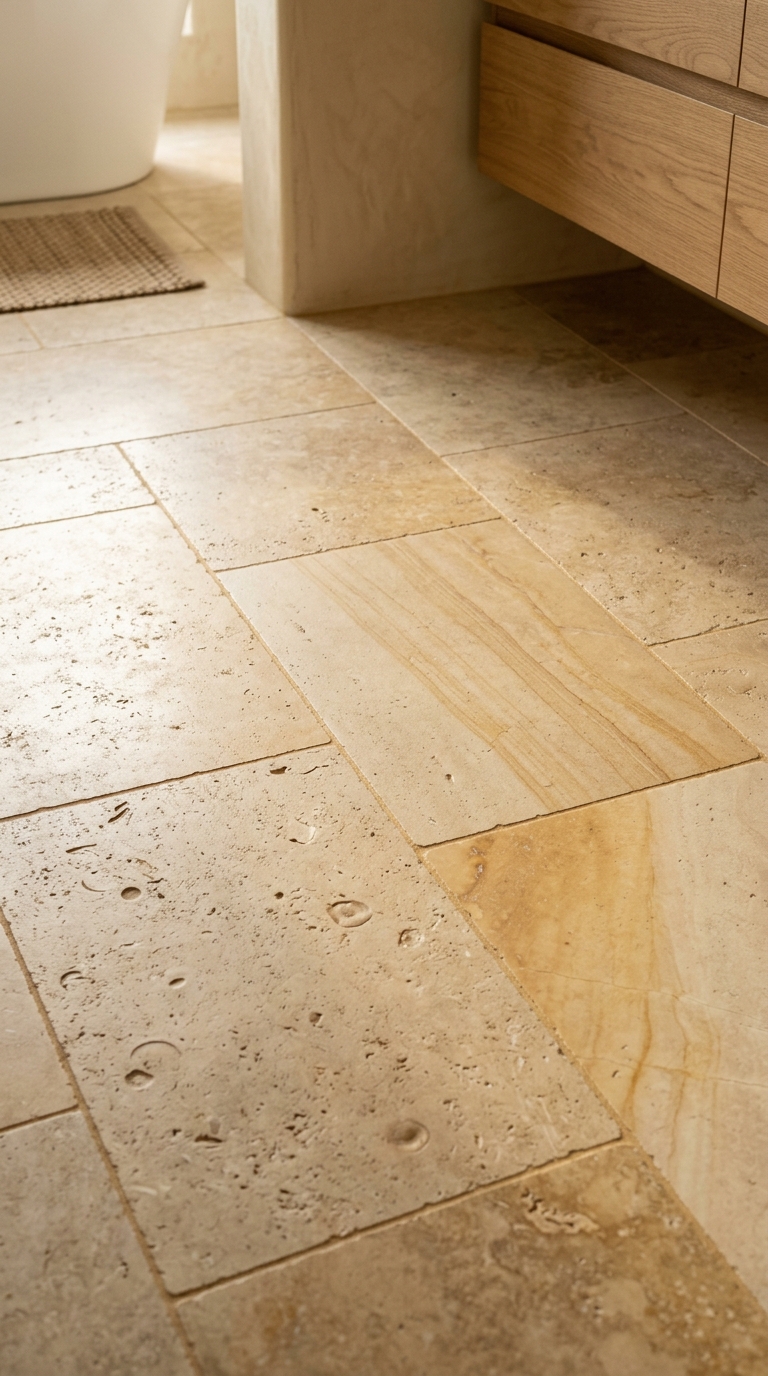
This room is one undertone from skirting to ceiling, and that is the whole decision. The walls carry a chalky cream with yellow in it, the ceiling stays in the same family instead of switching to brilliant white, and the limestone floor tiles sit a half shade deeper. Because nothing changes temperature as the eye travels, the corners soften and the narrow plan stops announcing its width.
Daylight is doing a lot of the work here. The sash window at the far end pours neutral light down the room, and the two recessed downlights take over after dark. That handover is where cream succeeds or fails, because a yellow-cast cream under warm bulbs goes honeyed and calm, while the same cream under cool white downlights turns sallow. The wall colour cannot be chosen without the bulbs, which is why the sample board needs an evening viewing under the actual fittings.
That is a soft plaster cream, mottled, not flat, which forgives the uneven walls of an older house. Farrow & Ball White Tie No.2002 or Slipper Satin No.2004 get close, as does Little Greene Slaked Lime in its paler dilutions. Bathroom emulsion in these ranges runs about £38 to £62 for 2.5 litres in 2026, and the moisture-resistant formula earns its price where steam sits daily.
Skip the all-over cream where the only light is a cool extractor fan unit with a daylight bulb. Without a warm source anywhere, the room will read dingy by February whatever the paint name promises.
One terracotta wall behind the basin
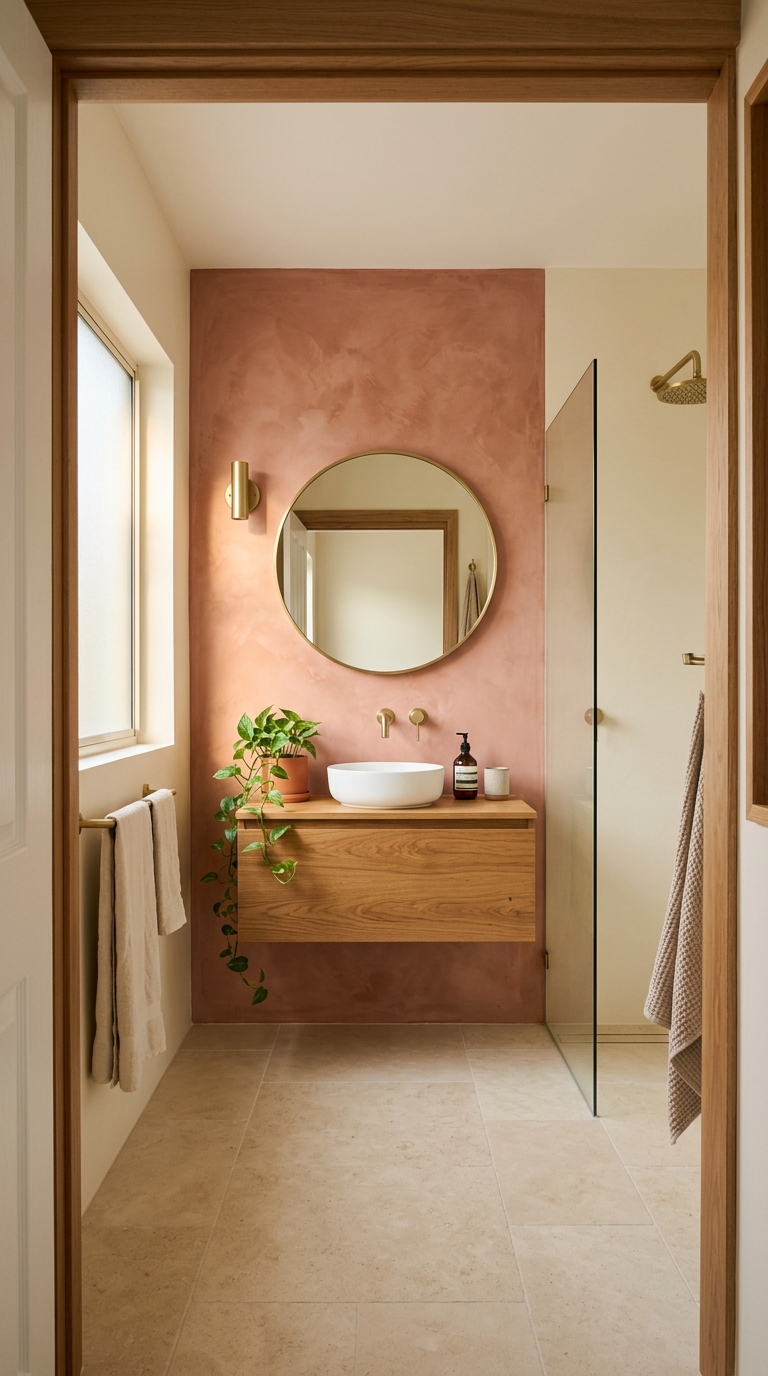
The wall carrying the colour here matters more than the colour itself. The terracotta sits on the single wall behind the basin, the one the mirror hangs on, while every other surface stays pale cream. One saturated plane gives the eye somewhere to land, while four would leave it nowhere to rest.
The particular clay matters. This is sun-baked earth, muted and a little dusty, the sort of tone that sits behind skin without competing with it. A brighter orange would shout in a room this size, and under bathroom bulbs it would throw a tint onto the face in the mirror. The muted version glows instead, especially in the limewash finish pictured, whose soft mottling breaks up the flat plane so the colour reads as texture first.
The green plant on the vanity is doing quiet work for the palette. Terracotta and leaf green sit opposite each other, which is why the trailing pothos looks so at home against the clay. Brass taps repeat the warmth at a smaller scale. Farrow & Ball Dead Salmon No.28 or a diluted clay plaster will land in this territory, at roughly £55 to £85 for a limewash-style finish in 2026 against £38 to £55 for standard emulsion.
Keep this to the vanity wall. Colour on the window wall would fight the daylight, and colour inside a glass shower cubicle reads much darker once wet.
Mushroom, the neutral between cream and clay
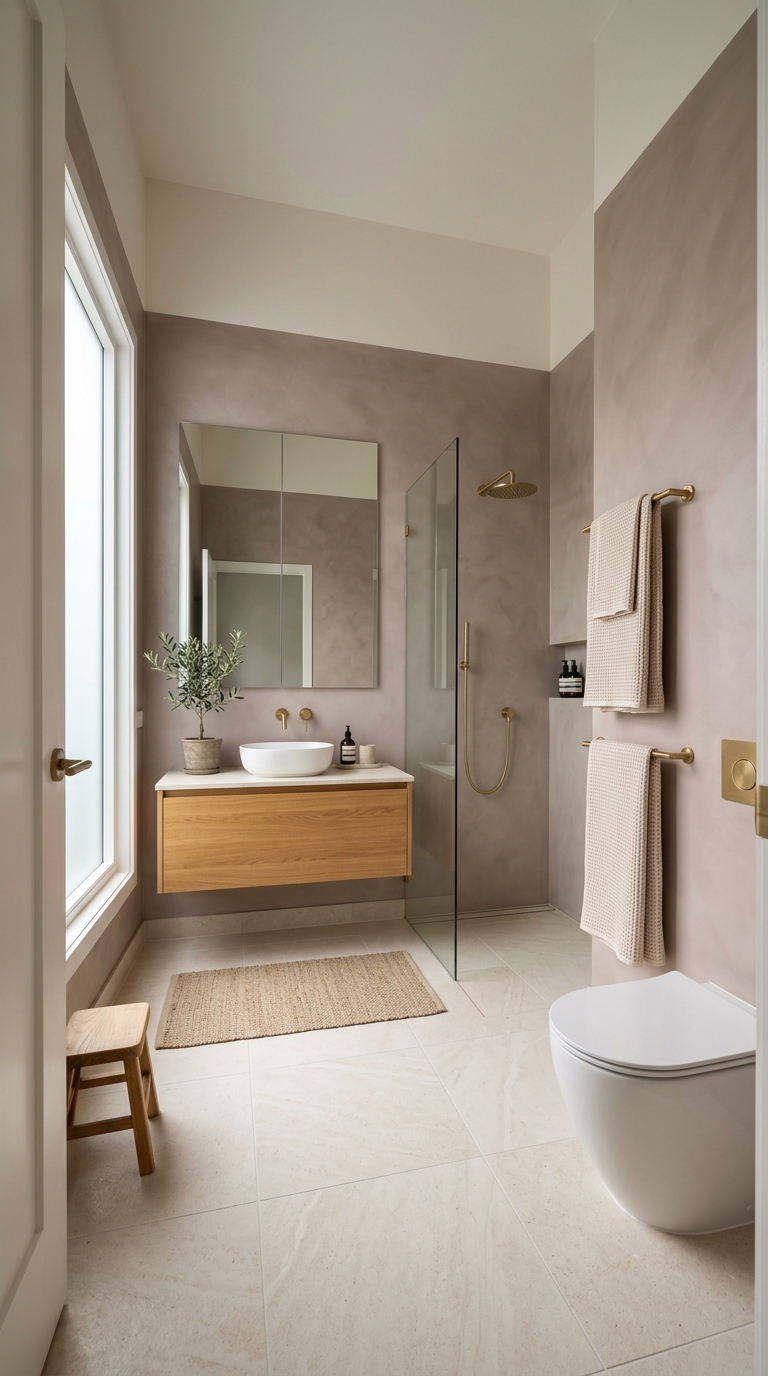
This is the colour for someone who finds cream too sweet and clay too committed. Warm mushroom holds grey, pink, and brown in one tone, which makes it the most changeable neutral on this page. Under the warm downlights pictured it reads as a deep, companionable taupe. Under a cool bulb it would flatten towards office grey, so the lighting matters more here than with any other shade in the article.
The ceiling tells the second half of the story. It is painted a clean warm white, a shade or two lighter than the walls, and that lift is what stops the mid-tone from pressing down on the room. Rooms painted one colour to the ceiling suit deep tones. Mid-tones want the paler lid, because the contrast is what gives back the height the depth takes away.
Towels and planting have been chosen inside the same family. The waffle towels hang in oatmeal and flax instead of white, so they extend the palette instead of interrupting it. Farrow & Ball Skimming Stone No.241 or Elephant’s Breath No.229 sit in this ground, the second of which leans lilac under cool light and should be sampled accordingly. Expect the usual £38 to £62 for 2.5 litres of bathroom emulsion in 2026.
Deep sage under warm bulbs
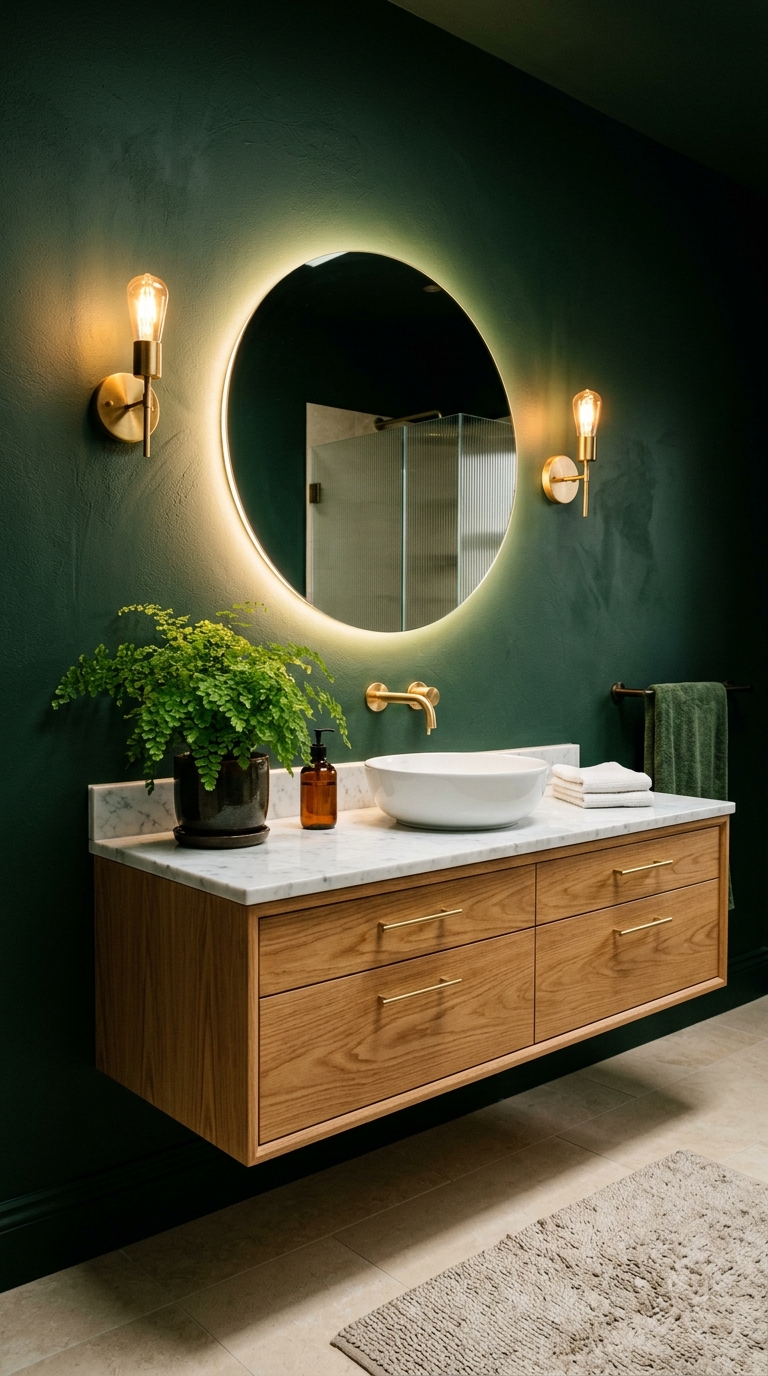
A windowless corner painted nearly black-green should feel oppressive, and here it feels like evening. The reason is that dark colours stop describing the boundaries of a small room. Pale walls in a room with no outlook keep reporting exactly how small the box is. A deep green absorbs the edges, the mirror floats, and the vanity reads as furniture rather than fitment.
Undertone decides whether this works with timber. The green pictured leans yellow, not blue, which is why the oak drawers beneath it look honeyed and the brass sconces read as jewellery. A blue-leaning green would quarrel with both, turning the oak muddy and the brass hard. Sample the green against the actual vanity timber, not against a white card, because the relationship is the thing being tested.
The filament sconces and the halo behind the mirror both burn warm, near 2700K, and a green this deep needs that. Under cool white it would sit flat and civic. Farrow & Ball Green Smoke No.47 is the reference shade for this family, with Little Greene versions a little earthier. A sample pot costs a few pounds; the full tin runs in the standard designer band of £45 to £70 for 2.5 litres in 2026.
Dusty rose that flatters the mirror
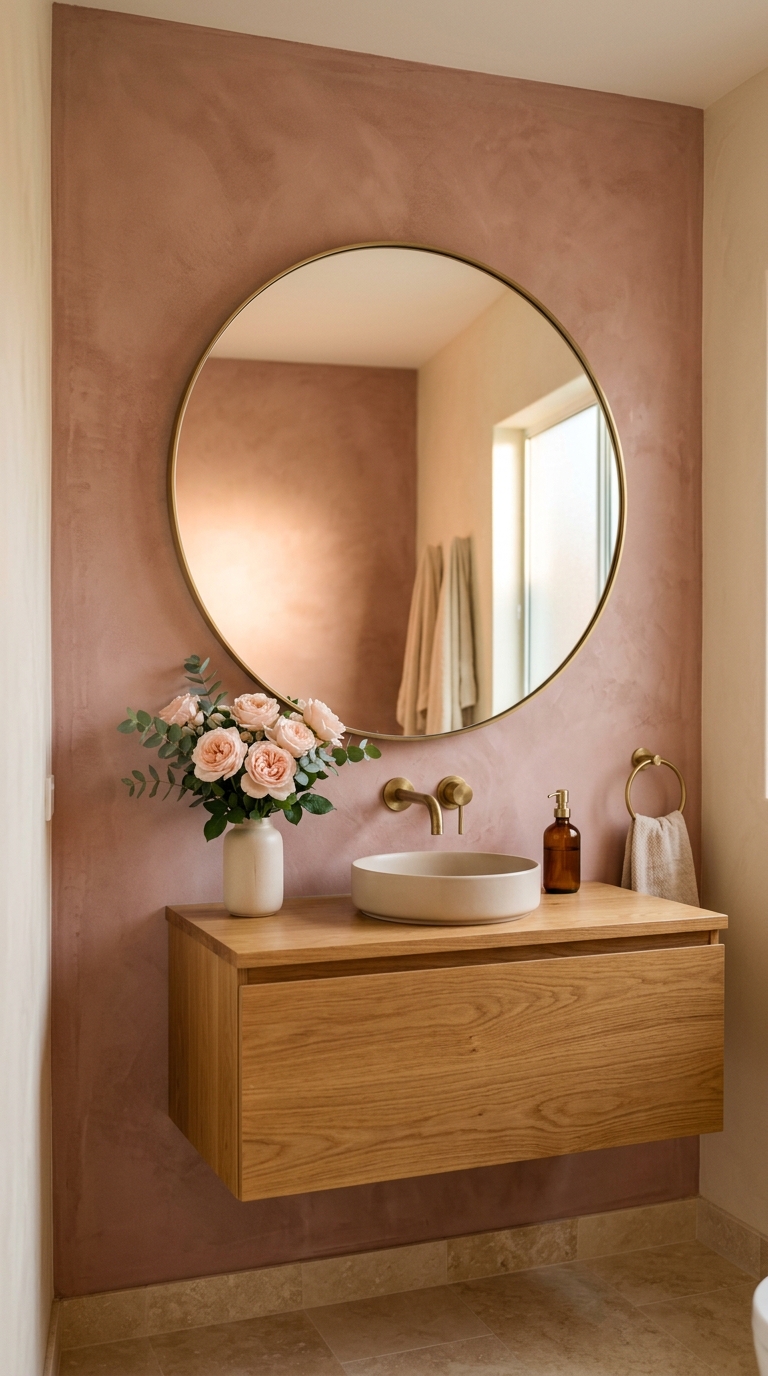
The mirror doubles this wall, so the face in it is framed by pink on every side. That is the point of the colour. Overhead bathroom light typically carries a blue cast, which is unflattering at close range, and a warm pink surround corrects it the way a photographer’s reflector does. Skin looks rested without a single fitting being changed.
Restraint is what keeps this a bathroom. The pink here is powdered and greyed, closer to plaster dust than to blossom, and it reads as a warm neutral until something truly pink, like the roses on the vanity, sits against it. The side walls stay pale, the basin is a quiet stone oval, and the brass tap is the only glint. One blush wall with quiet neighbours is a scheme; blush on every surface, with blush textiles to match, stops being one and starts being a theme.
Farrow & Ball Setting Plaster No.231 lands close to the pictured tone, and most paint makers carry a version under names like plaster, blooming, or faded rose. Bathroom emulsion runs about £35 to £60 for 2.5 litres in 2026. Sample it beside the mirror at night, since that reflected view is where the colour earns its keep, and keep the saturation below the level that photographs as sweet. Cameras exaggerate pink; the wall should look almost beige on the sample card.
Navy as a single dark wall
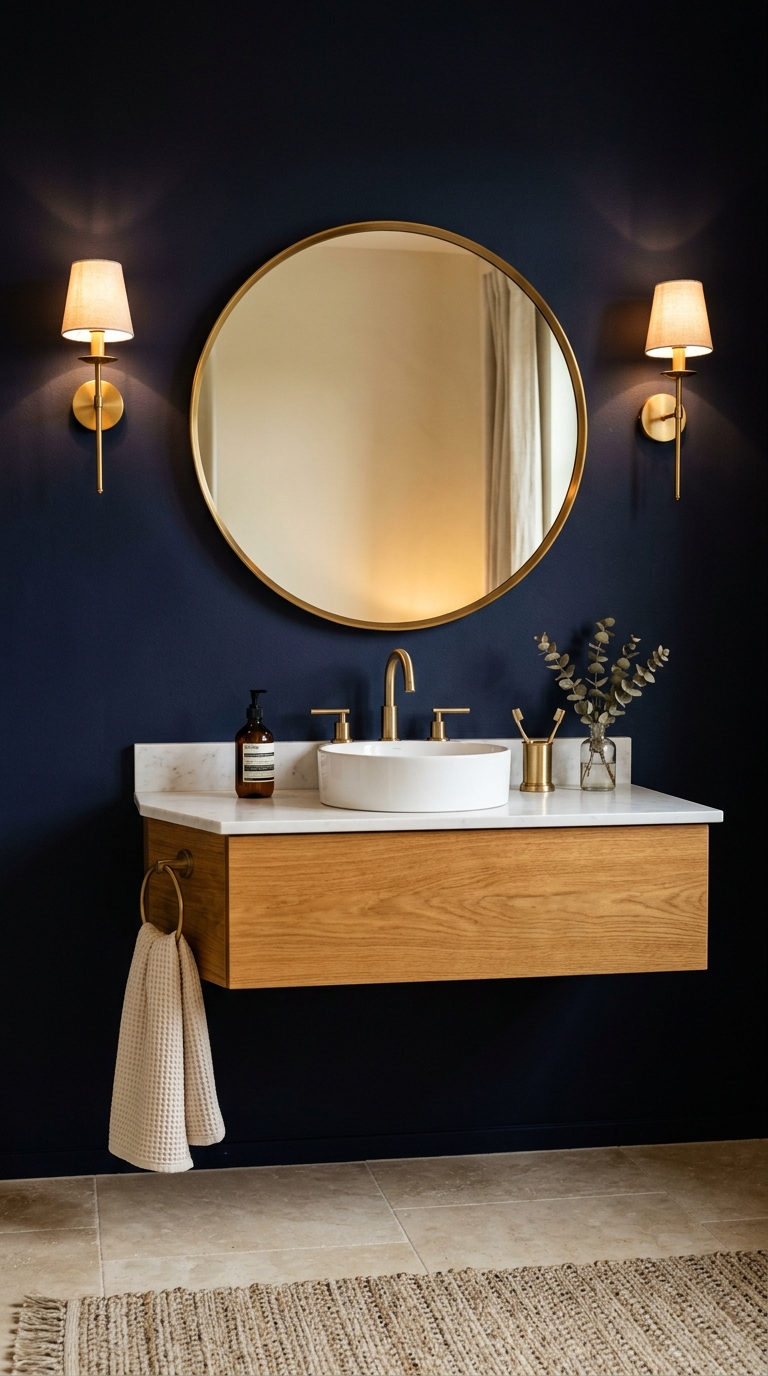
Navy is the bravest colour on this page and the most dependent on company. On its own wall it recedes hard, which gives the floating oak vanity a stagelike setting, and the brass sconces and mirror frame ignite against it the way candles do in a dark room. Nothing else in the house makes metalwork look this good.
The conditions are strict, which is why navy belongs on one wall only. The remaining walls need to stay warm white, the vanity needs to be timber instead of white lacquer, and the sconce shades need to be fabric. Those little cream shades are colour decisions as much as the paint, because they filter the bulbs down to lamplight and stop the navy turning inky. Without the warm counterweight the same wall would read cold and a little corporate.
Farrow & Ball Hague Blue No.30 is the dependable reference, a near-black blue with enough green to sit calmly beside oak. Little Greene Dock Blue 252 runs deeper and duskier. Both are priced as designer paints, roughly £45 to £70 for a 2.5 litre tin in 2026, and both want two coats over a tinted primer since dark blues flash patchy over white. Skip navy where the bathroom’s only light is cool downlights; the wall will go slate and the brass will go dull, which wastes both.
Warm ivory tiles from floor to ceiling
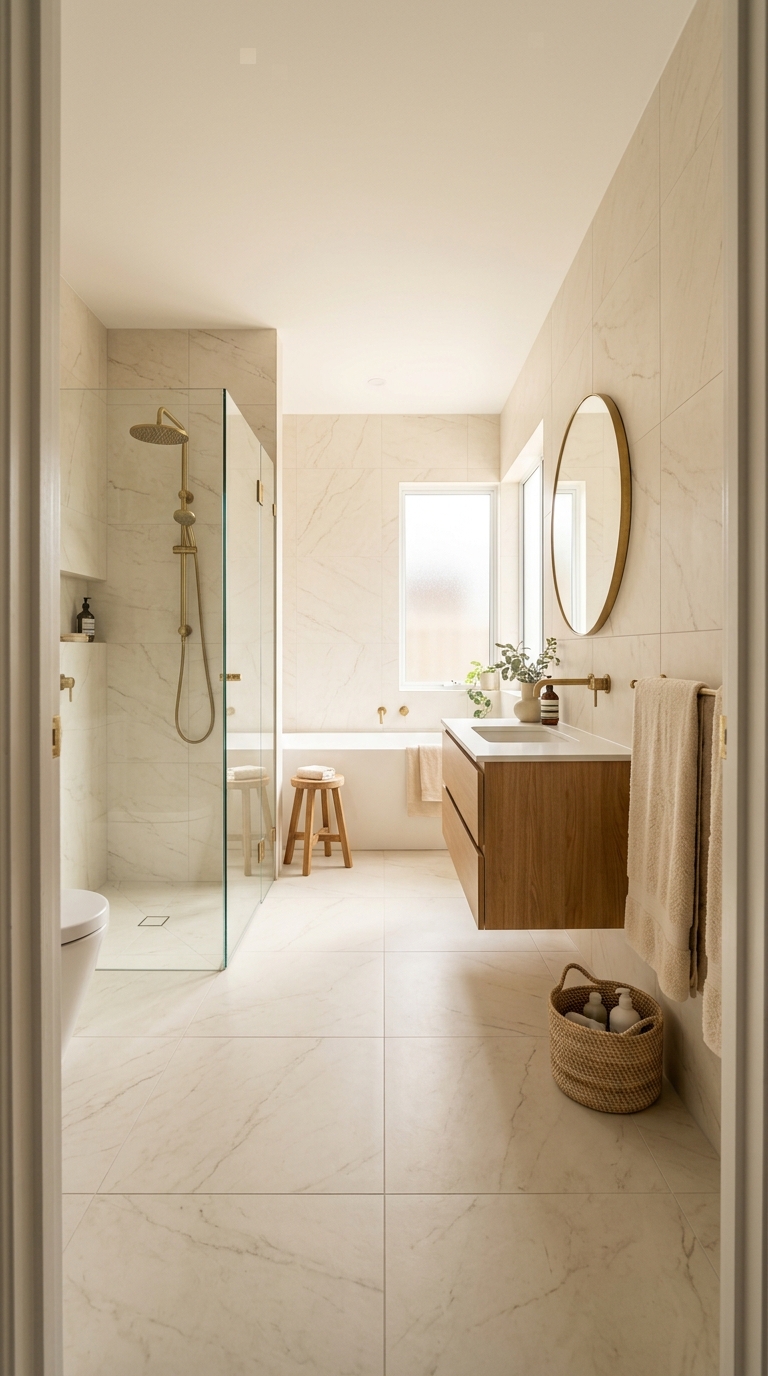
Paint washes off and repaints. Tile is a ten-year decision, which is why this room chooses the safest permanent colour available. The porcelain carries the tone of heavy cream with a faint grey vein, warm enough to flatter oak and brass, pale enough to bounce the window light to the far corners. Bright white tile would have made the same room clinical. Grey tile would have chilled it.
The large format is part of the colour effect. Fewer joints mean fewer grout lines chopping the surface, so the eye reads whole planes of ivory instead of a grid. Running the same tile across floor and walls dissolves the corner junctions, which is what makes the narrow plan feel continuous instead of corridor-like. The finish matters too: this is matt with a soft honed look, so reflections stay diffused. A polished tile in the same tone would throw hard cold highlights and undo half the warmth.
Stone-look porcelain at this scale costs roughly £35 to £70 per square metre in 2026, with rectified large formats at the upper end. Order a full tile to sample, not a chip, since veining varies across faces and one tile can mislead. And choose it under the bathroom bulbs, because showroom spots run cooler than home fittings and flatter grey tiles over warm ones.
Cream, oak, and brass as one gradient
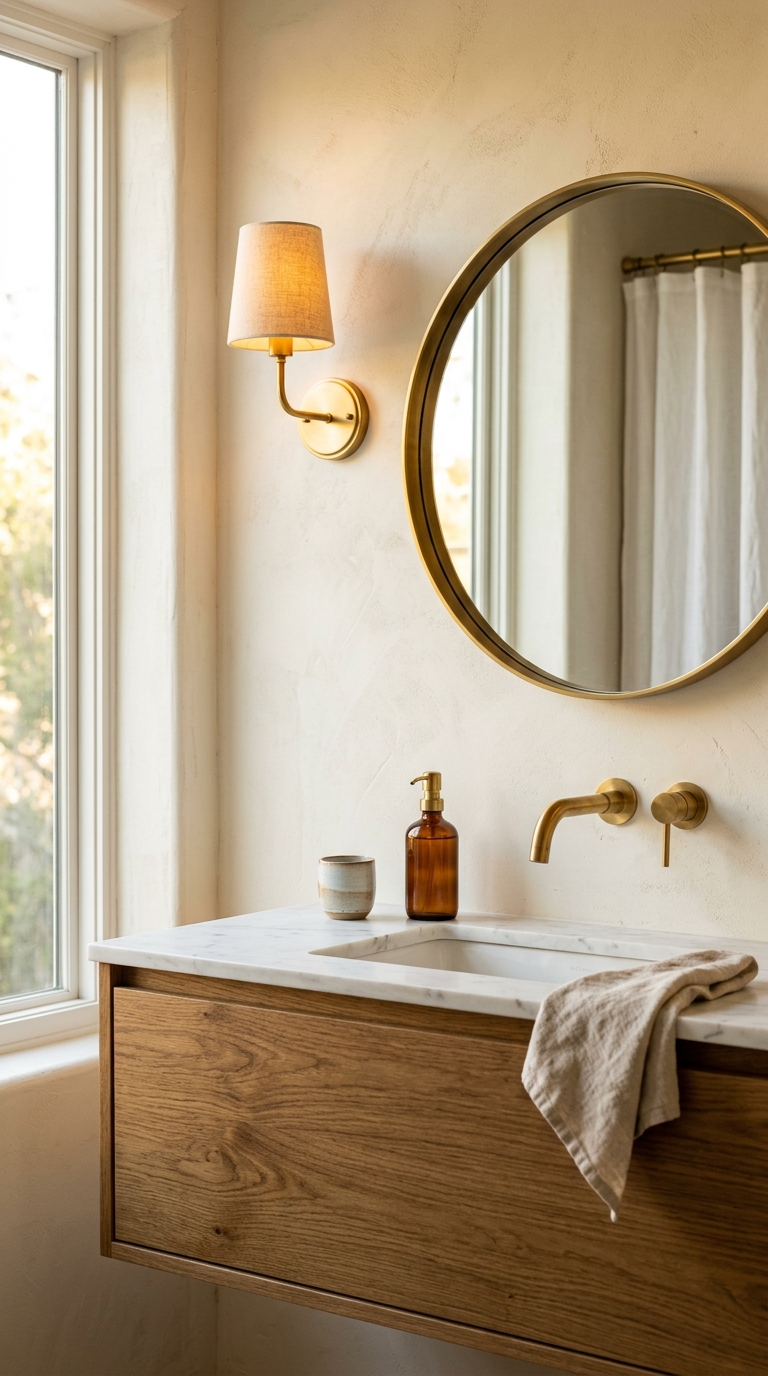
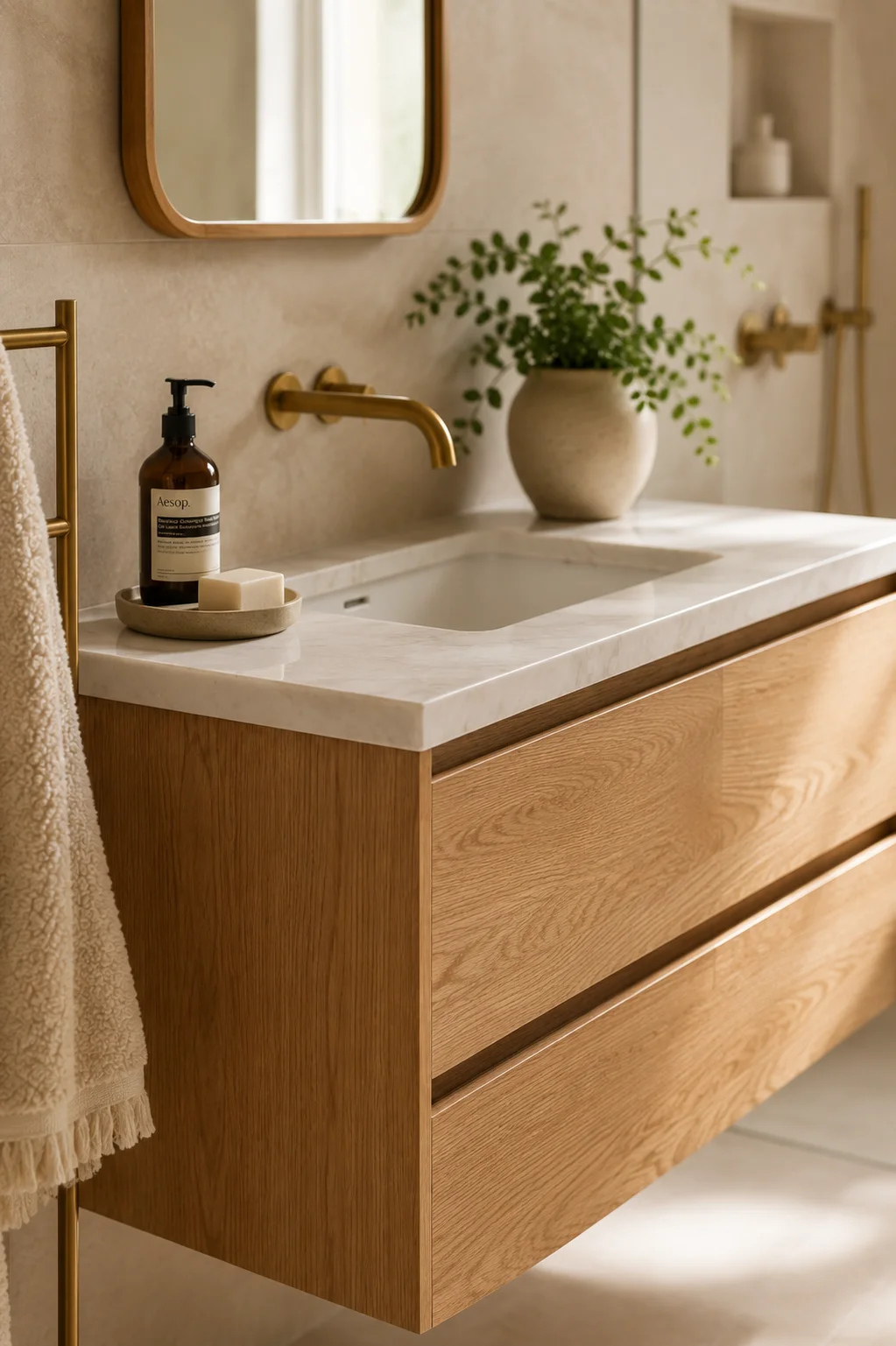
This close crop shows the most reliable palette in the article at its smallest scale. Cream plaster on the wall, honeyed oak in the drawer front, white marble with grey veining across the top, and brushed brass for the tap and mirror frame. Four materials, one temperature. The shared yellow undertone is the reason they cohere, and it is also the test any substitution has to pass: whatever replaces one element must bring the same warmth or the gradient breaks.
The sconce shade earns a second look. Fabric in oatmeal filters the bulb to something near candlelight, which gilds the brass and creams the marble veining. A clear glass shade in the same position would throw a harder, cooler pool and the whole corner would read a degree colder. Light fittings are colour fittings in a bathroom, because the room is used after dark more than in daylight.
Small styling repeats the palette instead of adding to it. The amber glass bottle picks up the brass, the folded linen picks up the wall, and the stone cup sits between the two. A wall-mounted brass tap and mixer set in this style runs about £140 to £320 in 2026, and a round brass-framed mirror of this size about £120 to £300. Keep every metal in the room to the one finish. Mixed metals need a bigger room and a surer hand than this palette asks of anyone.
Grout decides whether tile reads continuous
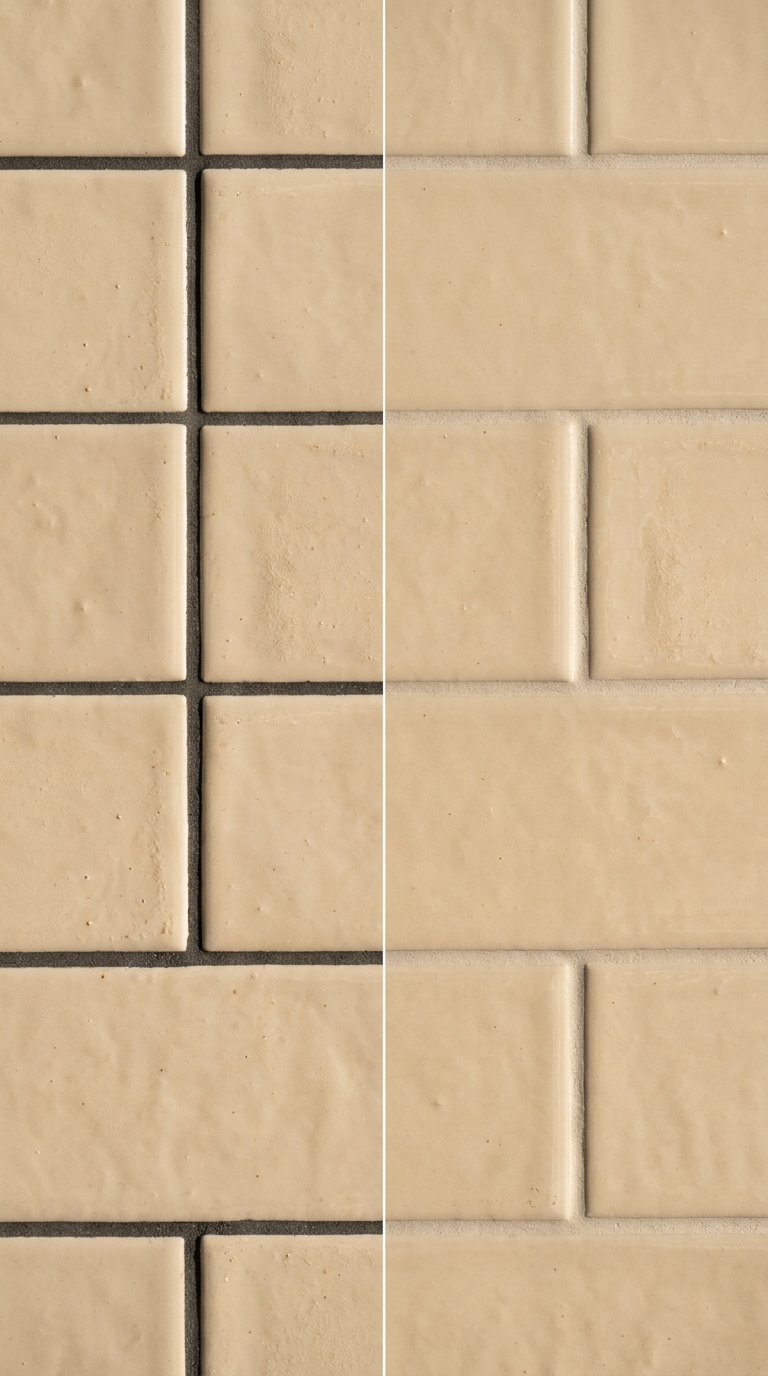
Two halves of one tile, two different bathrooms. On the left the dark joints draw a grid over the cream squares, and the eye counts lines instead of seeing surface. On the right the matched grout lets the same tiles read as one unbroken plane. No tile was changed. The lines between them did all of it, which makes grout the cheapest colour decision in the room and among the most visible.
The rule is to match the tile as closely as possible, then go a fraction darker instead of lighter, since grout lightens as it cures and pale grout in a steamy room rarely stays pale. Warm grey suits warm ivory, warm sand suits greige, and a clay tile wants its grout tinted to the same earth. Bright white grout against warm tile is the combination to avoid; it outlines every tile like a diagram and shows discolouration fastest.
The practical part is inexpensive. A bag of Mapei Ultracolor Plus or BAL Micromax2 covers a small bathroom and costs about £18 to £30 in 2026. Trial both shortlisted grouts as full boards against the tile, viewed under the bathroom bulbs at night, because a match that works in the shop often drifts by a shade at home. In a shower zone the epoxy versions resist staining better, at roughly double the material cost, which is still small money against the tiling bill.
Frequently asked
Frequently Asked Questions
Which wall shade suits the brass taps I already have?
Let the metalwork choose. Brushed and aged brass glows against creams, soft whites with a yellow cast, clay tones, and deep greens that lean yellow. It dulls against blue-grey walls and brilliant white, where chrome would actually be the happier partner. Holding the tap or a knob against each sample card settles the question in seconds.
Will a deep green or navy overwhelm a compact bathroom?
One dark wall usually enlarges the feeling of a compact room, because the boundary stops reporting its position. Confine the depth to the basin wall, keep remaining surfaces pale and warm, and insist on timber and brass for company. Rooms lit only by cool ceiling spots should avoid the idea, since dark paint turns flat without a warm source.
What surfacing makes a bathroom feel larger without moving walls?
Large ivory porcelain across floor and walls, with joints tinted to disappear, creates the most continuous envelope. Fewer lines means the eye travels uninterrupted, which reads as space. A paler ceiling over mid-tone walls gives back height, and a frameless glass panel keeps the shower zone inside the room visually.
How do I use blush without the room turning saccharine?
Keep the pink powdered and greyed, closer to plaster than petal, and confine it to a single wall. Pale neighbours, a stone basin, and one brass fitting hold it grown up. Test the sample at night beside the mirror, since cameras and shop lights both exaggerate pink beyond what the wall will show at home.
Should the ceiling match the walls?
Deep colours can run over the ceiling for a cocooned effect, but mid-tones generally want a lighter lid. A ceiling one or two shades paler than mushroom or sage returns the sense of height the depth removes. With pale cream walls, keeping ceiling and walls in one tone dissolves the junction and suits low rooms.
What bulbs keep warm paint looking warm?
Lamps near 2700K with a colour rendering index of 90 or above preserve the honey in creams and clays. Higher colour temperatures push the same paint towards grey, which is why a shade chosen at noon can disappoint at night. Fabric sconce shades filter output further towards lamplight, so sample paint under the fittings that will actually light it.
Before you buy paint
- Choose the wall colour after the fittings, not before.
- Hold the actual metal against each sample while deciding.
- Use warm whites with brass and copper, cooler whites with chrome.
- Test on card, and look at it under your own bulbs at night.
- Avoid mid-tone cool grey; it flatters almost nothing.
This article may contain affiliate links. We may earn a commission at no extra cost to you.