10 Small Garden Ideas With Room to Breathe: What Makes a Plot Feel Bigger
Add us as a preferred source to see more stories on Google.
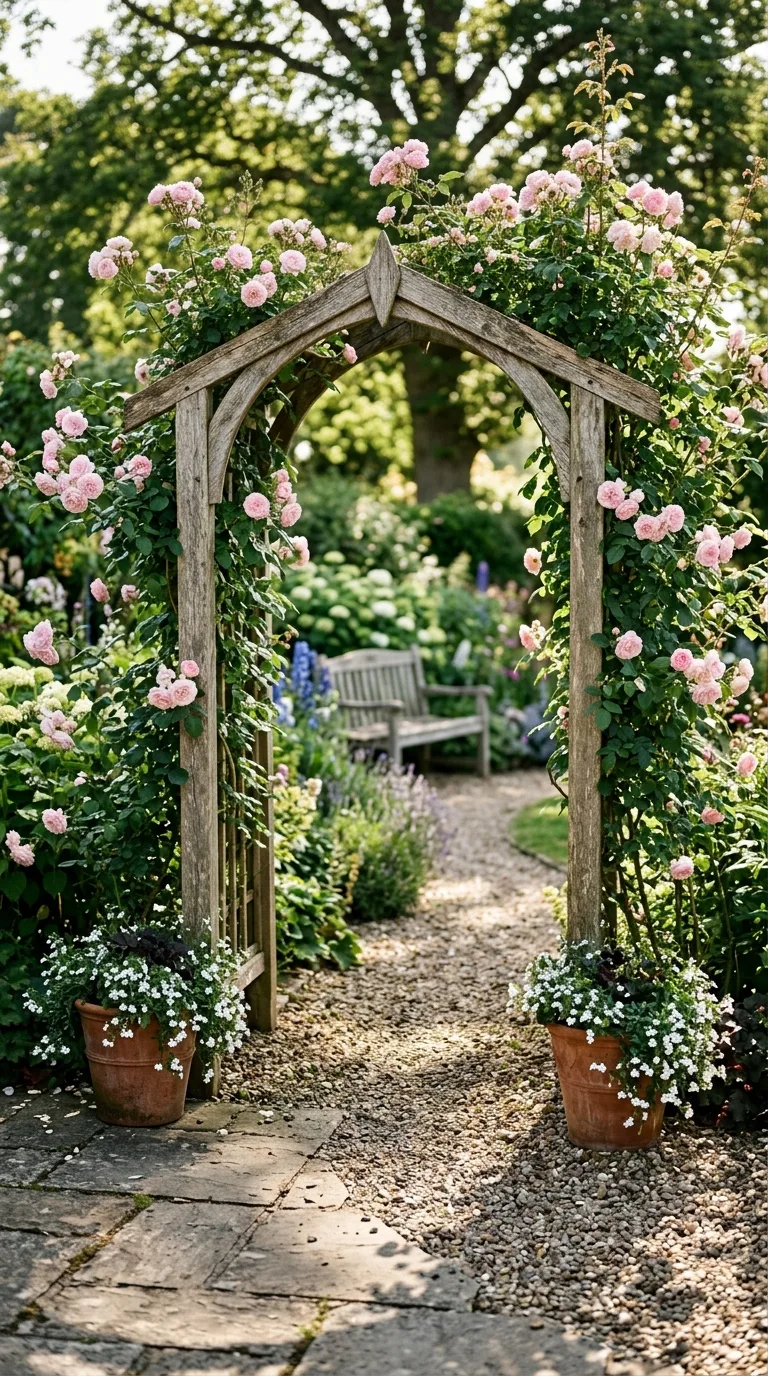
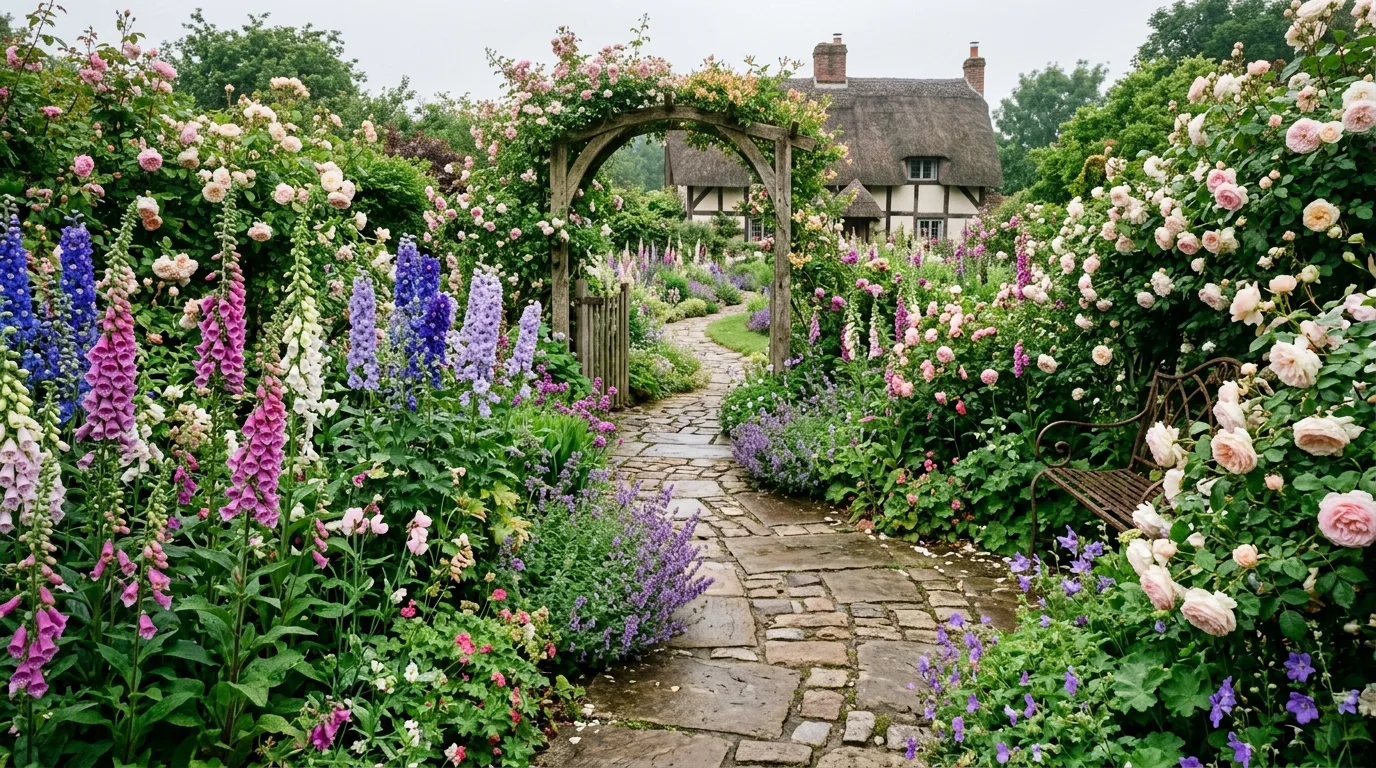
The useful thing in the photograph below is not the roses. It is that you cannot see what is past the bench.
The arch interrupts the view, the path bends away behind it, and the eye runs out of information before it runs out of garden. Your brain fills the gap with more garden than is actually there.
A small garden laid out so you see every boundary from the back door has told you its exact dimensions before you have taken a step. Nothing you plant afterwards undoes that first impression.
Where to put the division
Two thirds down, rather than in the middle.
Halfway divides a small garden into two small gardens, and both then feel cramped. Two thirds leaves a usable main space near the house and a smaller, more secretive one beyond, and the proportion between them reads as deliberate.
The gap you walk through should be narrow relative to the screen: an arch, a gateway, a break in a hedge. A wide opening lets the eye through and you have built a frame rather than a division.
What works, in rough order of cost:
| Divider | Depth taken | Time to work |
|---|---|---|
| Arch with a climber | Almost none | One to three seasons |
| Trellis panel, planted | 30cm | Two seasons |
| Beech or hornbeam hedge | 60 to 90cm | Three to five years |
| Multi-stem tree or large shrub | 1 to 2m | Immediate if bought large |
| A turn in the path alone | None | Immediate |
The last one is free and underrated. A path that curves out of sight behind a single large shrub does most of the work of an arch.
Now the honest part about those roses
That arch sits under a mature tree canopy, and the light is dappled at best. Climbing roses want four to six hours of direct sun to flower the way they do in photographs. In real shade they grow, reach for the light, and flower thinly at the very top where you cannot see them.
There is also root competition, which almost nobody plans for. A large tree takes an enormous volume of water from the soil around it, and anything planted within its canopy is drawing from what is left. A rose in that position needs watering and feeding for years, not one season.
So before choosing a climber, sit in the garden and count the hours of direct sun that spot gets in midsummer. Then choose from what suits it.
| Sun on the arch | Sensible climbers |
|---|---|
| Six hours or more | Most climbing roses, wisteria, clematis |
| Three to five hours | Rosa ‘Madame Alfred Carrière’, clematis ‘Nelly Moser’ |
| Under three hours | Climbing hydrangea, Clematis montana, ivy, Akebia |
| Deep shade, dry | Climbing hydrangea, and expect it to be slow |
Hydrangea anomala subsp. petiolaris, the climbing hydrangea, is the plant most people should be using and almost nobody considers. It is genuinely happy in shade, self-clinging so it needs no tying in, and it flowers cream in early summer. Its one real drawback is that it does nothing much for two or three years and then goes quickly.
‘Madame Alfred Carrière’ is the shade-tolerant rose worth knowing by name. It is a large noisette, pale blush, scented, and it will flower on a north wall, which very few roses will.
What the arch itself should be
Oak or sweet chestnut if the budget allows, because both weather to the silver-grey in that photograph and last decades untreated.
Softwood arches from garden centres are typically £60 to £120 and last five to eight years, which is often shorter than the plant growing over them. That is the failure people do not anticipate: taking a mature climber down to replace a rotted arch is a genuinely miserable job.
Galvanised steel is the practical middle ground and disappears once planted.
Whatever it is, set the uprights in properly. An arch carrying a mature rambler in wind is taking real load, and post spikes are not enough for anything permanent.
Where this does not apply
Gardens under about five metres deep. There simply is not room for a two-thirds division, and putting one in produces two spaces that are both unusable.
In a very small courtyard the better approach is the opposite: keep it open, plant the boundaries heavily so the edges blur, and put the interest overhead rather than across the space. A garden with no visible fence line reads as larger even when you can see all of it.
One surface, from the door to the wall
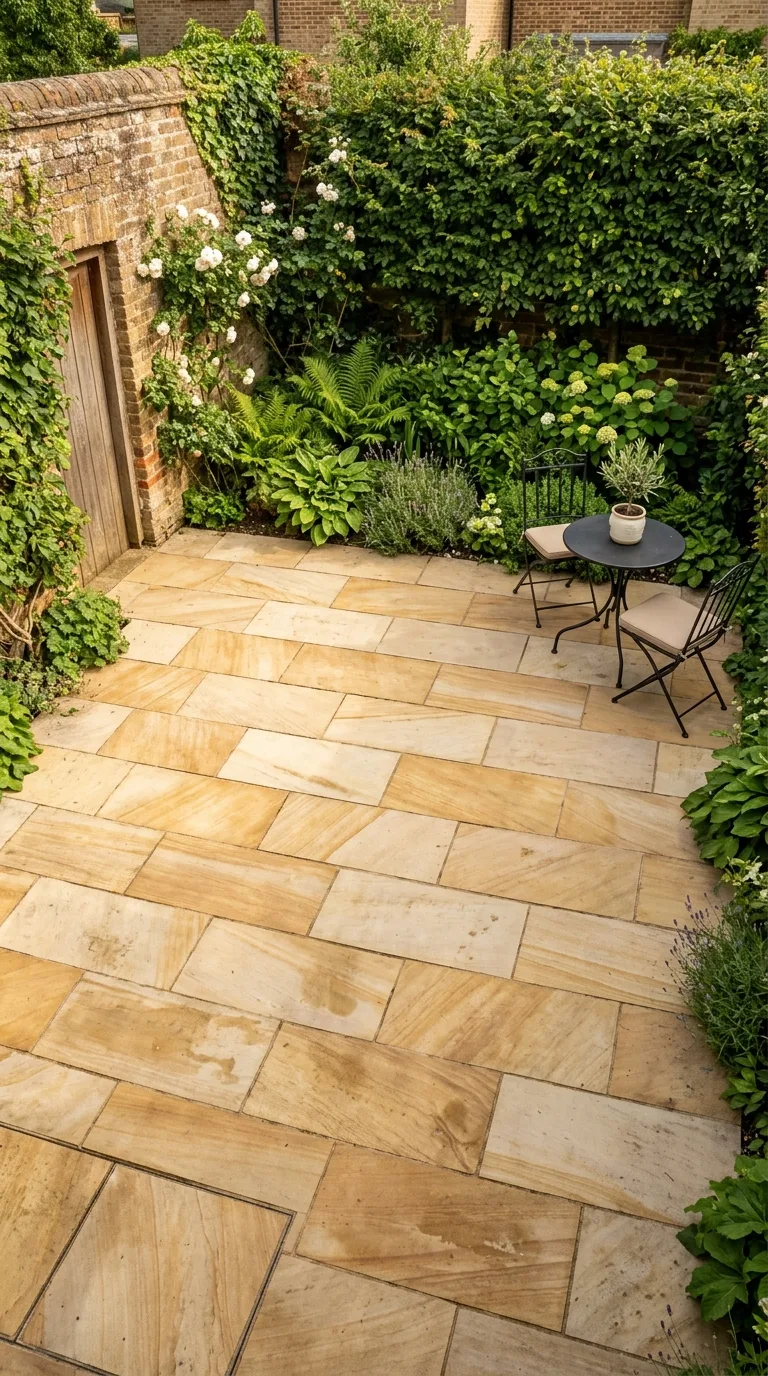
Every hard surface in this courtyard is the same warm sandstone, and there is no lawn anywhere in the frame. Stand at the door and you are looking at one material all the way to the wall. The flags run in a mixed random pattern, larger slabs beside smaller ones, with joints narrow enough that the eye reads a single floor.
A small garden split between paving, grass, and gravel is three small floors, and the brain adds up the divisions instead of the area. One material removes the arithmetic, and you stop noticing the ground at all. The tone here is a buff sandstone with a little grey in it, which sits easily against the brick and does not fight it.
You can lay flags of 600 by 900mm, 600 by 600mm, and 450 by 600mm together in a random coursed pattern without much cutting. Calibrated Indian sandstone runs about £25 to £45 per square metre; British Yorkstone starts nearer £80 and is worth the difference if your budget reaches that far. Point the joints at 10 to 15mm with a brush-in mortar, and keep your finished level 150mm below the damp course.
The planting sits in one band along the wall, not scattered in pots across the floor. Ferns, a hydrangea, and a low rosemary hedge soften the line where stone meets brick, and they do it from one side only, which leaves the floor you walk on clear.
Let the timber and the terracotta age
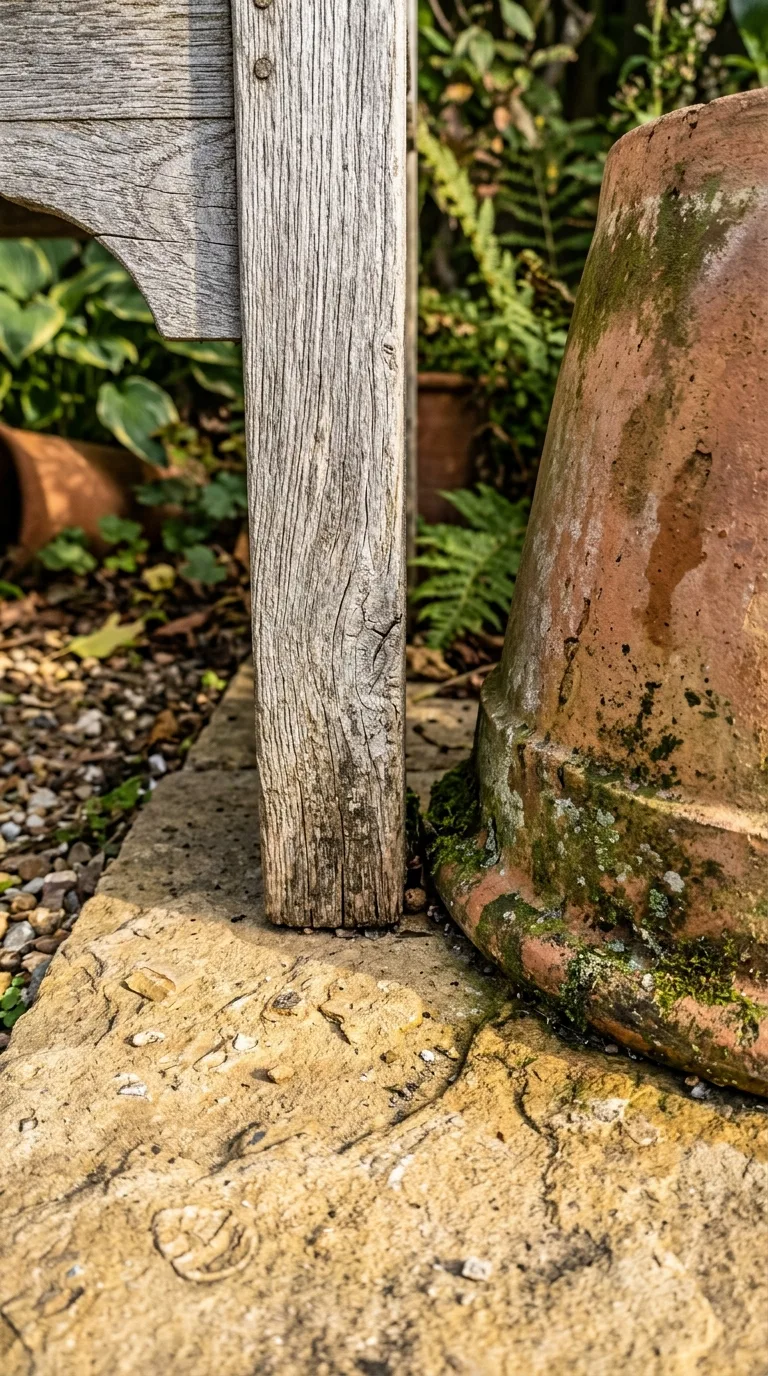
The timber in this corner has gone silver-grey, and the pot beside it is furred with moss and algae. Neither has been cleaned, and that is exactly why the corner looks settled instead of new.
Untreated oak does this on its own. Ultraviolet light breaks down the lignin at the surface, and within about 18 months the wood has weathered to a soft grey that no stain reproduces convincingly. The alternative is a finish such as Osmo UV Protection Oil 420, which holds a honey tone for years, though you will be redoing it every two or three. Both are defensible. Half a coat is the one thing you cannot do.
The pot is also telling you about the site. Moss and algae on terracotta mean a damp, shaded corner, probably east or north facing, where the surface stays wet for hours after rain. Terracotta is porous, so it holds that moisture, and if you leave a wet pot out through a hard freeze it will spall and flake. A glazed pot suits that corner better, and you will water it less through a dry August.
The flagstone underneath is a fossiliferous limestone, with shells visible in the face. Yorkstone and Purbeck both carry that detail, and you get more from both by leaving them alone than by sealing them.
The path, and what to do instead of grass
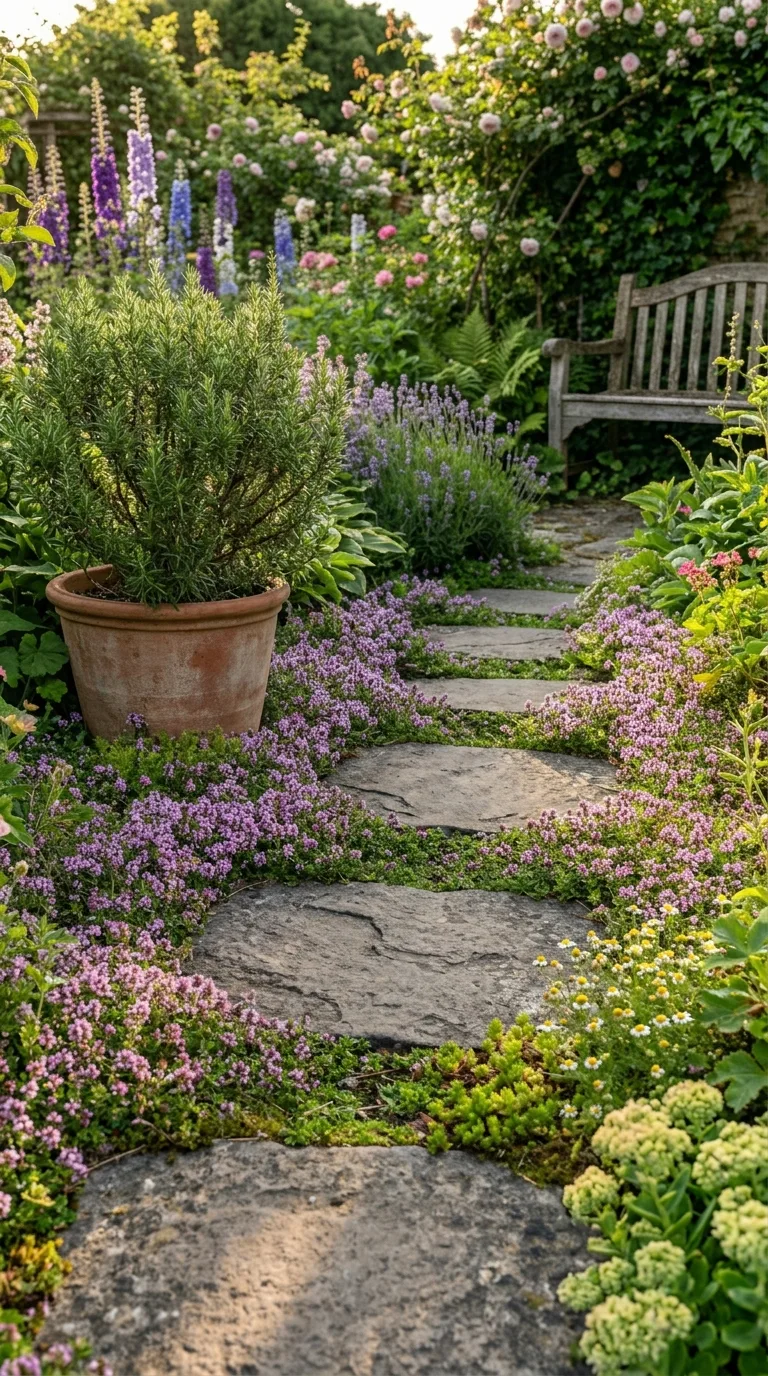
The stepping stones curve left and vanish behind the planting, and the gaps between them are filled with creeping thyme. That single detail is the one to take.
Grass needs width before it reads as grass. Under about three metres across, a lawn stops being a lawn and becomes a rug: the mowing edges dominate, your eye measures the boundary, and the space feels smaller than it did before you started. If you have a patch that size, you already know it does not work. Below that, either pave it or plant it. Thyme is the classic substitute because it takes light foot traffic and releases scent when you brush past it, though it wants full sun and sharp drainage to come through a wet winter. Thymus serpyllum and Thymus vulgaris both work, and you can sand the joints with horticultural grit at planting time.
The borders either side are deliberately unequal. Two narrow strips leave a garden feeling like a corridor, because you end up measuring the walkable strip down the middle. One deep border of 900mm or more, and one thin one of 300 to 450mm, holds the same amount of planting while keeping the floor open along one side.
The rosemary in the big terracotta pot is doing something the border cannot. It stands at waist height on a path where everything else is ankle high, so it interrupts the run of stone before your eye reaches the end.
Farm the wall, not the floor
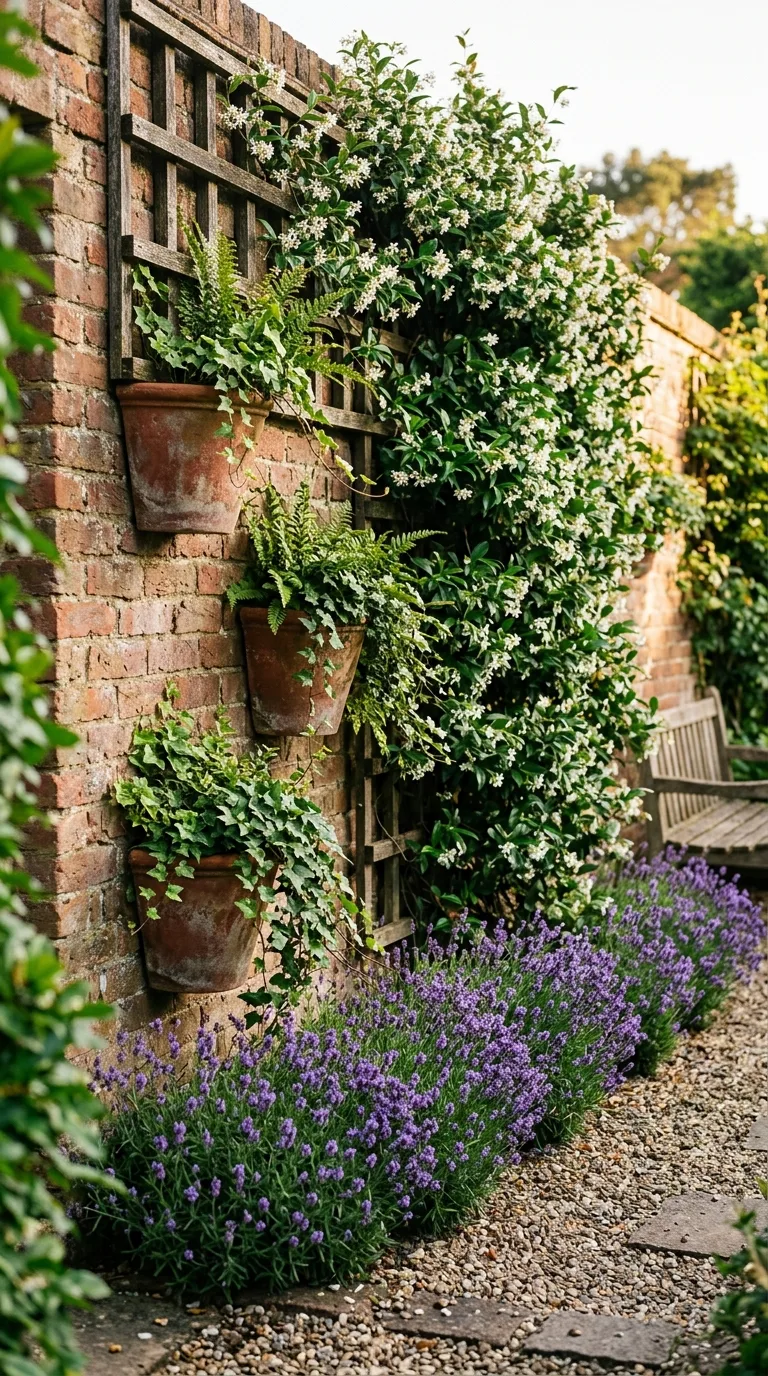
Almost nothing in this corner is standing on the ground. The brick carries a trellis, the trellis carries a white jasmine, and three terracotta pots hang off the wall at roughly chest, waist, and knee height, holding a fern, an ivy, and a trailing campanula.
A wall is about the same area as the floor in front of it, and in a small garden that area is free. Wall pots cost more than ground planting and need more attention, but they add somewhere to grow without taking a single centimetre of the floor you stand on.
Fix them properly, because you are hanging weight above your own head. A planted 250mm terracotta pot weighs 8 to 12kg when it is soaked, so it wants two masonry screws into the brick itself, not a hook in the mortar. Stand the pots off the wall by 30mm so air moves behind the foliage, and you will water them more often than the border, because a wall pot dries from every side at once.
The climber here is Trachelospermum jasminoides, the white star jasmine, and it is the one to choose if you want scent on a warm wall. It is evergreen and heavily scented in July, though it will be cut back by anything below about -5°C. The trellis sits on battens so the stems have air behind them and the brick can dry, which you will be glad of in a wet winter.
Four plants, repeated, not forty
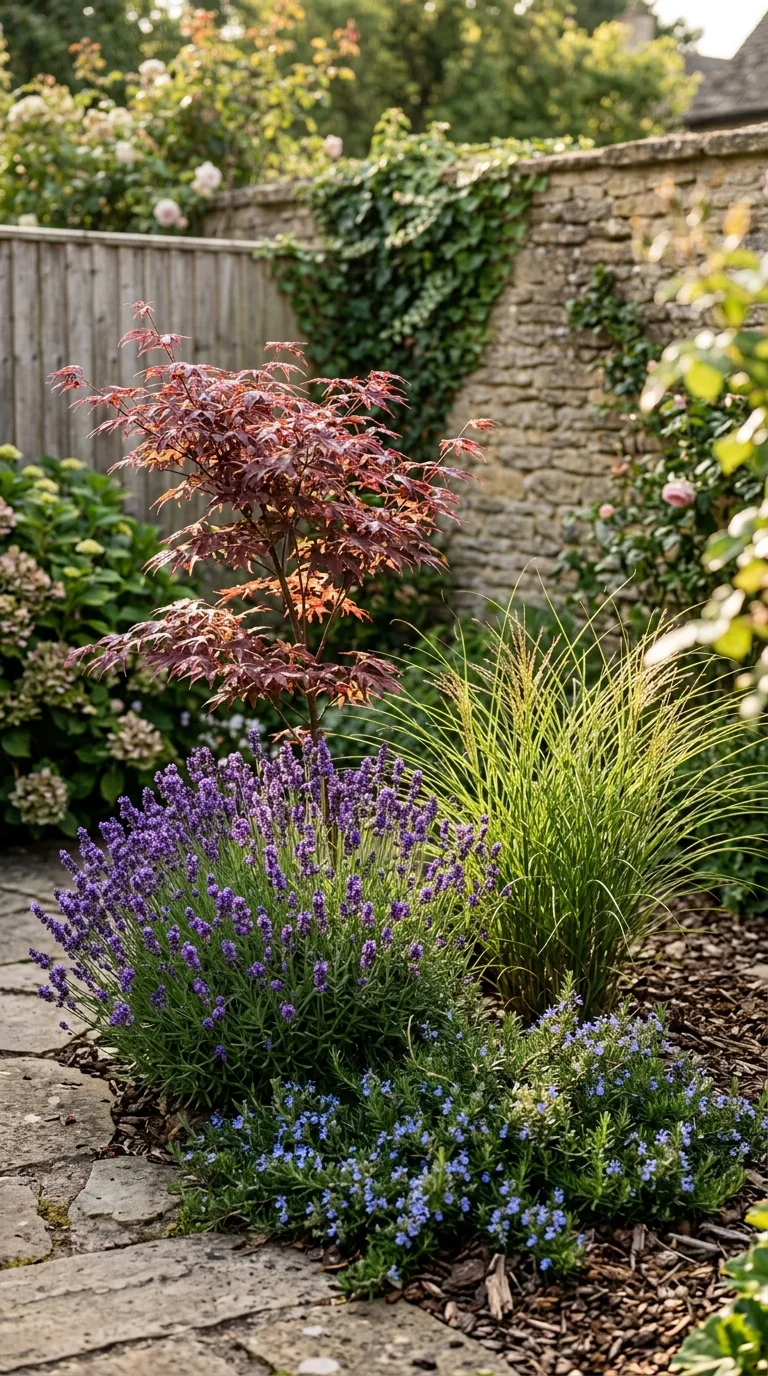
Count the species in this border and you get about four: a burgundy Japanese maple, lavender, a golden grass, and a blue-flowered rosemary. The same four repeat along the whole run.
A small garden cannot absorb variety. Twenty different plants in three square metres gives the eye nowhere to settle, and the result is clutter. Three or four species repeated across the plot read as rhythm instead, because your eye learns each one and starts to expect it. Repetition is what makes a border look designed, and it is cheaper than collecting, which matters if you are planting the whole plot in one go.
The maple is providing the height. Acer palmatum stays small enough for a courtyard, and a dissected cultivar such as ‘Garnet’ or ‘Seiryu’ grows slowly and keeps its shape without much pruning. Where you want more, choose a small tree over a large shrub. Acer griseum reaches roughly 6m in 30 years and peels cinnamon bark all winter; Amelanchier lamarckii gives white blossom in April and orange leaf in October. A Photinia ‘Red Robin’ fills the same ground and offers nothing above head height.
Grass and lavender want the same two things, which are sun and drainage, so you can plant them together without argument. A 50mm mulch of bark keeps the maple’s roots cool and stops the lavender collar rotting in winter.
One tree, and the courtyard is furnished
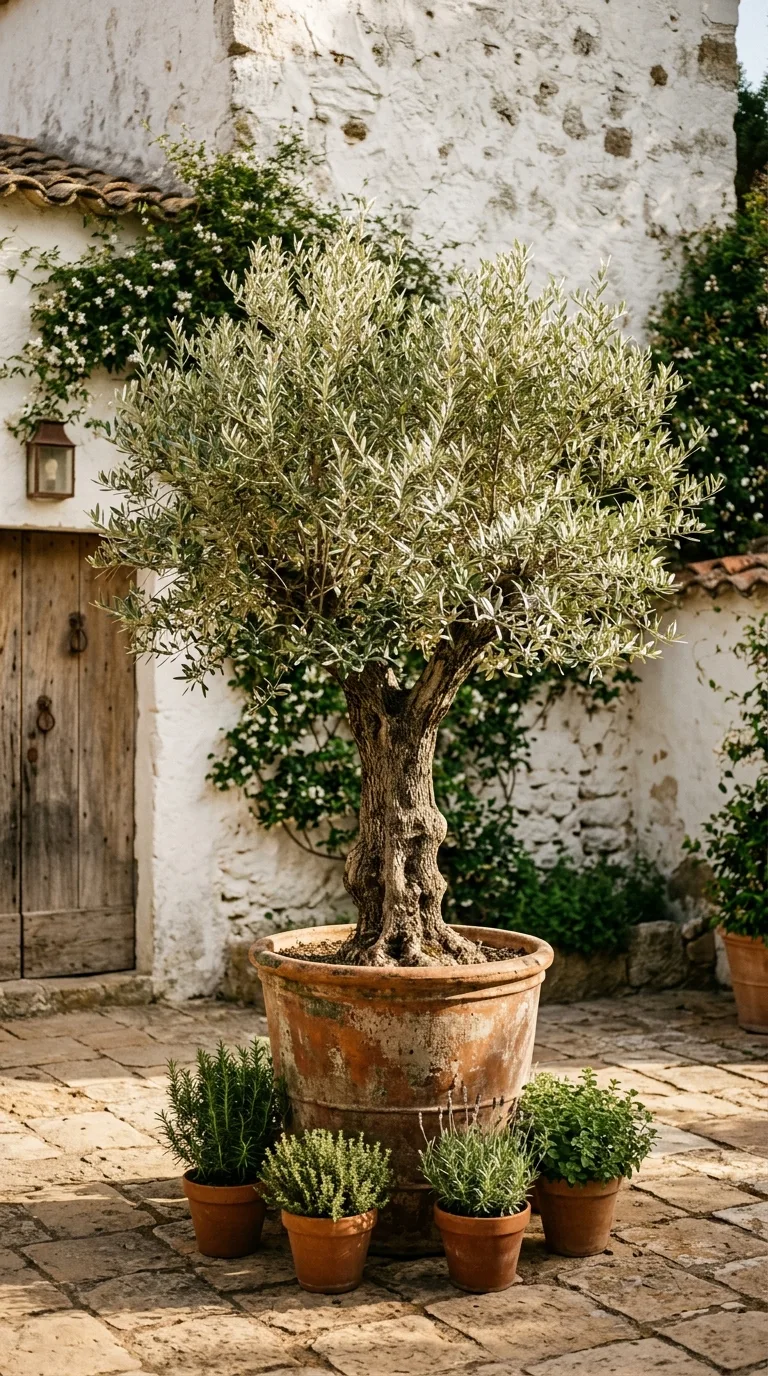
A single olive in a pot the size of a dustbin, standing clear of the wall, and the space has a centre. Apart from a ring of small pots at the base, there is nothing else in it to distract you.
A large object anchors a small space; many small ones break it into pieces. The olive is doing the work of a tree and a sculpture at the same time, and because it is in a container you can move it, replace it, or take it with you when you leave.
Olea europaea wants full sun, six hours or more in summer, and free drainage. Give it less and you are buying a replacement. It is hardier than its reputation suggests and will take about -10°C in a sheltered spot, but it drops leaves and sulks in wet winter soil, which is the usual reason a British olive dies. Use a soil-based compost such as John Innes No.3 cut with 20% horticultural grit, and a pot at least 500mm across, or you will be repotting it within two years. Move it up a size every three or four years, in spring, before the roots circle.
The whitewashed wall behind it is doing quiet work as well. It bounces light back into the corner, which matters if your courtyard faces north, and it makes the olive leaves look darker than they are.
How deep a raised bed actually needs to be
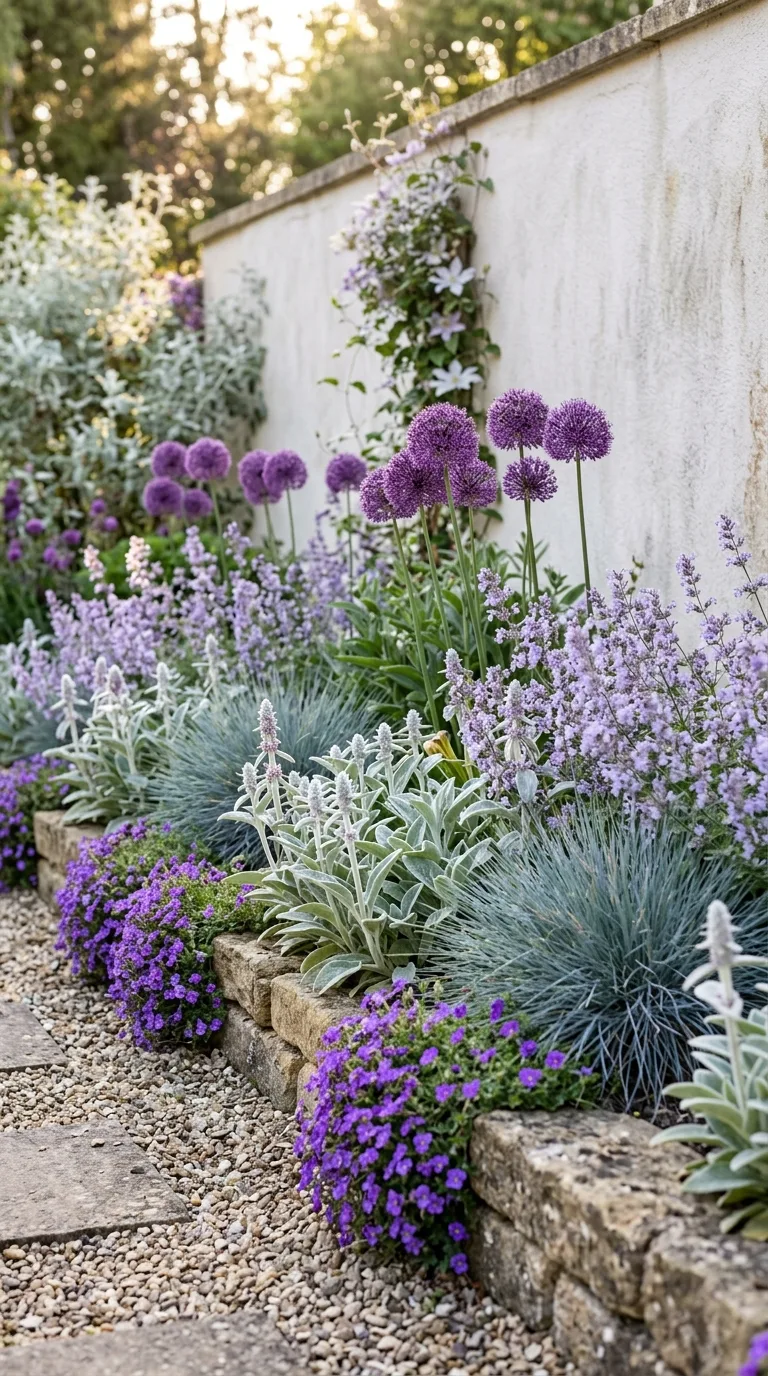
This border is held by two courses of sandstone block, which lifts the soil roughly 200mm above the gravel path. That is enough for the alliums, lavender, and lamb’s ears growing in it. It is not enough for a carrot, and if you want one you need more.
Depth is the number that decides what you can grow in a raised bed. Salad leaves, radishes, herbs, and most annuals are happy in 300mm. Anything grown for its root wants 450mm, which covers carrots, parsnips, and beetroot. Potatoes and long carrots want closer to 600mm, which is more than most people build. A bed standing on open soil can be shallower than one standing on paving, because the roots will find their own way down through the base and you can get away with less, so the same 200mm here would be generous over a border and mean over a patio. If you are building over a hard surface, add 20mm of gravel in the base for drainage.
The planting suits the depth. Allium hollandicum ‘Purple Sensation’ throws a purple globe on a 900mm stem in June, Stachys byzantina supplies the silver, and Festuca glauca fills the front edge. All three want the same conditions, which you can give them in full sun with a gravel mulch around the crown to keep the collar dry.
At dusk the boundaries disappear
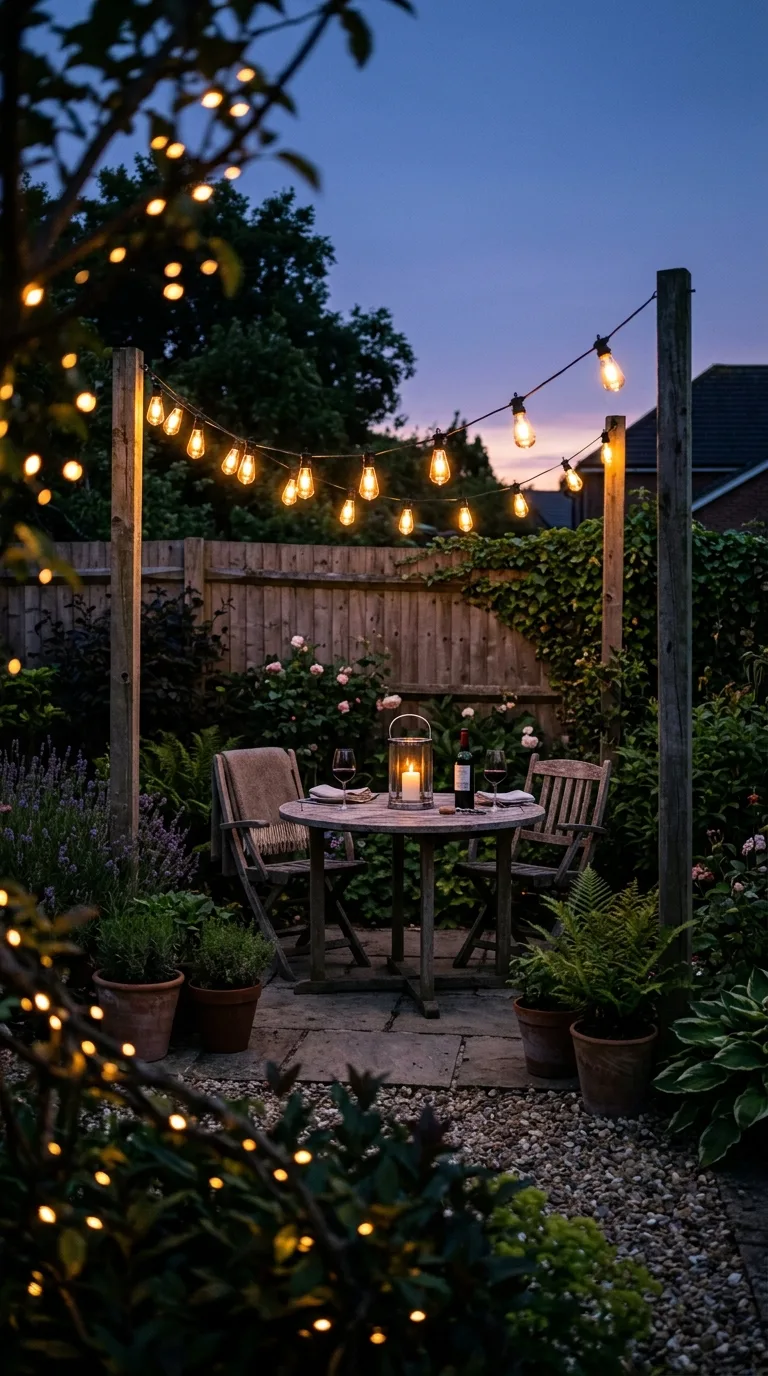
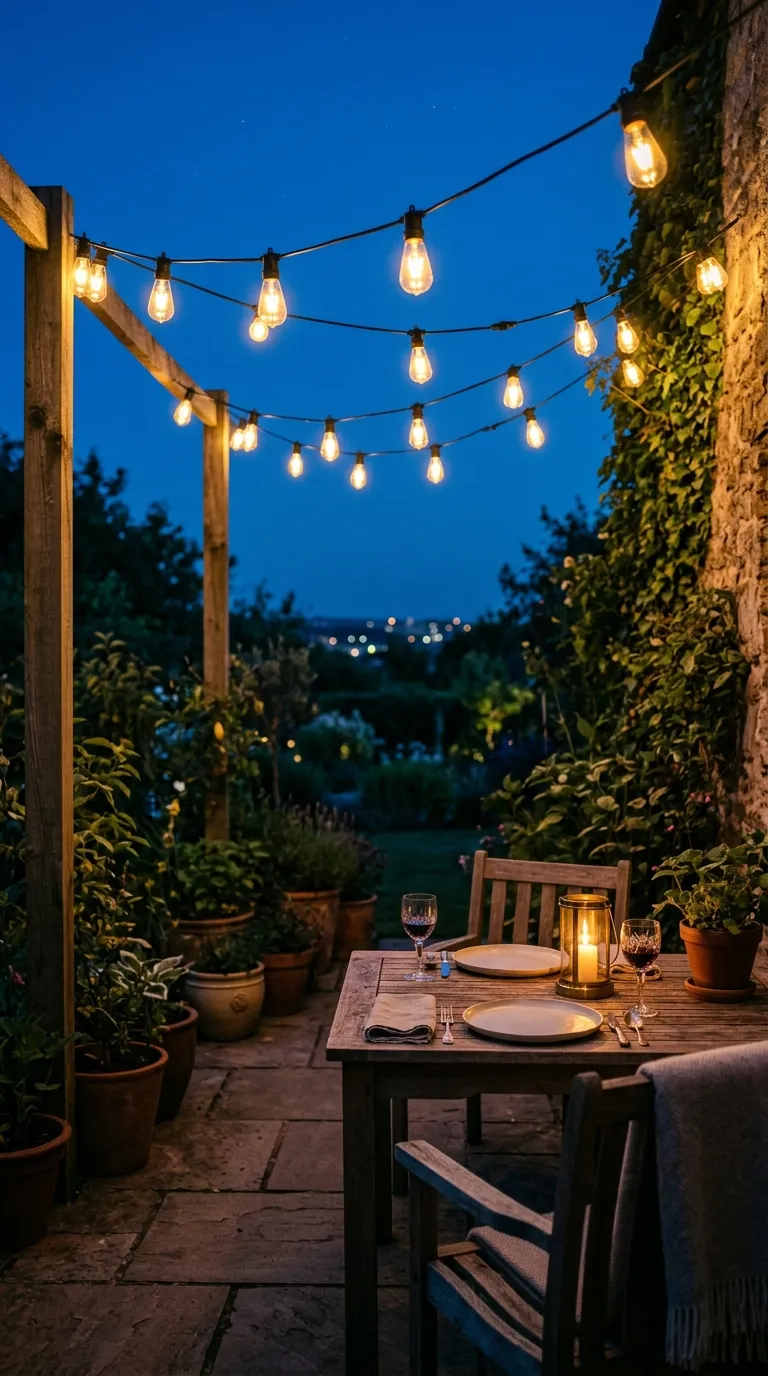
Festoon lights strung between two timber posts, a candle in a lantern on the table, and by the time the sky is that colour the fence has stopped being visible. That is not only atmosphere. It is the cheapest way to make a small garden feel larger.
Daylight shows you the walls, the fence, and the end of the plot, and the brain measures them. After dark, light only reaches what you light, and everything outside the pool of it is simply not there. A garden that appears to continue past the fence is a garden with no visible boundary.
Run the festoon between posts, not from the house to the fence, so the line crosses the space instead of tracing its edge and you walk underneath it. Warm white bulbs at 2700K, spaced about a metre apart, on a set rated IP44 or better. Ten metres carrying 20 bulbs costs roughly £30 to £80. Hang it at 2.2 to 2.5m so you are not walking into it, and use a catenary wire on any run past about 8m, because the cable sags.
Keep your second layer low. The lantern on the table does more for the mood than another string overhead, and it puts light where you are actually sitting.
Furniture that leaves the floor alone
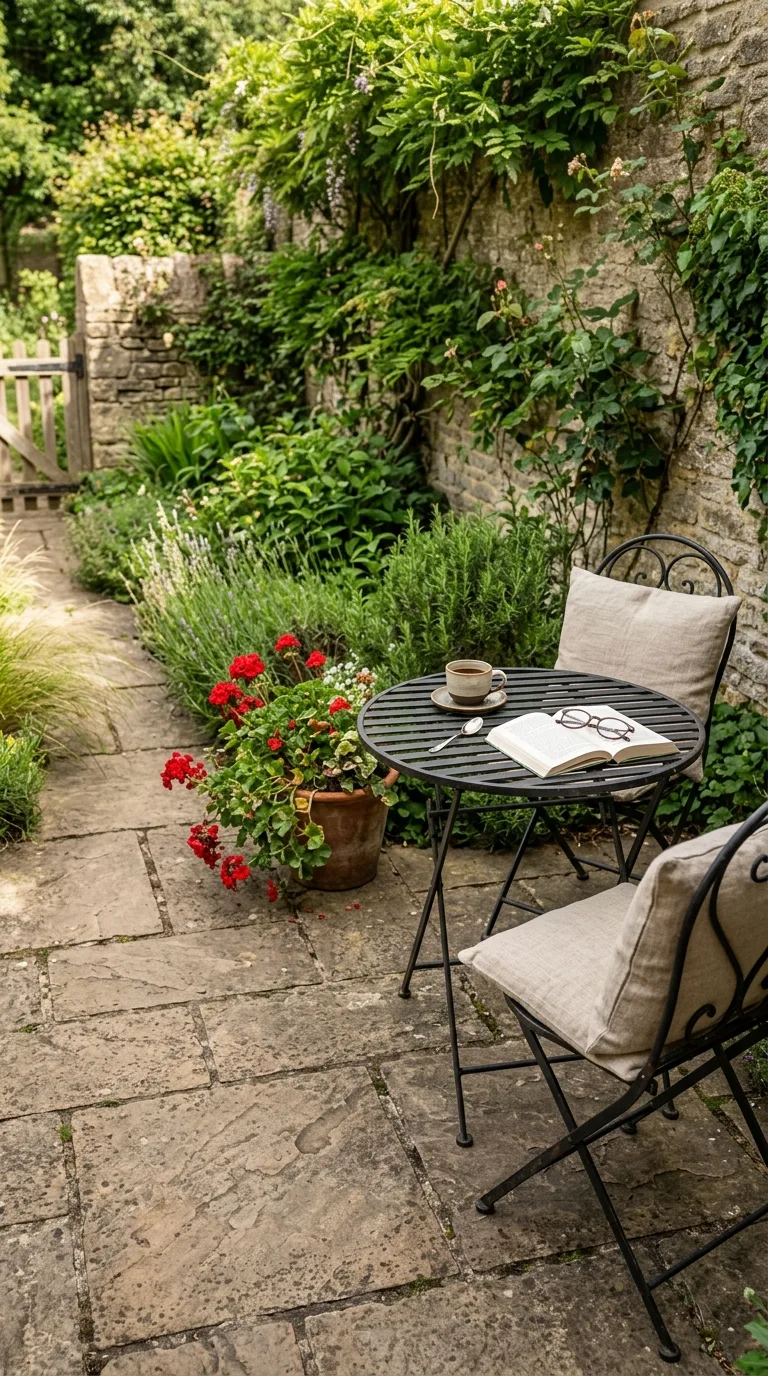
A bistro table about 600mm across and two folding chairs, and that is the whole terrace. There is more paving visible than furniture, which is what makes the corner read as a garden with a table in it.
Furniture is usually the thing that makes a small garden feel small. A six-seat dining set eats the floor and then stands empty for most of the year. Keep your footprint under about a fifth of the paved area. A two-seat bistro set in powder-coated steel costs £60 to £150, and folding means you can put it in a shed in November.
The cushions decide whether you actually sit down. A 40mm seat pad in a showerproof linen blend runs £15 to £30 each, and it turns a metal chair into somewhere you will stay for an hour. Choose ones with ties, or you will find them on the paving after the first gust.
The red pelargonium in the terracotta pot is the only strong colour in the frame, and it sits at table height, so it is the thing your eye lands on as you pull the chair out. One saturated pot beats a dozen muted ones.
Frequently asked
Frequently Asked Questions
How wide does a garden have to be before grass is worth it?
Three metres is the rough threshold. Narrower than that and the edges dominate, so the patch reads as an offcut of turf on a hard floor. Pave it, or plant something that tolerates treading, such as thyme or camomile.
Should I plant a tree or a large shrub for height?
A tree, in almost every case. Acer griseum and Amelanchier lamarckii both lift the eye well above head height while keeping a narrow footprint at ground level. A big evergreen shrub occupies the same soil and gives you nothing to look up at.
How deep does a raised bed need to be for vegetables?
Leaf crops, radishes, and herbs manage in a spade’s depth. Anything harvested for its root needs half again as much. Maincrop carrots and potatoes want the full 600mm, and a bed sitting on concrete needs gravel beneath it as well.
How many different plants should a small border hold?
Three or four, used again and again. A tight space cannot carry variety; each new species competes with the last and the eye gives up. Repetition is what the brain reads as design.
Do outdoor string lights make a garden look bigger?
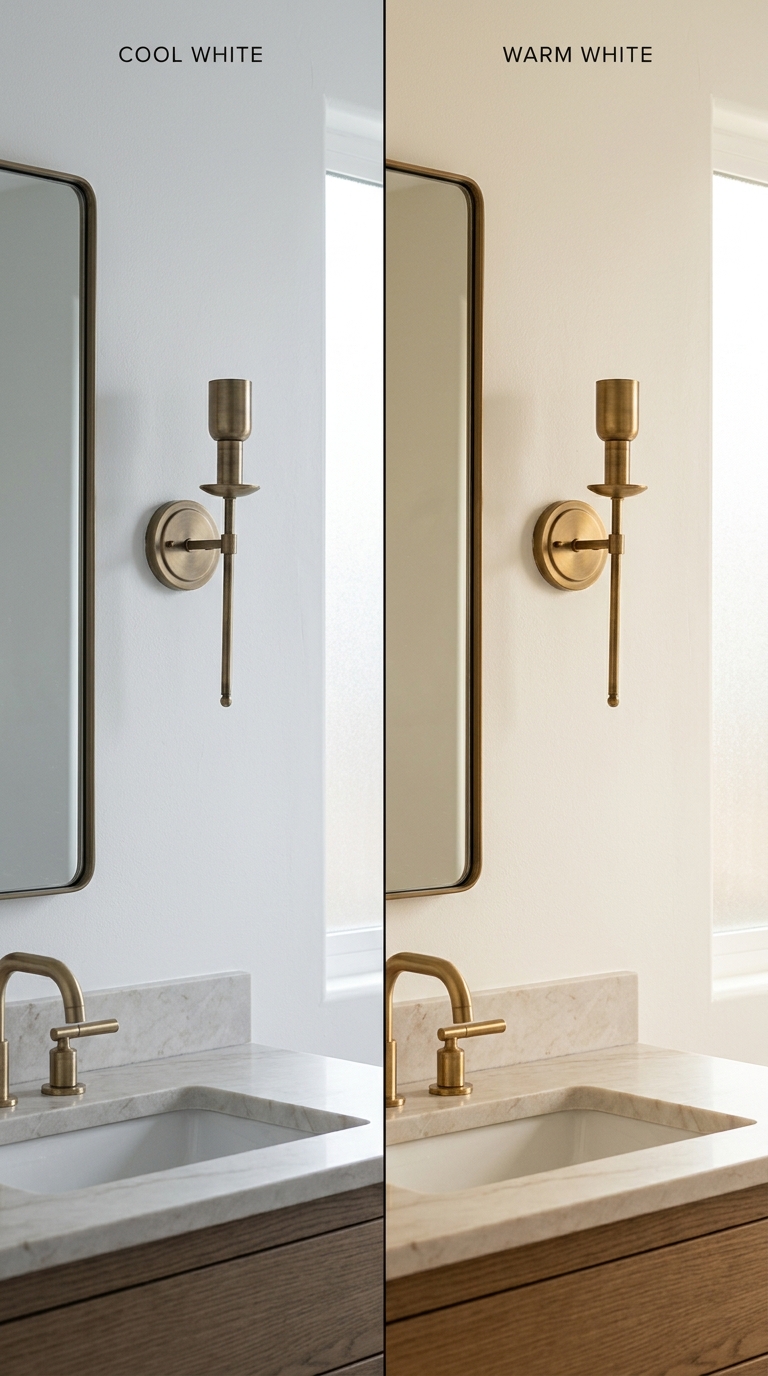
They can, because darkness removes the boundary. Once only the lit area is visible, the eye has nothing left to measure, and the plot stops having a visible end. Warm white reads calmer than cool white at close range.
How do I hang pots on a brick wall safely?
Into the brick, not the mortar joint, and allow for the weight of wet compost rather than dry. Two screws per bracket is the minimum. Stand the pot off the wall so air can move behind the leaves.
Where to start
- Divide the plot two thirds of the way back, not in the middle, and leave a narrow gap to walk through.
- Lay one paving material from the door to the back wall; three surfaces read as three small gardens.
- Grass under about three metres across is not a lawn, so pave it or plant something that takes treading.
- Farm the wall as well as the floor, with a trellis and two or three pot brackets.
- Repeat three or four species across the plot instead of collecting a dozen.
- Choose a small tree where you need height, not a large shrub.
- Set raised beds at 300mm for leaves and 450mm for roots.
- Keep furniture under a fifth of the terrace, and light the garden at night so the boundary vanishes.
This article may contain affiliate links. We may earn a commission at no extra cost to you.