12 Container Gardening Ideas: What You Plant Them In Decides Everything
Add us as a preferred source to see more stories on Google.
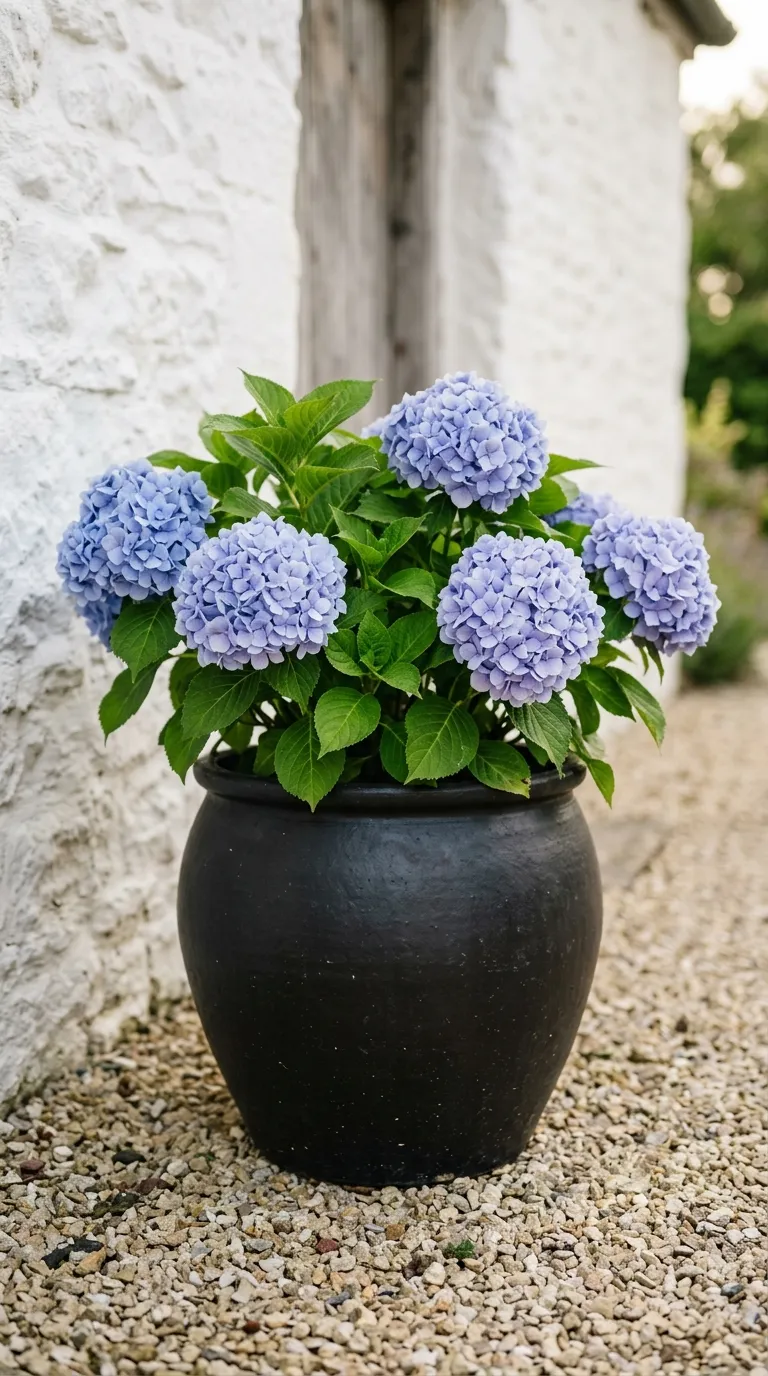
The hydrangea below will probably not be that colour next summer, and nothing about the way it is being cared for is to blame.
Mophead hydrangeas take their flower colour from aluminium, which is present in most soils but only available to the roots when conditions are acid. Below roughly pH 5.5 the plant can reach it and the flowers come blue. Above about pH 6.5 the aluminium locks up, the plant cannot take it in, and the same plant flowers pink.
A nursery grows them in acid compost to sell them blue. Move one into ordinary multipurpose, which sits near neutral, and the blue fades through mauve to pink over a season or two. People assume the plant is unhappy. It is not; it is reporting on its compost.
Keeping one blue
Plant in ericaceous compost rather than multipurpose. Melcourt SylvaGrow Ericaceous and Westland Ericaceous are both widely stocked at around £7 to £10 for 40 litres, against roughly £6 for ordinary multipurpose. Over a single pot the difference is a couple of pounds.
If the blue is already drifting, a hydrangea colourant will bring it back. These are aluminium sulphate, sold under names like Vitax Hydrangea Colourant, applied as a drench a few times through spring. It is not a one-off fix; it has to be repeated, because every watering with hard water pushes the pH back up.
Top-dress each spring by scraping off the top few centimetres of old compost and replacing it. That does more than feeding, and it is less work than repotting.
One honest caveat on the evidence: the pH thresholds above are reliable, but how fast any individual plant responds varies a great deal with variety, pot size and water. Expect a season to see a change, not a fortnight.
What the pot itself is doing
That pot is dark and matt, and it is standing in a shaded spot against a whitewashed wall. That combination is right, and it is worth knowing why.
Dark containers absorb heat. In full sun, the compost and the roots in a black pot run considerably warmer than in a pale one, and hydrangeas want their roots cool and evenly moist. A black pot in a sunny position is a genuinely poor pairing; a black pot in dappled shade, as here, is fine.
Size matters more than most people allow for. A mophead wants a pot of at least 40cm across, and preferably more. In anything smaller the compost dries so fast in July that you will be watering twice a day and still losing flowers.
And it needs drainage. Hydrangeas want moisture, not standing water, and the symptoms of waterlogging look almost identical to drought: wilting, browning leaf edges, flopping. If a wilting hydrangea does not perk up within a few hours of watering, check whether it is sitting wet before adding more.
Watering, honestly
The name comes from the Greek for water vessel, and it is not a decorative detail. In a container through summer a mophead will want watering most days and sometimes twice.
| Situation | Rough frequency |
|---|---|
| Shade, cool spell | Every two or three days |
| Dappled shade, warm | Daily |
| Sun, over 25°C | Twice daily, and it will still sulk |
| Winter, dormant | Occasionally, just enough not to dry out |
The afternoon wilt in hot weather is normal and not necessarily a sign it needs water. Check it again in the evening. A plant that has recovered by dusk was managing; one that is still flat in the morning was not.
Which varieties suit a pot
Compact mopheads and lacecaps do well. Look for varieties bred for containers rather than the large old garden types, which want more root run than a pot gives.
Hydrangea paniculata is the easier plant generally: it flowers on new wood, so pruning is forgiving, it tolerates more sun, and its colour is unaffected by pH, moving from white to pink as the flowers age regardless of compost. If the blue is not the point, it is the lower-maintenance choice.
White mopheads stay white whatever you do. No aluminium, no colour shift. Genuinely the simplest option, and worth knowing before you spend a season chasing blue.
Heights, and why the wall box matters
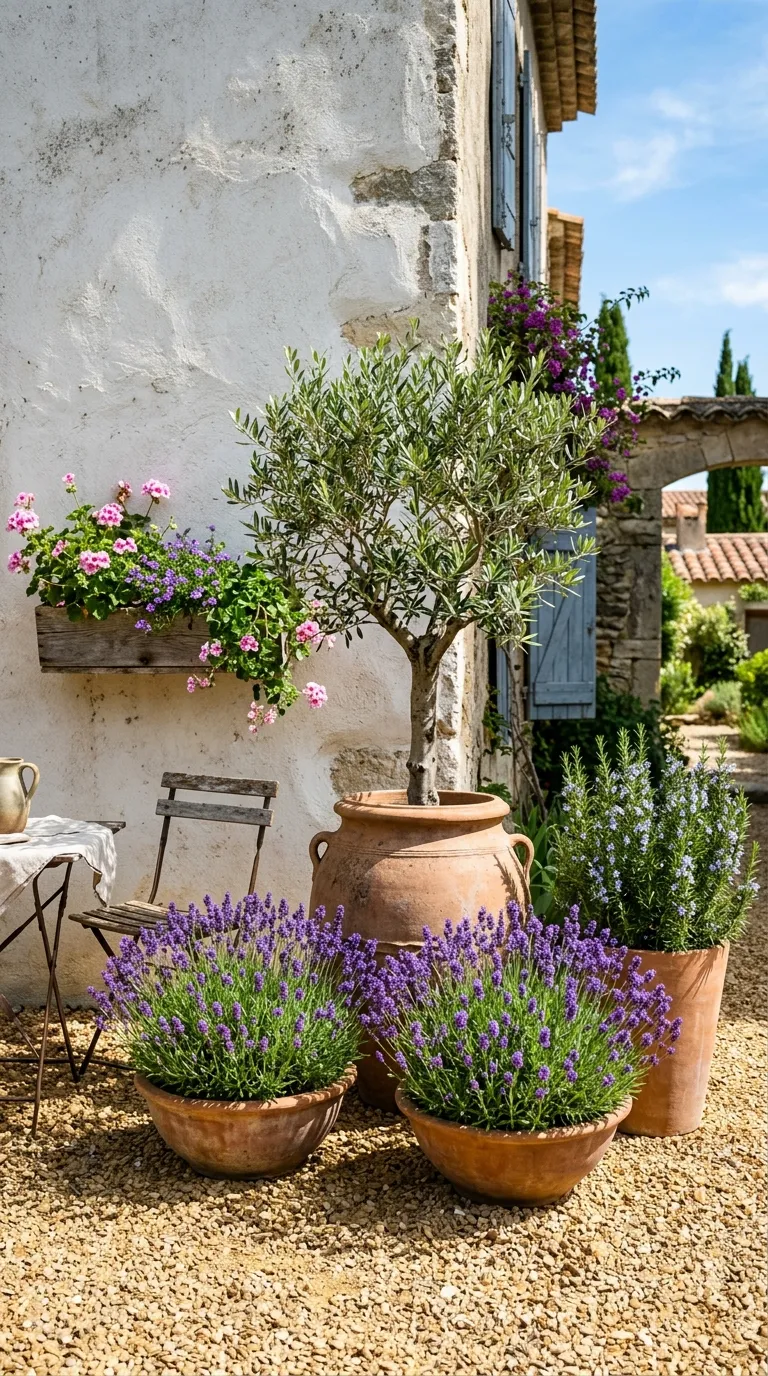
Five terracotta containers on gravel, and the eye climbs: two low bowls of lavender at the front, an olive in a big urn above them, and a timber window box of pink pelargoniums up at the shutter hinge. Nothing here is tall on its own. The group reads as a garden because the tops sit at three levels.
That wall box is the one to copy. It costs a bracket and a box, and it lifts flowers to eye level, where a pot on the ground never gets them.
The compost is decided by the plants. Lavender, olive and pelargonium all come from dry, stony ground, so they want John Innes No.2 cut with about a third horticultural grit, and they want terracotta, which dries from the sides. The same mix in a glazed pot holds water, and the lavender sulks and then dies over a winter. The grit decides whether the plant sees February out.
Count the clay: every container is the same unglazed orange. One material, three levels.
The one container that must not drain
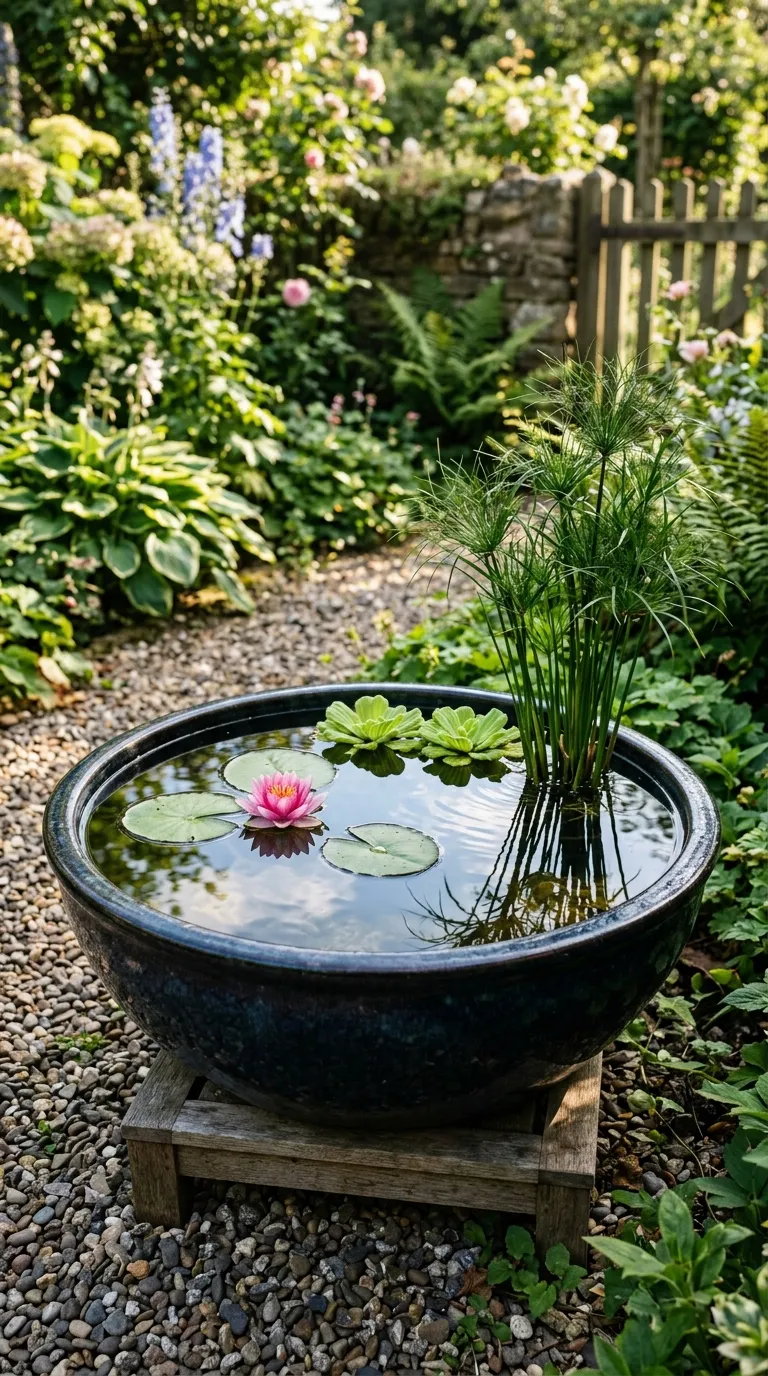
Every other pot on this page needs a hole in the bottom. This one must not have one. A wide glazed bowl, a wooden stand to lift it to sitting height, and no drainage at all.
Inside: a dwarf water lily with one pink flower open, water lettuce floating in rosettes, and a clump of papyrus at the back. That is a whole habitat in about 50cm of water. The stand matters more than it looks. At ground level the rim hides the surface; raised, you see the surface, and it reflects sky and holds light, which is the point.
Plant into aquatic baskets, not loose compost. Use aquatic compost, which is heavy and low in nutrients, top it with grit so it does not cloud, and lower the basket in. Rain keeps it topped up, and tap water is fine here, unlike the hydrangea.
The honest note: this is not a pond and will not behave like one. Algae arrives in warm weather, blanketweed follows, and a fortnight of sun can turn a clear bowl green. One oxygenating plant and a weekly scoop of fallen leaves keep it presentable.
The surface, which is part of the compost
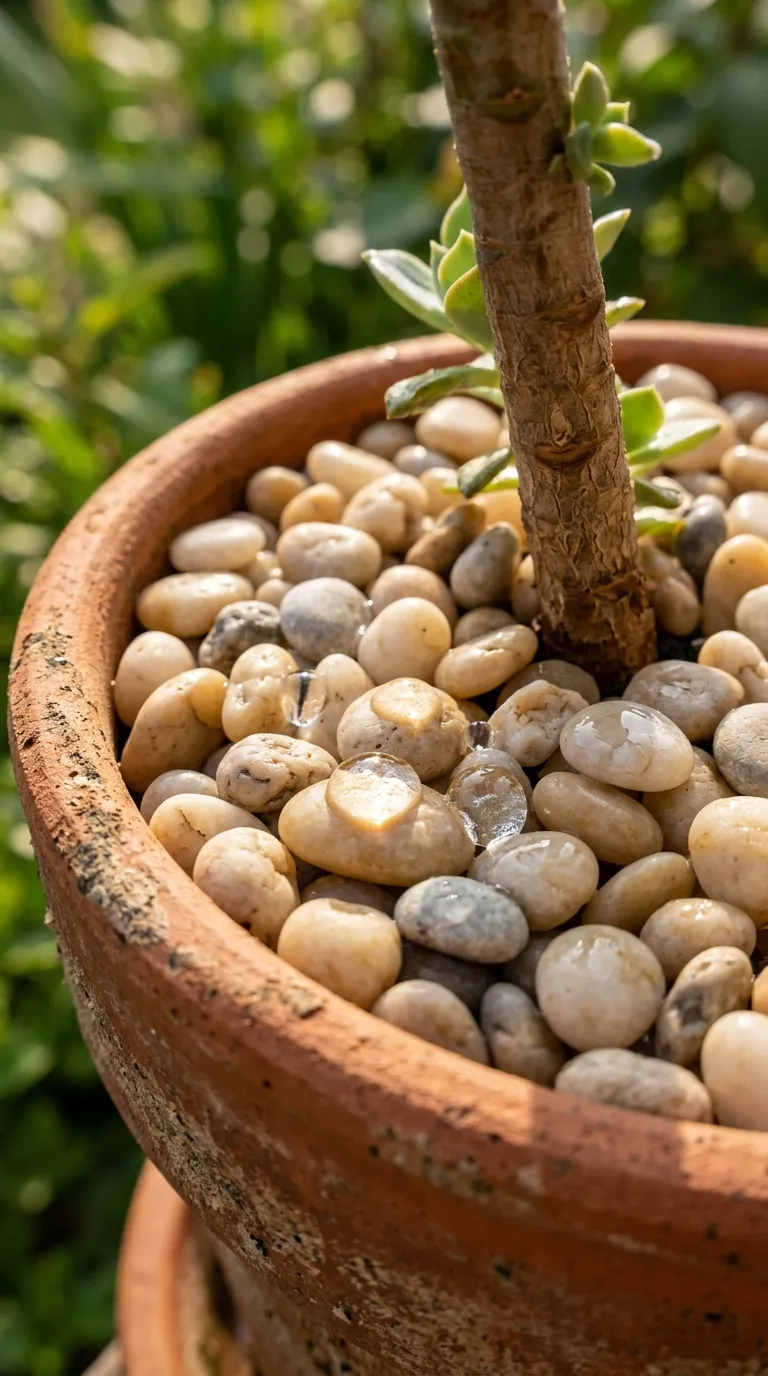
A thick woody stem, small green leaves, and a pot of smooth pale pebbles instead of bare compost. The pebbles are wet and glossy, so this was watered not long ago. The pot is old: the rim wears a white crust of lime scale, which is what hard tap water leaves behind over a year or two.
A grit top-dressing does three jobs. It slows evaporation from the surface, which matters most in terracotta on a sunny step. It keeps the neck of the plant dry, so a succulent or a woody shrub does not rot where the stem meets the compost. And it stops liverwort and algae greening the surface, which is what happens to bare compost in damp shade.
The grit has to suit the plant. A 4 to 6mm horticultural grit suits a succulent, because it drains and warms in sun. On a moisture-lover such as a hosta, a deep gravel collar does the opposite of what you want, and a thin layer is plenty, mainly to keep slugs off the new shoots.
A cutting garden that fits on a patio
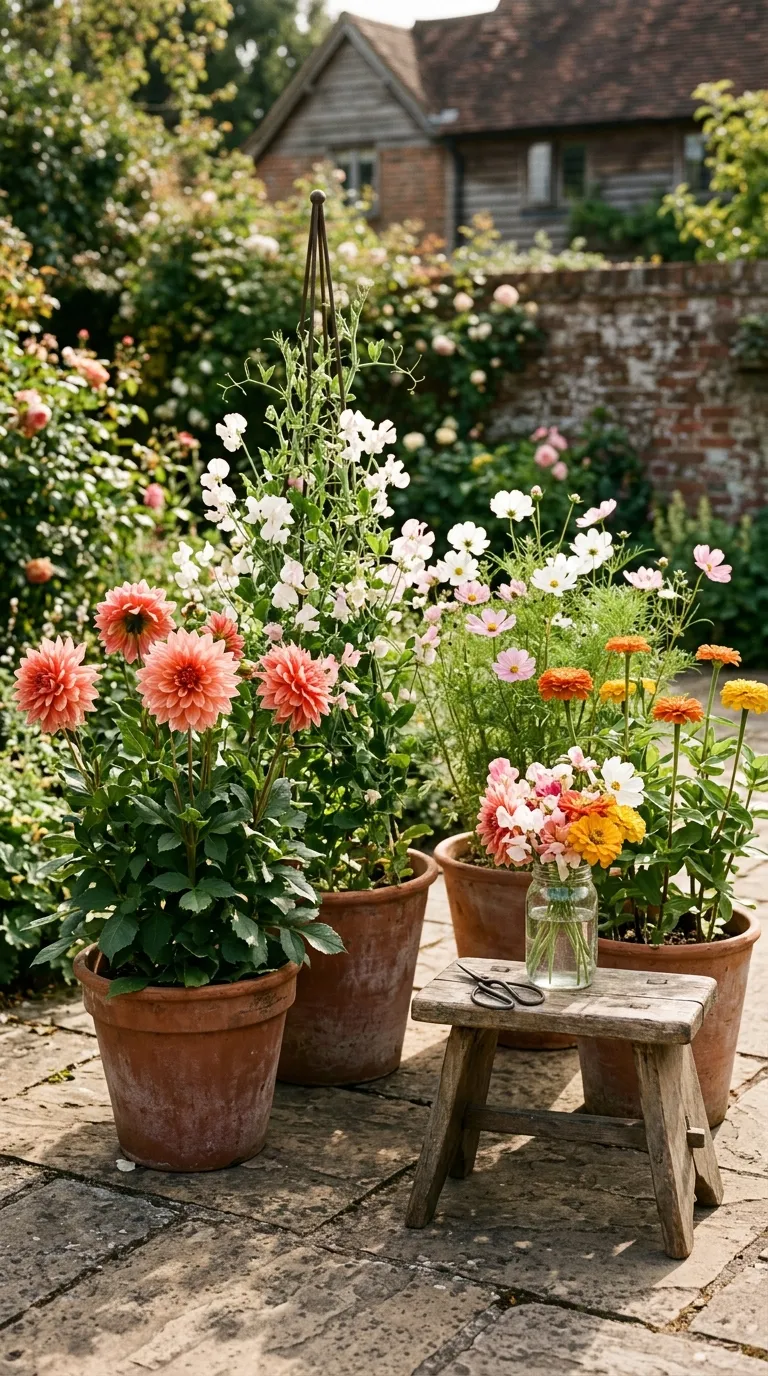
Three terracotta pots on flagstones: a dark-leaved dahlia with white sweet peas on a support at the left, cosmos and zinnias in the middle, more cosmos and a shorter dahlia at the right. On the stool, a jam jar of cut stems and an open pair of secateurs. This is a cutting garden, and it works in pots because the plants are annuals with shallow, greedy roots.
The compost is the whole crop. Fast growers in a small volume want a rich, moisture-retentive mix, John Innes No.2 with a couple of handfuls of garden compost, and they want feeding. A potash-rich tomato feed from July, once a week, keeps flowers coming where a nitrogen-heavy feed would give leaves. Cut stems in the morning, straight into water, and the plant answers by making more.
Sweet peas want depth, so give them the tallest pot and something to climb. Everything else is happy in 35cm. The dahlia will double its top growth by August and want the water that goes with it.
Pots for a wall that never sees sun
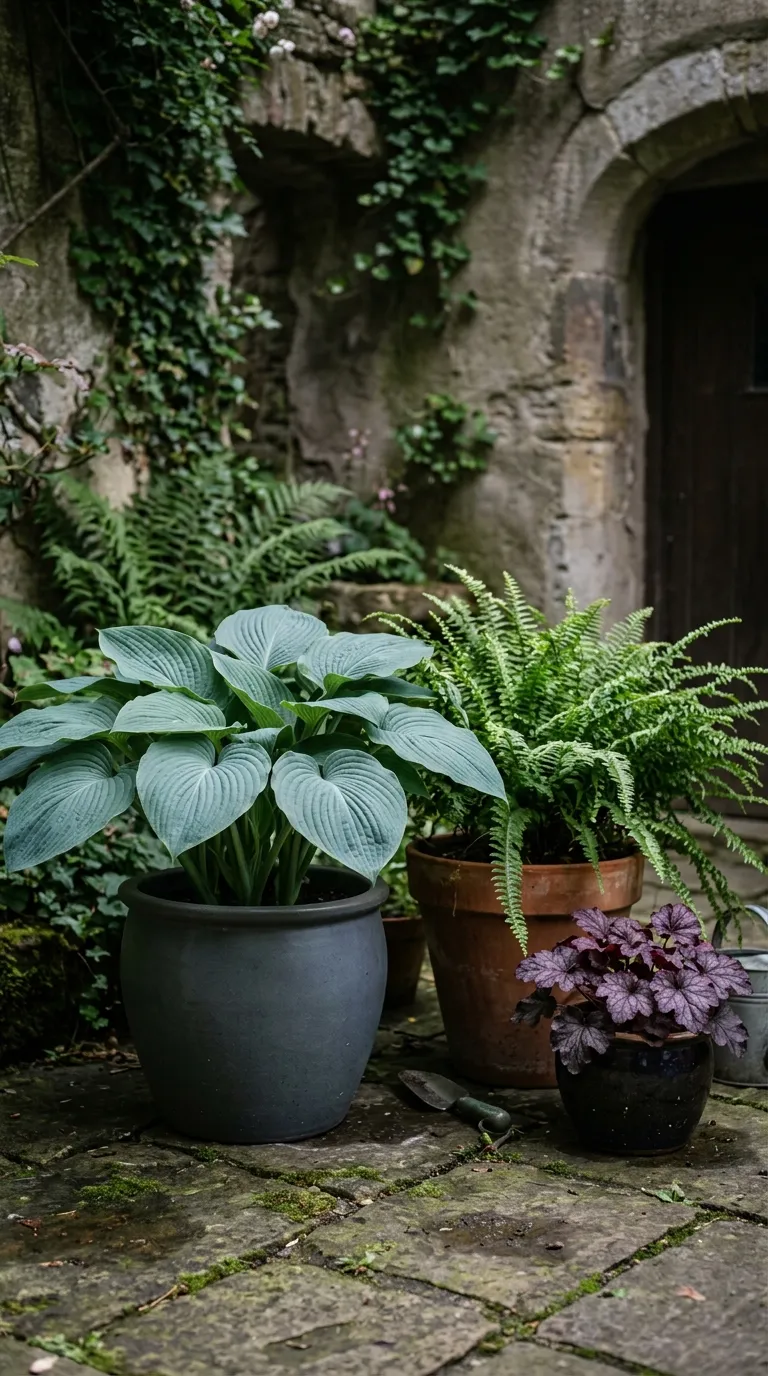
A mossy flagged yard against a stone wall, an arched doorway, ivy on the stone. The pots hold a blue-leaved hosta in charcoal glaze, a soft shield fern in terracotta, a purple heuchera in a small black pot. A trowel has been left lying on the flags. That wall never sees direct sun, and everything in the frame was chosen for it.
Shade changes the compost decision. A hosta or a fern loses less water than a lavender, but its compost must still drain, or the crown rots in a wet winter. John Innes No.3 with a third leafmould holds moisture without going sour, and it suits a glazed pot, which dries more slowly than terracotta. The blue on that hosta is a waxy bloom on the leaf, and it fades in strong sun, which is one more reason this wall suits it.
The real enemy here is not light but slugs. Damp shade is their habitat and a hosta is their favourite meal. A 3cm collar of sharp grit round the crown, refreshed each spring, beats any bait.
Raise one pot and the group changes
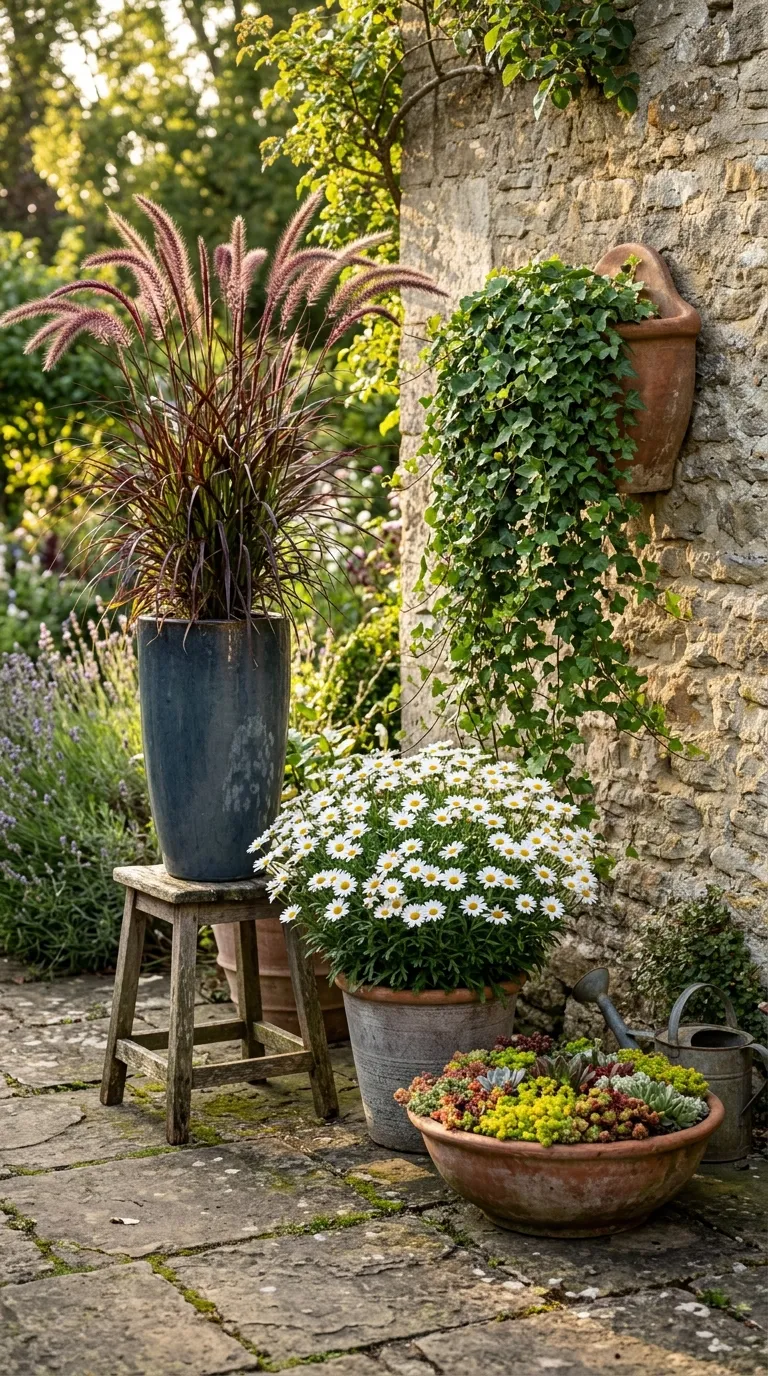
The same lesson as the Mediterranean wall, made with a stool. A tall slate-blue glazed pot of purple fountain grass stands on a wooden stool, so its arching seed heads sit well above the white marguerites and the bowl of succulents below. An ivy trails from a terracotta wall pocket, and a galvanised watering can sits at the back. The one thing that lifts the group is the stool.
What the pots are made of matters as much as the height. The succulents are in a shallow terracotta bowl, which is right: they want a wide, quick-draining root run, not depth, and they rot in a deep pot that stays wet. The grass wants the opposite, a tall pot with room for a deep root ball, and the marguerites want a middling one. Size the pot to the root the plant will have by August, not to the root it has now.
The wall pocket is the cheap move. It adds a planting level for the price of a bracket and takes the ivy off the floor entirely.
Water it until it runs, then empty the saucer
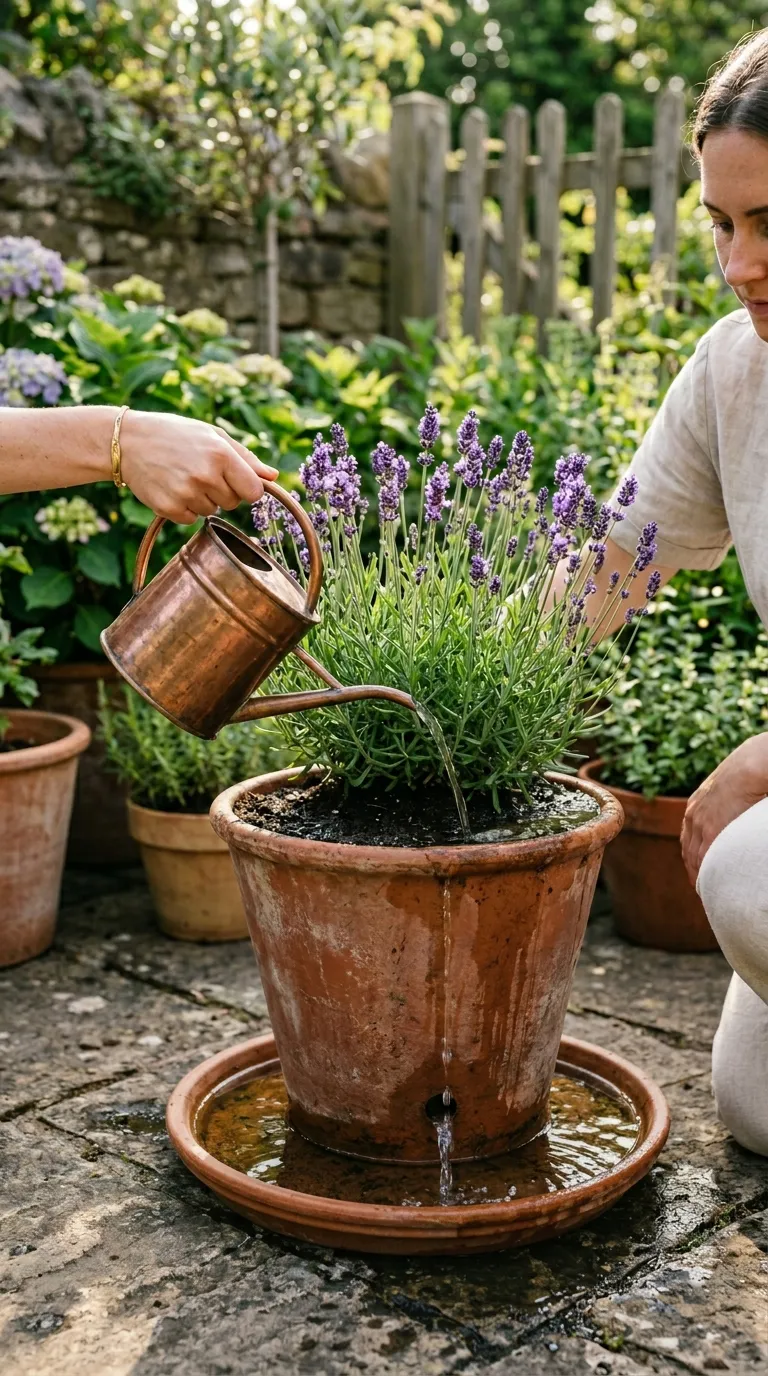
A copper watering can, a lavender in a terracotta pot, and a thin steady stream running out of the drainage hole into the saucer below. The saucer is brim full. That stream is the proof you want: water has passed through the whole root ball, not only wetted the top inch. A daily splash never reaches the roots at the bottom, which is why a pot watered every morning can still wilt by afternoon.
The second half of the job is the one people skip. Once the pot has stopped dripping, tip the saucer out. Lavender, olive and rosemary all rot at the root in standing water, and a saucer left full after a wet week is a slow drowning. In winter, take the saucer away and let the pot drain onto the ground.
Terracotta and lavender pair well for the same reason: the clay breathes and the plant likes to dry between waterings. A long-spout copper can such as a Haws runs about £45 to £90, and the fine rose matters for seedlings.
A run of identical pots is one decision
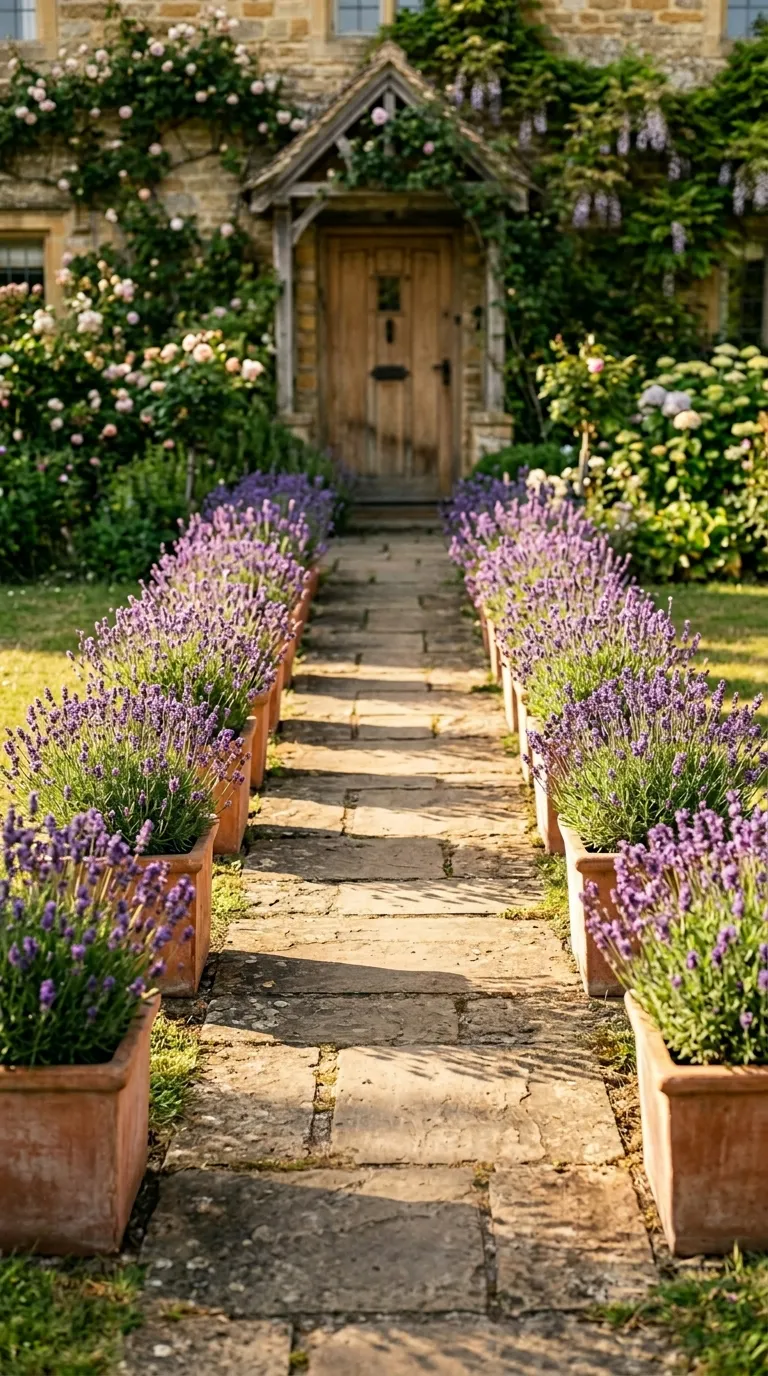
A flagstone path to an oak door, wisteria and roses on the stone, and a long run of square terracotta pots of lavender on both sides. It looks effortless, and it is the most demanding thing on this page, because a repeated run is one decision repeated, and a bad decision shows up twelve times.
Every pot in that line has to hold the same compost, or the row ripens unevenly. Lavender wants John Innes No.2 with about 30% grit, and it wants the same watering as its neighbours. Two pots in a run of twelve that hold water will die over a winter while the rest carry on, and the gap will be visible from the door.
The cost is real. Square terracotta pots at 25 to 30cm run about £8 to £15 each, so a run of fourteen is £120 to £210 before a single plant. Standing them on stone, not soil, drains them from below and dries them a little faster, which suits lavender.
The pots stand a pot’s width apart, not touching, so air moves between them.
Compost, and repotting by one size
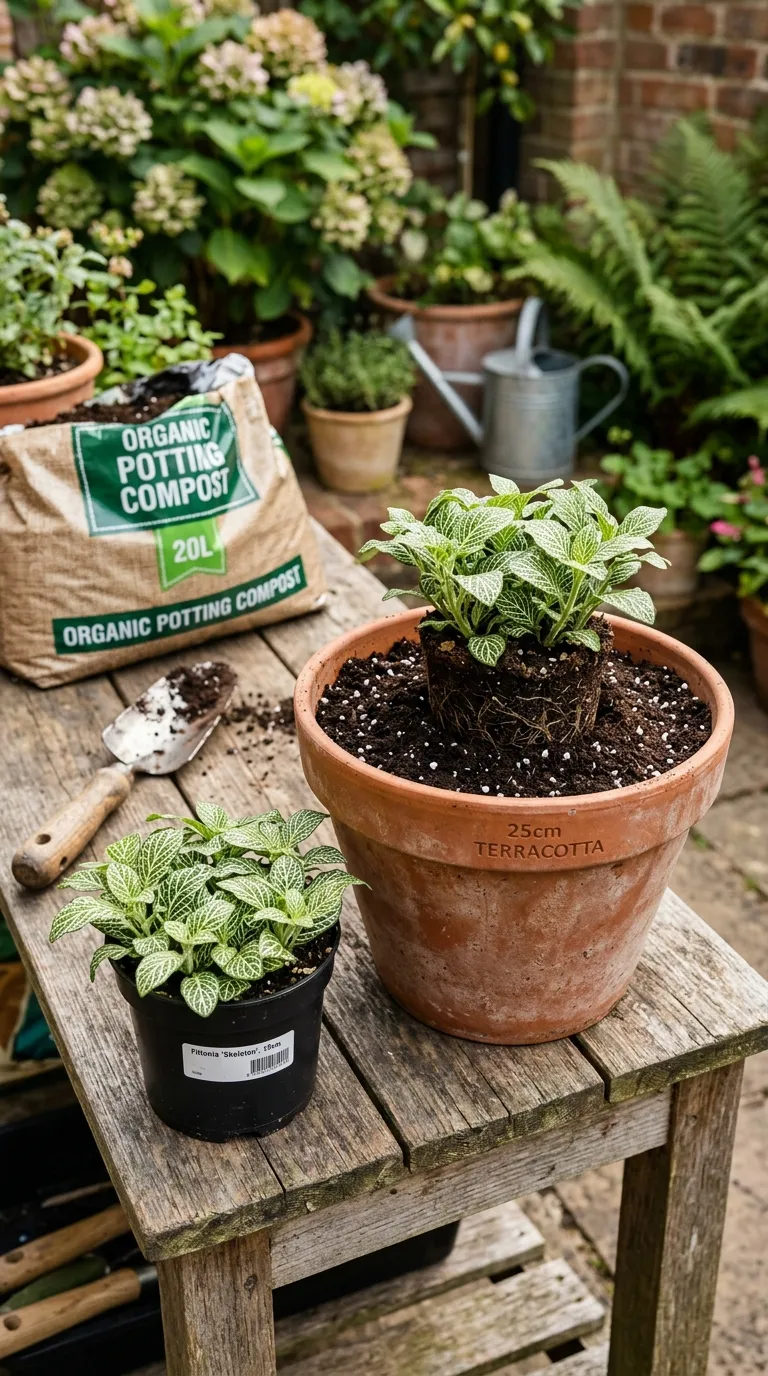
A potting bench, and the whole argument sitting on it: a paper sack of organic potting compost, a trowel, a black nursery pot, and a 25cm terracotta pot with a fittonia already in. The compost is dark and open, with white perlite through it, one grain in four. The root ball sits at the same level it sat in the nursery pot, which is exactly right. Bury a plant deeper and the crown rots.
Two rules follow. First, use potting compost, not garden soil. Garden soil in a pot compacts into a brick within a season and the roots suffocate. Second, move up one size, not four. A plant that arrived in a 15cm pot wants a 20 or 25cm one. Drop it into something far too large and the excess compost stays wet around the roots, and the plant sits still for a season while it fills the space.
The label on the pot reads 25cm, and the bag reads 20 litres. A 20-litre sack is about £6 to £9 and fills three pots of this size.
The pebble layer is not doing what you think
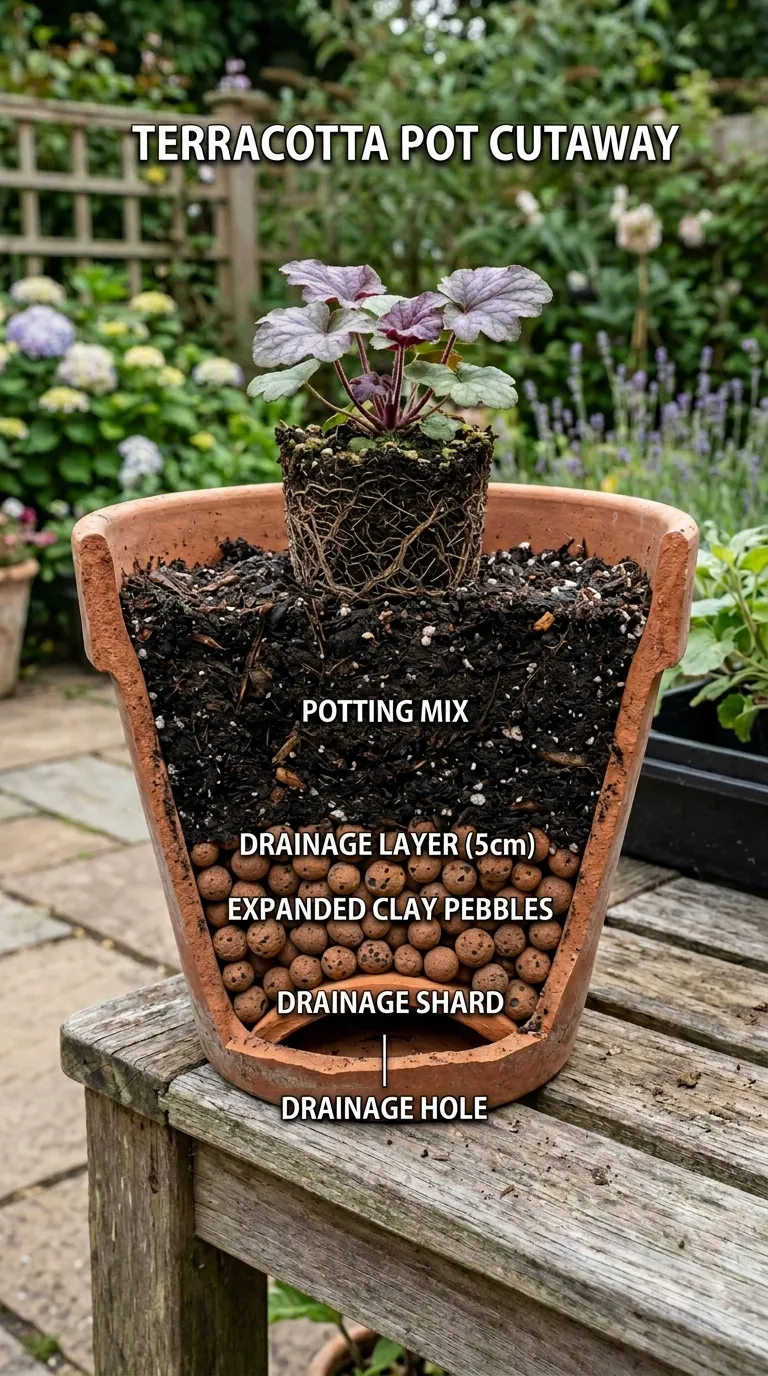
A terracotta pot sawn in half and labelled: potting mix above, a 5cm layer of expanded clay pebbles below, then a shard over the drainage hole. It is the picture most of us were taught, and the pebble layer is largely wasted work.
Water does not move easily from fine compost into coarse pebbles. It sits in the compost until that layer is nearly saturated, and only then crosses into the gaps below, so a wet band forms at the join and the root ball stands in it. The plant ends up no drier than it would have been. This part is physics, not folklore: see the join between the two layers, where the water stalls. The pebbles persist because they look tidy and cost almost nothing.
What the pot actually needs is a single crock or a piece of mesh over the hole, so compost cannot wash out and a slug cannot climb in, then compost all the way down. Keep a shallow layer of pebbles in an outdoor pot if you like the look, and do not count it as drainage.
The edible pot, plainly
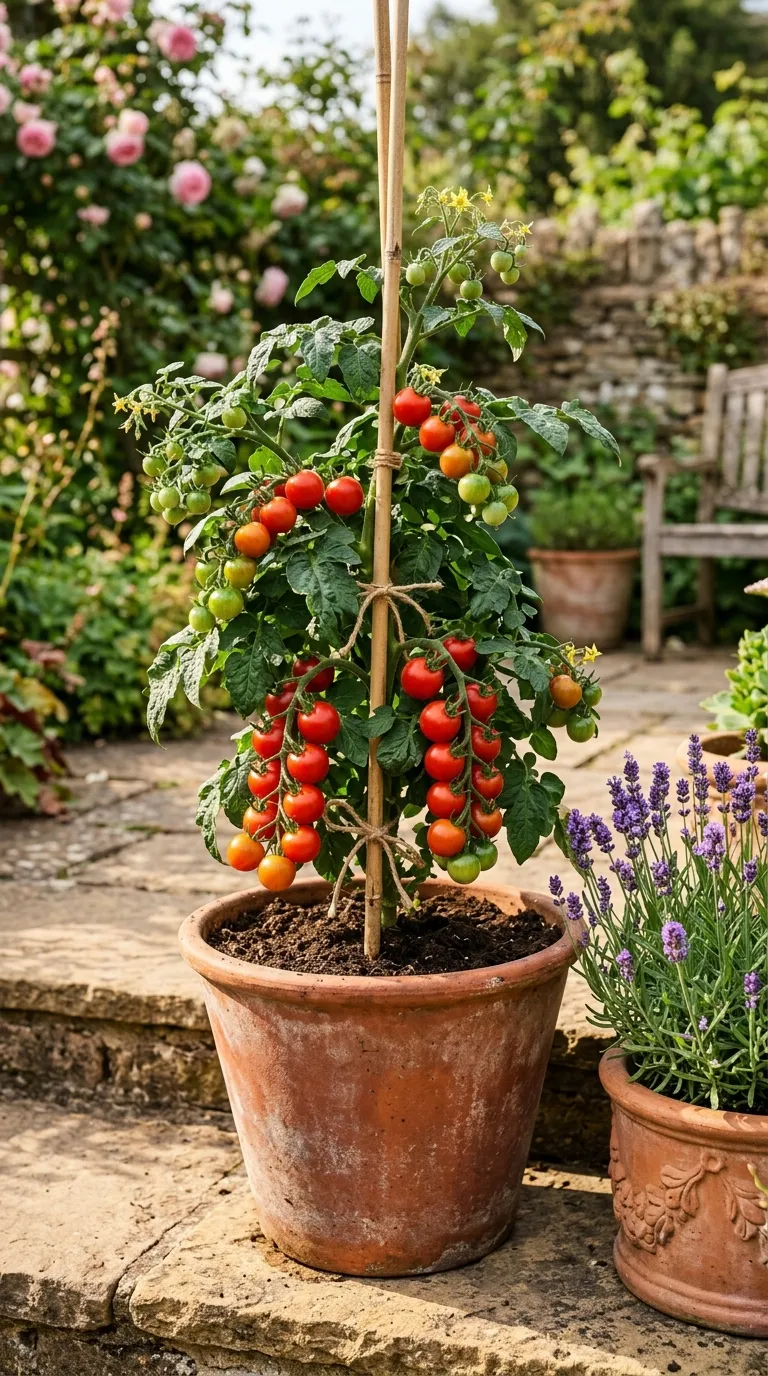
This one is straightforward: a cherry tomato in a terracotta pot, tied to a single bamboo cane, ripening from red at the bottom of the truss to green at the top. A smaller pot of lavender sits beside it on the step. Nothing here is a design idea. It is a plant doing what a tomato does, and it happens to be handsome.
It does, though, test the argument harder than any ornamental. A tomato is hungry and thirsty, so the compost and the pot decide the crop. Give it 30cm or more, a rich multipurpose with added compost, and steady water. Let the pot dry out and then flood it, and the fruit takes up calcium badly: the base of each tomato turns black and leathery. That is blossom end rot, a watering fault rather than a disease.
Feed with a high-potash tomato feed once the first truss sets. The cane is only for support, so tie it loosely in two places and let the stem move. Pick ripe fruit before the birds find it, which they will.
| Plant group | What to plant it in | Why it matters |
|---|---|---|
| Blue hydrangea | Ericaceous compost, pH 5.5 or lower | Keeps aluminium reachable, so the flowers stay blue |
| Lavender, olive, rosemary | John Innes No.2 with 30% horticultural grit | Fast drainage; these rot at the root in wet compost |
| Hosta, fern, heuchera | John Innes No.3 with a third leafmould | Holds moisture through summer without going sour |
| Tomato, dahlia, cosmos | Peat-free multipurpose with added garden compost | Hungry, fast plants in a small volume |
| Sempervivum, sedum | Free-draining mix, half grit | They want a shallow, quick-drying root run |
Where this will not work
A hot, south-facing balcony with no shade. Hydrangeas in containers there are a losing proposition, however diligent you are, and the honest recommendation is pelargoniums, salvias or olive in that position instead.
Similarly, if you are in a hard-water area with no way to collect rainwater, keeping a blue hydrangea blue becomes an ongoing chemistry project. A white variety or a paniculata will give you far more pleasure for far less attention.
Frequently asked
Frequently Asked Questions
What compost should I use for pots?
It depends on the plant, and there is no single best bag. Acid-lovers such as a blue hydrangea want ericaceous compost, dry-climate plants want John Innes No.2 cut with grit, and shade plants want something that holds moisture. Ordinary multipurpose is the neutral default, and it suits most annuals.
Do I need a layer of stones at the bottom of a pot?
Not for drainage, no. Water struggles to cross from fine compost into coarse stone, so it gathers at that boundary and the base of the pot stays wet. A square of mesh, or a single broken pot laid over the hole, is all the barrier you need.
How do I stop a pot drying out so quickly?
Size up, and slow the surface. A bigger pot holds more compost and more water, and a layer of grit over the top cuts evaporation. Terracotta dries faster than glazed or plastic, so it needs more attention in July. Moving a pot out of midday sun helps more than any of it.
Can I grow vegetables in containers?
Yes, and tomatoes, chillies and salad leaves are the easiest. The catch is feeding: a tomato in a pot exhausts its compost in weeks and then depends on you. Give it a large container, steady water, and a potash-rich feed from the moment the first truss sets.
Why do container plants need feeding when border plants do not?
Because a pot is a closed system. A plant in the ground can send roots out for water and nutrients, and rain carries more down to it. In a pot, every watering washes a little of the goodness out of the bottom, so the supply lasts only as long as the bag you started with.
How large a pot does a shrub need?
Larger than the one it is sold in, and larger than feels necessary. A mophead hydrangea wants 40cm across or more, a tomato 30cm, and a lavender 25 to 30cm. Choose for the root ball you will have by late summer, not the one you are holding now.
To start
- Decide the compost for the plant before you choose the pot: ericaceous for a blue hydrangea, gritty and free-draining for lavender and olive, moisture-retentive for hostas and ferns.
- Size the pot to the root ball the plant will have by late summer, and move up only one size when you repot.
- Give every pot a drainage hole, except a water bowl, which needs the opposite.
- Skip the 5cm layer of pebbles; a square of mesh or a broken pot over the hole is enough.
- Water until it runs from the hole, then empty the saucer so nothing stands in water.
- Feed from April to September, and top-dress the compost each spring.
- Lift one pot onto a stool or a wall bracket to give a group a high point.
- Keep one water bowl and one edible pot for the pleasure of them, and read what each one needs.
This article may contain affiliate links. We may earn a commission at no extra cost to you.