10 Flower Garden Ideas, From Mulch to a Moonlit Border

Add us as a preferred source to see more stories on Google.
The border below has been planted properly and mulched immediately, and the mulch is the thing that will hold it back.
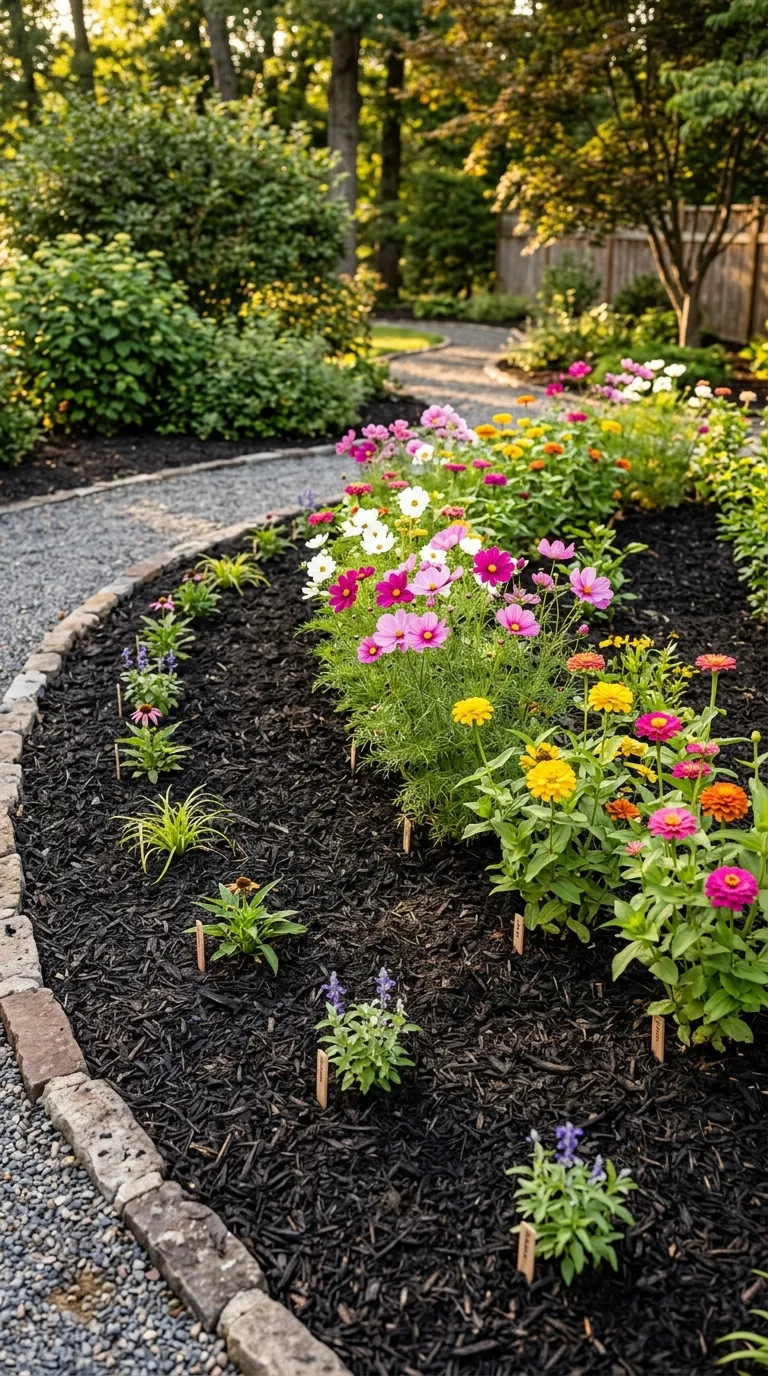
Those small plugs down the front have most of their roots in the top few centimetres of soil. That is also where fresh wood chip does its work, and while it decomposes it takes nitrogen out of that exact layer.
The effect is temporary and local, and on established shrubs it barely registers. On a newly planted annual with a small root ball, it shows up as pale leaves and a plant that sits and does nothing for a month.
What to mulch with instead
For a border of annuals, compost. Garden compost, well-rotted manure or leaf mould, spread 50mm deep. It suppresses weeds, holds moisture, and adds nitrogen rather than tying it up.
Save the wood chip for paths, for around established trees and shrubs, and for anywhere nothing new is going in.
If chip is what you have, leave a clear circle of 100mm or so around each young plant and top the border up properly next year once the plants are away.
| Mulch | Feeds the soil | Suits |
|---|---|---|
| Garden compost | Yes | Annual and perennial borders |
| Well-rotted manure | Yes, strongly | Hungry plants, roses, vegetables |
| Leaf mould | Slowly | Woodland planting, seedlings |
| Bark or wood chip | Eventually | Paths, shrubs, established beds |
| Gravel | No | Mediterranean planting, alpines |
On dyed mulch, honestly
The mulch in that photograph is dyed black, and it is worth being straight about what is and is not known.
The colourant itself is usually carbon or iron oxide based and is not the concern. The question is what wood it was made from. Dyed mulches are frequently produced from recycled wood waste, which can include pallets and demolition timber, and older treated timber may contain copper, chromium and arsenic compounds.
Reputable suppliers state their feedstock. Most do not. That is the actual issue, rather than the dye.
Separately, and regardless of source: a black surface absorbs heat, so soil under dark mulch runs warmer than under a natural chip. Useful in a cold spring, less so in a heatwave.
If the black look matters to you, buy from a supplier who states the source wood. If it does not, undyed chip or compost does the same job with none of the question.
The two plants doing the work here
Cosmos. Fast, generous and almost impossible to kill, which is why it is the standard recommendation for a first flower border. It flowers from midsummer until frost if deadheaded, and it self-seeds freely.
The thing nobody mentions is height. The common varieties reach 1.2 metres and flop in rain unless supported, and once flattened they do not stand up again. ‘Sonata’ is the compact form at about 60cm and the right choice near a path. Support the tall ones with twiggy sticks in June, before they need it.
Zinnias. Brighter and stiffer-stemmed than cosmos, excellent for cutting, and they hold their colour as well as anything.
Two honest cautions. They dislike root disturbance and generally do better direct-sown where they are to flower than transplanted as plugs. And they mildew in humid weather with poor airflow, particularly if watered overhead in the evening. Space them properly and water at the base.
Filling the gaps faster
That border looks sparse now and will not for long. Cosmos and zinnia both put on substantial growth in six to eight weeks in warm soil.
If the bareness bothers you in the meantime, sow a fast hardy annual directly into the gaps: calendula, nigella or nasturtium will all germinate in a fortnight and be over by the time the main planting wants the room.
Resist the temptation to plant more closely instead. Overcrowded annuals mildew, flower less, and the border collapses in August.
The rest of this piece is about arrangement, read from 10 photographs: what goes where in the bed itself, on the assumption that the soil question above is settled.
One colour, blocked
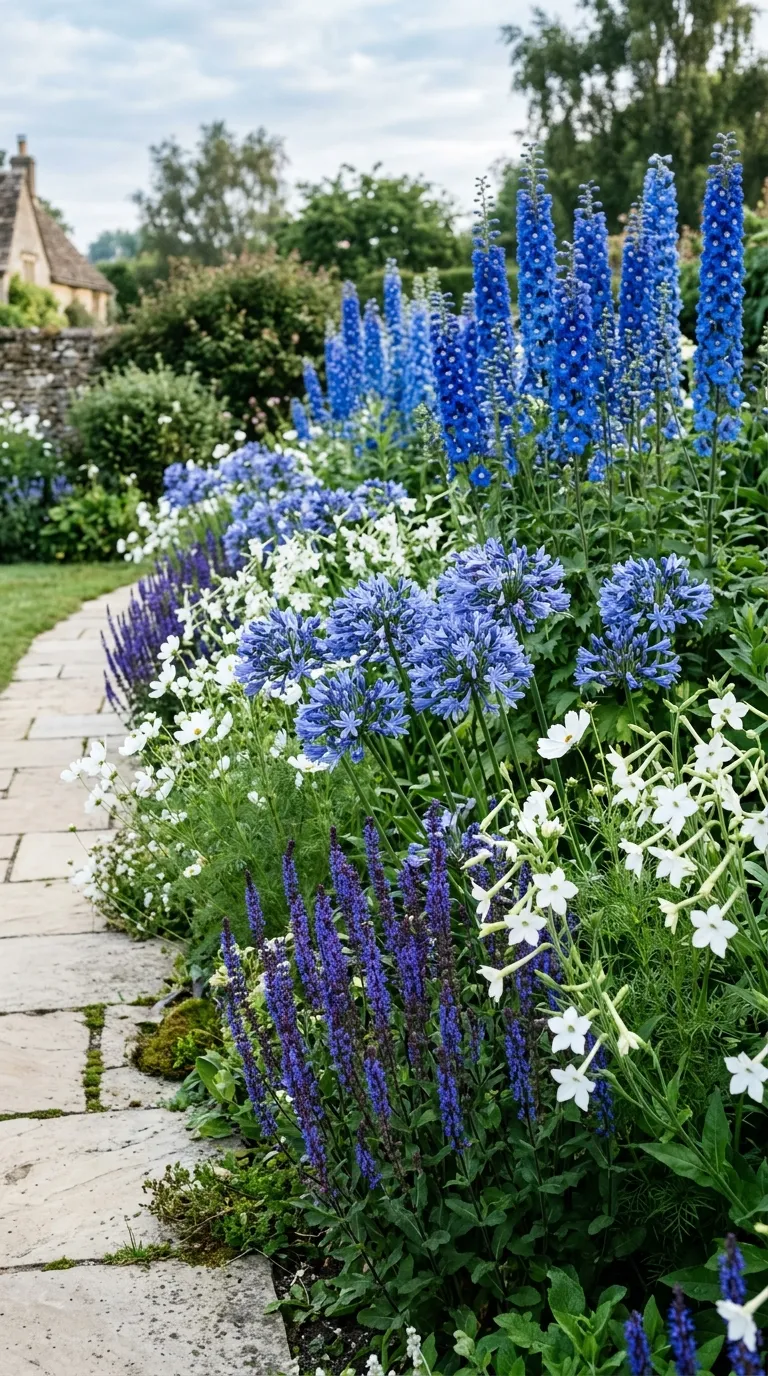
Look at the left-hand third of this border and try to find a stray colour. There is almost none. Everything is blue or white, running from the flagstones at the front to the tops of the tallest delphinium spires at the back.
That is colour blocking, and it is the quickest way to make a border read as a decision instead of a collection. The eye sorts by colour before it sorts by shape, so a run of one family at 1.2 metres, then agapanthus heads at 60cm, then salvia at 45cm, is read as a single object, not 20 separate plants.
Blue is the easy family to try, because so much of it flowers in the same six weeks. Delphinium ‘Black Knight’ and Agapanthus ‘Northern Star’ both open in July, and Salvia nemorosa ‘Caradonna’ will carry the same blue from June into September if it is cut back after the first flush. Add white nicotiana for scent and a white cosmos to fill gaps, and the scheme holds for a season. A 9cm pot of any of them runs £5 to £8.
Two cautions. Delphiniums want shelter and a stake; at 1.5 metres they snap in wind. And blue and white with nothing else is cold in a north-facing border, which matters before committing a whole bed to it.
Drifts, and why one of everything fails
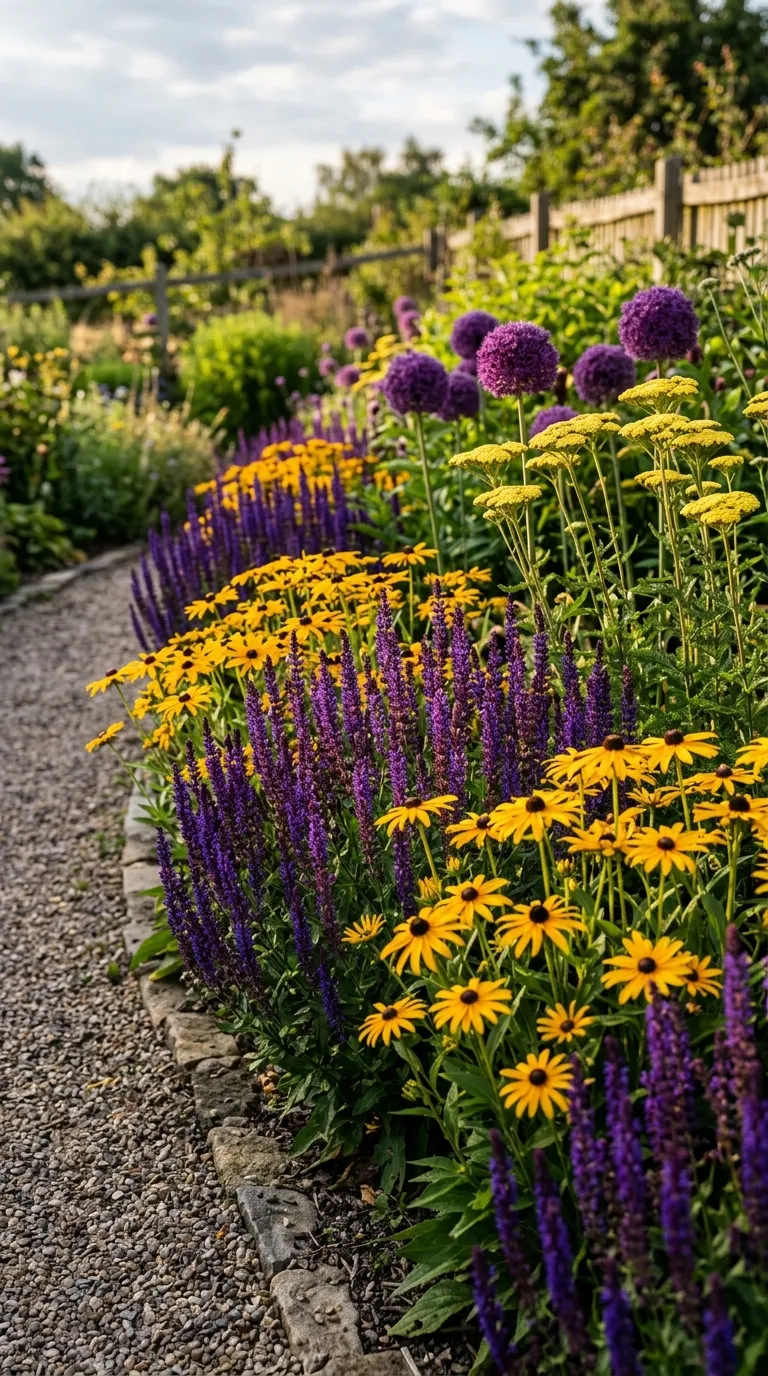
Count the plants along the path edge and you reach two, or maybe three. There is a yellow daisy and a purple spike, and each of them is repeated 20 or 30 times along the gravel. The purple globes above are the same trick again.
That repetition is what gives the border its weight. One rudbeckia at 60cm disappears into gravel and green. Nine of them in a flowing group read from the other end of the garden, because the eye takes in the mass and not the individual flower.
The two yellows are easy to tell apart once you know them. Rudbeckia fulgida var. sullivantii ‘Goldsturm’ is the daisy with the black cone, flowering from August into October. Achillea ‘Moonshine’ is the flat mustard plate above it, and it belongs at the front where its grey leaves show.
The purple spikes are Salvia nemorosa again, and the globes are alliums going over. Leave the allium heads on the plant when the colour fades. They hold their shape for another six weeks, and by then the seed heads are better than the flowers were.
Seven plants in a group is the usual advice, and it is about right for a border this size. Odd numbers matter less than making each group wide enough to be read as a group.
Three heights, in one frame
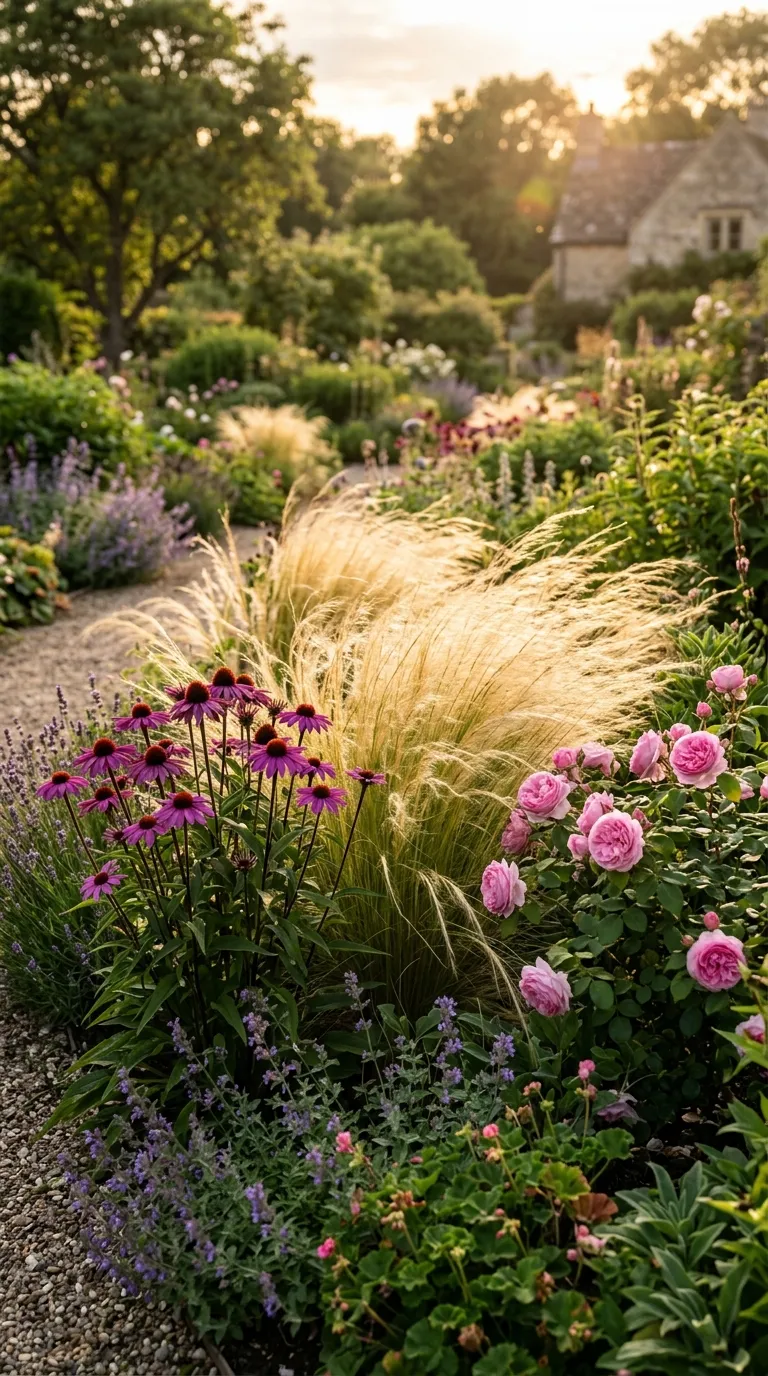
The grass in the middle of this border is doing the structural work, and it is worth naming: Stipa tenuissima, sold as ponytail grass, about 60cm tall and moving in the least wind. Everything else is arranged around it.
Read the frame front to back and the three depths appear. Low, along the gravel: catmint and hardy geranium. Middle: Echinacea purpurea at about 90cm, its cones already orange-brown, which puts this at late July or August. Tall: the pale pink roses behind, with the grass leaning through all three.
| Depth | Height | Plants that work |
|---|---|---|
| Front | 20 to 45cm | Catmint, hardy geranium, sweet alyssum |
| Middle | 60 to 90cm | Echinacea, achillea, salvia |
| Back | 1.2 metres and up | Delphinium, hollyhock, Stipa tenuissima |
Notice how the grass does not sit in a middle row. It leans forward over the echinacea and back into the roses, so the edges of each layer blur. A border built in three tidy strips reads as a striped border.
Two things to copy. Plant the tallest thing about two-thirds of the way back, not hard against the wall, or the front half of the bed looks empty. And leave the echinacea standing through winter; the seed heads hold until February and the birds take them.
The deadheading nobody photographs
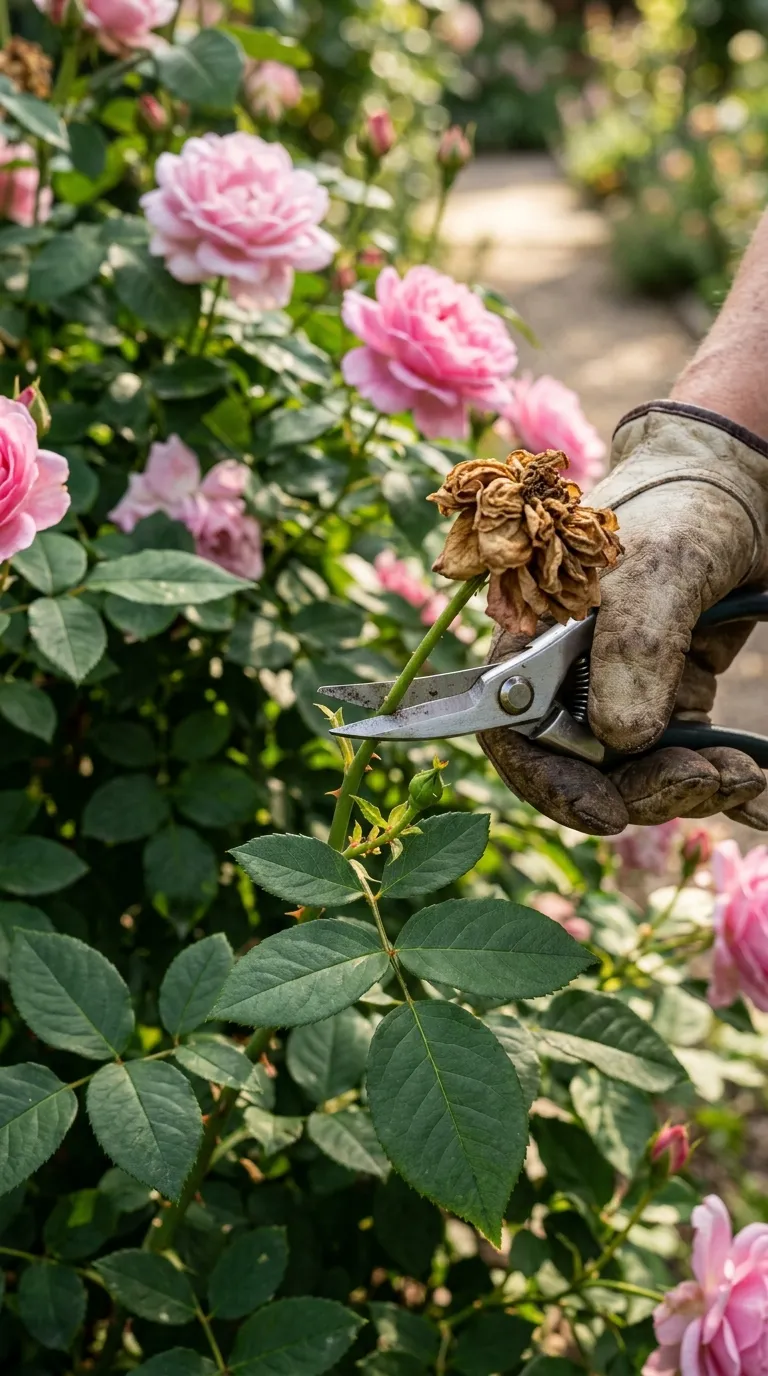
The subject shown here is not a border. It is a pair of secateurs, a worn leather glove, and one spent rose, and it belongs in a piece about borders because deadheading decides whether any of the others flower again.
The cut is in the right place. Follow the faded bloom down its stem to the first leaf with five leaflets and cut about 5mm above it, angled away from the bud. The shoot below that leaf is the next flower. Cut higher, into blind wood, and nothing comes for a fortnight.
Pink shrub roses like the ones behind the hand are repeat-flowering, which means they will do this again in six to eight weeks if they are cut. Let the hips form and the plant has no reason to make another flower. That is the mechanism, and it is the same one that keeps cosmos going until frost.
Two honest notes. Stop deadheading in early September in a cold garden, so the last flowers set hips and the wood hardens before frost. And a rose fed nothing but fresh wood chip will not have the reserves to repeat at all, which is the nitrogen problem the mulch creates. The secateurs in the frame are the bypass kind; a pair of Felco No.2 costs £45 to £60.
Flowers in among the vegetables
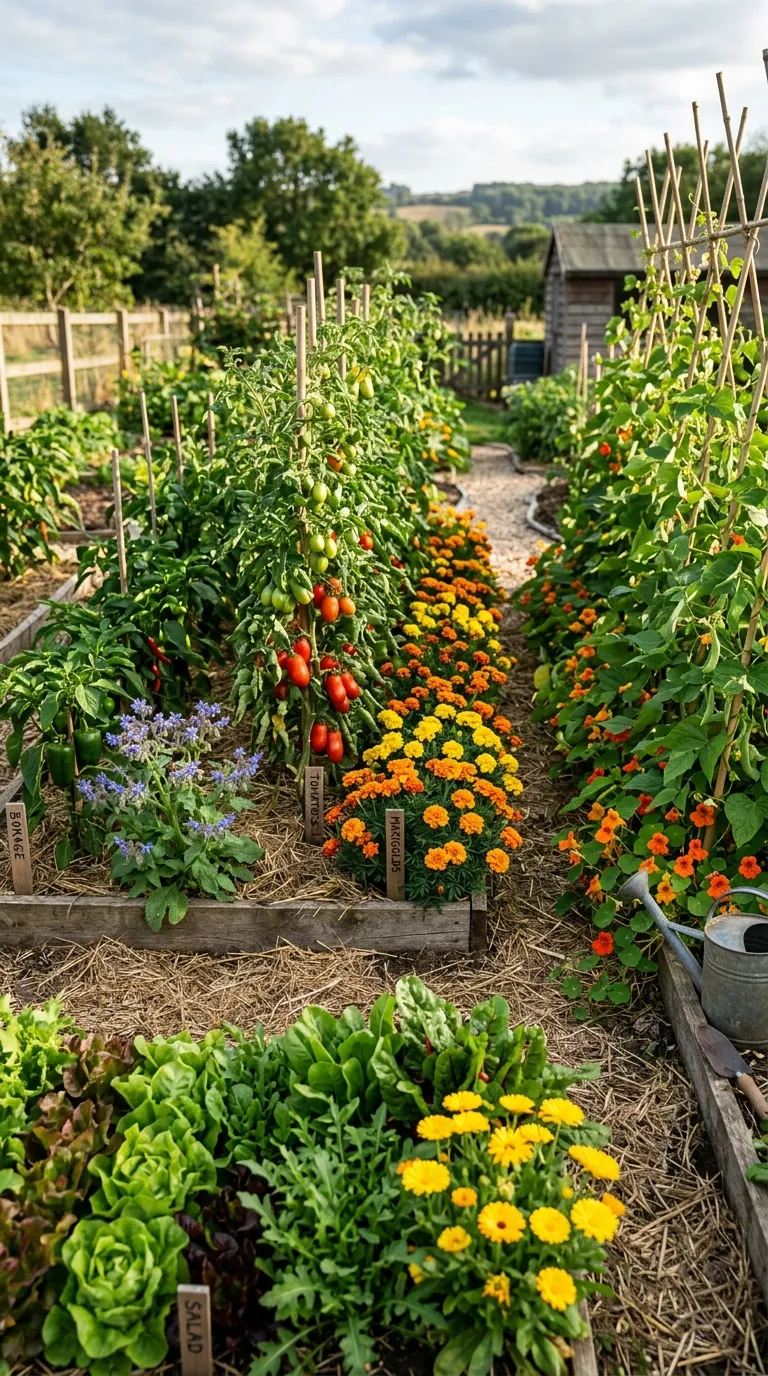
Not one of the flowers in this picture is there to be looked at. The marigolds sit in a row between the tomatoes. The nasturtiums run along the base of the bean wigwam, and the borage is in with the peppers.
This is the oldest form of companion planting and the one with the clearest mechanism. French marigolds (Tagetes patula) release a compound from their roots that suppresses root-knot nematode in the soil around them. Trial results vary with species and with soil, so treat it as a good bet and not a guarantee. Nasturtiums draw blackfly off the beans; you plant them to be eaten. Borage is a bee magnet, and the bees that work it also work the beans.
In a small plot you do not need a separate strip. Sow a 30cm band of Tagetes ‘Linnaeus’ or a dwarf nasturtium down one edge of each bed and let the vegetables have the rest. Seed is cheap: a packet of each runs £2.50 to £4 and covers a bed.
One caution. Nasturtiums are thugs on good soil. In a rich bed they make 2 metres of leaf and almost no flower, so keep them at the dry, hungry end.
Scent at the door, not in the middle
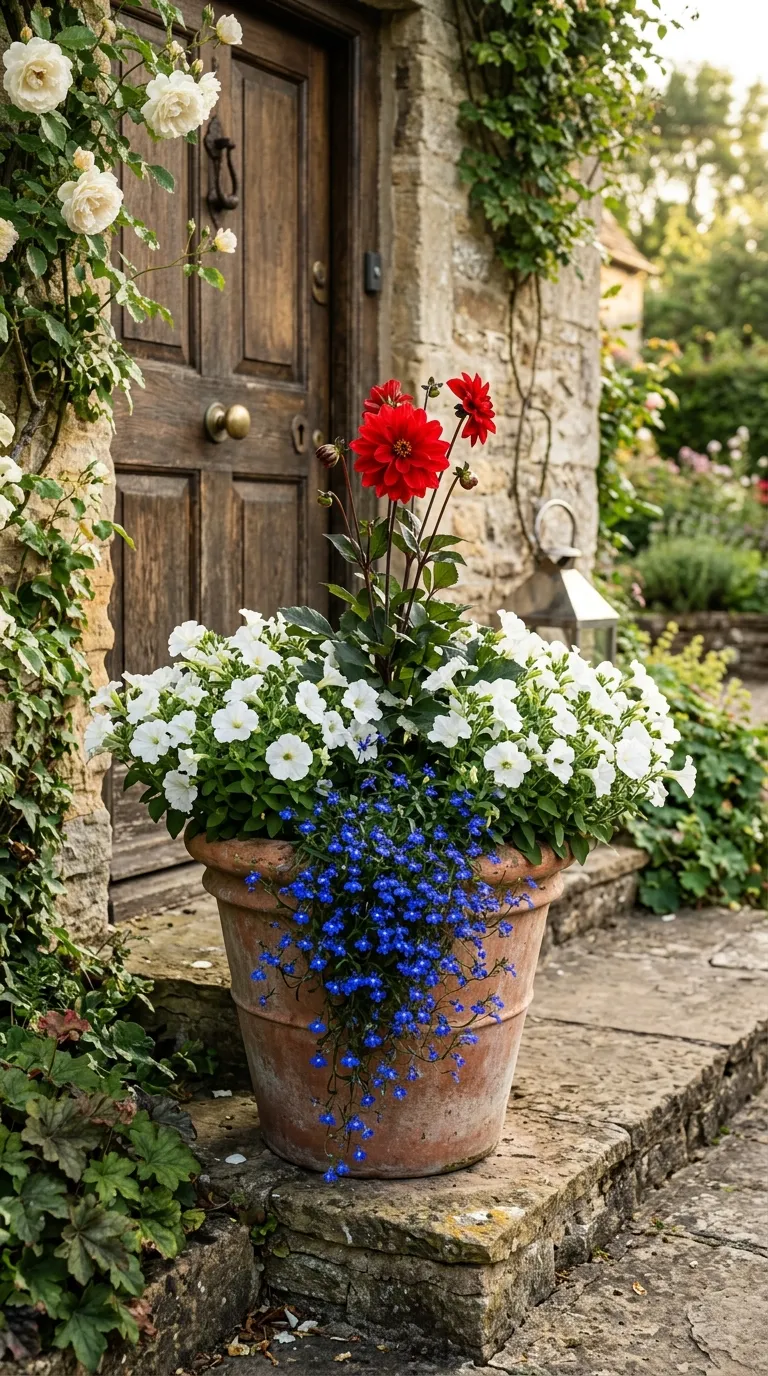
A pot this close to a door is a scent trap first and decoration second. White petunias are the mass in the pot shown here, red dahlias give it a centre, and the blue spilling over the rim is lobelia.
Scent is a chemistry problem before it is a planting one. Petunias release most of their perfume in the evening, which suits a door you pass after work. Put them where a sleeve brushes the leaves and the scent comes for free; a pot set two metres back on a lawn gives you the view and nothing else.
The white rose climbing the wall on the left is a repeat-flowering climber, and a doorway is one of the few places one earns its keep, because you walk past it. Rosa ‘Iceberg’ and ‘Madame Alfred Carrière’ both do this against stone, and neither needs more than a 45cm square of soil at the base.
Two things I would change. The petunias need deadheading every few days or they set seed and stop, which is the price of a scented door. And red dahlias at a door are a bold choice that fights white unless you keep the dahlia to two plants, which is what this pot does.
White flowers, and the hour after the sun goes
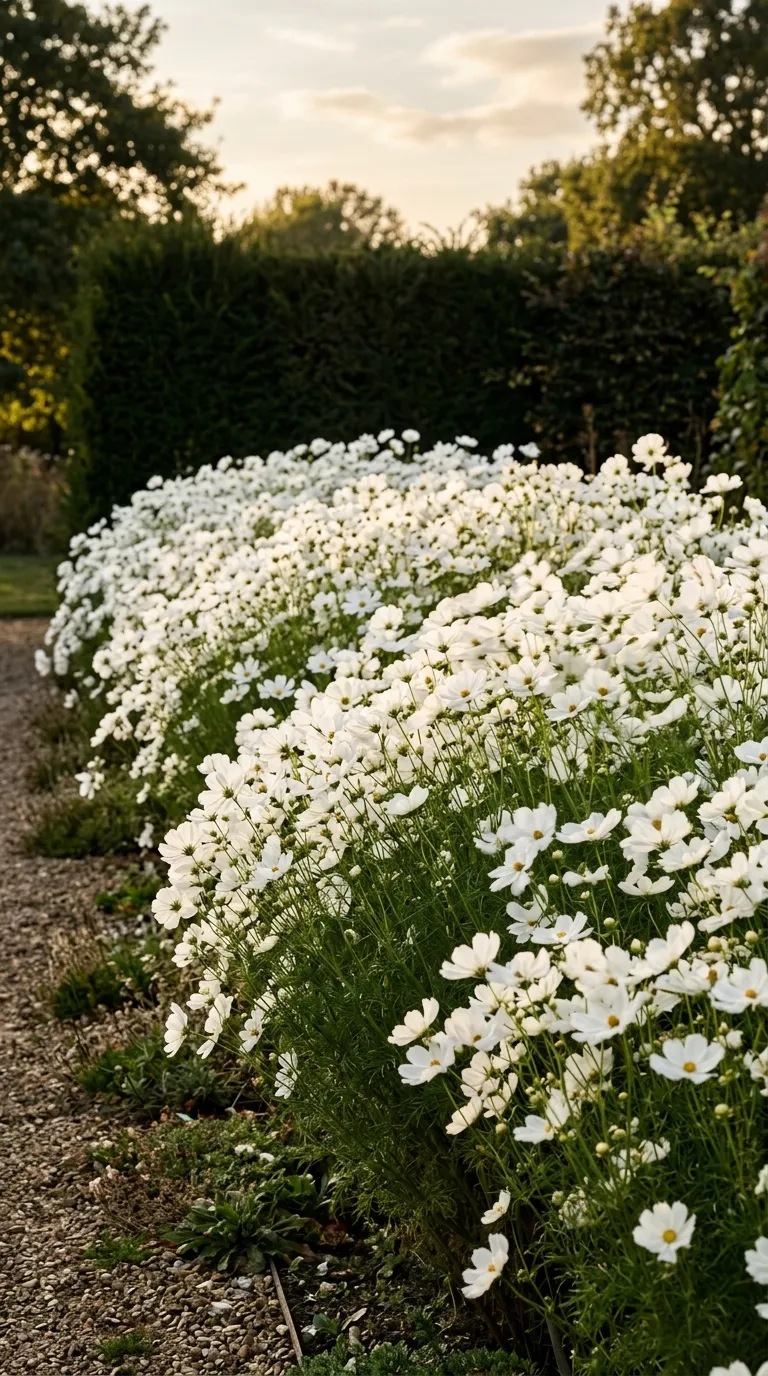
The border shown here is one plant, repeated: white cosmos, sown thick along the edge of a gravel path, with a dark hedge behind and the light already flat.
That flat light is the whole point of a white planting. Colour needs direct sun to read; white does not. At dusk a white flower keeps reflecting whatever light is left, so the border stays visible for another half hour after everything else has gone grey. Put white against a dark yew or box hedge and the contrast does the rest.
Cosmos bipinnatus ‘Purity’ is the one to sow. It reaches about 1.2 metres, it self-seeds hard once it is happy, and a £3 packet scattered in late May will give you this by August. For a long run of path it is also the cheapest option, because you are buying seed and not plants.
Two qualifications. Cosmos wants full sun and will sulk on less than six hours of it. And white on its own can read as a gap instead of a scheme at midday, so this is a border for the evening.
What a wall tells you about aspect
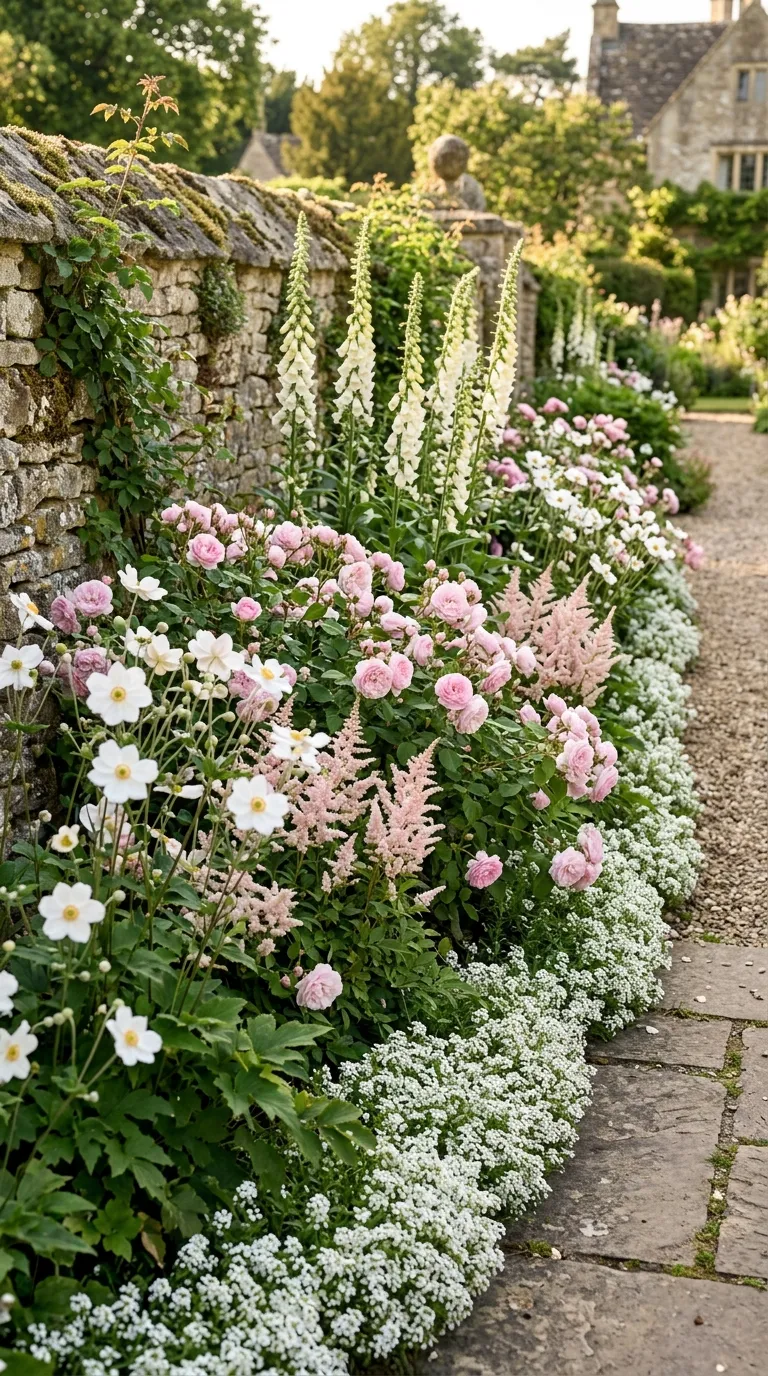
Everything in this border grows in the strip between a stone wall and a gravel path, which is about as narrow and as dry as a border gets. That it looks like this is a lesson in reading a site before buying anything.
Look at the front edge first. The white froth along the flags is sweet alyssum, and it is there because the soil at the edge of a path is the driest and leanest part of the bed. Behind it, pink astilbe and white Japanese anemones want the opposite: moisture, and shade for part of the day. Both are in the same 90cm of ground because the wall holds water at the back and the path drains the front.
The foxgloves are the giveaway. Digitalis purpurea self-seeds into any gap it can reach, and here it has colonised the foot of the wall, which tells you the wall faces away from the worst of the sun and stays damp. A foxglove will not do that on a hot south-facing wall.
So the method is not to choose plants and then look for room. Watch one bed for a day, note where the shadow falls at ten and at four, and where water stands after rain, and the planting list writes itself. A pH test kit costs about £8 and settles the other half of it.
The cottage mix that holds together
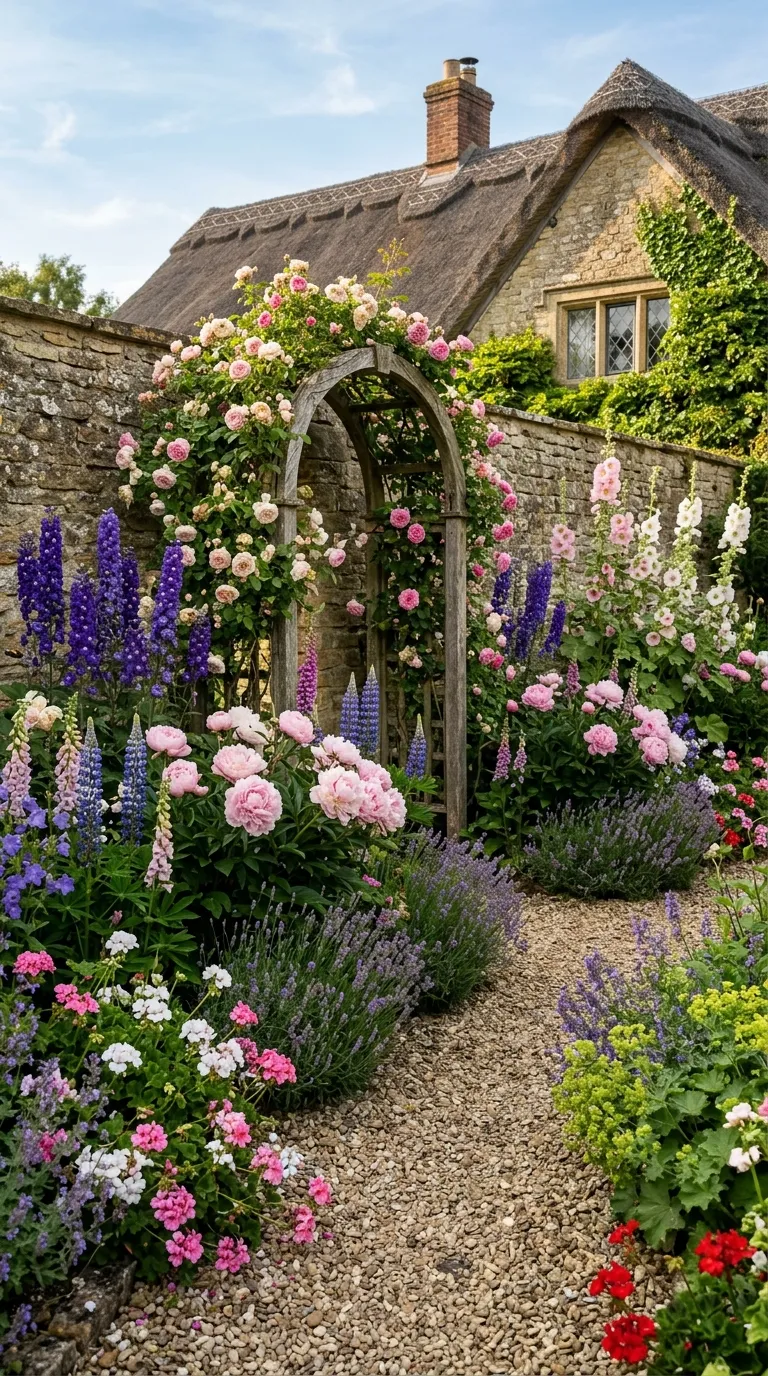
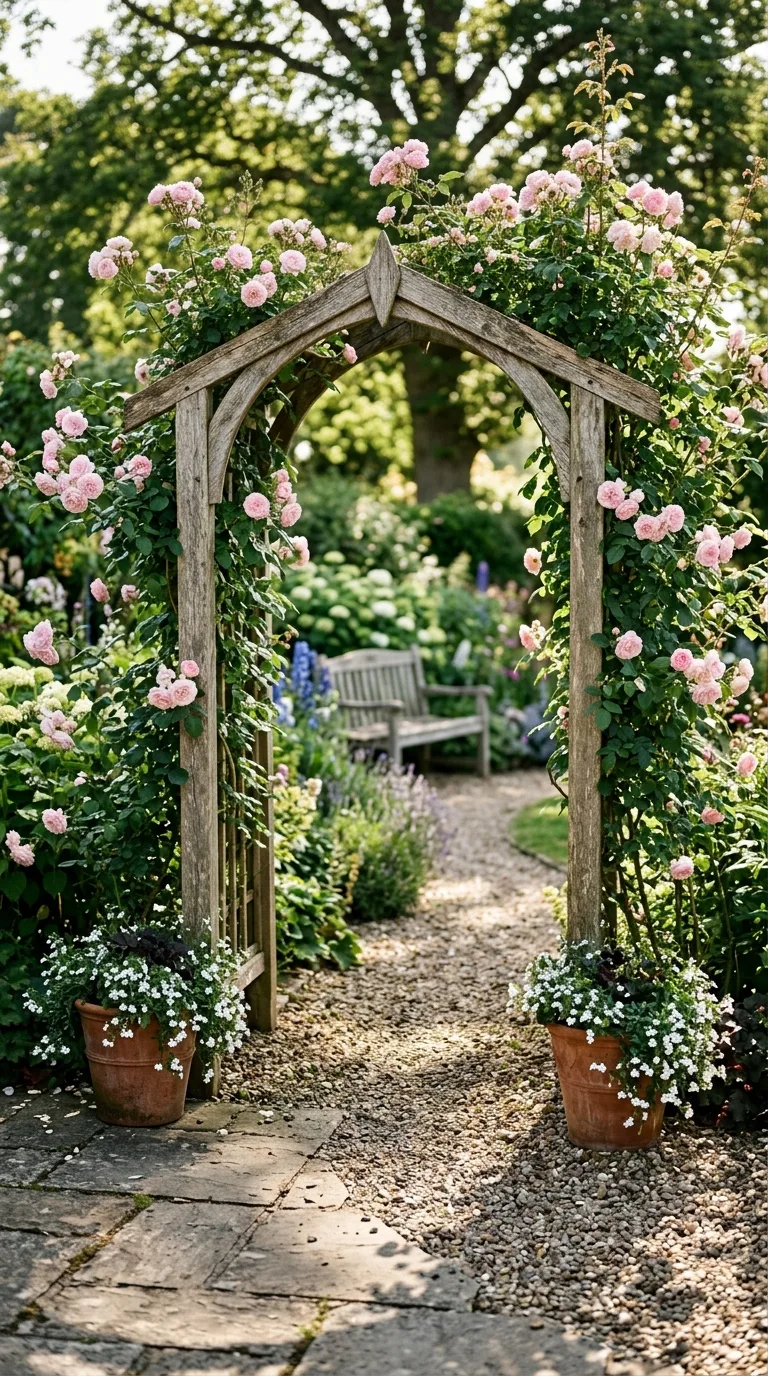
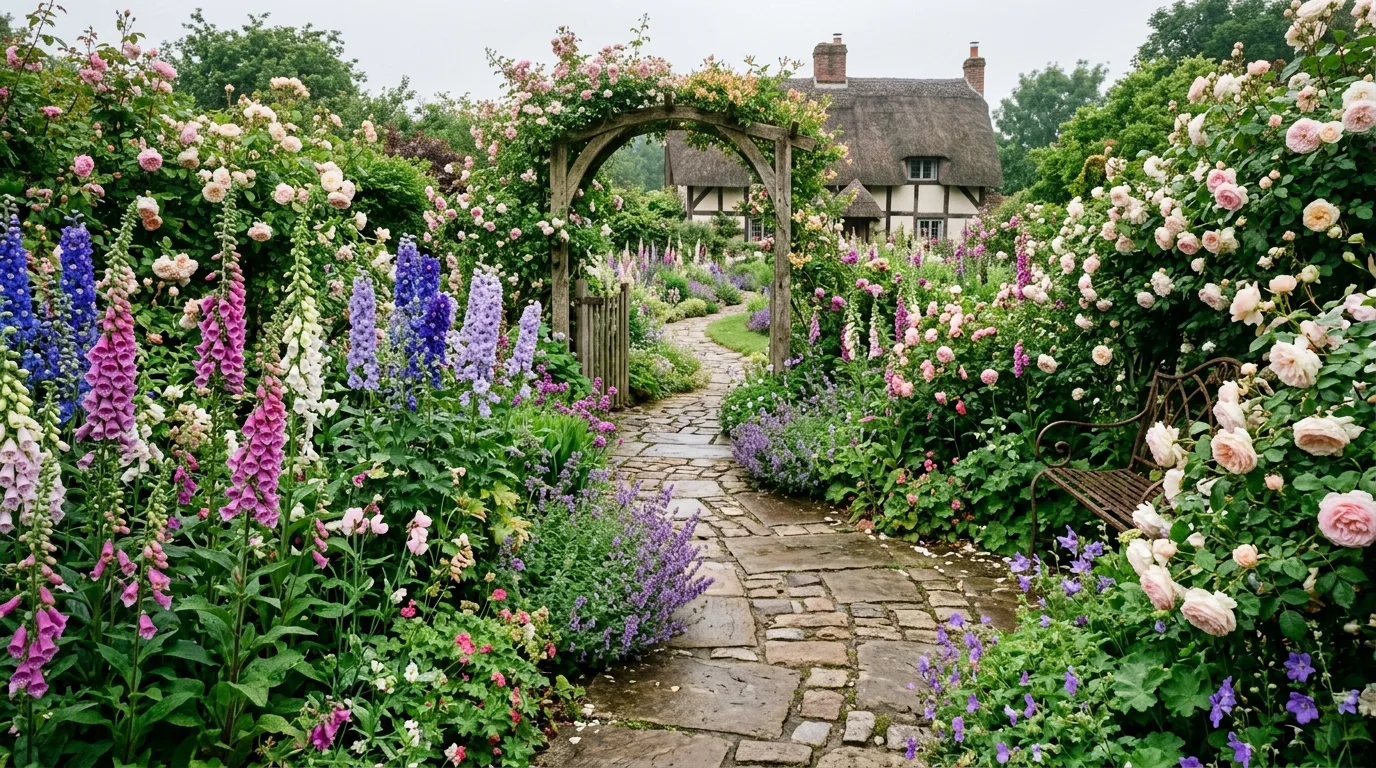
A cottage garden looks as though it happened by itself. The garden shown here did not, and the giveaway is the arch. Everything in the frame is arranged so that you walk under the roses and then along a path with something in flower from ankle to shoulder height.
The mix is doing two jobs. Delphiniums and lupins give the vertical, peonies and roses give the mass, and lavender and hardy geraniums hold the front edge so that no bare soil shows anywhere. Bare soil is what makes a planting of this kind look like a collection of separate plants.
To copy it, work in three depths and repeat. Tall spires at the back, big round flowers in front of them, a low grey or green edging along the path, then the same few plants repeated down the whole run. Six or seven varieties used repeatedly will do more than 20 used once. Delphinium ‘Pacific Giant’, Paeonia lactiflora and Lavandula angustifolia ‘Hidcote’ will build most of it.
The honest cost: a cut-back every fortnight through summer, a stake for every delphinium, and a fortnight in August when the whole thing looks tired. Budget an hour a week, and do not expect it to look after itself.
Where this does not apply
Established shrub borders and around trees, where wood chip is the right mulch and the nitrogen effect is negligible because the roots are well below the surface layer.
And gravel gardens, where the whole point is a lean, free-draining surface that discourages the growth compost would encourage.
Frequently asked
Frequently Asked Questions
Does wood chip really rob a new plant of nitrogen?
Only in the layer it touches, and only while it is rotting. The effect is strongest in the first season and fades as the wood breaks down. A shrub has roots well below that layer and never notices it. A plug has almost all of its roots in that same top layer, which is why it stalls.
What is the best mulch for a bed of annuals?
Garden compost or well-rotted manure, spread about 50mm thick. Both feed the soil as they break down, so the plants get back the nitrogen the mulch is using. Leaf mould is a gentler option for seedlings and woodland planting. Save bark and wood chip for paths, trees and shrub borders.
Why do my zinnias keep getting mildew?
Airflow, more often than disease. Zinnias crowded closer than about 30cm, or watered over the top in the evening, sit in still humid air and the leaves go grey. Water the soil at the base in the morning, thin the rows, and look at a mildew-resistant series such as Zahara or Profusion.
How many of each flower should I plant?
Enough that the group reads as one shape. For most perennials that means five to nine plants of the same variety, set in a flowing patch. For annuals sown from seed, a whole packet scattered over one area. One of everything is the mistake that leaves a border looking thin.
Which flowers give the most scent for the least space?
Sweet peas, night-scented stock and white petunias, all of which smell strongest after dusk. Put them where you walk or sit rather than where they look best from the house. A single pot at a door will scent more of your day than a whole border further off.
Can I sow cosmos and zinnias straight into the border?
Cosmos, yes, once the soil is above about 12C in late May. Zinnias are less reliable from a direct sowing in a cool garden, so they are usually started in modules indoors in April and planted out after the last frost. Either way, thin them to 30cm to 45cm apart.
To start
- Mulch a new annual border with compost or manure, not fresh wood chip.
- Keep chip 100mm clear of every young plant, and water the plant in before the mulch goes down.
- Give a border one colour family, and repeat each plant in groups of five to nine.
- Build three depths: low at the path, mid in the middle, tall about two-thirds back.
- Deadhead repeat-flowering roses to a five-leaflet leaf, and stop in early September.
- Sow marigolds, nasturtiums and borage in bands along the vegetable beds.
- Put scent where you pass it, in a pot at the door, not a bed at the end of the garden.
- Read the site first: white flowers for dusk, damp feet for foxgloves, full sun for cosmos.
This article may contain affiliate links. We may earn a commission at no extra cost to you.