11 Warm Minimalist Decor Ideas Where Materials Do the Work

Add us as a preferred source to see more stories on Google.
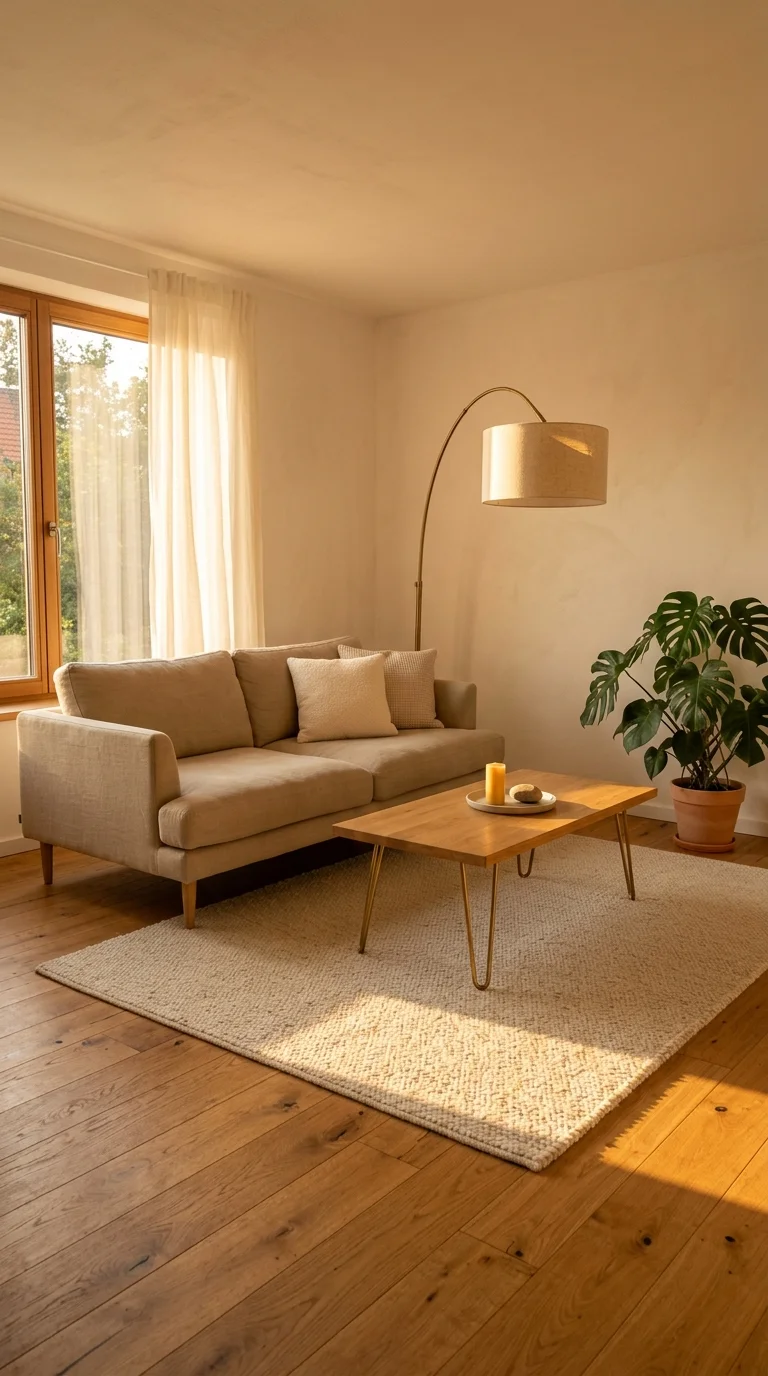
There is almost nothing in the room below, and it does not read as empty.
One sofa, one table, one lamp, one plant, one rug, two cushions, a candle and a bowl. The walls carry no art at all.
Now list the materials: oak floor, oak table, linen upholstery, jute rug, terracotta pot, brass lamp stem, linen curtain. There is no white in that room, no grey, no chrome, no glass and no concrete.
That is the whole difference between this and the minimal room people actually end up with.
Why the material matters more than the count
A room with six objects in it is not automatically calm. It is calm when the six things it does have are pleasant to look at and made of something the eye enjoys.
Warm materials do that because of how they handle light. Oak, linen and jute all have broken surfaces that scatter light and produce thousands of tiny shadows, which the eye reads as softness. Glass, polished concrete and powder-coated steel reflect evenly and read as hard.
Strip a room back to six objects in hard materials and you have removed the things that were compensating for them.
A working palette
| Element | Warm version | The cold default to avoid |
|---|---|---|
| Floor | Oak, terracotta, seagrass | Grey laminate, polished concrete |
| Upholstery | Linen, wool, cotton in oatmeal | Grey bouclé, black leather |
| Rug | Jute, sisal, undyed wool | Flat grey pile |
| Table | Solid timber | Glass, black metal |
| Lighting | Brass, paper, fabric shades | Chrome, black metal, exposed bulb |
| Pots | Terracotta, unglazed stoneware | White ceramic, concrete |
| Walls | Warm off-white, limewash, plaster | Brilliant white |
Brilliant white is the one to reconsider first. It is the default minimal wall, and it is a manufactured colour with no warmth in it at all.
Warm off-whites worth testing: Farrow & Ball Pointing and School House White, Little Greene Slaked Lime, Benjamin Moore White Dove OC-17. For a plaster or limewash finish, Bauwerk Colour and Pure & Original both make them, at roughly £60 to £90 for 5 litres against £25 to £40 for a good trade matt.
For the furniture, the useful brands sit across a wide range: Vitsoe and Carl Hansen at the top, Loaf and Nkuku in the middle, and IKEA’s solid oak ranges at the bottom, all of which give you timber rather than laminate.
The sofa carries the temperature
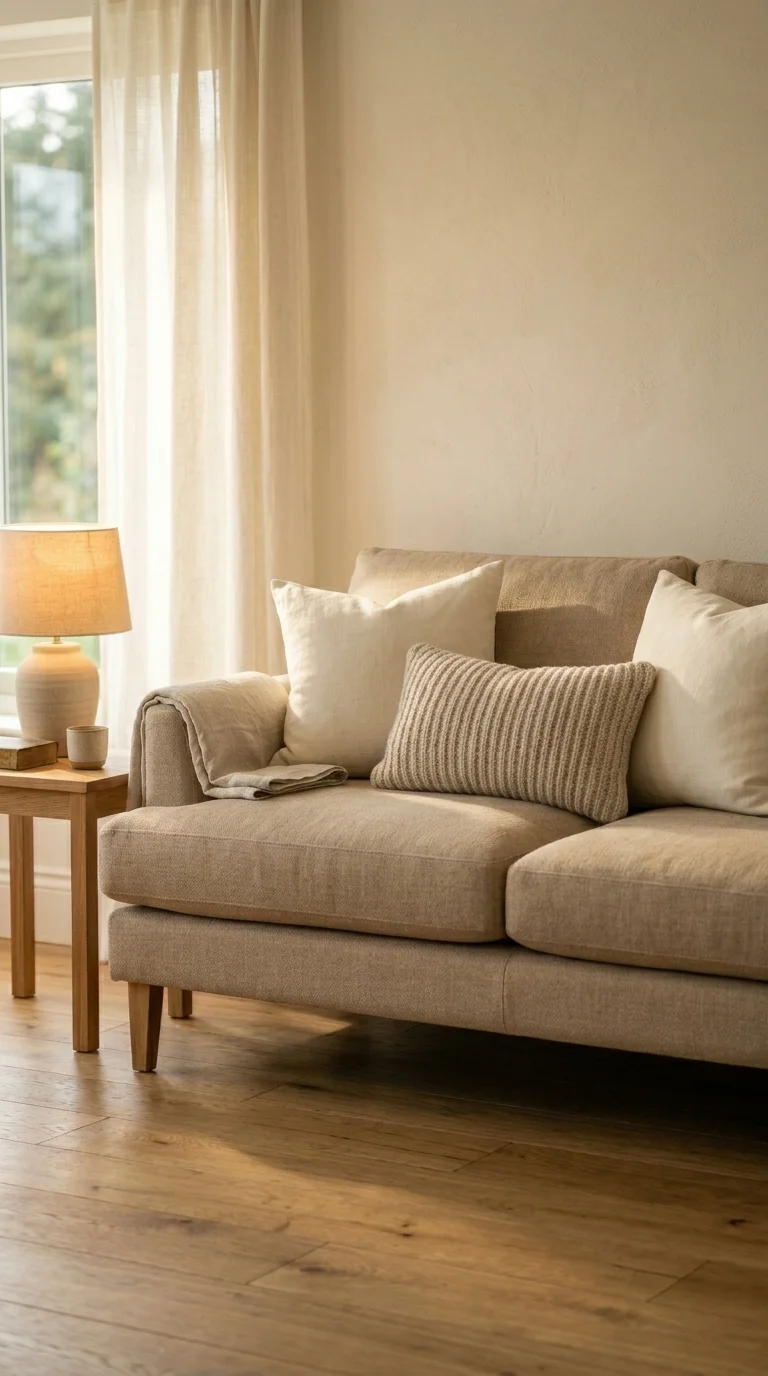
The largest object in a sitting room sets how the rest of it reads, and here that object is a linen sofa in a colour somewhere between oatmeal and sand. The weave shows across the seat, two cushions are plain ivory, the third is a narrow rib, and a heavier grey-taupe throw is folded over the arm.
Look at the arm nearest the light. It is not one flat colour: cream along the top of the roll, biscuit in the shadow underneath, because flax is spun unevenly and the cloth catches light at a hundred angles. A tight polyester weave cannot do that. The unevenness is the point of the cloth.
The cushion pile repeats the idea, three weaves inside one narrow colour range with no print anywhere, because where a room holds few objects texture is the only variation left. The legs matter as much as the fabric: a skirted base turns a sofa into a block, while four tapered legs let the boards run beneath it. Oak or beech, oiled and not lacquered, stays in family with the floor. Linen at this grade runs £1,200 to £3,000 for a three-seater in 2026.
Five tones, and every one is a material
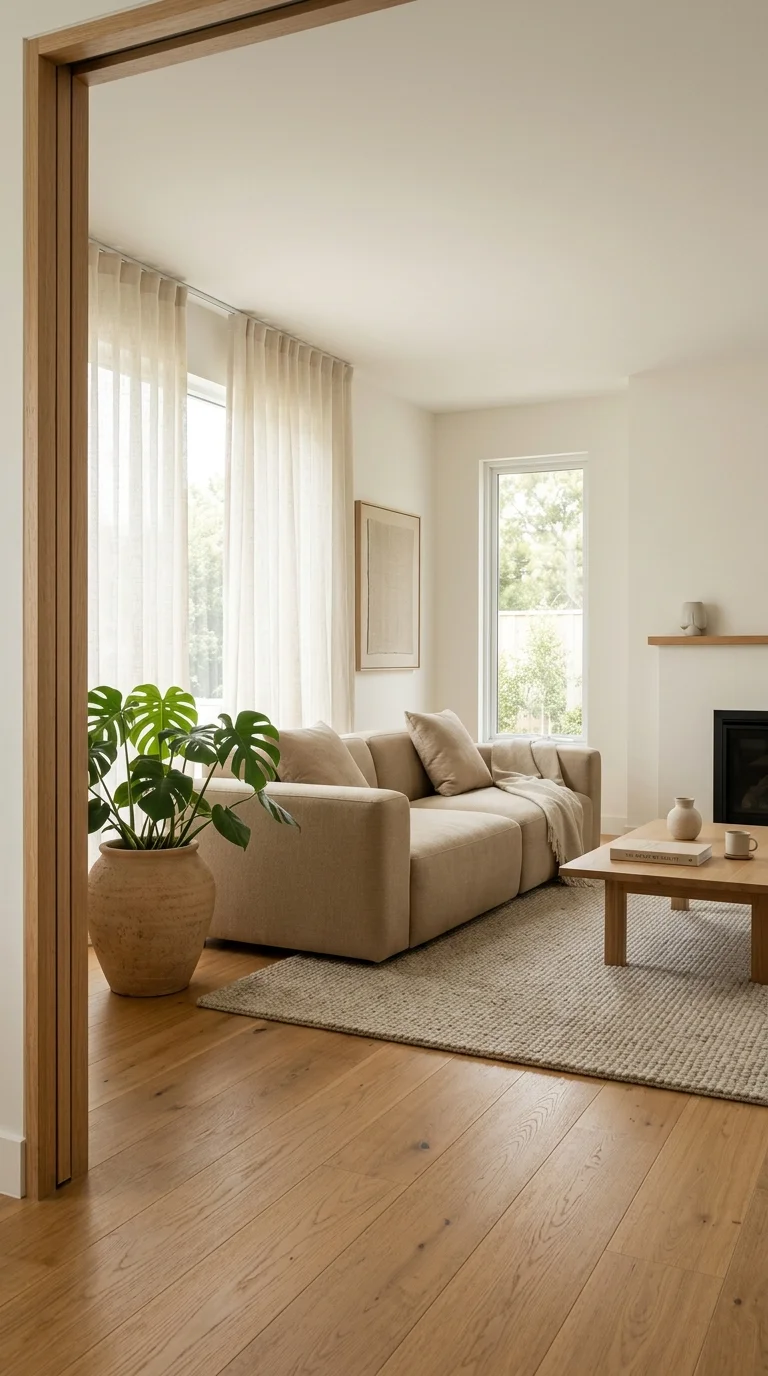
Count the tones in this room and you will find about five: cream on the walls, oatmeal on the sectional, the pale brown of a chunky jute rug, honey oak underfoot, and the warm grey of the plaster around the fireplace. The fifth is easy to miss because it sits behind the sofa, but it is there.
None of those five is a colour decision made at a paint counter. Four are materials: wool, jute, timber, and unglazed terracotta in the urn by the window. That is why the room holds together. The tones were never chosen one by one; they arrived attached to the things that carry them.
The oak door casing in the foreground frames the view and repeats the floor, so the eye enters through timber and finds timber again. The framed print above the sofa is a pale wash in the same band, and its frame is thin timber too.
The one dark note is the fire inset, black and rectangular. It reads as a hole, not as a colour, and a timber shelf sits directly above it, which is what keeps it from going cold.
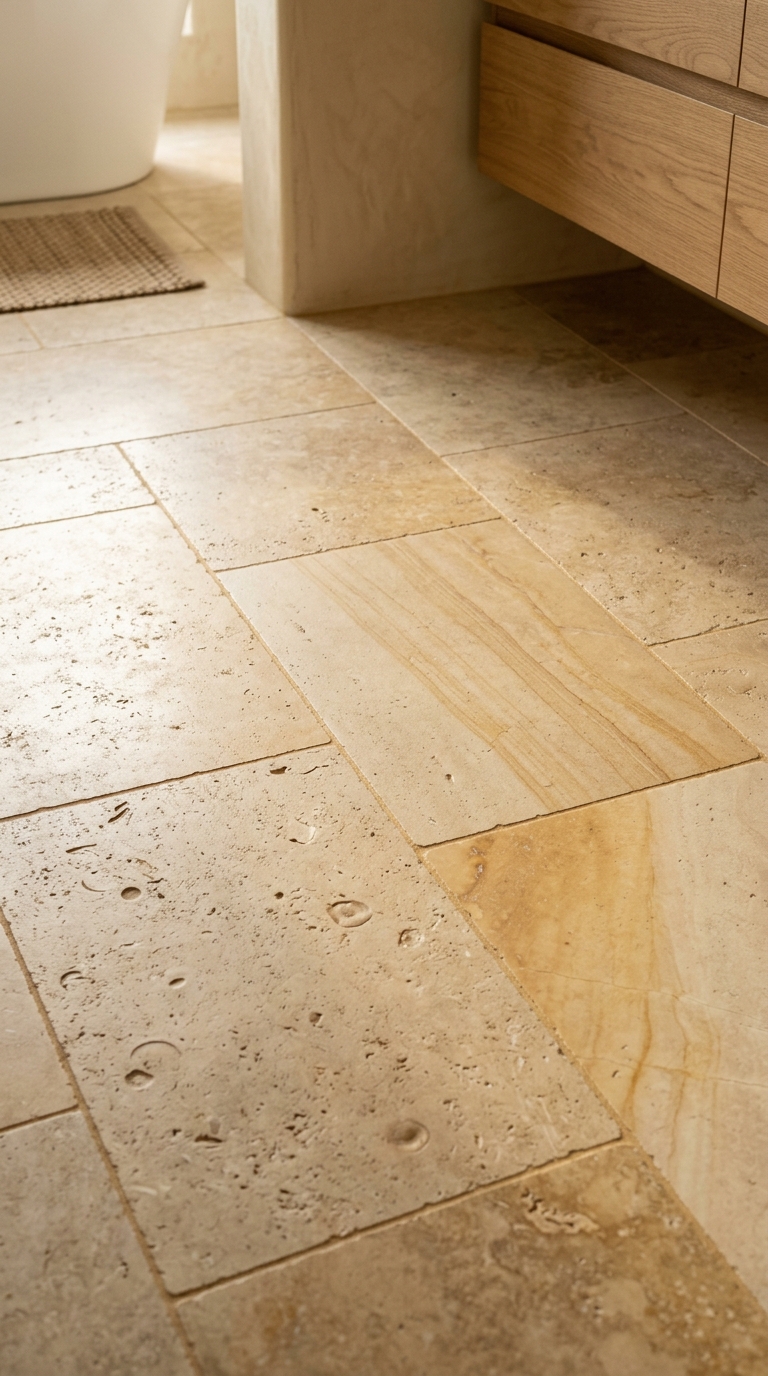
Stone can be warm when it is matte
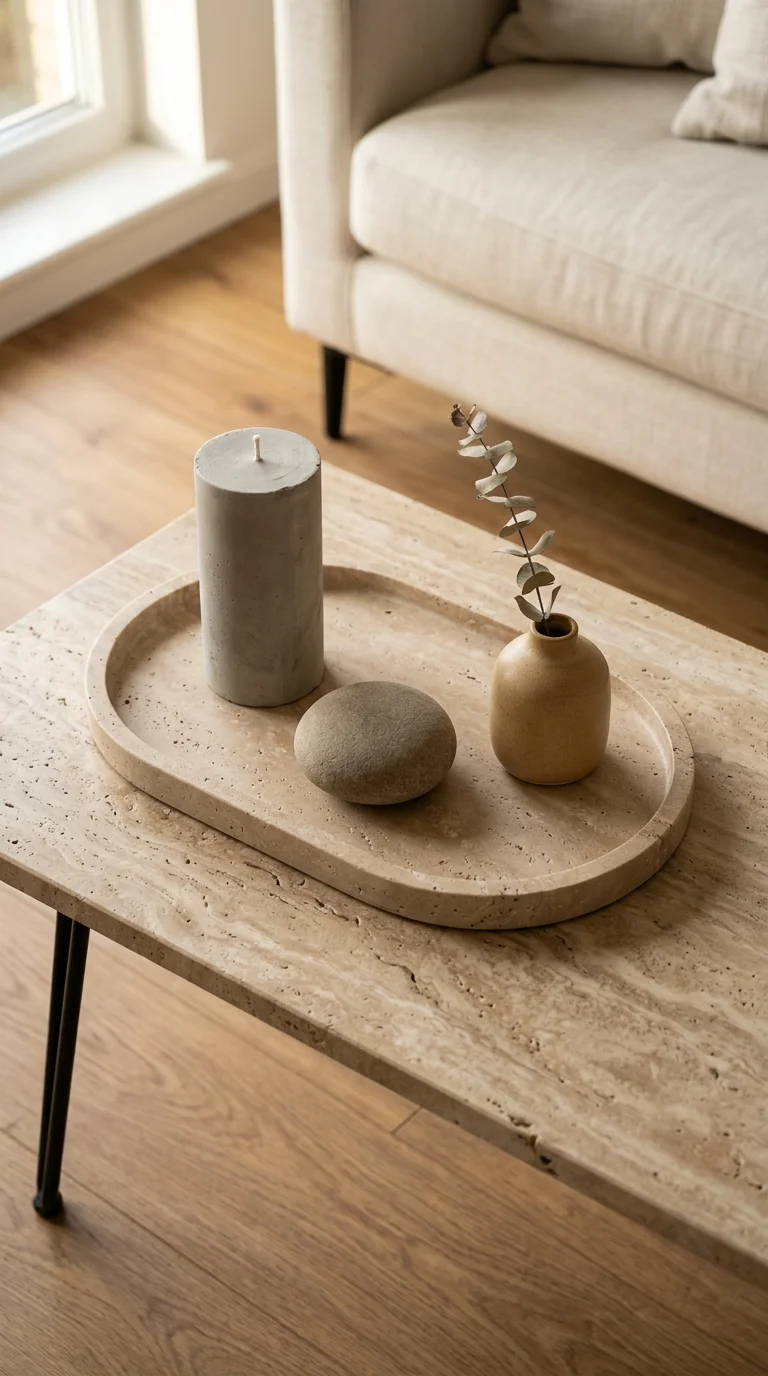
The table is travertine, and so is the tray sitting on it. Both are honed, which means matt and faintly pitted, not glossy, and that is why a grey object can live in a warm room without spoiling it. The tray’s rim shows why: the surface is full of small holes and soft shadows, and the light breaks across it instead of bouncing off.
The three things inside are a pillar candle in pale grey, a smooth grey pebble, and a small ochre vase with one eucalyptus stem. Two of the three are grey, which sounds like a mistake in a warm room. Both are matte stone, and that is what saves them. Grey in glass or polished chrome reflects the room back at you and reads hard; grey in unglazed concrete or river stone absorbs light and reads as another mineral.
The ochre vase does the colour work for the whole surface, and it is enough, because the table and the tray already carry the temperature. The legs underneath are thin black steel; brass hairpins would add a second metal story. Honed travertine at this grade runs £60 to £140 per square metre.
The shade is a material too
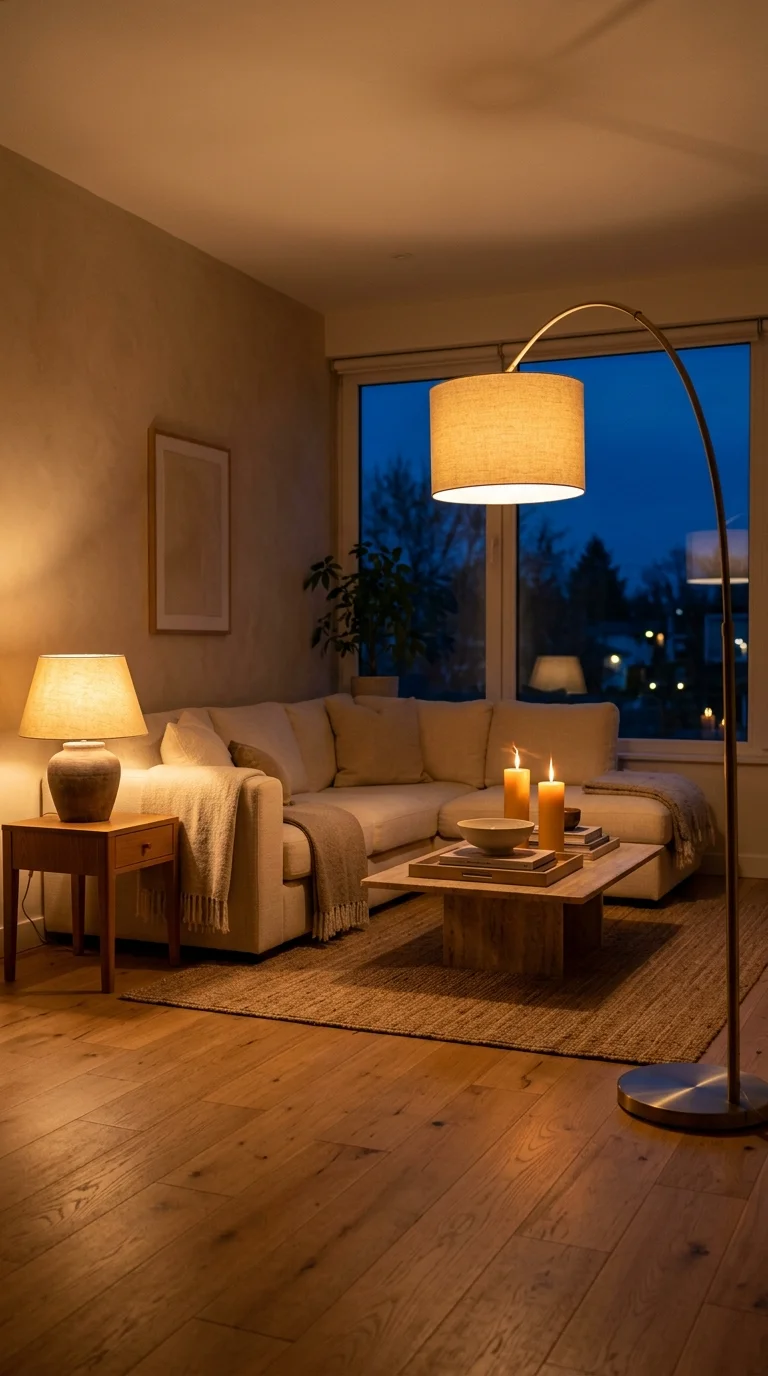
This is the first room again, after dark, and it is the version that decides whether the scheme works for most of the year. The window is deep blue, so there is no daylight left to flatter anything. Three sources carry it: a small table lamp on the timber side table, a tall arc lamp with a wide drum shade, and two candles on the coffee table.
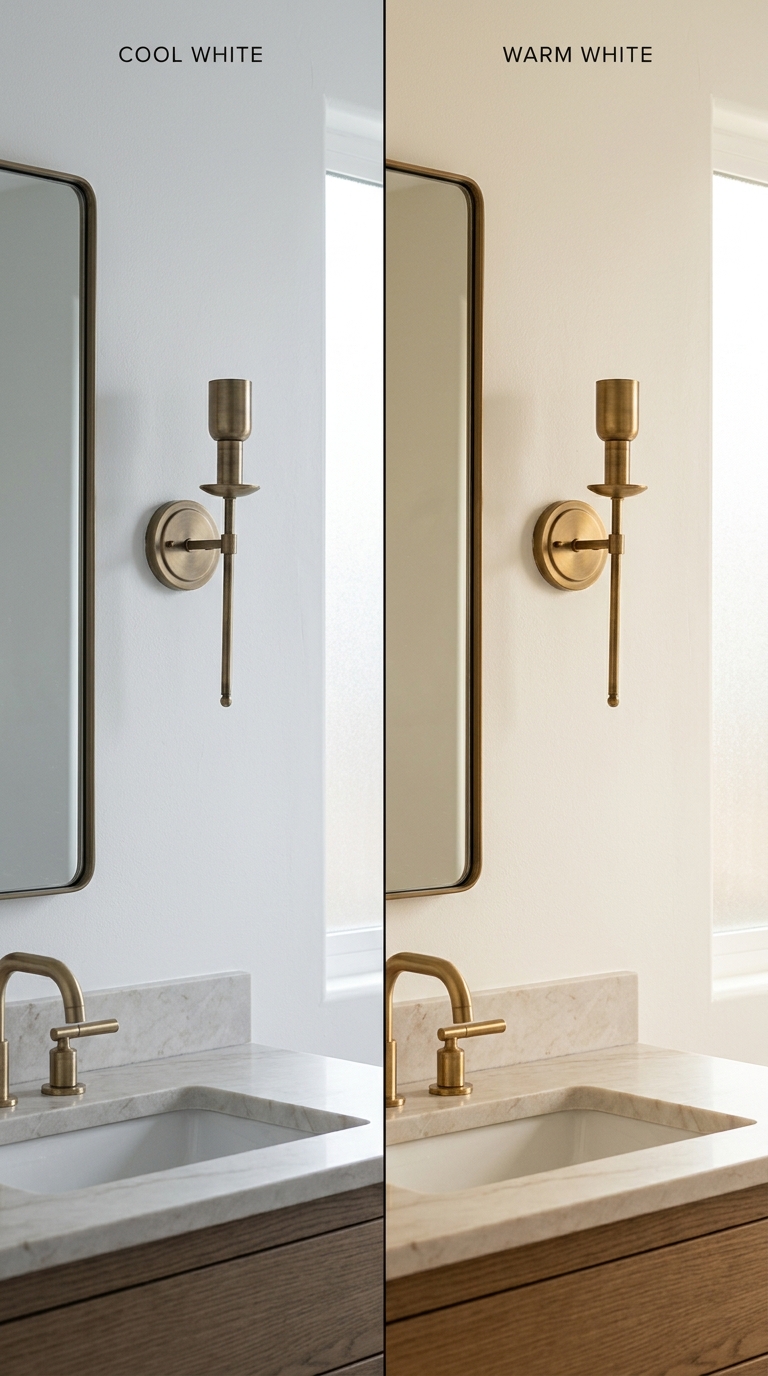
What makes it warm is the shade material, not the bulb alone. A linen or pleated cotton shade filters a 2700K lamp into a soft amber glow and throws it onto the wall behind. Swap that shade for grey paper or brushed steel and the identical bulb turns the corner grey, which is why the shade and the bulb are one decision. Tala and Philips WarmGlow both make warm dimmable filament bulbs; look for a colour rendering index of 90 or above.
Watch where the light stops. The arc lamp reaches the sofa back, the table lamp lights the arm and the throw, and the candles put a moving pool on the rug. Three heights, nothing overhead. A single ceiling fitting would flatten all of it and push the shadows downward.
One picture, and the frame around it
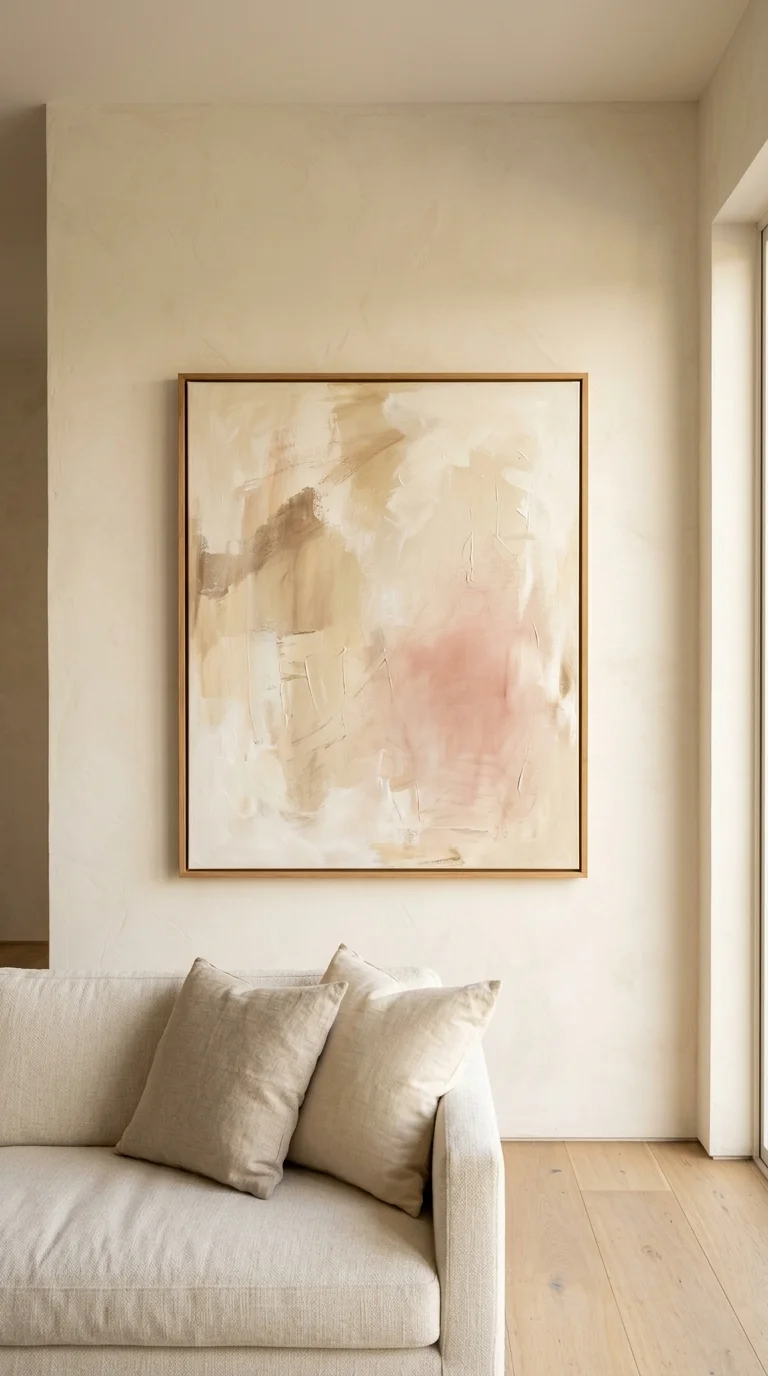
One picture, hung alone, on a wall with nothing else on it. The canvas is square and large, roughly the width of the sofa beneath it, and the paint is a pale abstract in cream, sand and tan with a single soft blush patch. The frame is thin, and it is timber, not black.
That frame is the decision to copy. A black frame would draw a hard rectangle around the picture and give the wall the only cool edge in the room. A gilt or moulded frame would bring its own period and its own shine. A slim pale timber frame does what the floor and the door casing do elsewhere: it repeats the warm material and then disappears.
The painting is warm because of its pigment, cream and sand and a blush that leans warm, not blue. A cool abstract at this size would undo the wall, and so would a hard black and white photograph. The canvas spans about two thirds of the sofa width, and its top edge sits well clear of the sofa back, which is the gap that stops a picture looking pinned to the furniture.
The rug is undyed, and that is the point
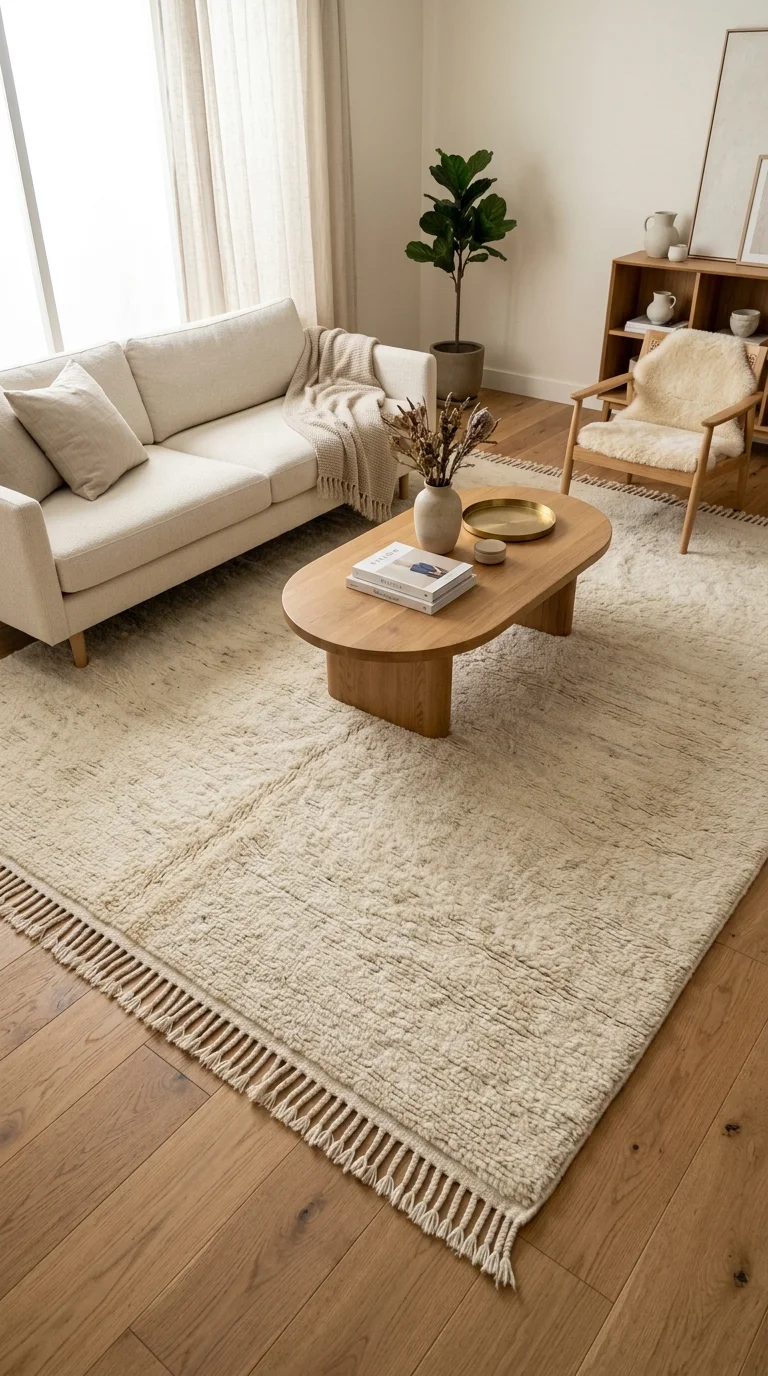
The rug fills most of the floor here, and its colour is the colour of the sheep, not a dye. Undyed wool is the warmest large surface you can put in a room, and it is also the one people skip. The pile is thick and slightly irregular, the knots show as small bumps across the field, and there is a fringe at the near edge.
Undyed wool reads warm for two reasons. The fibre itself is cream, ivory or a grey-brown depending on the breed, so it never carries the blue cast a dyed grey pile can. And a hand-knotted pile has a broken surface, so it holds light in the gaps between knots instead of reflecting it flat. A machine-made polypropylene in the same colour looks colder across a whole room.
The company it keeps is warm as well. The oval table is pale oak on chunky legs, the vase and the dish are unglazed ceramic, the tray is aged brass, and the chair by the shelf carries a cream fleece over its timber frame. The rug is the plane they all sit on.
Wool at this scale wants airing and shaking, not washing, and a pale undyed field shows every mark. That is the trade for the warmth.
| Fibre | What it does | Price band, 2026 |
|---|---|---|
| Undyed wool | Soft, springy, holds light | £300 to £900, 200 x 290cm |
| Jute | Coarse, flat, cheap | £60 to £120 |
| Sisal | Drier, harder underfoot | £120 to £250 |
Two weaves, one warm family
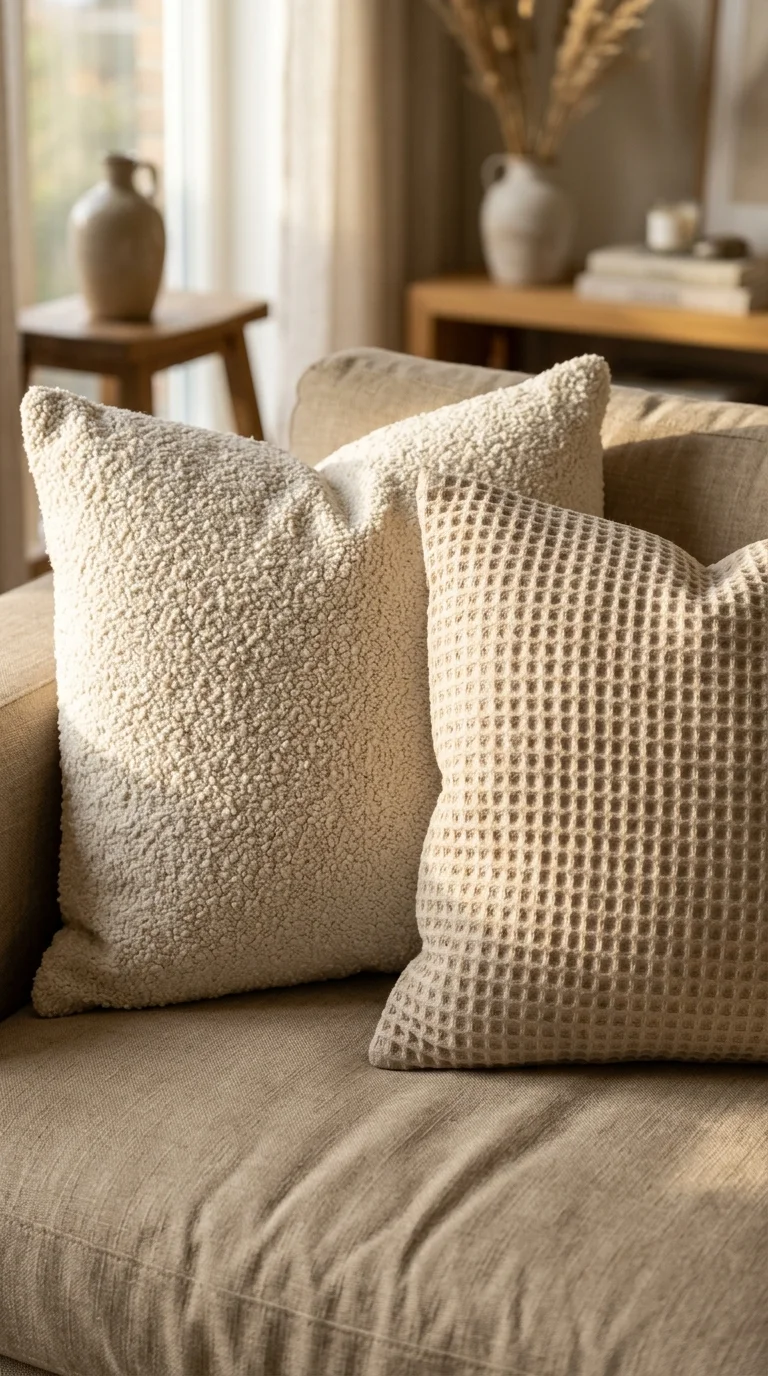
Two cushions, both in the same warm family, and the difference between them is entirely texture. The one on the left is bouclé, a cream loop pile that reads almost like fleece. The one on the right is waffle weave in oatmeal, a small grid of raised squares. Behind them sits a third in plain linen, a shade darker than the sofa.
This is what texture does in a room with no pattern. Bouclé catches light on the loops and drops it into the gaps, so the surface looks soft from any angle. Waffle weave does the opposite: the raised grid throws a tiny shadow into every cell, so the cushion reads as a small repeating pattern without a print being involved.
The failure is the printed cushion. A cover with a botanical print or a slogan introduces line and colour the rest of the room has deliberately avoided, and it becomes the loudest thing in a quiet space. If you want variation, change the weave, not the picture. Bouclé in a wool blend runs £25 to £60 each, a heavy linen cover £20 to £45, and a feather and down insert £8 to £20.
Oak, ceramic and terracotta on one board
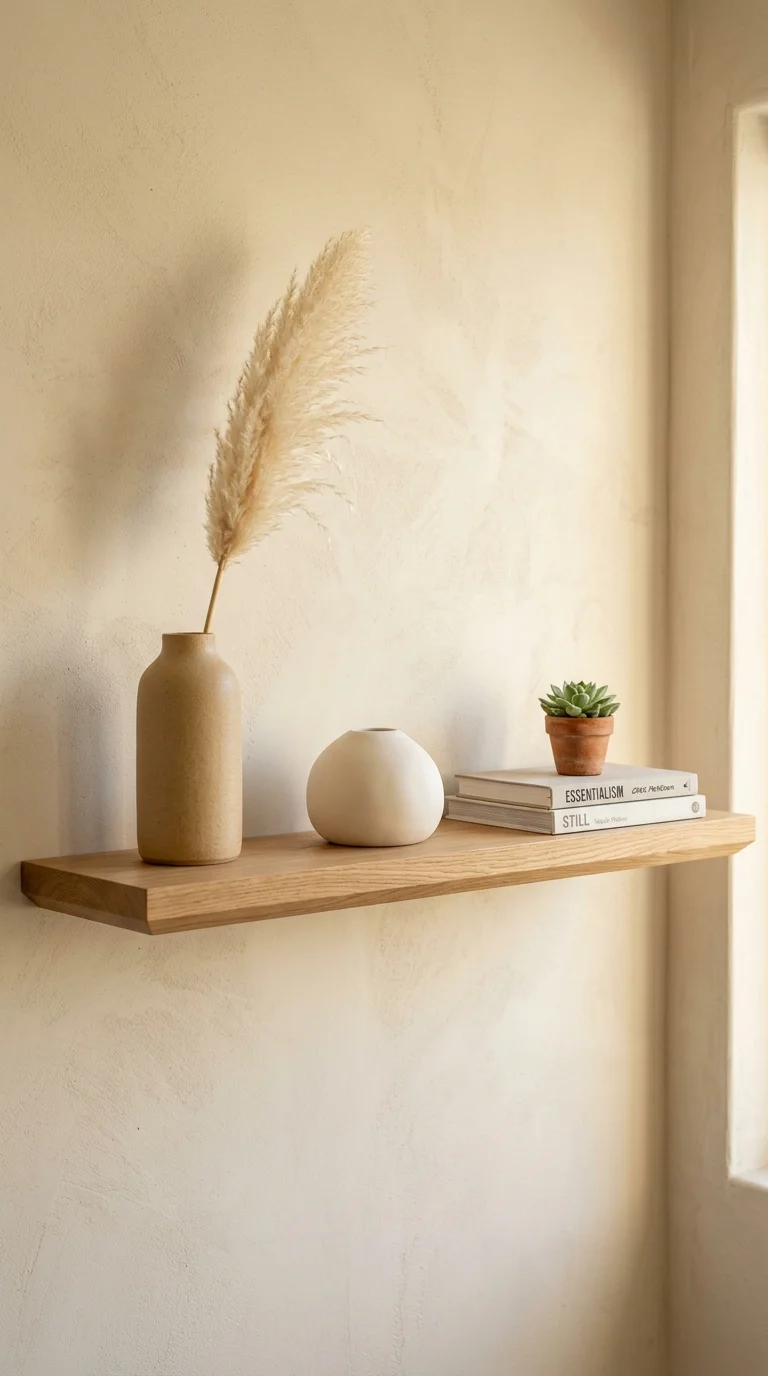
A single oak shelf on a plaster wall, and three objects spaced along it. On the left, a sand-coloured ceramic bottle holding one dried pampas plume. In the middle, a round cream vessel with a small opening. On the right, two paperbacks stacked flat with a tiny terracotta pot of succulent sitting on top.
The shelf itself is the warm material, and it is doing more than holding things. It is solid oak, thick enough to show its front edge, and the grain runs the length of the board. A thin painted MDF shelf at the same height would read as a line; a solid board reads as a piece of timber that happens to be attached to the wall. Floating fixings hide the brackets, so the shadow underneath is one thin dark line instead of a row of metal.
Everything on it is matte. Unglazed ceramic, terracotta, dried grass, paper. Four materials, none of them reflective. The wall behind is limewash in a warm off-white, and the plume throws a soft shadow up it, which is the only pattern in the frame. The two books give the group a small solid base and a horizontal line, which stops three upright objects reading as a row of bottles.
Linen gets better, and that is measurable
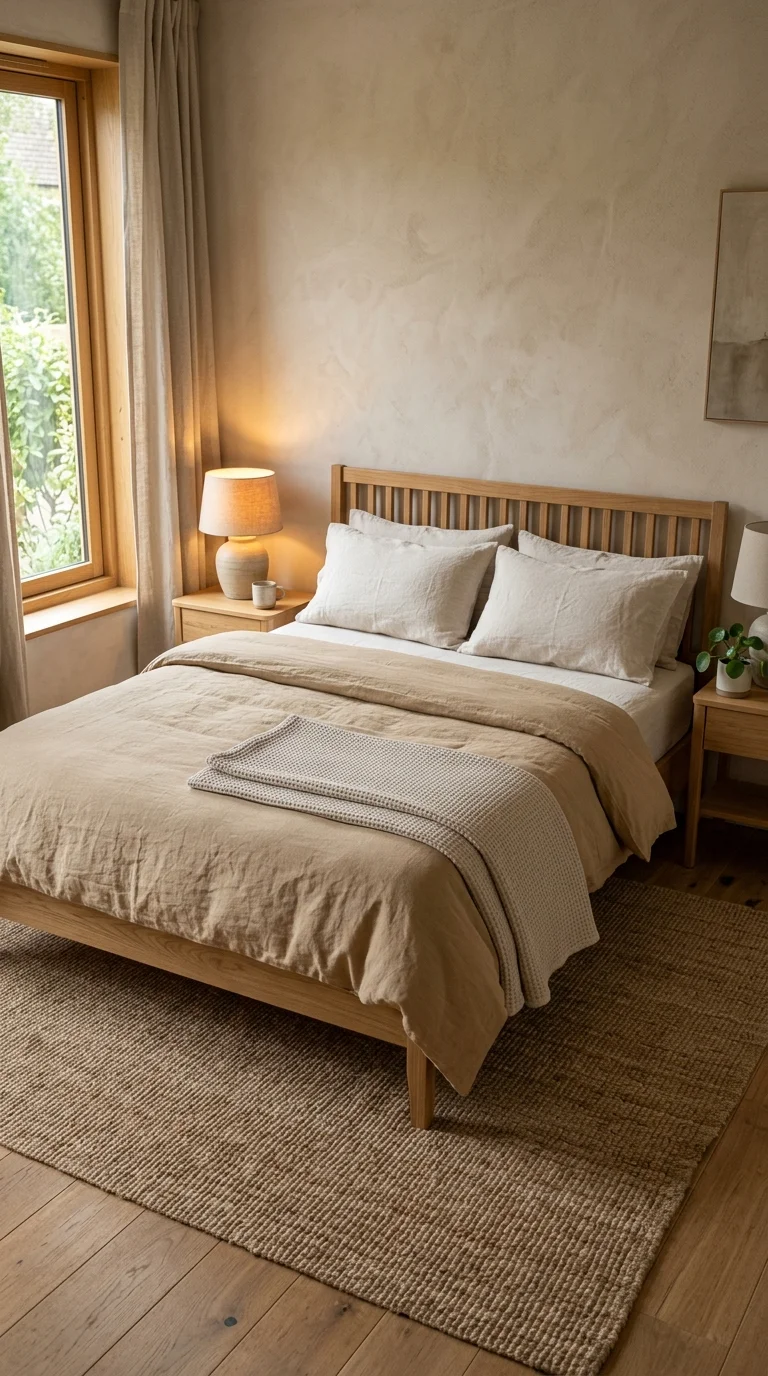
The bed is oak, with a slatted headboard and a low footboard on short legs, and everything on it is linen. The duvet is washed linen in a camel-oatmeal that sits between the pale pillows and the darker floor. A waffle throw is folded across the foot. Underneath, a jute rug on oak boards, and the walls are warm plaster grey, not white.
Washed linen is the one textile here that improves with use. Linen is a flax fibre, and every wash breaks the starch in the yarn a little further, so the cloth softens and hangs in looser folds. New linen looks slightly stiff and pressed. Three washes in, it has the rumple you can see here, and that rumple is why an unmade linen bed still looks deliberate. A cotton and polyester blend never does this, because the polyester does not relax.
The layers are few, which is the point: two pillows, a duvet in a linen cover, one throw. Where a bed carries three valances and five pillows, the eye stops reading material and starts counting objects. Washed linen bedding runs £150 to £400 for a double set in 2026, and it wants a cool wash and a line dry, because a hot tumble shortens the fibre.
What the leg does to the shadow line
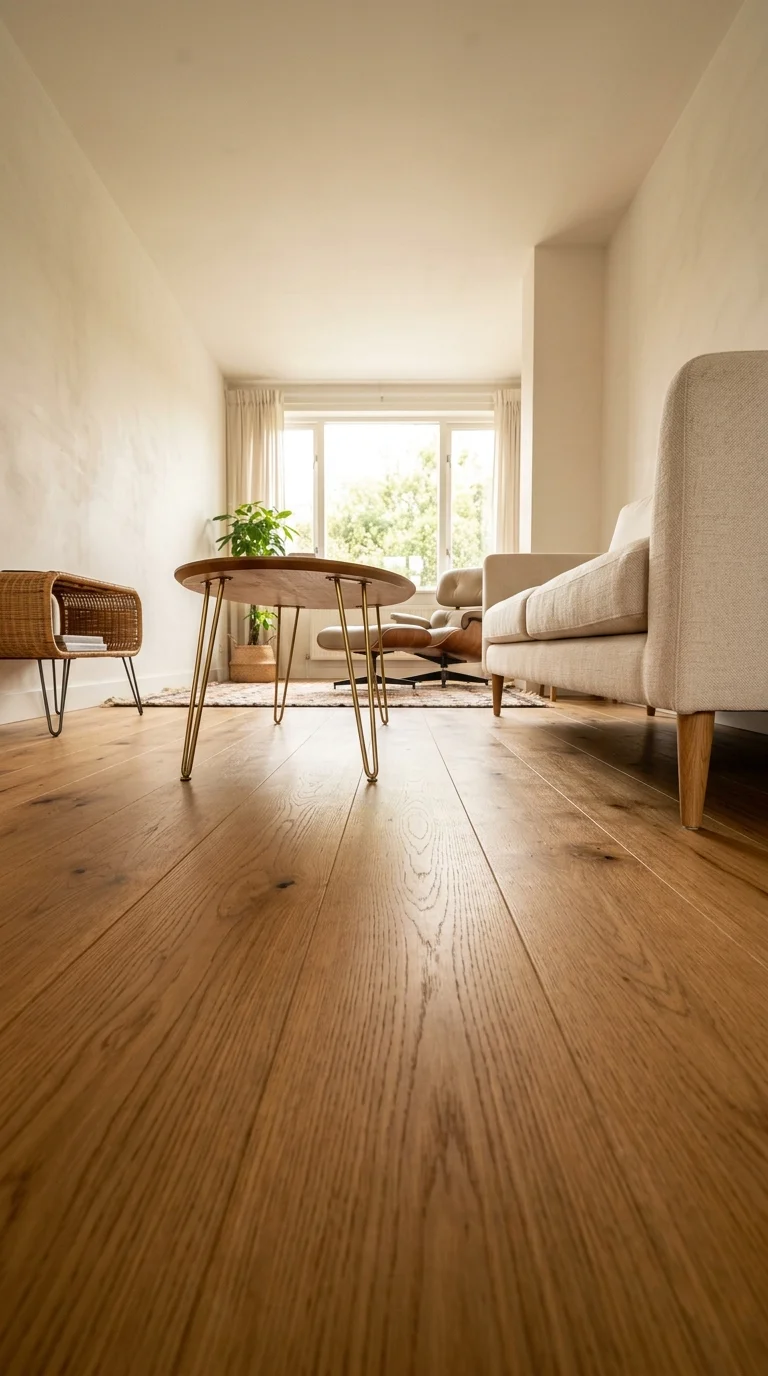
The camera is almost on the boards, which is the only height from which legs and their shadows can be judged. There are three kinds of leg in this frame. On the left, a cane side table stands on black steel hairpins. In the middle, a round pale oak table stands on brass hairpins. On the right, a cream sofa stands on four tapered timber legs.
What each does to the floor is different. The tapered timber leg under the sofa is thick at the top and narrows as it meets the boards, so it casts a soft, slightly blurred shadow that widens toward the floor and reads as warm. The brass hairpin under the table is a thin bright line; it barely shadows the boards at all, and from most angles it disappears. The black hairpins under the cane table throw the hardest shadow of the three, a crisp dark arc, and that is a graphic note in an otherwise soft room.
None of this is about making the room look larger, which is the usual reason given for legs. It is about what happens under the furniture once the room is cleared of clutter. A closed plinth removes the shadow line altogether and grounds a piece like a wall; a leg keeps a gap, and the gap is where the light and the floor get to show.
| Leg | Shadow line | Reads as |
|---|---|---|
| Tapered solid timber | Soft, wide, warm | Furniture |
| Brass hairpin | Thin, bright, almost none | Light and open |
| Black steel hairpin | Crisp, graphic, dark | A drawn edge |
| Closed plinth | None | A wall |
A set of four replacement tapered oak legs runs £35 to £70, and a brass hairpin set £20 to £40. Swapping them is a ten-minute job with a screwdriver, and it alters the temperature of a piece more than re-covering it would.
The light in that photograph
Worth being honest about, because it is the least reproducible part.
That is low, late afternoon sun raking across the floor and up the wall. It exaggerates the grain in the oak, the weave in the rug and the fold in the curtain, and it is doing a very large proportion of the work.
The same room at eleven on a grey morning is considerably flatter, and the bare walls that look serene in the photograph read closer to unfinished.
Two practical consequences. Bare walls suit rooms with good light and suit dark rooms badly, where one large piece of art earns its place. And in any minimal room, low lamps matter more than usual, because there is nothing else to catch the light in the evening.
The part nobody photographs
A room this empty has to have somewhere for everything else to be.
The books, the paperwork, the cables, the children’s things, the post. None of it has disappeared; it has moved into a cupboard in another room. Minimalism is not a low-effort style. It is a style that relocates the effort out of frame and then requires maintaining daily.
Anyone attempting it in a house without generous closed storage is attempting something quite different and considerably harder.
Where it genuinely suits
Rooms with something worth looking at that furniture would compete with: a good window, a fireplace, an unusual ceiling, a view.
And rooms used for one thing. A minimal sitting room in a house where the sitting room is also the office, the playroom and the dining room is a photograph rather than a plan.
Frequently asked
Frequently Asked Questions
Does a minimalist room have to be white?
No, and the white version is the one that usually fails. A warm off-white or a plaster finish keeps the same calm and gives the timber and the textiles something to sit against. Brilliant white is made, not found, and it carries no warmth, which is why an all-white minimal room so often feels like a waiting area.
What is the quickest way to warm a cold minimal room?
Change the light, then the largest textile. Replace any cool bulb with a 2700K one, then put a linen or wool throw over the biggest surface you own. Both are cheap and both are reversible, and together they shift the temperature more than a repaint does.
Which materials should I avoid in a minimal scheme?
Chrome, polished glass, grey laminate and anything powder-coated in black. They reflect light evenly instead of breaking it up, and they leave the eye nothing soft to rest on. Where you need a metal, unlacquered brass or aged bronze behaves far better.
Can I keep a grey sofa?
Only if the grey has brown in it. A greige sits happily beside cream and oak; a cool blue-grey fights them, and no cushion will settle that argument. Hold a swatch against the floor and against a linen cushion before you commit to it.
How many materials should a minimal room have?
Four or more, and at least two of them natural. The number of objects matters less than the number of materials, because a room with four warm surfaces reads calmer than a room with two objects in cold ones.
Do I need art on the wall?
One quiet piece if the light is good, and none if it is not. A bare wall suits a bright room and looks unfinished in a dark one. Where you hang something, choose a warm-toned image in a thin timber frame so it repeats the room instead of interrupting it.
To start
- Count materials, not objects: four or more, at least two of them natural.
- Replace every bulb with one warm temperature at 2700K and CRI 90 or above.
- Let linen, wool, jute and oak carry the colour, and keep the paint a warm off-white.
- Keep frames, legs and lampshades in timber, ceramic or fabric, never black metal.
- Choose matte over polished wherever a surface will catch the light.
- Swap brilliant white for plaster or limewash before you change anything else.
- Judge the room after dark, not only at midday, before you commit to anything.
This article may contain affiliate links. We may earn a commission at no extra cost to you.