12 Bohemian Decor Ideas: One Palette Applied to Many Things

Add us as a preferred source to see more stories on Google.
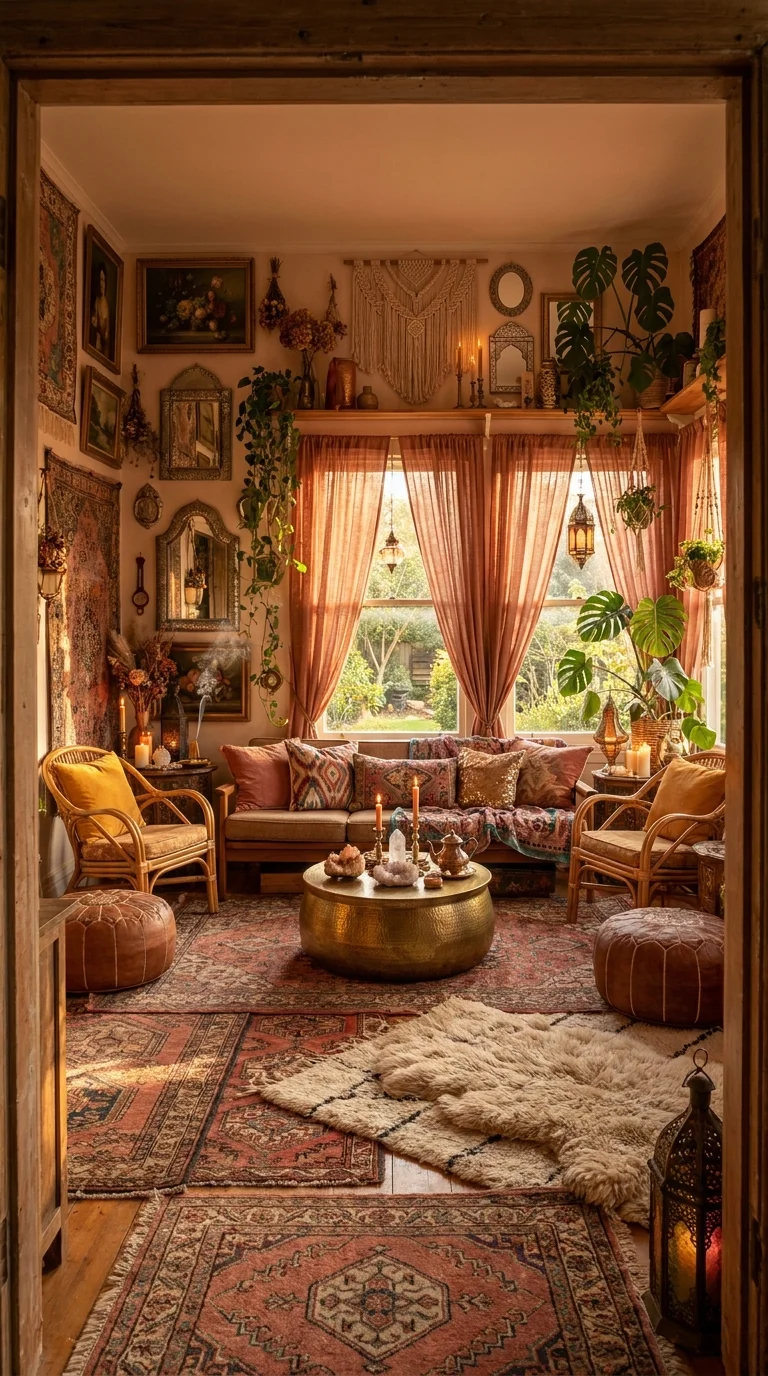
There is an enormous amount in the room below, and almost none of it is fighting.
Count what is actually there. Four overlapping rugs, a gallery wall of a dozen frames, a macrame hanging, three hanging lanterns, two rattan chairs, two leather pouffes, ten or so cushions, a brass table, several plants and about a dozen candles.
Now look at the colours. Terracotta, rust, ochre, dusty pink, cream, brass, and the green of the plants. That is the entire palette, and everything in the room is inside it.
Bohemian decorating is sold as freedom, and the rooms that actually work are among the most disciplined in the house.
The palette does the work
This is why collected rooms so often fail. Things are bought one at a time, each lovely on its own, and the room ends up holding a green kilim, a blue Moroccan pouffe, a grey sofa and a pink throw. Each is fine and together they have no conversation.
Pick a range before buying anything else. Terracotta and rust is the most common and the most forgiving. Indigo and cream is the other classic. Green, ochre and brown suits a darker room.
Then everything you add has to belong to it. That sounds restrictive and is actually liberating, because it means you can buy a great deal without the room ever tipping over.
The exception, and there is always one: a single object in a contrasting colour, deliberately. One is a full stop. Three is a different room.
Layering rugs, properly
Four rugs on that floor, and they work because two things are true.
They are in the same palette, so the overlaps read as depth , not as a collision. And there is a size hierarchy: one large flat rug underneath doing the groundwork, smaller pieces laid across it at angles, and a shaggy pale one in the middle as relief.
Practical notes, because this is the part that goes wrong in real houses. Put a non-slip underlay beneath the bottom rug and rug-to-rug grippers between layers; overlapping rugs slide and the edges curl, which is genuinely a trip hazard. Keep the top layers away from doorways where they will catch.
Sources that help: vintage Persian and Turkish rugs from eBay and local auctions start around £60 to £150 in 2026 for small pieces and are usually better value than new; Weaver Green and Nkuku sit in the middle at £180 to £450 in 2026 for flatweaves; a Beni Ourain or a good sheepskin is the pale relief layer, and a wool-look synthetic does that job at a fraction of the price.
Texture is the variety
With the colour locked down, the interest has to come from surface, and the room above is carrying a great deal of it: rattan, leather, wool, brass, macrame, glazed ceramic, dried flowers and plant foliage.
That range is what stops a single-palette room reading flat. The rule from any calm room applies here too, just with more of everything: something woven, something rough, something smooth, something with a sheen.
Brass is doing a specific job. It is the only reflective thing in the room, and it picks up every candle. A boho room in wholly matt materials looks dusty.
The lighting is not incidental
There is no ceiling light on in that photograph. There are three hanging lanterns, a dozen candles and the daylight through pink curtains.
Low, warm, multiple small sources. That is what makes the room feel like a cave in the good sense. An overhead bulb in the same room at the same time would flatten every texture and expose every surface, and the whole effect would go.
If candles are impractical, which for many households they are, small lamps at low level with 2700K bulbs do most of the same work. What does not work is one bright central light.
The floor as three layers, not one
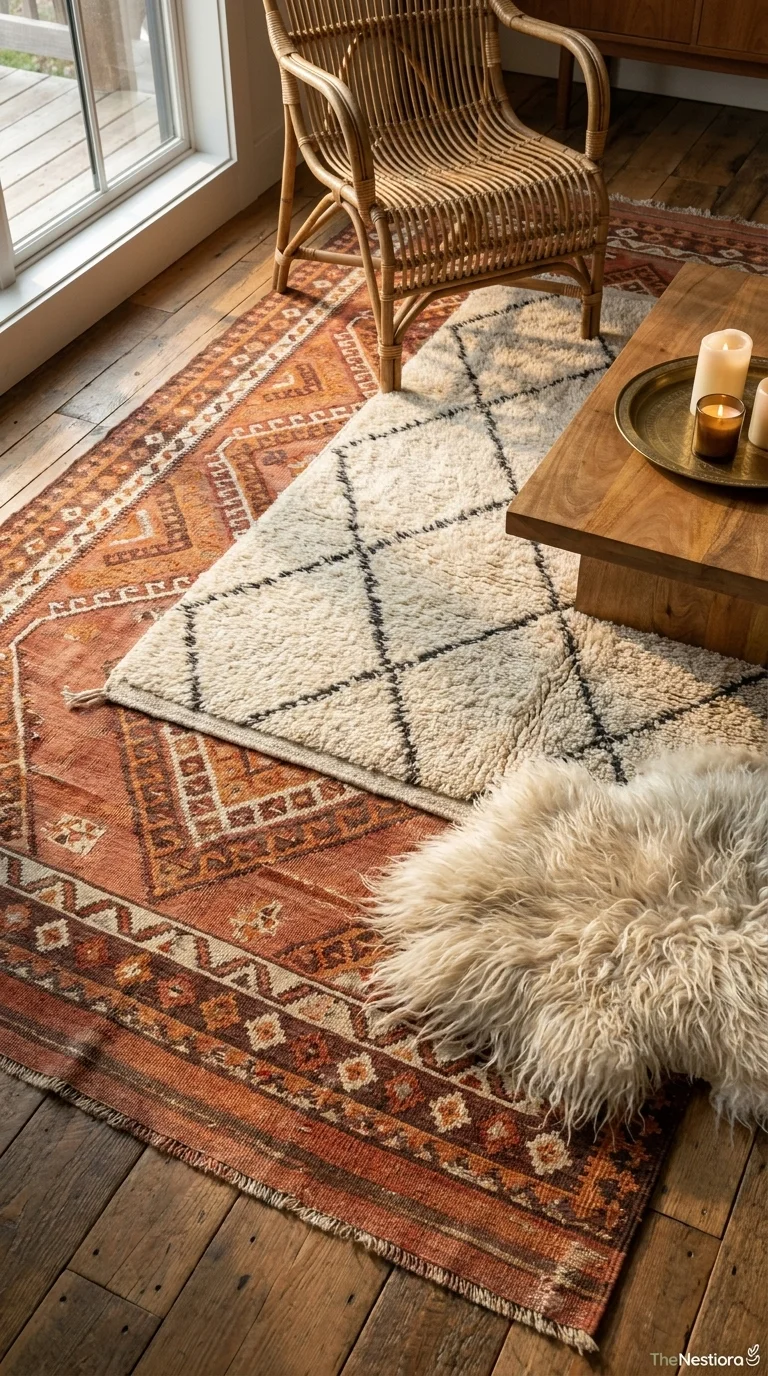
Look at the floor in this close view. The bottom rug is a flatweave kilim in terracotta and rust, the mid layer is a cream Beni Ourain with a loose black diamond lattice, and the top is a long-haired sheepskin that sits half on and half off the other two.
The scale is doing the work here, which is the principle behind the whole bohemian way of collecting. One large motif dominates: the kilim with its dense geometric border. Then a single medium motif answers it: the Beni lattice, which is a different geometry but the same two colours. Then the sheepskin supplies no motif at all, only texture.
That is why they read as collected, not matched. If the two rugs both carried a small dense pattern at the same scale, the eye would try to compare them and find them busy. Because one reads as ground and one as figure, and the third reads as fur, the group has a hierarchy.
To copy it, start with the kilim. Vintage Turkish and Persian flatweaves in this palette turn up often on eBay and Vinterior, where small runners sit around £60 to £150 in 2026 and larger 200 by 300 cm pieces run £220 to £480 in 2026. Look for a soft handle instead of a stiff print; handwoven wool has a slight irregularity that a machine-made copy never quite catches. Lay the Beni or a wool alternative across it at a slight angle so the overlap is visible, and keep a non-slip mat between layers. The sheepskin, which you can find new from Bazaar Velvet or second hand for £40 to £120 in 2026, goes last and slightly off centre, which is what makes it look casually placed , not arranged.
One warning that shows up in houses and not in photographs: layered rugs drift. A rug-to-rug gripper mesh, about £12 to £25 in 2026 for a roll, stops the creep that otherwise appears after a week of footsteps.
| Layer | what it does | typical ask in 2026 |
|---|---|---|
| Large kilim, flatweave | ground, dense border and central field | £220 to £480 for 200 by 300 cm |
| Medium Beni lattice | figure, loose diamond on cream | £180 to £450 for similar size |
| Small sheepskin | texture, no pattern, just relief | £40 to £120 |
A wall that grew over months, not an afternoon
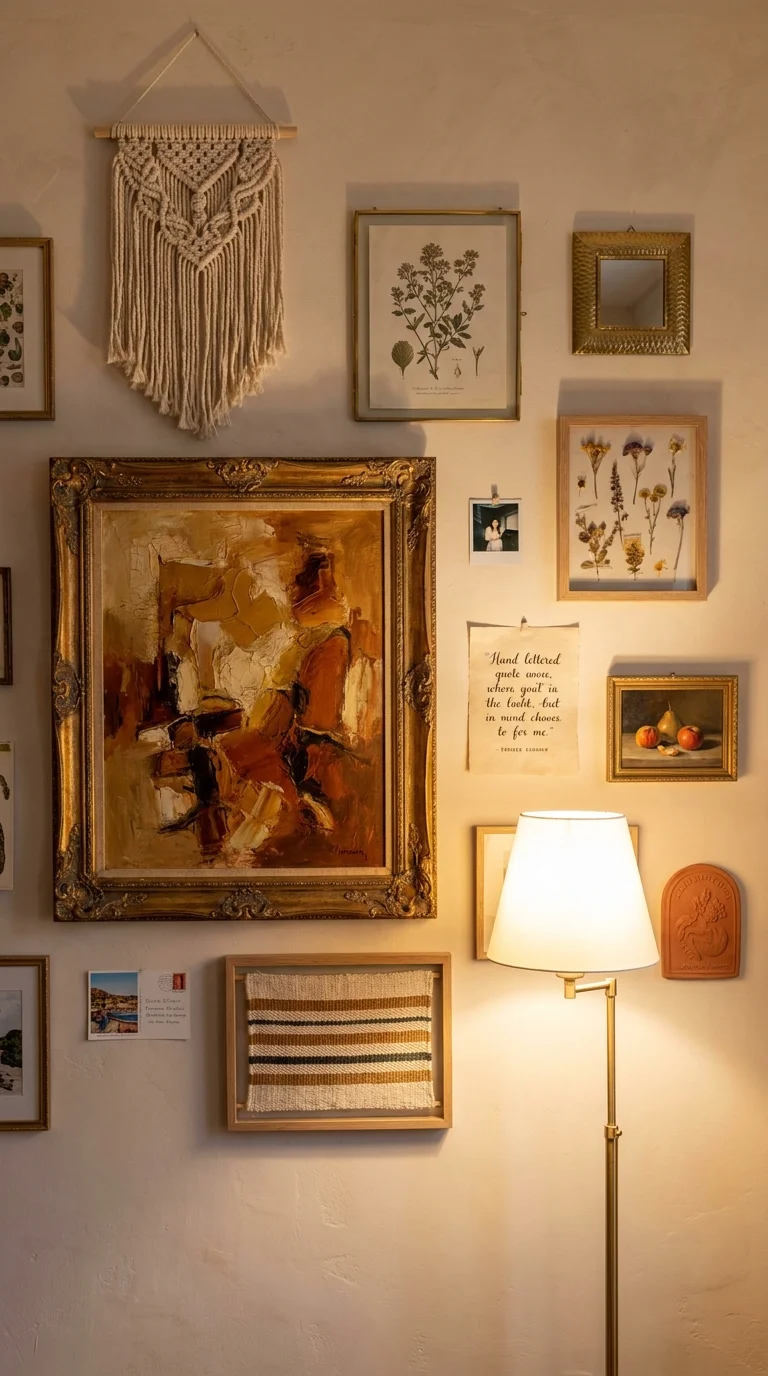
This wall is a collection, not a set, and that is why it feels personal. The anchor is the large gilt-framed oil painting in ochre and brown, hung at eye level. Everything else is smaller, and everything else is in some way quieter.
Count the scales. One large painterly image with no repeat, then three medium botanical prints where the line work is at roughly the same weight, then several very small things: a Polaroid clipped with a brass clip, a postcard, a tiny terracotta plaque. The macrame hanging at the top works as a different kind of large motif, textile rather than paint, which is what stops the wall reading as a shop display of frames.
Cressida’s test for this kind of wall is where your eye lands and how it moves. Here it lands on the heavy gilt frame, then drops to the woven textile band below it, then travels sideways through the paler prints. That movement is possible because there is only one object at the largest scale. If there were three large gilt frames competing, the eye would simply choose one and the rest would read as crowding.
To build it slowly, hang one piece and live with it. A good spacing is two fingers between frames, not tight gallery spacing and not scattered. Keep frames to two or three finishes: gilt and natural wood carry this wall, with the black of the Botanical line drawings tying to the lamp stem. For the large anchor, house clearance auctions and charity shops often have unsigned oil paintings for £30 to £120 in 2026; a new botanical print from a specialist like Goldmark or a framed herbarium sheet runs £18 to £45 in 2026. The small textile in the beech frame at the bottom centre, a narrow stripe in cream, ochre and indigo, is a good copy: plain cotton weave reads as rest where a fourth printed fabric would have tipped into pattern.
There is a dusting cost to this kind of wall, and it adds up. A dozen frames means a dozen pieces of glass. If you dislike dusting, skip glass on the textile pieces and use a light wax on the gilt frames so they can be wiped quickly.
Six mirrors that behave as one
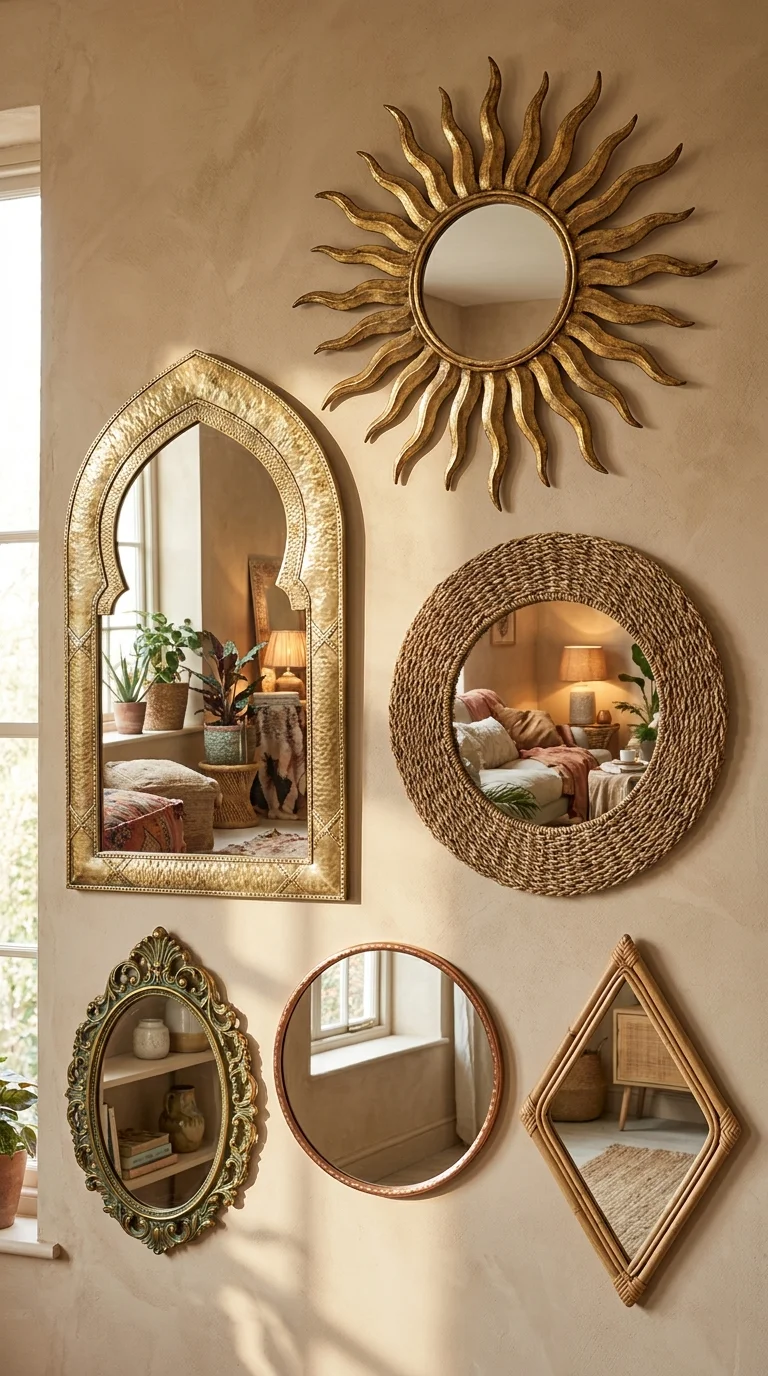
Six different mirrors, and the group hangs as a single composition because the scale has been set correctly. The sunburst at the top is the one large motif; its rays throw the diameter out to roughly twice the others, and it is the only one with that radiating shape. Below it, two medium arches do the middle work: the hammered brass arch on the left and the round seagrass mirror on the right are a similar size and a similar visual weight. The bottom row is three small rounds and a diamond, all narrower and quieter.
That is the collected versus matched idea at its clearest. The frames are all different materials: brass, seagrass, wood, painted plaster. What makes them read as a group is not material matching but the shared warm tone and the clear hierarchy of size. If all six were the same diameter, the wall would look like stock on display.
Notice how they are hung. Two at the top, four below, with the left arch set higher than the round seagrass so the top edge steps instead of aligning. That little offset is what keeps the cluster from feeling gridded. Each mirror catches a slightly different view: the left arch reflects a cane table and plants, the seagrass round catches a sofa and lamp, the tiny gilt oval at the bottom left catches shelves. Reflections are part of the decoration, which is why these work best on a wall that has something to reflect.
For sources, sunburst mirrors in brass or gold poly run £45 to £140 in 2026 at Oliver Bonas, Graham & Green and Zara Home; arch Moroccan arches in pressed metal sit around £70 to £180 in 2026; seagrass and rattan rounds are cheaper at £25 to £65 in 2026 from H&M Home and Dunelm, and second-hand ones appear often on Facebook Marketplace for £10 to £30 in 2026. Hang with proper fixings, not a single picture hook. A brass mirror with glass is heavier than it looks, and a plasterboard wall wants a toggle or a screw into a stud.
Bohemian rooms get away with more mirrors than minimal rooms precisely because the rest of the room is so textural. Glass is the smooth counterweight to raffia, wool and rattan, which is the same reason the brass in the first room worked.
A woollen textile used as a wall hanging
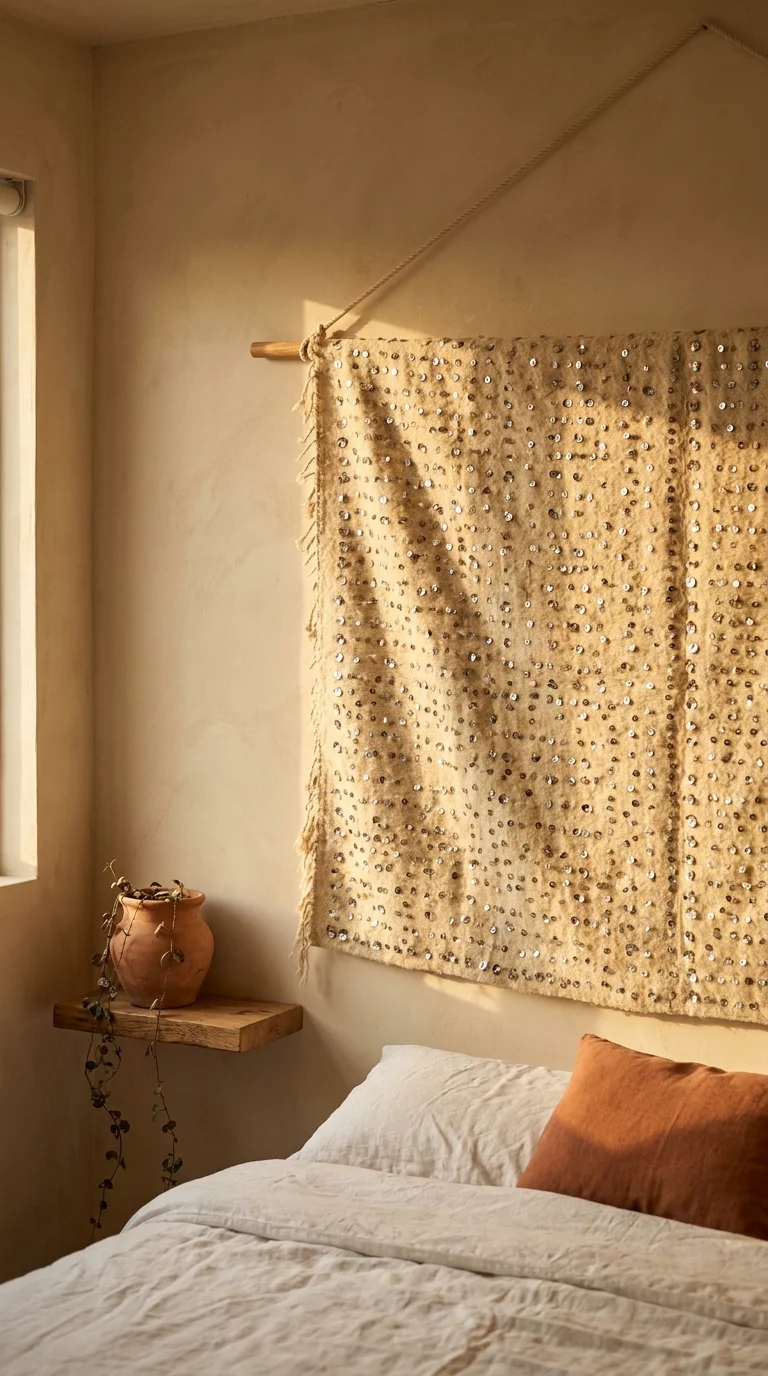
This is a Moroccan handira, sometimes called a wedding blanket, hung as the only large thing on the wall. The wool is cream and slightly felted, and the surface is scattered with hundreds of small flat sequins that catch light without adding colour.
The choice matters because of what it is not. It is not a print, and it is not framed. In a bohemian house where the eye is already handling pattern on rugs, cushions and walls, a flat print at this size would be one more motif competing for attention. A textile of this kind supplies texture and a little shimmer while staying inside the same cream and oatmeal range as the bed linen below it. The sequins read as light, not as pattern.
Notice the scale again: one large textile, no other large pattern on that wall. The bed below carries a single rust linen cushion as its one contrasting shape, and the walls are bare plaster. That is the one large motif rule, applied vertically. If there were also a bold headboard fabric or a large artwork beside it, the two would argue.
To hang it, use a simple wooden dowel through a sleeve or with small brass clips, tied with rope as shown. Handira and handira-style throws are sold by a great many small shops at very different quality. A genuine vintage one, which will be heavier and more irregular, lists around £180 to £400 in 2026 on Etsy or at fairs; good reproductions in cotton and wool sit around £70 to £160 in 2026 at Nkuku, Weaver Green and La Redoute. Whichever you choose, keep it out of strong direct sun. The sequins are metal and the wool will fade at the top edge first, which is exactly the part the light hits.
The small shelf below, a raw oak plank with a single terracotta pot and a trailing pothos, is the right accompaniment: low, plain, and slightly imperfect. If that shelf held four small objects instead of one, the composition would feel stacked.
The chair that needs space around it
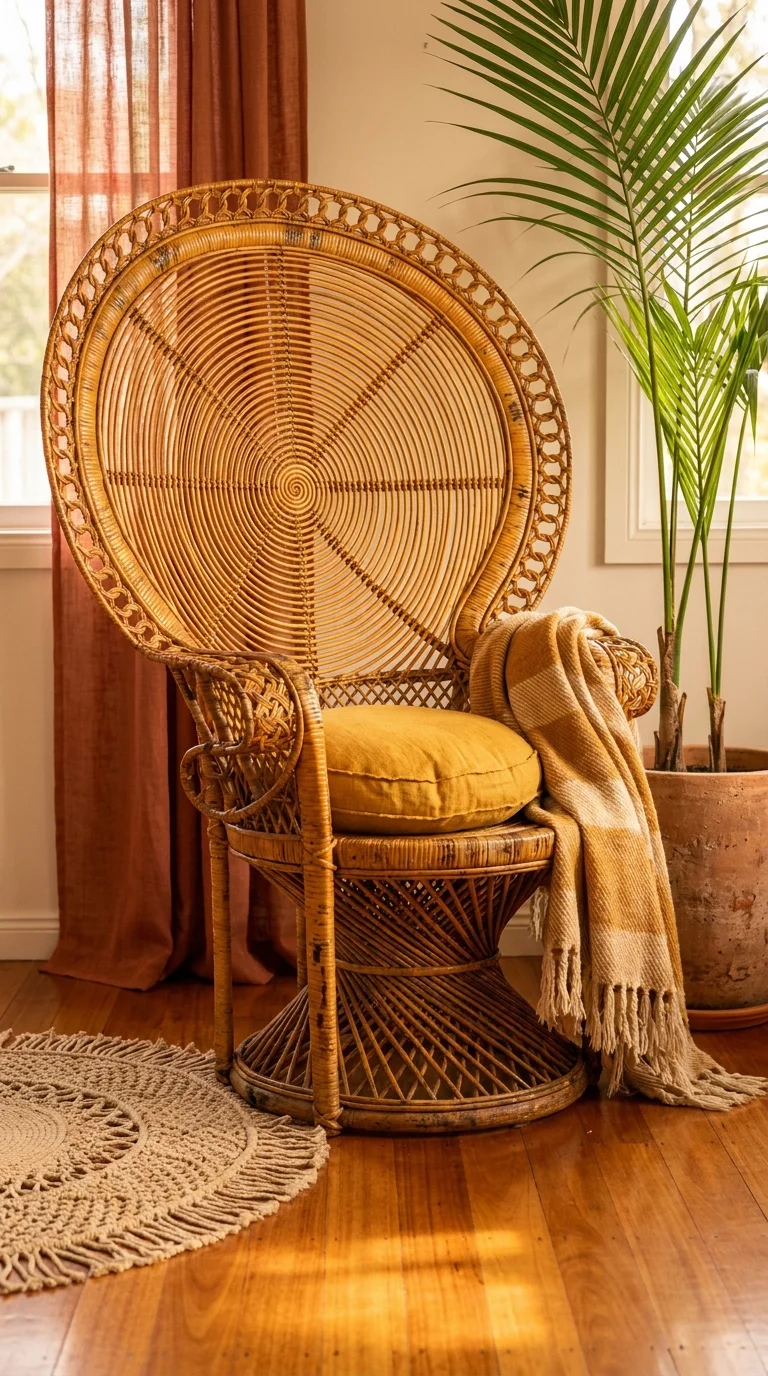
The peacock chair is the most recognisable single object in bohemian decorating, and the reason it so often disappoints in a photograph is that it is bought as a spare chair and used as one. In this room it is treated as a sculpture.
Look at the negative space. The chair sits clear of the walls, on bare timber, with a small round macrame mat underneath and a tall palm to one side. Nothing is tucked up against it. That gap is what lets the silhouette read: the huge fanned back, the concentric rings at the centre, the lattice at the arms. Push this chair into a corner between two other pieces and the silhouette disappears, and you are left with a bulky wicker.
Pattern scale applies here too, though the pattern is rattan , not print. The chair itself is the one large motif in this corner. The cushion on it is a plain mustard linen, and the throw over the arm is a broad stripe in cream and mustard that matches the cushion. Both are larger, simpler shapes than the fine rattan weave, which is exactly the relationship that works. A small, dense printed cushion on this chair would pick a fight with the weave and lose.
Chair history is part of its appeal. The peacock form, with its fanned back and open weave, was popularised in the Philippines and widely exported from the 1960s onwards, which is why originals turn up in charity shops and auctions with a deep honey colour that new rattan has not yet reached. Vintage pieces in good condition sit around £120 to £350 in 2026; new reproductions from suppliers like Audenza and Maisons du Monde list at £180 to £400 in 2026. Check the seat height before buying; many sit lower than a normal dining chair and feel odd at a table.
This is also the chair that shows damage first. Rattan dries and becomes brittle in centrally heated rooms, and the fine bindings at the arm will crack if the air is very dry through winter. A light wipe with a damp cloth and an occasional rub with boiled linseed oil extends its life, but a conservatory that drops to single figures at night is not its friend. If you heat that room only occasionally, choose a cane chair with a simpler frame instead.
Why a teak sideboard calms a bohemian room
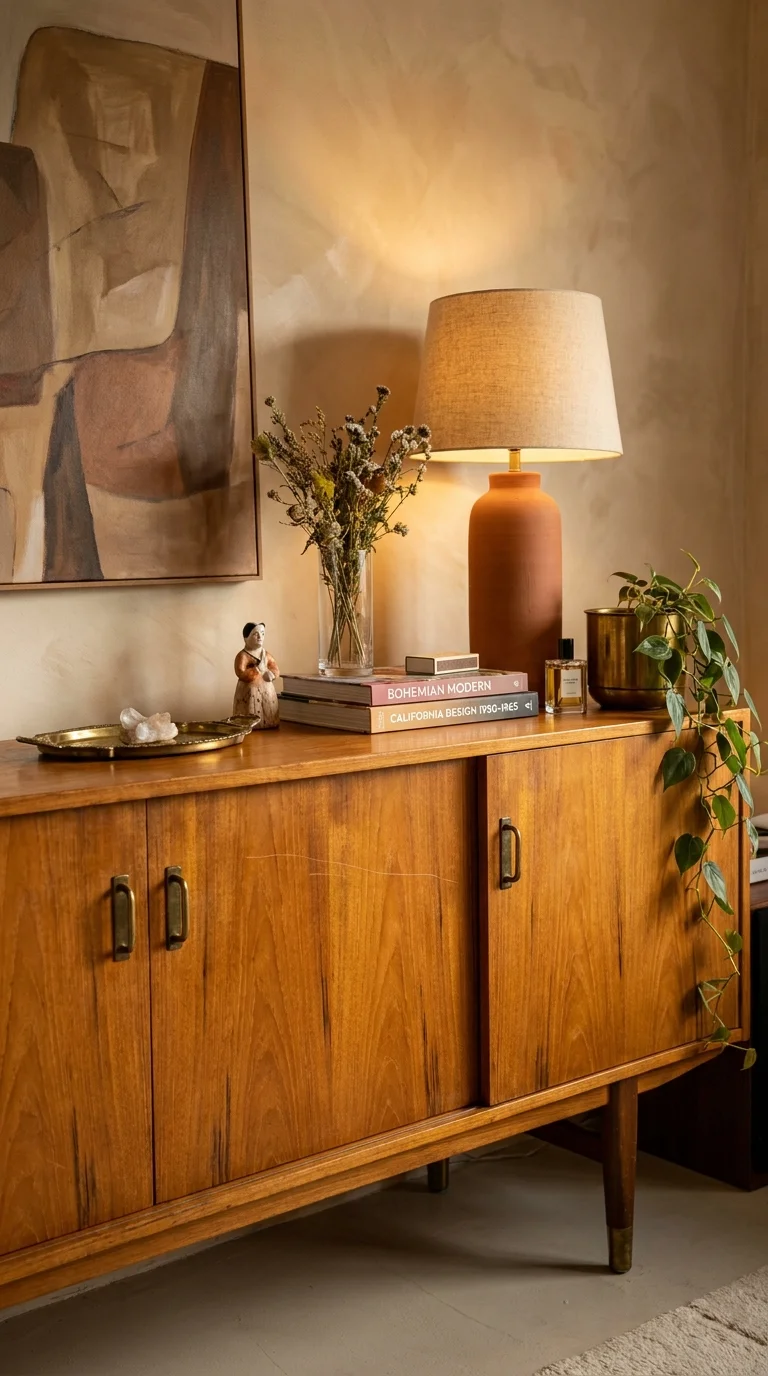
A bohemian interior can take a surprising amount of pattern before it looks full, and then very suddenly it looks too full. The sideboard is what stops that happening here.
The form is mid-century: long, low, legs that lift it clear of the floor, sliding doors or cupboards with slim brass pulls. The timber is teak, with a warm medium tone and a long straight grain that reads as a single calm surface against the textured plaster wall. That plain surface is the value. After rugs, cushions and a gallery wall, the eye wants one quiet plane, and this provides it.
What is sitting on top matters. A large ceramic lamp A large ceramic lamp in matt terracotta with a natural linen shade, a stack of books, a glass with dried flowers, a small figurine, a brass tray with crystal, and a trailing houseplant in a brass pot. That is six small things, but they are grouped tightly in the centre third, with empty timber to left and right. The empty ends are what keep the display from feeling like a shelf in a shop.
The scale principle appears here in the styling. The lamp is the one large object, which anchors the group; the books and the plant are medium, and the tray with stones is small. If there were two tall lamps, the top would feel symmetrical and therefore formal, which would fight the bohemian ease.
Sources are straightforward. Teak sideboards of this period, often Danish or British makers like G Plan and Nathan, trade at £280 to £750 in 2026 on eBay, Vinterior and local auction houses, with condition and leg detail deciding the price. Brass-cup handles and corked feet are often replacements; originals carry a modest premium. For the lamp, unglazed stoneware bases with linen shades sit around £70 to £160 in 2026 at Nkuku, Loaf and Pooky. A pothos like the one trailing here, in a 12 cm pot, costs £8 to £18 in 2026 and will cover the corner in a season if it is watered sparingly and kept out of direct midday sun, which bleaches its leaves.
If you are tempted to put a mirror above this sideboard, hang it a little higher than you think. The top of a large abstract painting, as shown here, wants breathing room; frames hung low over low furniture read as clutter.
When the sofa is the plain part
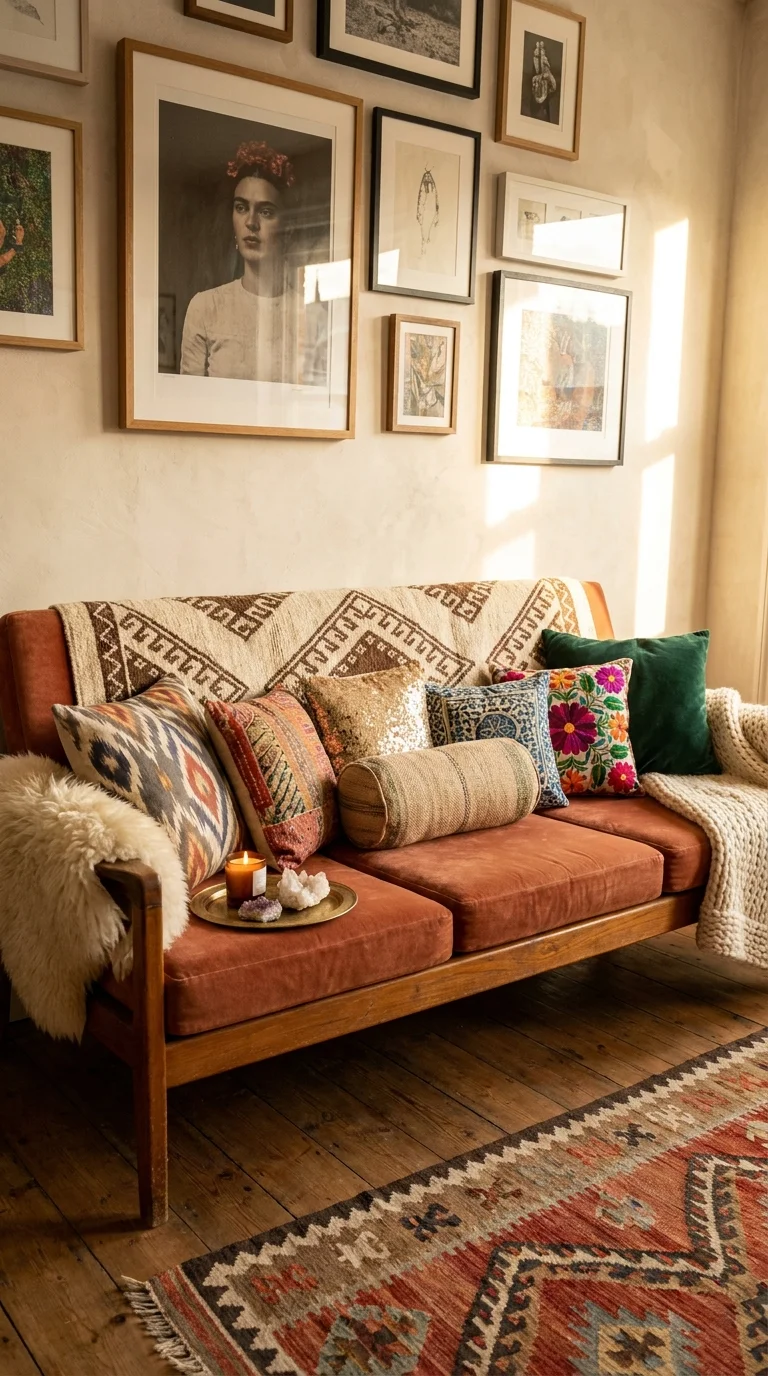
There are eight cushions and a throw on this sofa, which sounds like a great deal until you notice what the sofa itself is doing. It is a plain, low, mid-century frame in rusty terracotta velvet with simple turned legs, and the wall behind it carries a mixed gallery with one large Frida Kahlo portrait as its anchor.
That reversal is the whole lesson. In a bohemian room where textiles are supposed to carry the story, the sofa has to be quiet. This one has no tufting, no contrast piping, no pattern. It is the plain field against which the patterned cushions can be read. Put a patterned sofa here, then add a kilim throw and six printed cushions, and the base and the layers stop having a relationship; everything merges into one busy mass.
Point at the cushions. One large ikat with a diamond repeat, two medium florals with a more open spacing, a long bolster in a narrow stripe, a velvet green that is actually plain, and a sequined square that catches light. That is one large motif, two or three mediums, and texture filling the rest. The proportions stand out because this is where bohemian cushions most often fail: three mediums of the same size and the same complexity sit as rivals, whereas one larger, simpler repeat lets the others sit lower.
The kilim draped over the back, in cream and brown with a strong triangular motif, is the second large textile in the composition but it is behind the cushions, which is what keeps it from competing. Throw over the back, cushions on the seat: that layering gives depth.
To get close without shopping for exact copies, look for a sofa in a solid warm base. Velvet in terracotta, rust or oatmeal from Loaf, Heal’s or even IKEA’s Jattebo holds the right tone at £700 to £2,200 in 2026 depending on maker. For cushions, mix sources: an ikat or kilim cover around £30 to £65 in 2026 from Graham & Green or Etsy, a floral embroidery around £28 to £55 in 2026 from H&M Home and Weaver Green, and a plain velvet around £22 to £48 in 2026 from Dunelm or Habitat. The bolster, which many shops sell as a 40 by 90 cm shape, is useful because its horizontal line breaks the vertical of the back cushions.
Below, the rug repeats the palette instead of adding a new one. Its red and cream flatweave picks up the sofa and the wall, which is what stops the floor and the seating feeling like two separate decisions.
Six cushions, six different hands
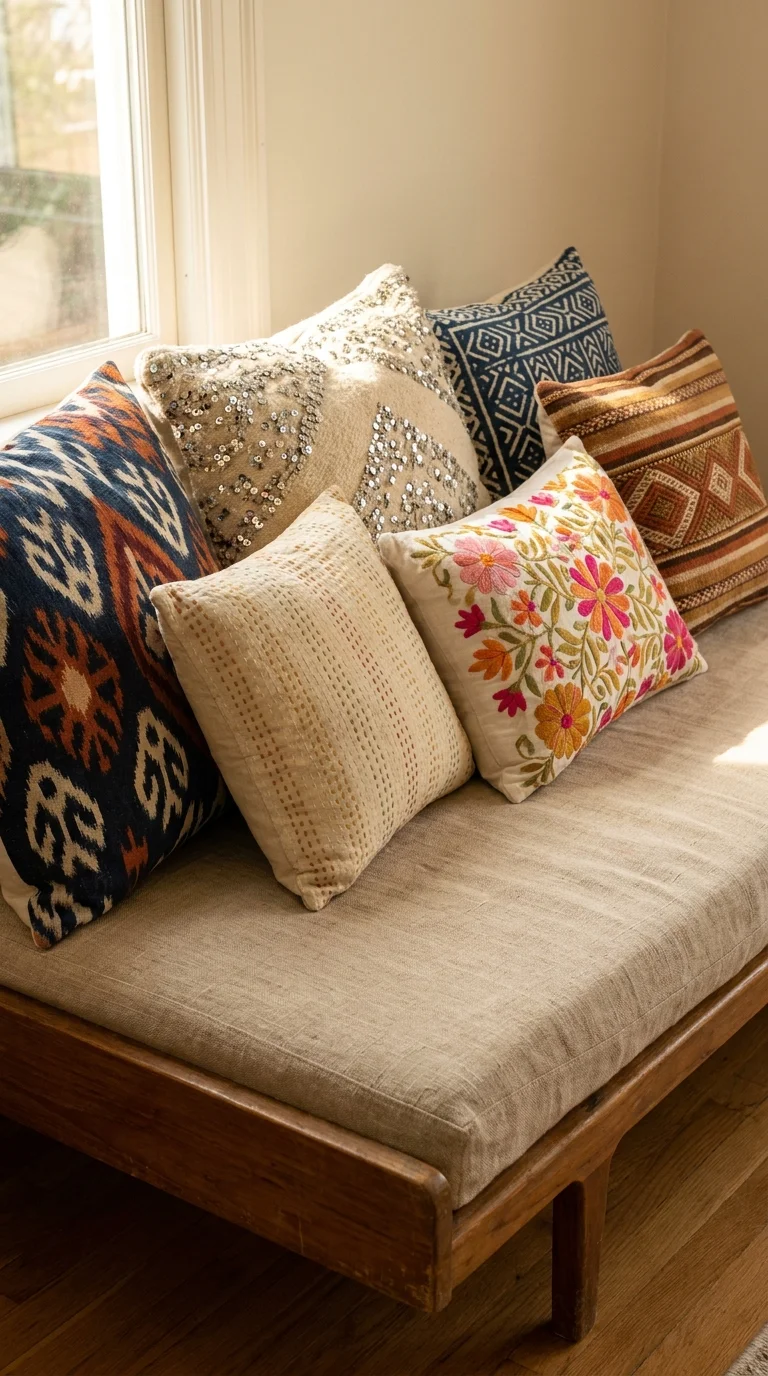
This daybed is a closer view of the cushion principle, and it shows the principle clearly because everything is visible. Six cushions on a plain linen base, each a different textile tradition, and none of them matching.
Left to right: a bold blue and burnt orange ikat with a large sunburst, a cream sequined diamond that is more sparkle than pattern, a small off-white with a fine dotted weave that reads as texture, an indigo block print with a tight geometric repeat, a striped kilim with a narrow diamond band, and a floral embroidery in pink, orange and green. The ikat is the one large motif; the print and the floral are the mediums; the sequin, the plain weave and the striped kilim are the quiet carriers.
Why this works where a shop-bought cushion set does not is that each textile looks as though it was made by a different hand. The weaves differ, the dyes differ, and the level of sheen differs. A set of six cushions from one range tends to share the same base cloth and the same print method, which is precisely what makes them look matched. The eye reads sameness before it reads colour.
If you are building a group like this, pull the colours from one source, usually the rug, as described at the top of this piece. Here the ikat supplies most of the palette, and the indigo print and the orange flowers answer it. The two creams, one matt and one sequined, are the unifying lights, which is a useful trick: one or two creams across the group will tie varied dyes together without adding a new hue.
Price ladders are helpful here because cushions are the cheapest way to change a room. Block prints and woven stripes from Indian suppliers on Etsy and via Weaver Green list around £18 to £38 in 2026; a good ikat or vintage suzani cover runs £32 to £75 in 2026; embroidered florals of the kind sold by Anthropologie and Graham & Green sit around £35 to £70 in 2026. The daybed itself, a simple teak frame with a deep linen cushion, is similar to those sold by Nkuku and Loaf at £500 to £1,200 in 2026, with simpler pine bases available for less.
Put simply, quantity is not the problem. One large repeat, a couple of mediums that talk to it, and the rest as texture is what keeps six cushions from reading as six patterns.
| Cover type | handle | price band in 2026 |
|---|---|---|
| Block print, indigo | tight geometric, cotton | £18 to £38 |
| Ikat or suzani | large sunburst, silk or cotton | £32 to £75 |
| Floral embroidery | open pink and orange flowers | £35 to £70 |
A bed that is also a room
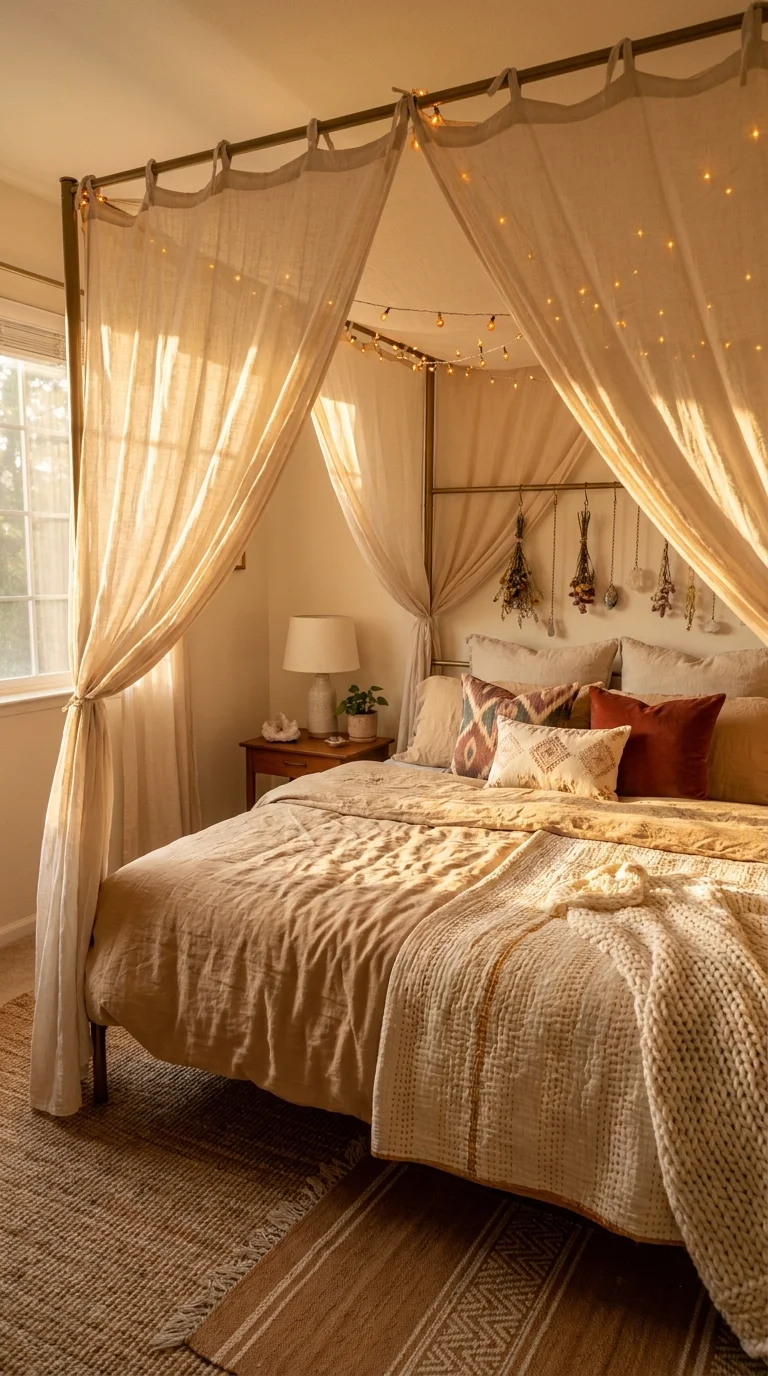
The bed in this photograph is doing something architectural. A brass four-poster frame holds sheer muslin that is drawn back in the day and can be closed at night, with tiny fairy lights woven through the upper frame. The bedding below is layered but plain: an oat coloured coverlet and a chunky cream knit throw.
Notice how little pattern there is in the inner room the curtains make. The bedhead is bare, the pillows are two pale geometrics, one rust velvet and one cream, and the single colour note is that rust cushion. The muslin is the one large textile motif, or rather the one large soft enclosure; everything inside it is quieter. That hierarchy is what lets the canopy feel romantic rather than fussy.
Why muslin instead of a heavier drape deserves a moment. Boho bedrooms often fail when the canopy is in a heavy patterned fabric, because then there are two large patterns: the canopy and the bedding, which have to compete in a small footprint. Sheer cotton gives shape and light without adding a second repeat, and it filters daylight into a warm haze that photographs misleadingly well.
Practical notes, because this is a bed people actually sleep in. The frame wants to be solid; a light brass lookalike with thin poles will sway if the curtains are pulled. Vintage brass four-posters trade at £250 to £650 in 2026 on eBay and at fairs, with new ones from Made and Oliver Bonas around £350 to £800 in 2026. The muslin itself is inexpensive; large panels of cotton voile run £12 to £28 per metre in 2026 and need only a simple heading tape. Fairy lights on a warm white, not cool, with a timer plug save fiddling; a 5 metre set costs £10 to £22 in 2026, and the battery versions dull quickly so a mains set justifies the cable.
The floor explains it. Two jute layers, a narrow runner and a broader bordered rug, pick up the same oatmeal range and give the bed a base that matches its soft enclosure. Without those, the brass legs would feel isolated on bare floor.
Plants at three heights, not one shelf
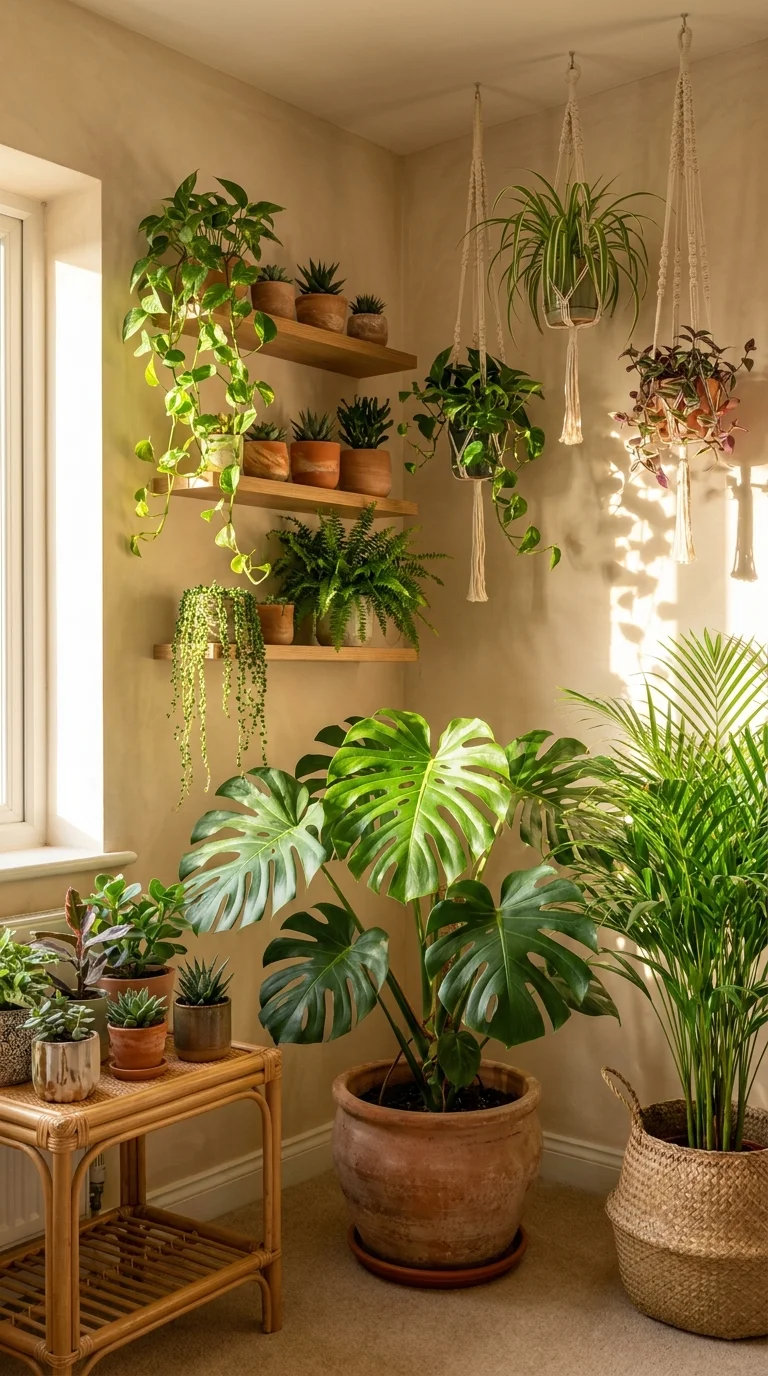
This corner is plants arranged with the same hierarchy that governs the textiles. One very large leaves, two mediums, and many small.
The monstera in the terracotta pot is the one large motif. Its leaves are broader than a hand and darker than anything else in the room, which is what makes it read as an anchor. To its right a tall palm in a woven seagrass basket does the second large job but in a different shape, palmate rather than fenestrated, which is enough difference to avoid twinning. The hanging pothos and spider plants are the mediums, and the small succulents and string-of-beads on the shelves are the fine texture.
The heights tell the story. Large plants sit on the floor, trailing plants hang from the ceiling, small pots line three low shelves and a cane table. That is floor, shelf and ceiling, all used, which is why the corner reads as a little indoor garden instead of a collection of pots on one surface. Put all those plants on a single shelf and they crowd; spread them vertically and air moves between them and the light reaches each one.
The pots are deliberately plain: terracotta, a little brass, and the seagrass basket. Plain pots keep the attention on leaf shape , not on container pattern, which is critical when the room already holds pattern elsewhere. Terra is also practical. Unglazed terracotta breathes, which helps roots, and a 28 to 35 cm pot like the monstera’s costs £22 to £45 in 2026 at garden centres and on Crocus, with a woven basket cover around £18 to £40 in 2026. Hanging macrame holders run £12 to £28 in 2026 for cotton examples from Nkuku and Etsy, and they want a proper ceiling hook into a joist, not a self-adhesive hook that will fail with water weight.
Three habits keep this kind of planting alive, and all three are low cost. Group plants with similar watering needs together so one routine suits several; wipe large leaves with a damp cloth when dust dulls them, because dust blocks light; and turn the monstera a quarter turn each time you water so it does not lean permanently toward the window. None of that needs a special feed.
Skip this density if the room is dark for most of the day. These leaves are all high-light tolerators, and they will thin and stretch if they sit more than a couple of metres from a bright window.
Light that moves after dark
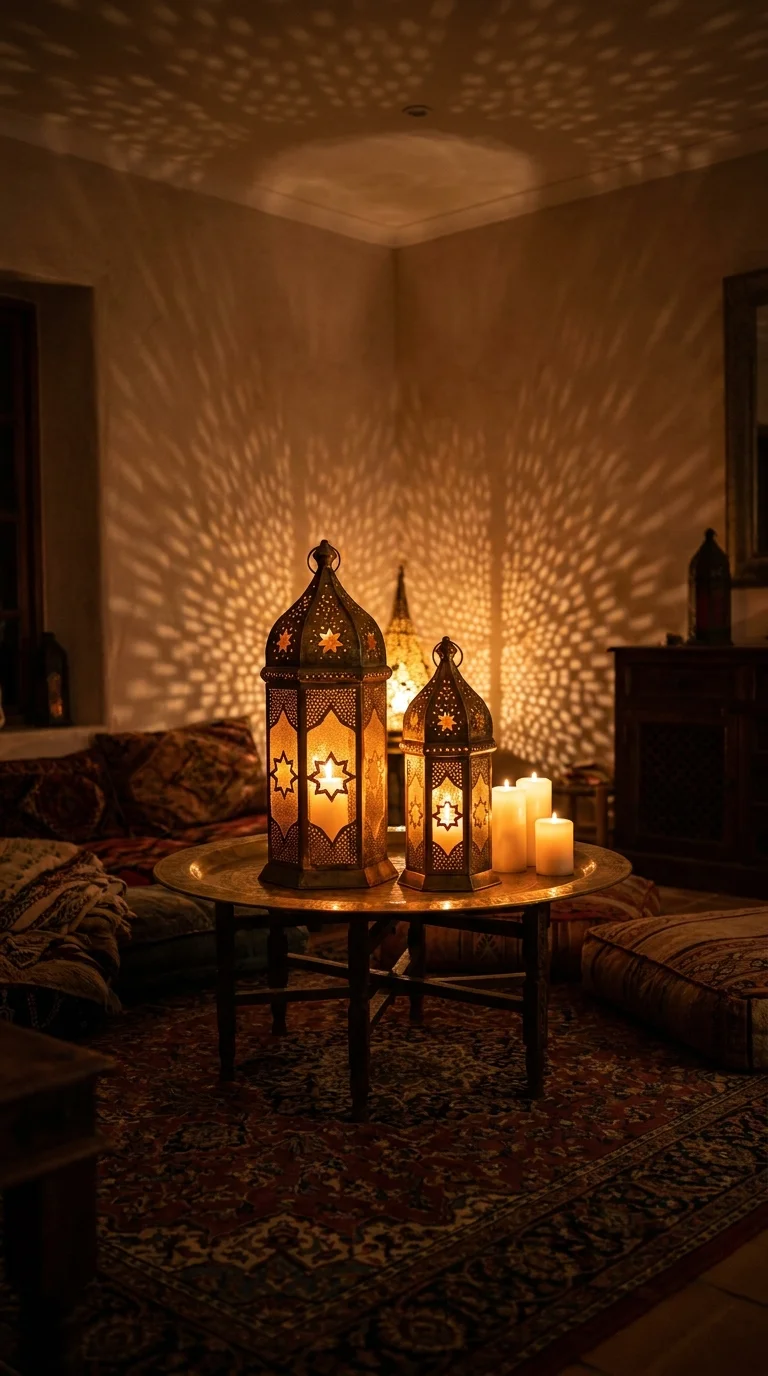
The last photograph is night, and it is the only one on the page taken without daylight. Two pierced brass lanterns sit on a low brass table, with a small cluster of pillar candles beside them. The light is throwing a lace of stars and dots across the ceiling and the limewashed walls.
This is low, warm, multiple small sources again, but here the mechanism is perforation. The lanterns are not shades; they are filters. Daylight hides what they do, night reveals it. That is why bohemian light is so often described as theatrical: the room itself becomes patterned after dark.
The table height explains it. It is roughly knee height, which places the lanterns well below eye level. From there the perforations project upwards and outwards, so the pattern stretches across the walls instead of pooling on the floor. A lantern hung at ceiling height throws a similar pattern onto the floor where it is walked on and lost.
Scale again, though smaller. One large lantern and one slightly smaller paired with it, not two the same size. The cluster of candles behind, at three heights, supplies the medium layer; the scattered pattern on the walls is the fine texture. One large pierced volume, medium solid flames, and a very fine projected repeat.
For shopping, perforated Moroccan lanterns in brass vary enormously in gauge. Heavier ones with tighter piercing lists £45 to £120 in 2026 for the 30 to 40 cm height at Graham & Green, Nkuku and Cox & Cox; lighter pressed versions sit at £22 to £55 in 2026. Thick pillar candles in ivory, which burn more evenly than thin tapers in a draught, run £6 to £14 per pillar in 2026. Use warm bulbs elsewhere in the room; a 2200 to 2700K LED keeps the brass looking brass , not yellow.
A safety note that belongs in a room with floor cushions and rugs: keep trailing fabric clear of naked flame and never leave pillars unwatched on a low table where a cushion might brush them. Lanterns contain the flame better, which is one more reason to let them do most of the work.
The honest drawbacks
This is a lot of dusting. Layered rugs, macrame, dried flowers, a dozen frames and a mantel of small objects add up to real upkeep, and a boho room that has not been cleaned looks noticeably worse than a minimal one in the same state.
Layered rugs are also awkward with a vacuum and difficult with a dog.
And it is a committed look. This is not a room you make by adding a macrame hanging to a grey sofa; the sofa has to go too, or at least be covered. Half-done boho looks like an accident rather than a decision.
Frequently asked
Frequently Asked Questions
Is bohemian decorating expensive to get right at the start?
Not necessarily. One decent rug that sets the palette can be found second hand for £60 to £150 in 2026, and most of the character comes from small things that collect over time: cushions, ceramics and plants. The budget version reads more convincing than a trolley dash of new boho sets.
How many patterns work together without feeling busy?
Aim for one larger repeat per area, two or three mediums that answer its colours, and texture for the rest. If every surface carries a motif of the same size, the eye compares them and tires. Let one textile speak loudest and keep the others quieter.
Can I mix bohemian textiles with a modern sofa?
Yes, if the sofa is plain and its colour already sits inside your palette. A simple velvet or linen in terracotta, cream or oatmeal lets the cushions do the talking. A bold printed sofa leaves nowhere for the textiles to go.
What lighting suits a layered, pattern-rich interior?
Several small warm lights set low, , not a single overhead. Lanterns, a ceramic table lamp at 2700K and a couple of candles throw shadows that give texture something to catch. High, bright central light flattens the very surfaces you layered to create depth.
How do I keep an eclectic wall of frames from looking crowded?
Choose one larger frame as the anchor, keep two finishes at most, and leave a little air between frames. Two fingers width prevents crowding, and one small textile among the prints stops the whole group reading as a print shop.
Do I need lots of plants for this style to work?
No. One strong floor plant and a couple of smaller trails give the impression without turning the room into upkeep. Place them at different heights, keep the pots plain terracotta, and skip dense displays if the room is dim.
Where to start
- Choose the palette first and refuse anything outside it.
- Layer rugs in a size hierarchy, with grippers between the layers.
- Get the variety from texture , not colour, and let one large motif lead each group.
- Include one reflective material, usually brass, to catch the light.
- Light it low and warm, with the ceiling fitting switched off.
- Collect slowly, and allow one large pattern per area with two or three mediums answering it.
This article may contain affiliate links. We may earn a commission at no extra cost to you.