12 Cozy Living Room Ideas: One Colour and Six Textures

Add us as a preferred source to see more stories on Google.
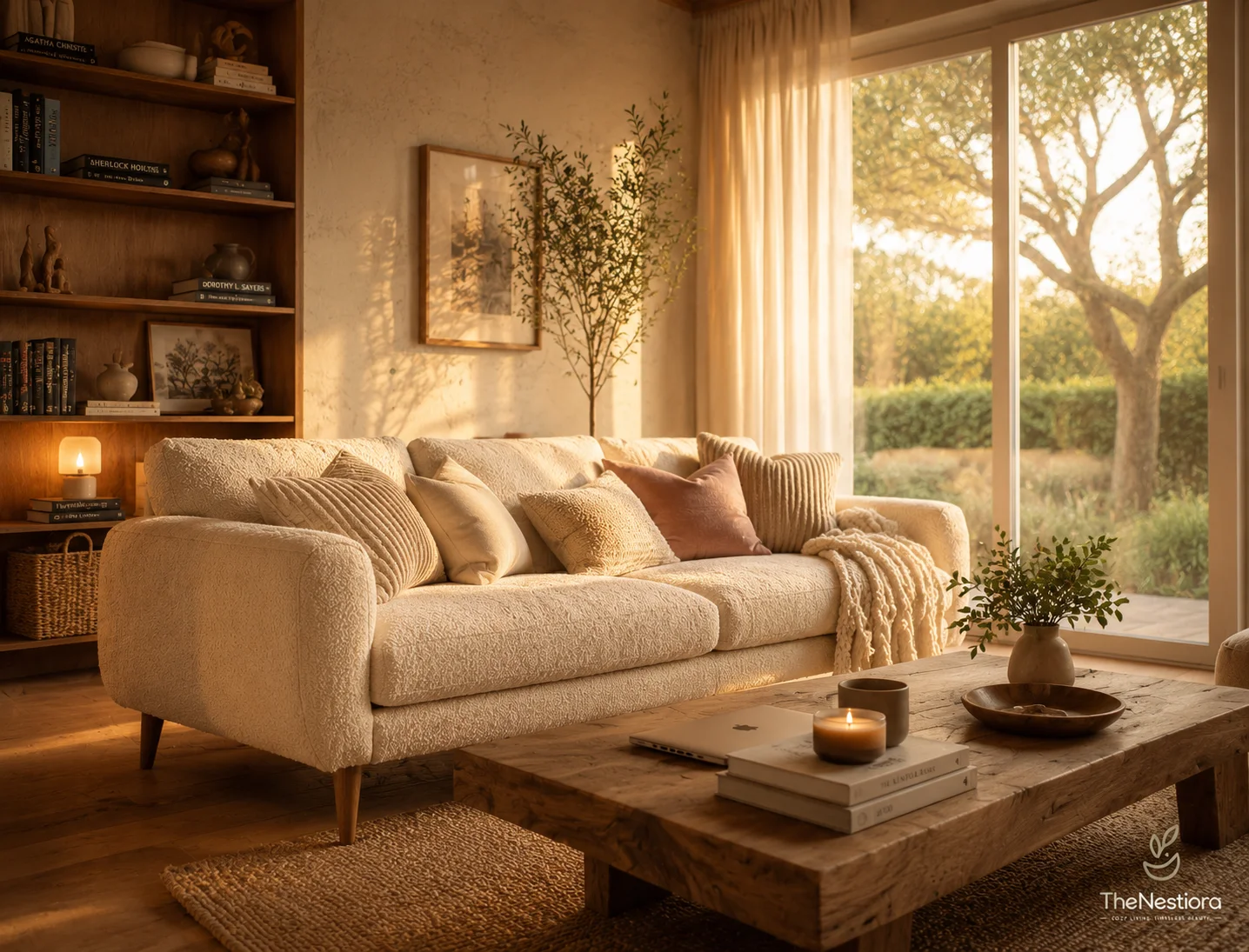
Count the colours in the room below. There is really only one.
Walls, sofa, cushions, curtains, rug and lampshade all sit in the same narrow band of cream and sand. One dusty pink cushion is the only departure, and it is small.
Now count the materials. Bouclé on the sofa, ribbed corduroy and chunky knit on the cushions, a loose tasselled throw, woven jute underfoot, sawn timber on the table, smooth ceramic in the vase, linen at the window, and oak on the shelves. That is eight textures in one photograph, and the room is doing all of its work with them.
This is the part people miss when they copy a room like this. They match the colour, buy smooth things in it, and end up with something that looks bland rather than warm.
Why texture works where colour does not
A surface reads warm or cold largely by how it handles light. Smooth finishes bounce it back evenly, which is why a room of flat paint, glass and polished wood feels crisp even in a warm colour. Broken surfaces scatter light in every direction and create thousands of tiny shadows, and it is those shadows the eye reads as softness.
That is the whole mechanism. Bouclé is warm because of the loops. Jute is warm because of the weave. Look at the coffee table in that photograph: the sawn edge catches light unevenly all along its length, and a sanded, lacquered version of the same table would read noticeably colder.
It also means you can get a substantially cosier room without repainting anything.
A working set of six
Aim for something from most of these, not all of them, and let one dominate.
| Role | Examples |
|---|---|
| Something woven | Jute or sisal rug, rattan basket, cane chair |
| Something knitted or looped | Bouclé upholstery, chunky throw, ribbed cushion |
| Something rough | Sawn or reclaimed timber, unglazed terracotta, limewash |
| Something smooth | Ceramic, marble, glass, a polished handle |
| Something soft and loose | Linen curtains, a rumpled throw, washed cotton |
| Something with a sheen | Brass, antique mirror, a glazed pot |
The last two rows matter more than they sound. A room of only rough textures reads scruffy rather than calm; it needs a couple of smooth or reflective things to push against. Notice how few of those there are in the picture: one ceramic vase, one glazed candle holder, and that is the lot.
Where to find each texture
Prices are rough bands for 2026 and for a medium room.
| Texture | Premium | Mid | Budget |
|---|---|---|---|
| Natural fibre rug | Armadillo, £900+ | Weaver Green, £200 to £400 | IKEA LOHALS, £60 to £120 |
| Chunky throw | Foxford or Begg x Co, £150+ | Tolly McRae, £70 to £120 | H&M Home, £25 to £40 |
| Linen curtains | Volga Linen, £300+ per pair | Loaf or Nkuku, £120 to £250 | IKEA AINA, £50 to £90 |
| Bouclé cushion | Designers Guild, £90+ | Zara Home, £30 to £50 | Dunelm, £10 to £18 |
| Unglazed pot | Rowen & Wren, £50+ | Nkuku, £20 to £40 | Any garden centre, £4 to £10 |
The rug is the one worth the money, because it covers the largest surface and takes the most wear. Everything else in that list is genuinely fine at the cheap end, and a £12 ribbed cushion does the same optical job as a £90 one from three feet away.
The light is doing more than you think
Worth saying plainly, because it is the least reproducible part of any room you have saved. That photograph is taken in late afternoon sun coming through a large window at a low angle. Low warm light rakes across surfaces and exaggerates every texture in the room, which is the whole reason the picture works.
The same room at eleven in the morning under grey sky will look noticeably flatter, and no amount of shopping fixes that. What does help: a couple of lamps at low level instead of one ceiling fitting, 2700K bulbs, and something reflective in the darker corner to bounce light back.
What to change first
If the room feels flat, work in this order and stop when it is enough.
The floor. A large textured rug changes more than anything else, because it covers the biggest uninterrupted surface. Natural fibre, tight weave, as large as the room allows.
The window. Heavy or loosely hung fabric absorbs sound as well as light, and a room that echoes never feels cosy. Linen or cotton, generous width, hung high and wide.
One large upholstered object. A bouclé or heavy weave chair does more than six cushions. That sofa is carrying most of the room on its own.
Then the small things. Baskets, throws, an unglazed pot. These are the cheapest and, on their own, the least effective.
Sit into the seat, not on it
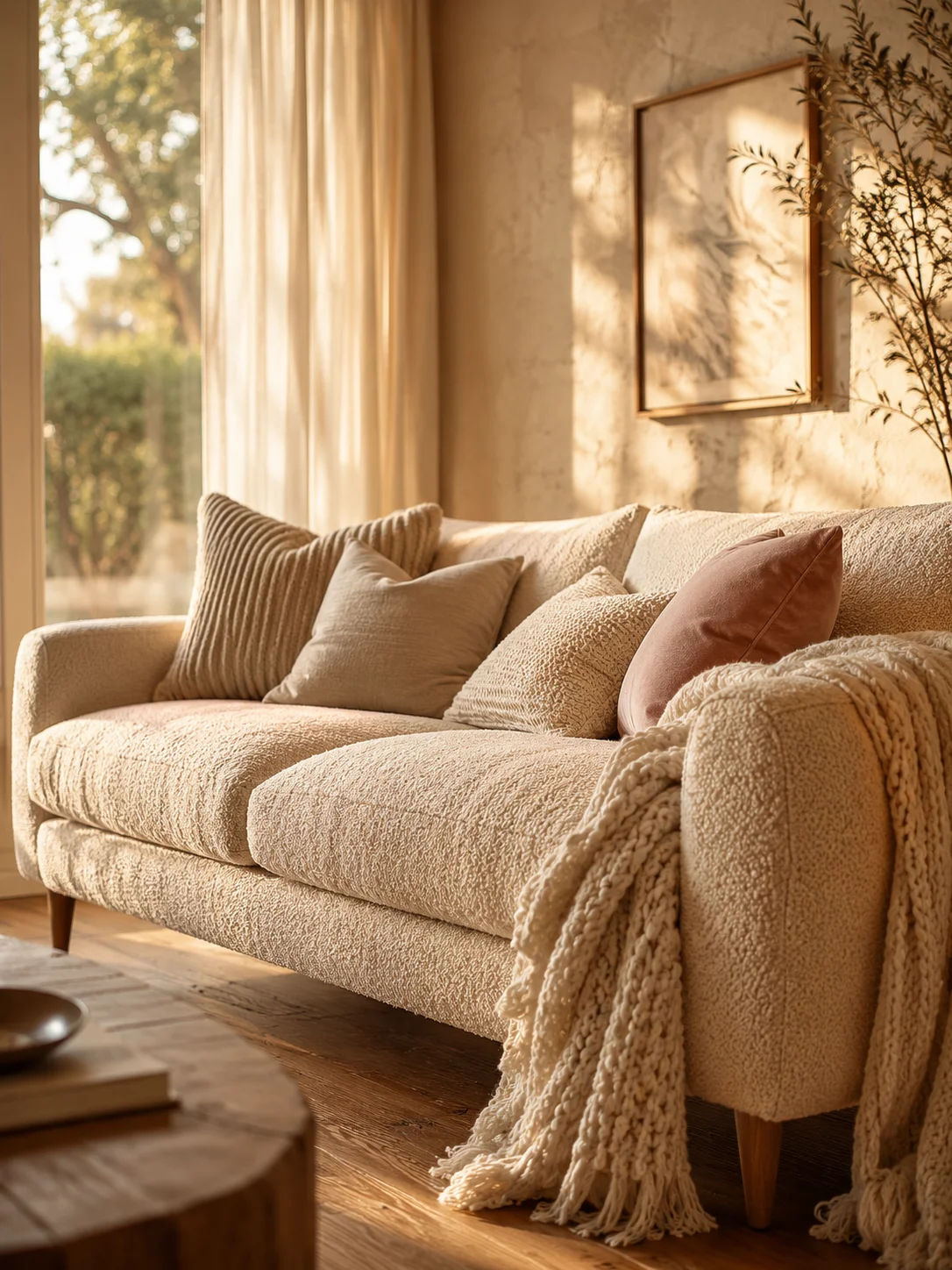
The sofa in this photograph explains why seat depth decides a room before anything else is bought. The two seat cushions run deep from front to back, the kind of depth that takes a whole thigh, so the sitter drops back into the piece instead of balancing on its edge. Everything else in the frame follows from that one property.
The cushions carry the argument further. A ribbed corduroy square stands at the back, a plain linen one leans in front of it, a looped bouclé one sits forward, and a single dusty pink velvet square breaks the run at the far end. Four different weaves, one narrow palette, and the pink one works precisely because it is alone. The chunky knit throw pooled over the right arm finishes the thought: it lies where somebody left it, which tells the eye this seat gets used.
Bouclé earns its place here for an optical reason. Each loop throws its own speck of shadow, so the whole surface shimmers slightly in low sun and reads soft from across the room. A flat weave in the same cream would sit flatter and colder. The low tapered timber legs underneath let daylight pass beneath the base, which keeps so much upholstery from reading as a block.
Sit in the candidate before ordering and notice where the knees land. Thighs fully supported with feet still reaching the rug means the depth suits the household. For reference, two seat boucle sofas from Loaf run £1,200 to £2,500 in 2026, while Dunelm carries simpler versions at £500 to £900. The cheaper ones use a shorter pile that flattens sooner, so plump the cushions weekly if that is the route taken.
Give the chair its own lamp and table
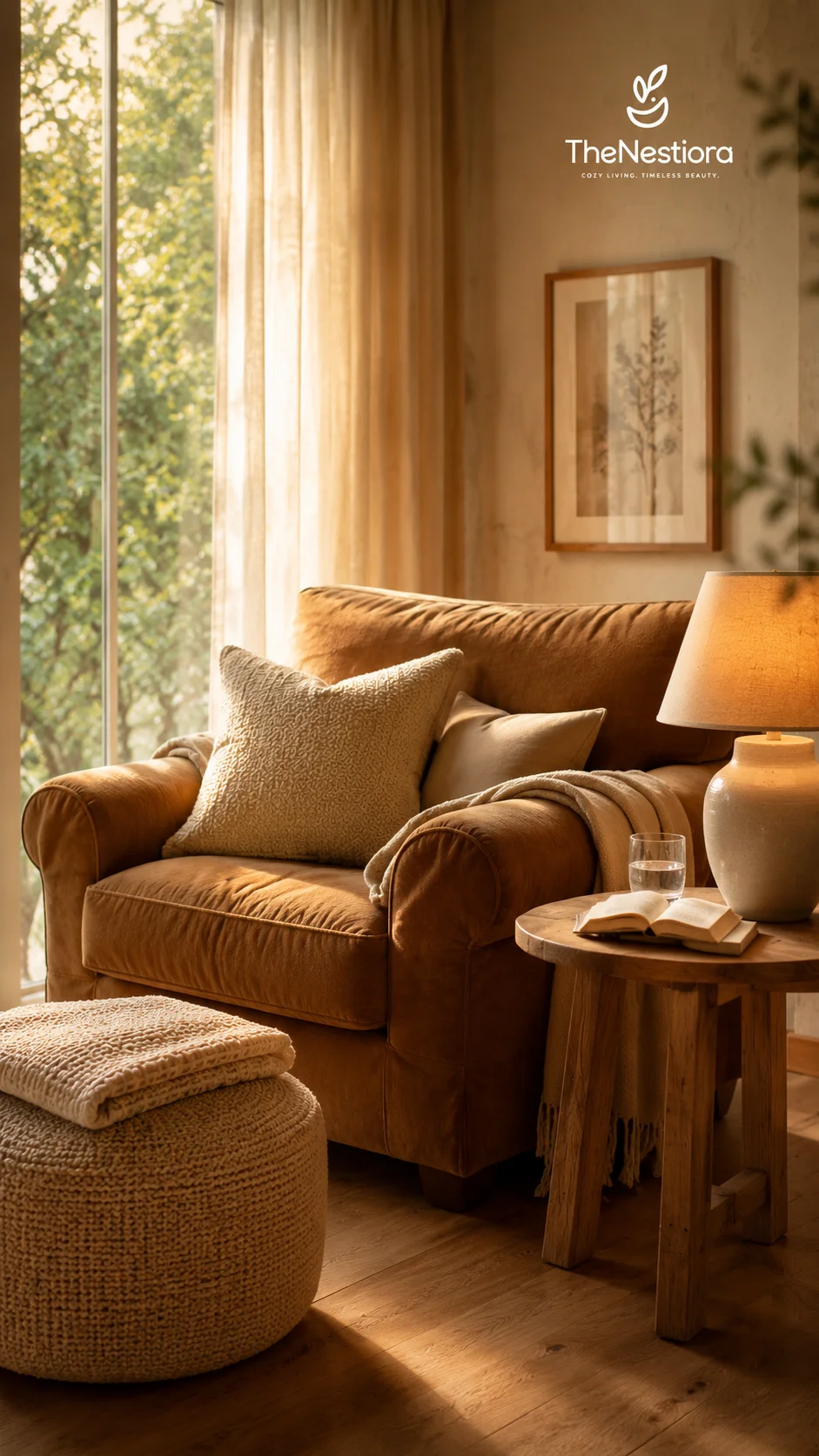
A chair becomes somewhere to go when three things stand within reach of it, and this corner arranges all three without fuss. The caramel armchair sits angled toward the garden glass instead of squared to the wall. Beside it stands a round timber side table carrying a ceramic lamp with its shade glowing, an open book, and a glass of water. In front waits a knitted pouf with a folded throw across it.
The angle is the decision that matters. Square to the wall, this would read as spare seating waiting for overflow. Turned toward the light with its own lamp behind it, the chair reads as a separate small room inside the larger one. The lamp shade sits roughly at shoulder height for a seated reader, which puts the glow where pages are held and keeps it out of eyelines across the room.
Texture does quiet work here as well. Lustrous velvet on the chair, nubby bouclé on the square cushion, smooth linen on the smaller one, open knit on the pouf: four surfaces in arm’s reach, all inside one band of honey and oat. Anyone counting materials from the sofa would add the ceramic lamp base and the sawn table top and arrive at six without standing up.
An equivalent corner costs less than a new sofa. Velour or velvet reading chairs from Nkuku sit around £600 to £1,100 in 2026, and ceramic lamp bases from Zara Home run £40 to £80. The pouf is the piece to buy last. It earns its floor space only once the lamp and table are already in place.
Layer a soft rug over a hard one
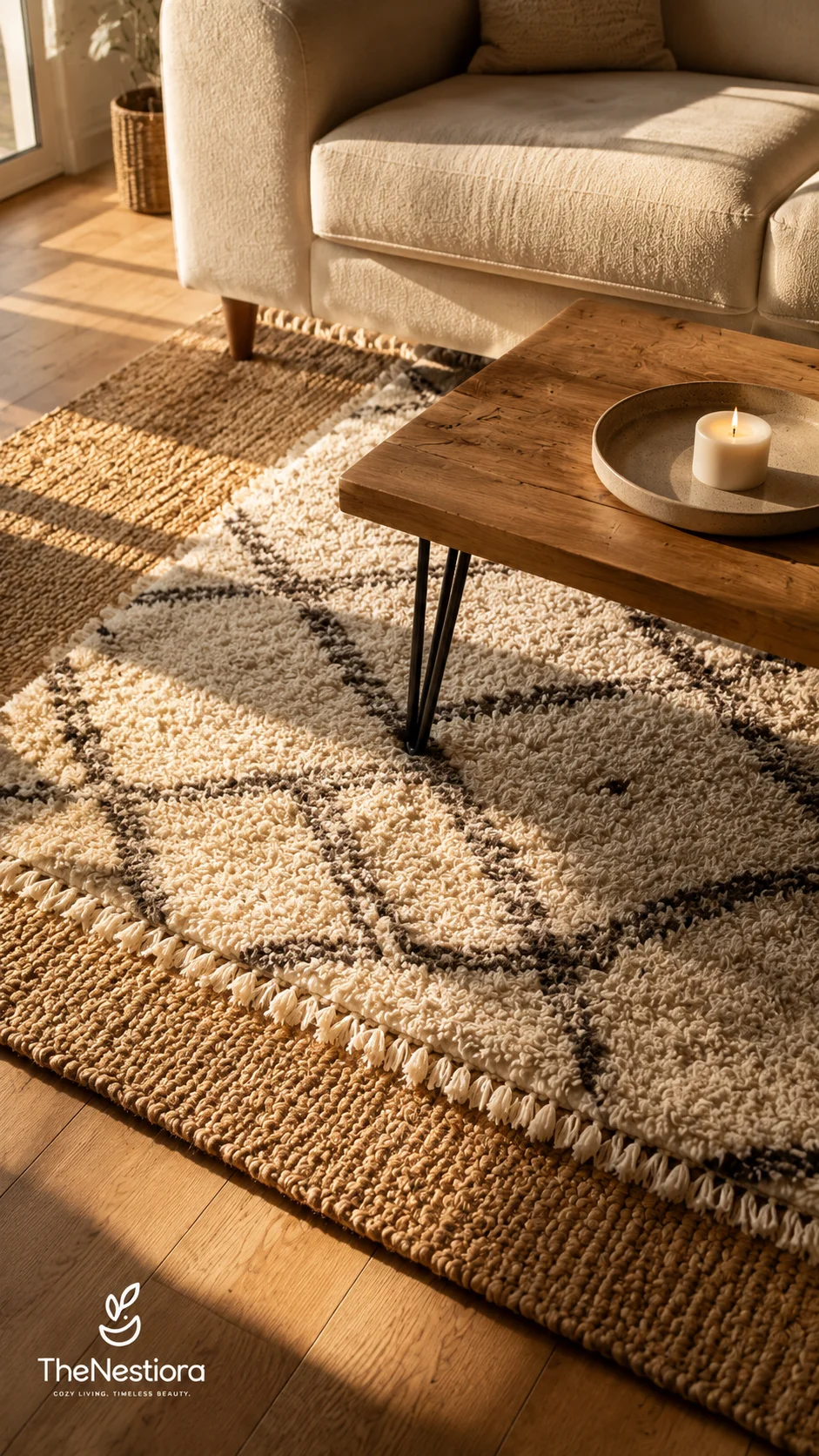
The floor in this close view carries two rugs doing two different jobs. Underneath lies a flat jute base with a tight braid, reaching past the furniture on every side. On top sits a smaller high pile piece with a dark diamond lattice, its tasselled fringe overlapping the jute by a hand’s width. The timber coffee table stands with its hairpin legs on both layers at once, and a stone tray with a single lit candle rests on the boards above.
The pairing works because each layer compensates for what the other lacks. Jute gives size cheaply and survives foot traffic, yet it feels coarse under bare feet. The shaggy top gives the softness where feet actually land, yet buying it big enough to carry the whole seating area would cost several times over. Together they read as collected over years instead of bought in one afternoon, which is a difficult impression to fake any other way.
Placement decides whether the trick holds. The top rug passes under the front legs of the seating and the table legs stand fully on it, so the layers register as one island. A small rug floating clear of every leg would chop the floor into pieces, which is the familiar failure with this idea.
As a guide to outlay, a large jute base such as IKEA LOHALS costs £60 to £120 in 2026, and a Moroccan style high pile from Dunelm runs £120 to £300. The woven basket behind the sofa leg in this frame, usually £15 to £35 from a garden centre, repeats the base fibre upright and ties the two levels together.
Keep three throws in three weights
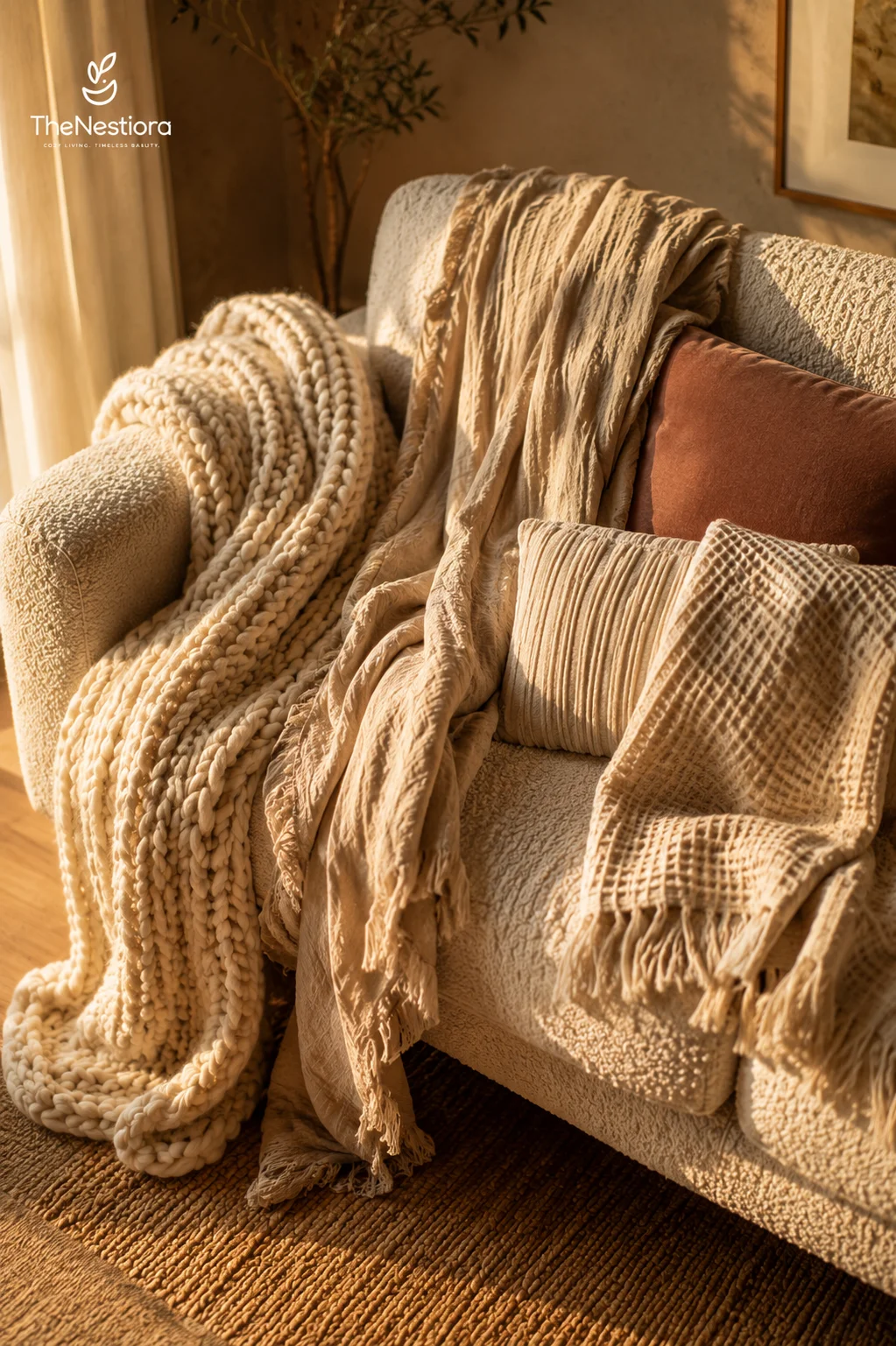
Three throws share one sofa arm here, and the photograph rewards a slow look at what distinguishes them. On the left hangs an enormously chunky knit with stitches thick as rope. Across the middle lies a crinkled linen, thin and rumpled, catching the sun along its creases. Over the seat itself spreads a waffle weave with a small proud grid and a knotted fringe. Same family of oat and cream throughout, three completely different hands.
The principle behind the pile is use. A heavy knit suits a cold evening, linen suits a mild one, and waffle sits between the two, so one of the three is always the right weight and the throws get pulled across laps instead of arranged for visitors. That lived-in drape then becomes its own decoration. Each length lies slightly twisted with folds going different directions, and low sun rakes across every ridge.
Resist matching sets when copying the arrangement. Three identical fleece blankets in one colour add bulk without adding information to the eye, which is why they photograph as clutter. One rustic knit from H&M Home at £25 to £40 in 2026, one washed linen from Nkuku at £45 to £85, and one waffle cotton from Dunelm at £12 to £25 cover the spread for most households. Wash the linen twice before judging it. It softens considerably once the dressing rinses out.
Count five textures from where you sit
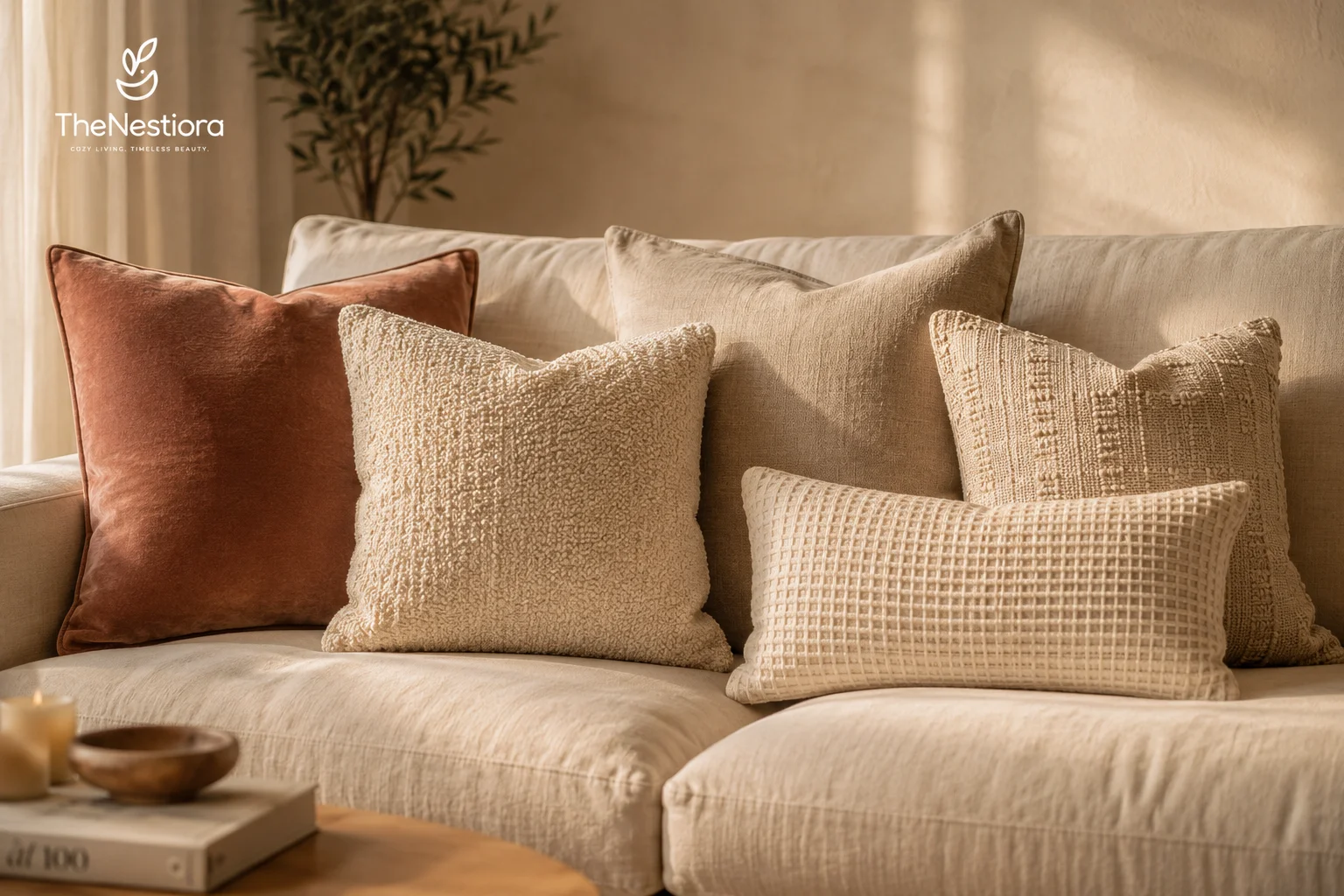
Five cushions stand in a row along this sofa, and the row functions as a tactile menu. From the left: rust velvet with a short dense pile, open bouclé in oatmeal, washed linen in natural, a second textured oatmeal weave, and a long waffle lumbar across the front. The timber side table in the foreground holds a turned wooden bowl on a book beside a small lit candle, adding turned wood and flame to the count.
The lesson is that variation belongs in the hand, not on the colour chart. Every cushion sits within one warm neutral family plus a single rust note, so nothing competes and the differences register as touch, not pattern. Velvet against bouclé is the pairing that carries it: one pile lies flat and drinks the light while the other loops it back, and set side by side they make each other look more like themselves.
Cushion people usually buy too many of one finish, often four smooth velvets that slide about and photograph as one long bolster. Mixing the weave solves the sliding as well, since napped and looped surfaces grip each other where silk-smooth ones slip. Sensible outlay stays modest: velvet covers from Zara Home run £30 to £50 in 2026, bouclé and waffle from Dunelm £10 to £25, and a turned acacia bowl of the kind shown costs £20 to £40 from Nkuku. Covers with hidden zips wash better than piped ones, so check the fastening before falling for the front.
Put the light below eye level
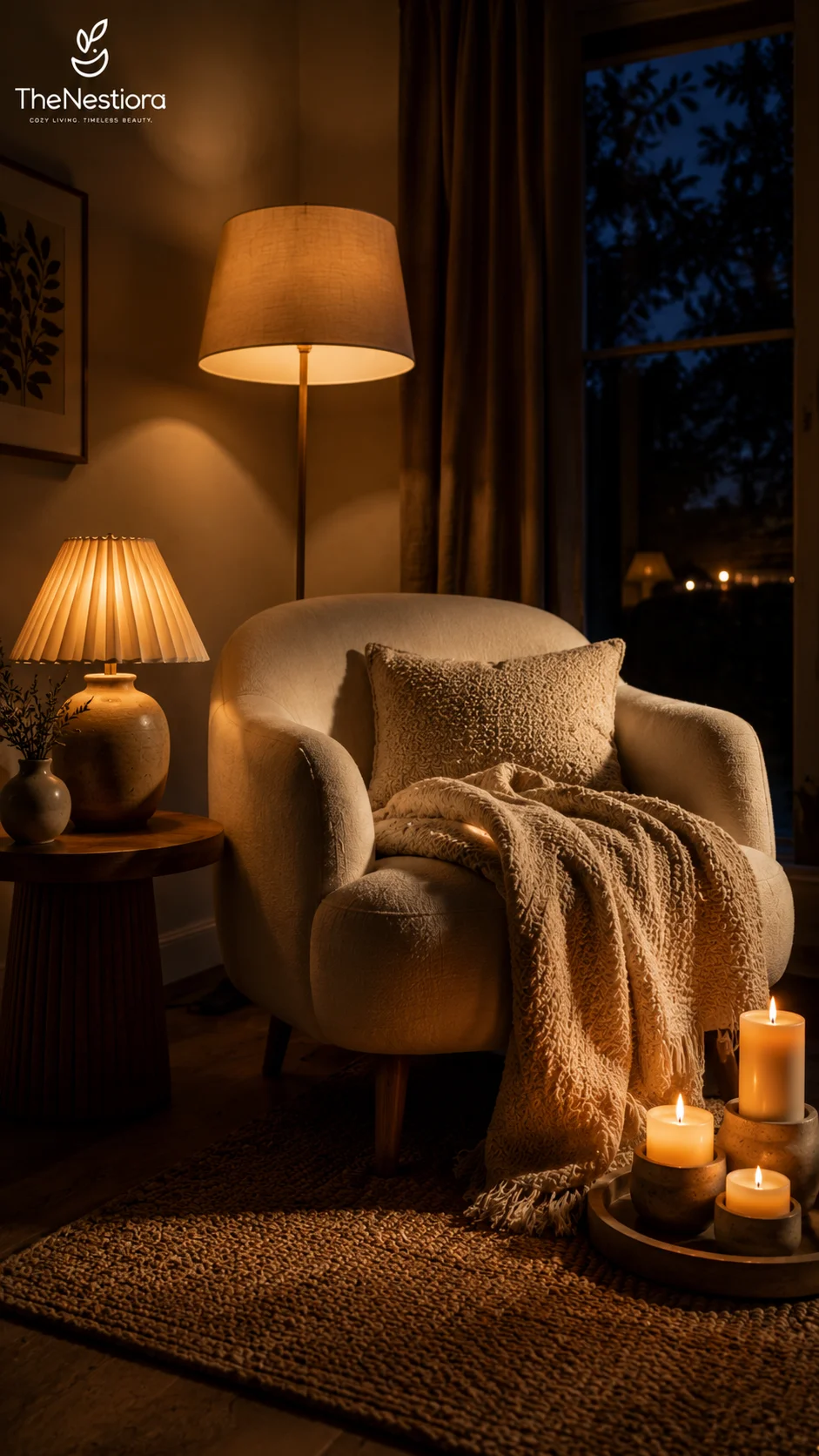
Night has fallen in this frame and the room is running entirely on low light. A floor lamp with a tapered drum shade burns behind the chair at one side, a smaller pleated lamp glows on a round side table at the other, and three pillar candles stand on a tray at floor level in front. No ceiling fitting is lit. The window behind the curtains has gone dark, and the walls have dropped away into shadow.
The effect follows a simple rule about height. Every source here sits at or beneath the eyeline of a seated person, so faces and fabrics are lit from the side and below instead of from overhead. Downlight flattens everything it touches and throws shadows into eye sockets; side light models faces kindly and lets each pool fade into darkness at its own edge. Those overlapping pools are what give the corner its depth after dark.
Cressida’s governing measurement for this is a count: three to five low sources per seating area, each on its own switch or a dimmer, all with matching warm bulbs. Mismatched colour temperatures undo the whole arrangement, because one cool lamp among warm ones reads as a streetlight indoors. Standard warm LEDs suit the job at 2700K, and a pack of four GLS bulbs costs £8 to £15 in 2026. Pleated fabric shades of the kind shown run £25 to £45 from Dunelm, and they flatter candlelight better than any hard shade.
Warm bulbs change more than paint does
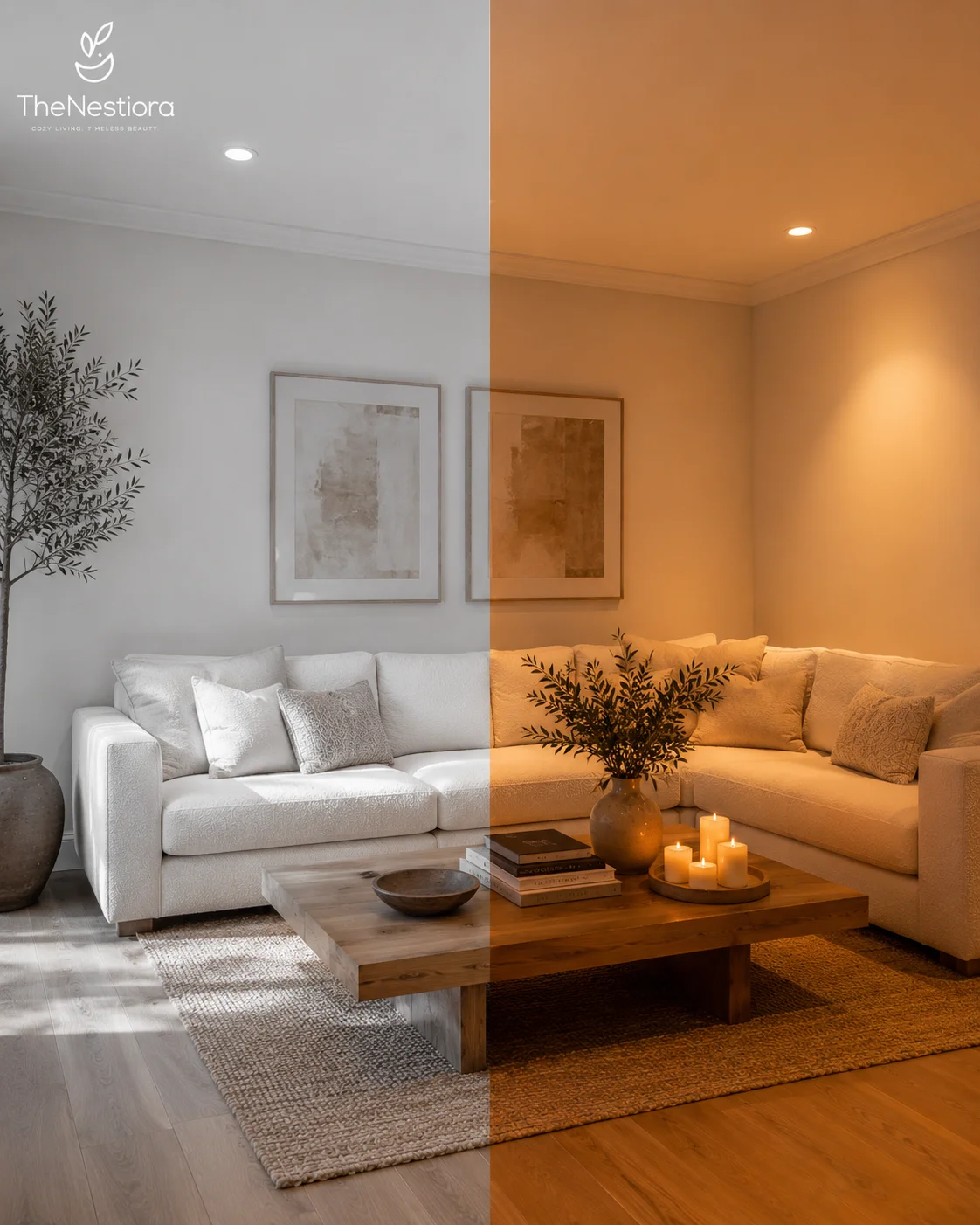
This split frame shows one room under two regimes, and the contrast settles a surprising number of arguments. On the left the space sits in cool daylight with ceiling spots on: pale grey floorboards, chalky walls, a white sofa that reads almost blue, an olive tree in a stone pot. On the right the same seating glows amber. Oak boards turn honeyed, the rug deepens, candles burn on the table, and the identical sofa looks upholstered in cream.
Nothing structural differs between the halves. The change is colour temperature plus light position, and it alters every surface at once, which repainting a single wall cannot do. Cool light above 4000K renders timber grey and flattens weave; candlelight around 2200 to 2400K gilds the same materials. The standard living room default of 2700K sits between the two and flatters skin, wool, and timber together. At 3000K the same room reads neutral, which suits a kitchen better than an evening sofa.
The practical move costs little and takes an evening. Ignore the words like warm white on the box and check the number printed on every bulb in the seating area, since much of what sells as warm measures 3000K. Replace the lot with matching 2700K dimmables, switch off the spots, and light two or three candles on a tray. Anyone renting gets the full benefit here without touching the walls, which is exactly why light belongs ahead of paint in the order of works.
Group candles instead of scattering them
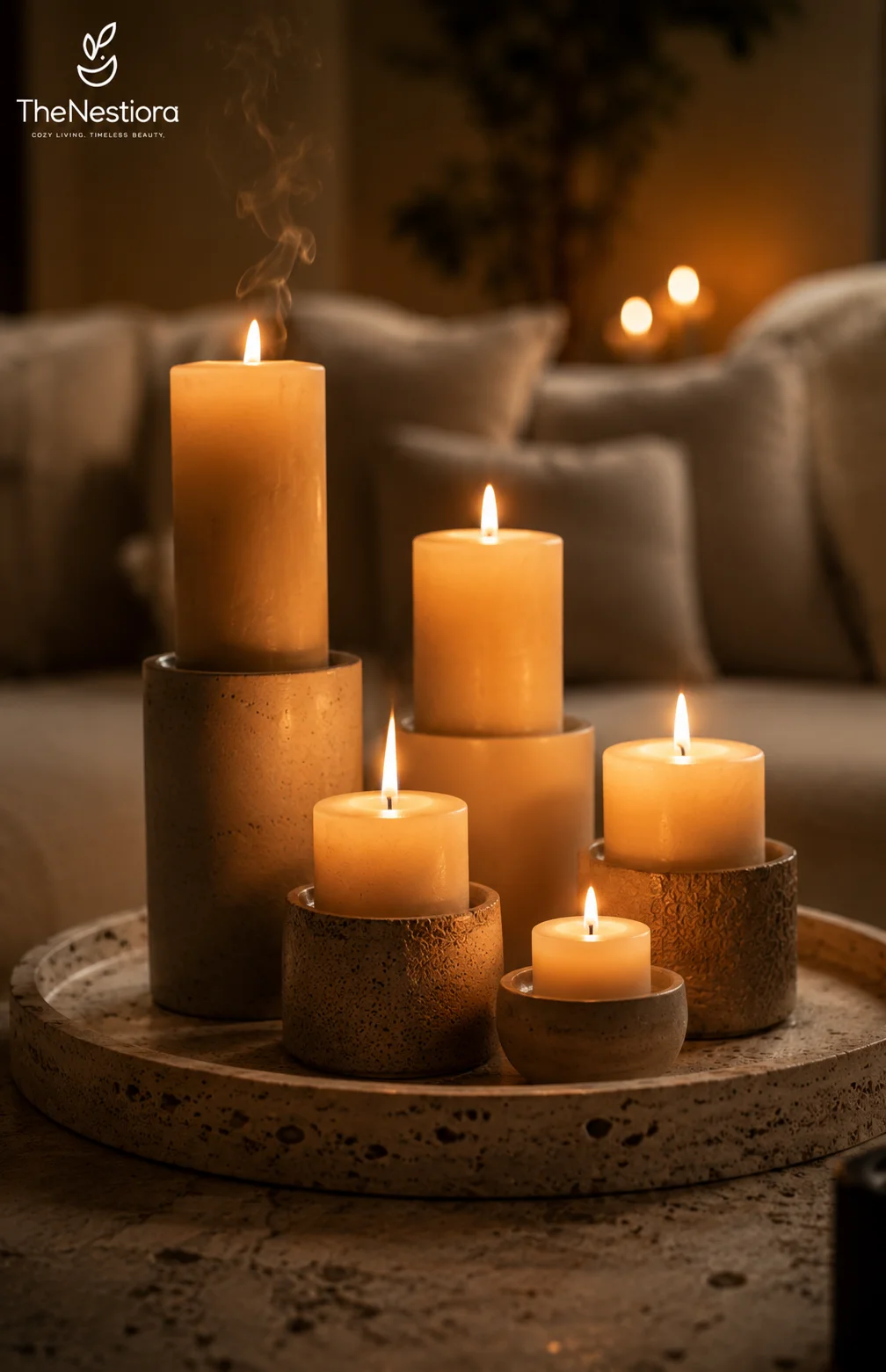
Five flames burn at five heights on one stone tray, and the grouping is the entire idea. A tall pillar stands in a travertine sleeve at the back, a medium one in smooth alabaster beside it, a short stump in a rough cast cup at the front, and two more filling the gaps between. The tray beneath catches wax and grounds the cluster as one object. Behind, the sofa sits softly out of focus with two more flames answering from the gloom.
A flame gives something no bulb can, which is movement. Fixed light, however warm, sits still; living light flickers, and the eye reads that flicker as company. Scattered singly about a room, candles lose this power and become maintenance. Gathered in odd numbers on one surface, they form a small hearth with a visible centre and edges, and the varying heights keep the silhouette interesting after the novelty fades.
Stone and travertine holders suit the purpose better than glass hurricanes. Glass throws hard highlights and shows every drip; stone absorbs the glow and hides sins. Unscented pillars work best for the main group so the cluster can burn through supper, with any scent kept to a single candle elsewhere. Five ivory pillars cost £10 to £25 in 2026 from most supermarkets, and cast stone holders from Nkuku run £20 to £40 each. Never leave the tray burning unattended, and keep the whole arrangement clear of linen throws.
Let the fire set the seating plan
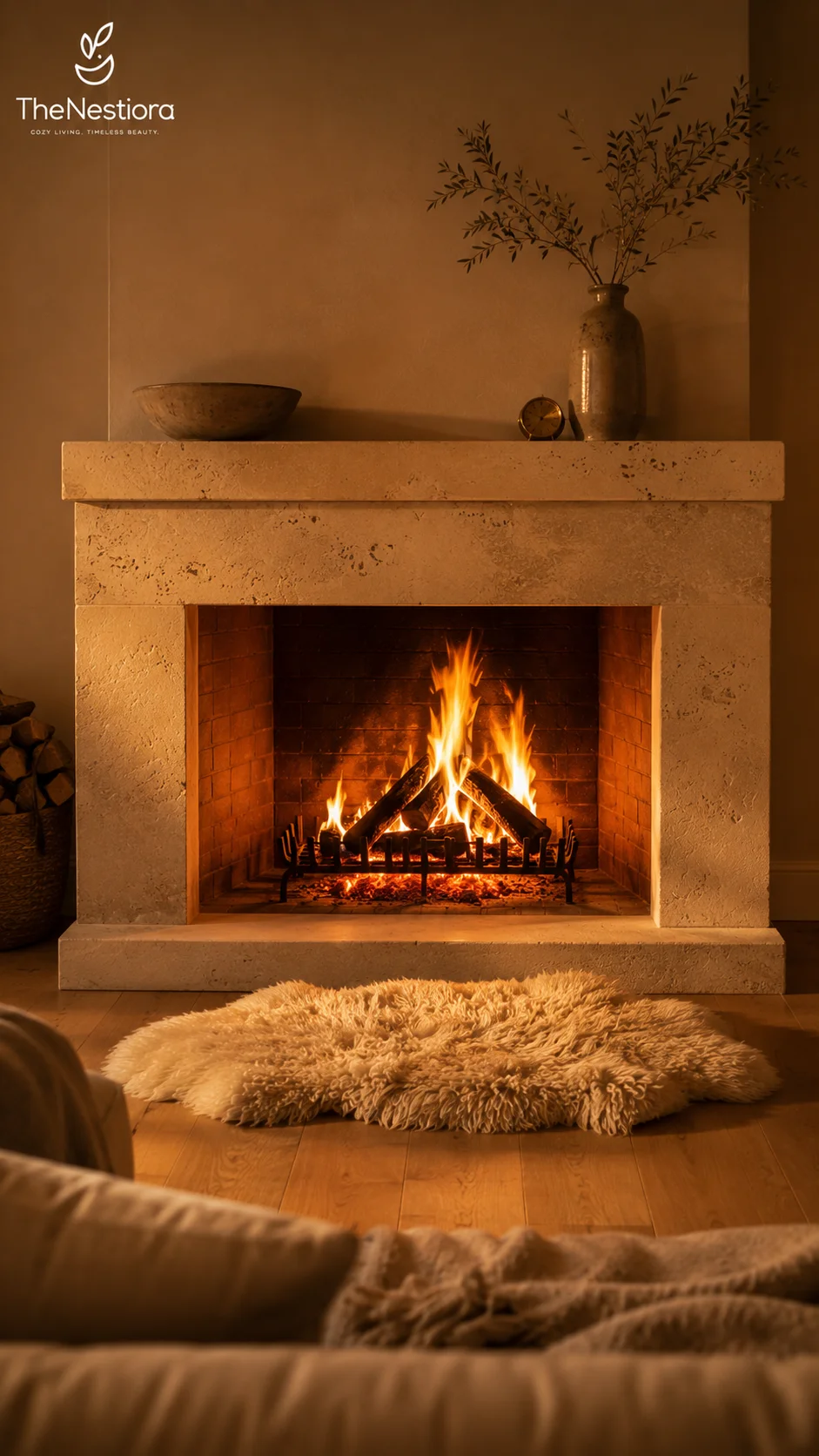
The fire in this limestone surround is doing what fires have always done, which is telling the furniture where to stand. Flames rise between even logs over a grate, light washing across the honed surround and the brick chamber behind. Before the hearth lies a single sheepskin, its long fibres lit from above. On the mantel sit only three things: a wide shallow bowl, a small brass disc, and a tall vase of dried stems. A basket of logs waits at the side.
The seating arrangement around such a hearth matters more than the surround material. Chairs turned toward the flames share one focal point and one conversation; a sofa aimed at a screen with the fire burning sideways gets the smoke without the communion. The sheepskin earns its place on hard hearthstone for a physical reason: stone draws heat from bare feet while wool returns it, so the rug is where people actually settle with a glass.
Rooms without a working flue can borrow the geometry. A cluster of large pillars inside an empty grate, or a low lamp with a warm shade standing in the same corner, gives seats somewhere to face. The mantel rule travels too: three objects of different heights beat a full row of small frames, because the eye needs empty stone to register the fire below. Genuine sheepskins from IKEA cost £35 to £60 in 2026, with larger New Zealand fleeces at £80 to £150 from sheepskin specialists. Shake them outside monthly; washing mats the fibres.
Start from a warm white wall
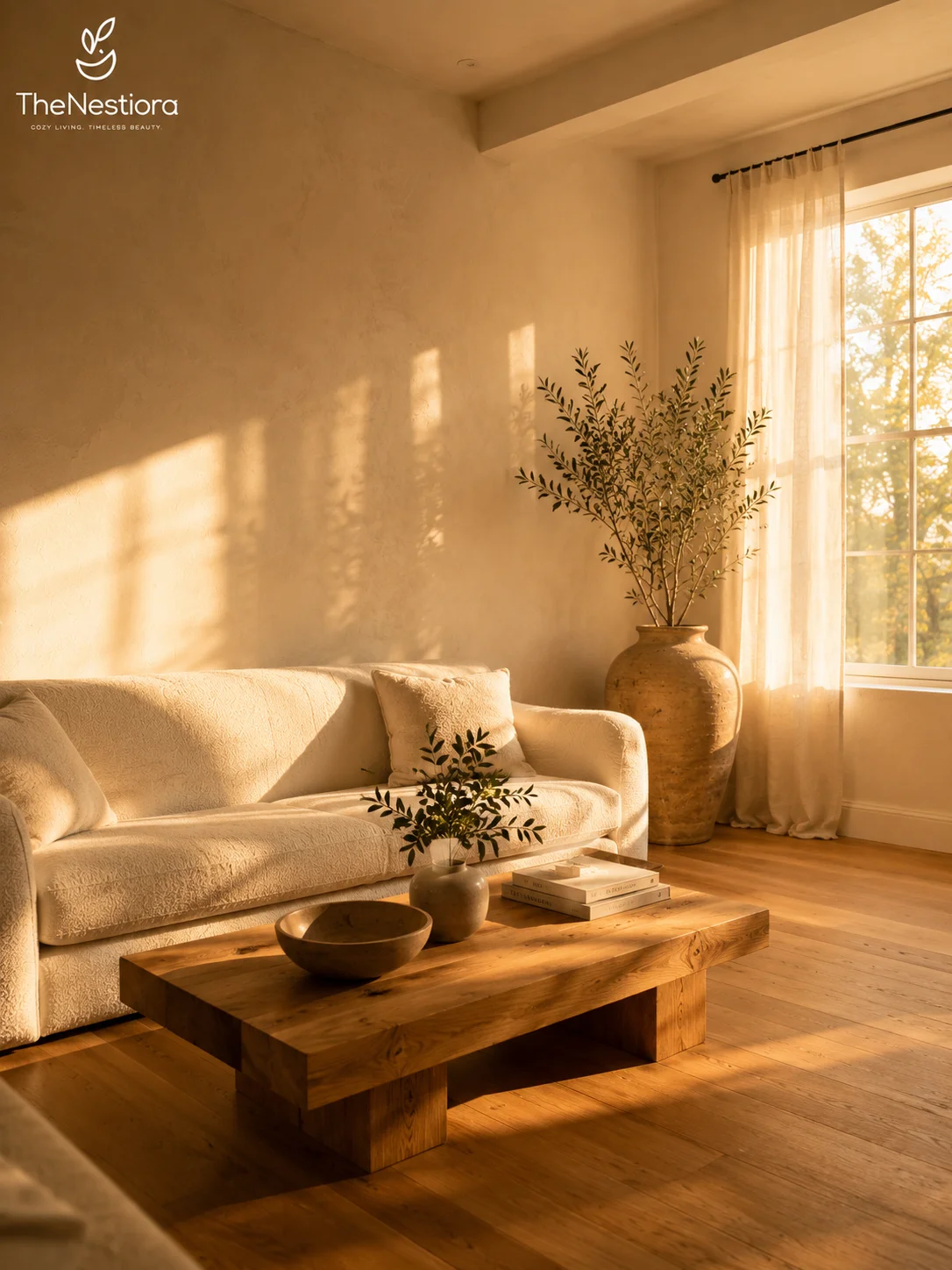
Afternoon sun crosses this wall and shows exactly what warm white means. The plaster carries a breath of yellow and grey, visible where the light falls beside the window, so the surface reads as milk beside paper. Against it sits a compact bouclé loveseat with two plain cushions, and before that a blocky timber table holding a wide bowl, a small potted plant, and a stack of books. A huge terracotta urn of olive stems anchors the corner.
The wall colour is load bearing here despite looking like nothing. A pure brilliant white with a blue undertone would throw the same textiles into contrast and make them read dingy, which is the failure behind many grey-looking neutral rooms. Warm white steps aside instead. The textiles keep their honeyed cast because the wall shares it, and the timber table looks richer for the same reason.
Testing beats theory with whites. Hold a sheet of printer paper against the candidate: the right white looks faintly creamy or dusty beside it, while a cool one looks cleaner and brighter. Paint a large sample and view it at night under the room’s own 2700K lamps, since daylight flatters whites that turn chalky after dark. Colours in the right family include Farrow & Ball White Tie and Pointing, and Little Greene Slaked Lime; sample pots run £5 to £8 in 2026 with 2.5 litres at £30 to £55. One honest caution: in a genuinely dark room even warm white goes mushroom, and a deeper earth tone usually serves better.
Repeat one earth colour three times
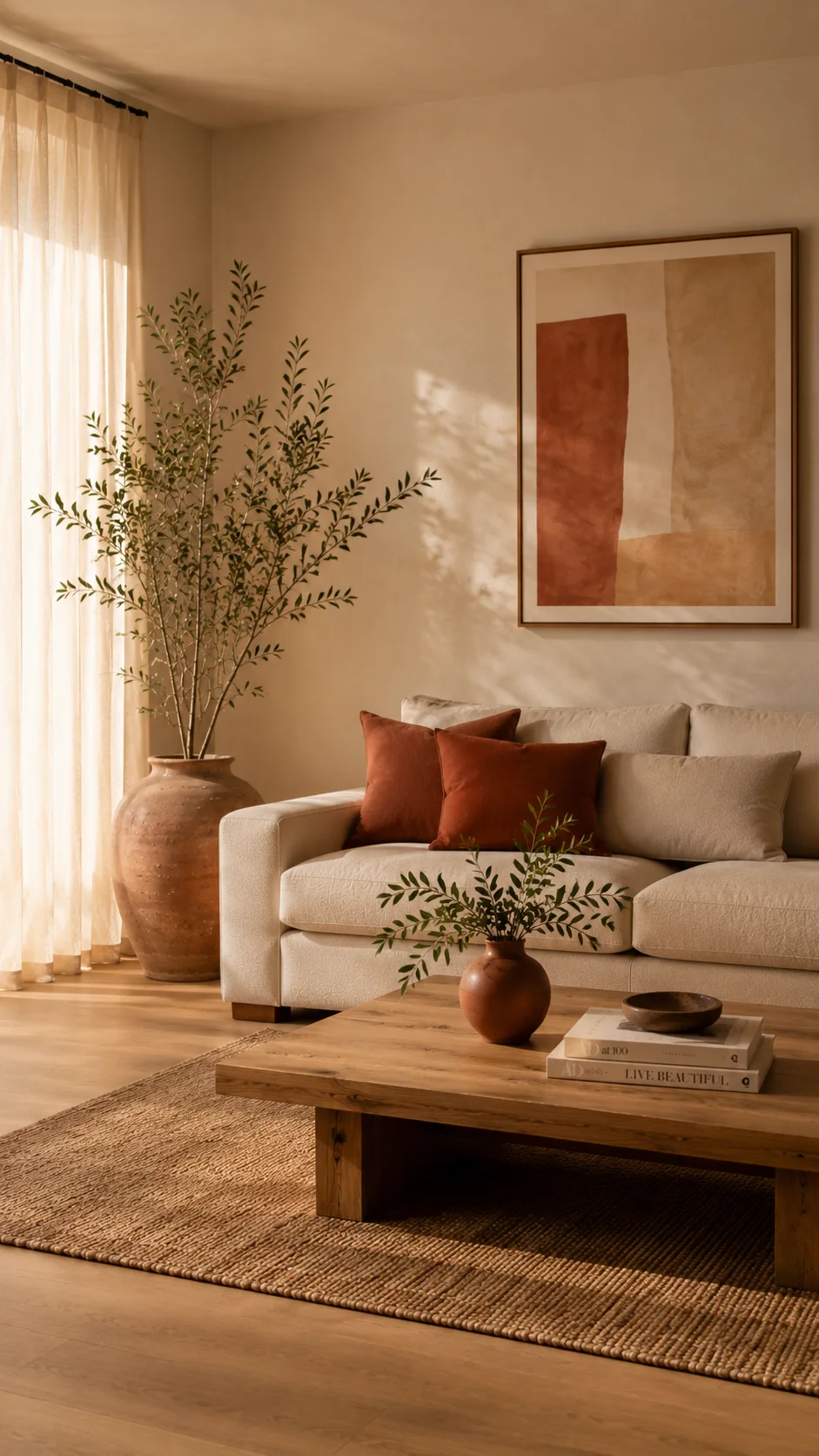
One colour leaves this neutral room at exactly three points, and counting them is instructive. Two rust cushions sit against the cream sofa, one large and one small. A small terracotta vase holding green stems stands on the block timber table. Above the sofa hangs a framed abstract with a single broad rust shape echoing both. Large, small, and flat: three scales, one pigment family.
The discipline matters because warm neutrals flatten without a point of contrast, while two or three competing accents turn the same room busy. A single earth note repeated thrice reads as decision. The eye travels from cushion to vase to print and back, and that small journey is enough to keep cream, jute, and pale timber from merging into beige. Olive stems in the giant urn and the green weed in the small vase supply the only other colour, and green scarcely counts since the eye files foliage as neutral.
Terracotta, rust, ochre, and deep olive all play this role well; clear brights do not, since they argue with the quiet around them. Anyone shopping the look should buy the smallest object first and live with it for a week, because a £15 to £30 vase from H&M Home in 2026 is cheap to get wrong while a pair of £40 to £70 rust velvet covers from Zara Home commits harder. Art comes last. A framed giclée with one rust shape costs £25 to £60 from high street framers, and it should pick up the pigment already in the room instead of introducing a new one.
Who this will not suit
Households with pale bouclé and small children, or a dog. Bouclé traps everything, shows every mark, and is difficult to clean because the loops catch. A tight flat weave in a mid tone gives you most of the same feeling and survives contact with real life.
It also suits rooms with reasonable natural light better than genuinely dark ones. In a dark room, this palette goes grey and slightly dingy. There, a deeper colour on the walls usually works better than more cream.
Frequently asked
Frequently Asked Questions
Why does my cream room look flat instead of cosy?
Matching the shade is only half the task. A flat finish reflects light evenly, so cream paint, smooth cotton, glass and polished boards together stay crisp instead of soft. Bring in looped, knitted, braided and rough sawn surfaces in the same tones, then drop the lamps low so evening light rakes across them.
How many low lamps does a sitting room need?
Three to five sources around the seats, each shaded and set at or beneath eye level when seated, usually does it. Fit every one with the same 2700K dimmable bulb, switch the ceiling fitting off, and add a tray of pillar candles for movement. A single cool lamp left in the mix will undo the rest.
What is the best value rug change for comfort?
Keep or buy a big plain foundation in jute or sisal that reaches under the front legs of the seats, then lay a smaller soft piece where feet land. The base supplies area for little money and the upper layer supplies softness, which together cost far less than one huge hand knotted carpet.
Can tenants get this look without painting walls?
Most of it, yes. Landlord friendly moves carry the effect: shaded lamps with warm bulbs, a large textured rug, mixed weave cushions with one rust note, three throws in different weights, and grouped candles on a tray. None of these touch the walls, and all of them move house when you do.
Which cushion mix stops a pale sofa looking bland?
Five covers in different hands within one cream family plus a single rust or ochre note, for instance velvet, bouclé, washed linen, waffle and one smooth cotton. Napped surfaces grip each other and hold their stance, while identical silky ones slip into a row. Washable covers with concealed zips earn their keep.
Must there be a working fireplace for a hearth feel?
No. Seats need a warm point to face, and that can be a bunch of large pillars in an empty grate, a low shaded lamp in the same corner, or a tray of candles on the table. Face the main chairs toward that anchor and leave the screen secondary. The orientation matters more than the fuel.
Where to start
- Count the materials in your room; if there are fewer than four, that is the problem.
- Stay in one narrow colour range and vary the surfaces instead.
- Change the rug first, then the curtains, then one large upholstered piece.
- Add one or two smooth or reflective things so the room is not uniformly soft.
- Use lamps at low level with warm bulbs instead of a ceiling light.
This article may contain affiliate links. We may earn a commission at no extra cost to you.