12 Balcony Garden Ideas: Wind and Weight Decide the Planting
Add us as a preferred source to see more stories on Google.
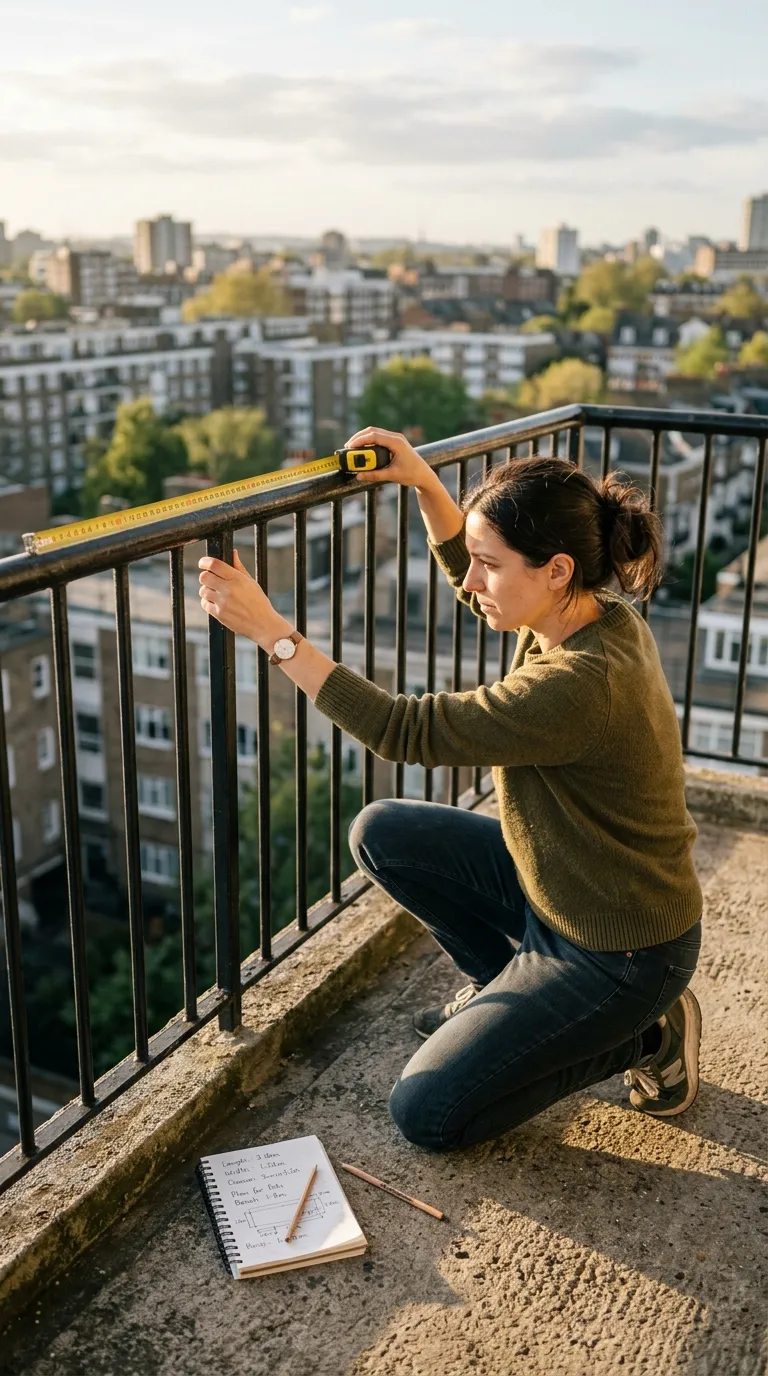
Measuring first is sensible, and the photograph below has the right instinct. The two measurements that matter most, though, are not the ones being taken.
Look past the tape measure at where this balcony is. Several storeys up, open on three sides, nothing taller nearby. That is a genuinely different growing environment from the garden at the bottom of the building, and plants do not care that it is only twelve metres higher.
What wind actually does
It is not the gusts that kill things. It is the constancy.
Moving air pulls moisture out of leaves faster than the roots can replace it, which is why a plant on an exposed balcony wilts on a breezy day that is not especially hot. In a pot, with a limited reservoir, that turns into genuine drought stress within hours.
Wind also strips heat. A balcony at height is effectively a colder place than the ground-level garden nearby, sometimes by enough to matter over winter. Plants rated as borderline hardy for your area will often not make it through up there.
And large soft leaves tear. Hostas, hydrangeas and anything with a big flat leaf will look shredded by midsummer.
What copes with it
Small leaves, tough leaves, or flexible stems. The plants that do well on exposed coasts do well on balconies, for the same reasons.
| Plant | Why it copes |
|---|---|
| Lavender, rosemary, thyme | Small tough leaves, want dry roots anyway |
| Ornamental grasses | Bend rather than break; move beautifully |
| Pittosporum, hebe, euonymus | Dense small-leaved evergreens |
| Sedum and sempervivum | Store water; almost indestructible |
| Pelargoniums | Thrive on heat, sun and neglect |
| Bamboo, clumping kinds | Flexible; gives height and screening |
What to avoid unless the balcony is genuinely sheltered: hydrangeas, hostas, acers, ferns and most large-leaved tropicals. They are all good plants in the wrong place.
The weight question, honestly
Saturated multipurpose compost is around 1kg per litre. A 40cm pot holds roughly 40 litres, so it weighs about 40kg full, plus the pot and the plant.
Six of those along a railing is a quarter of a tonne in a concentrated line, and balconies have load limits, particularly on older buildings and particularly at the outer edge.
This is not scaremongering, and it is also not something to guess at. If you are planting more than a few modest pots, ask the building manager or a structural engineer what the balcony is rated for. Most are fine for ordinary use; the point is knowing instead of assuming.
Practical ways to reduce it: keep heavy pots against the wall, not at the railing, use a peat-free compost with added perlite or bark to lighten it, and choose fibreglass or plastic containers instead of concrete and stone.
Containers that suit the position
Low, wide and heavy at the base. Tall narrow pots blow over, and a broken pot on a balcony can go over the edge, which is a different order of problem.
Terracotta looks right and dries very fast in wind, which is either helpful for Mediterranean planting or fatal for everything else. Glazed ceramic holds moisture far better. Fibreglass is light, which is good for weight and bad for stability.
Whatever you choose, put pot feet or a tray underneath. Standing water on a balcony surface causes staining and, on a shared building, complaints from below.
Railing planters are excellent for space and need proper brackets rated for the load, checked at the start of each season. A planter that comes off a railing at height is a serious matter.
Watering, which is the real commitment
An exposed balcony in summer will need watering daily, and often twice. This is the single most common reason balcony gardens fail: the plants are fine and the schedule is not.
Water-retaining granules help modestly. A larger pot helps more, because volume buys you time. A simple gravity drip kit from a bottle, or a battery timer on a tap if there is one, helps most of all.
If you are away regularly, plant sedums, sempervivums and grasses and accept that pelargoniums and herbs are for people who are home.
Leave the middle empty
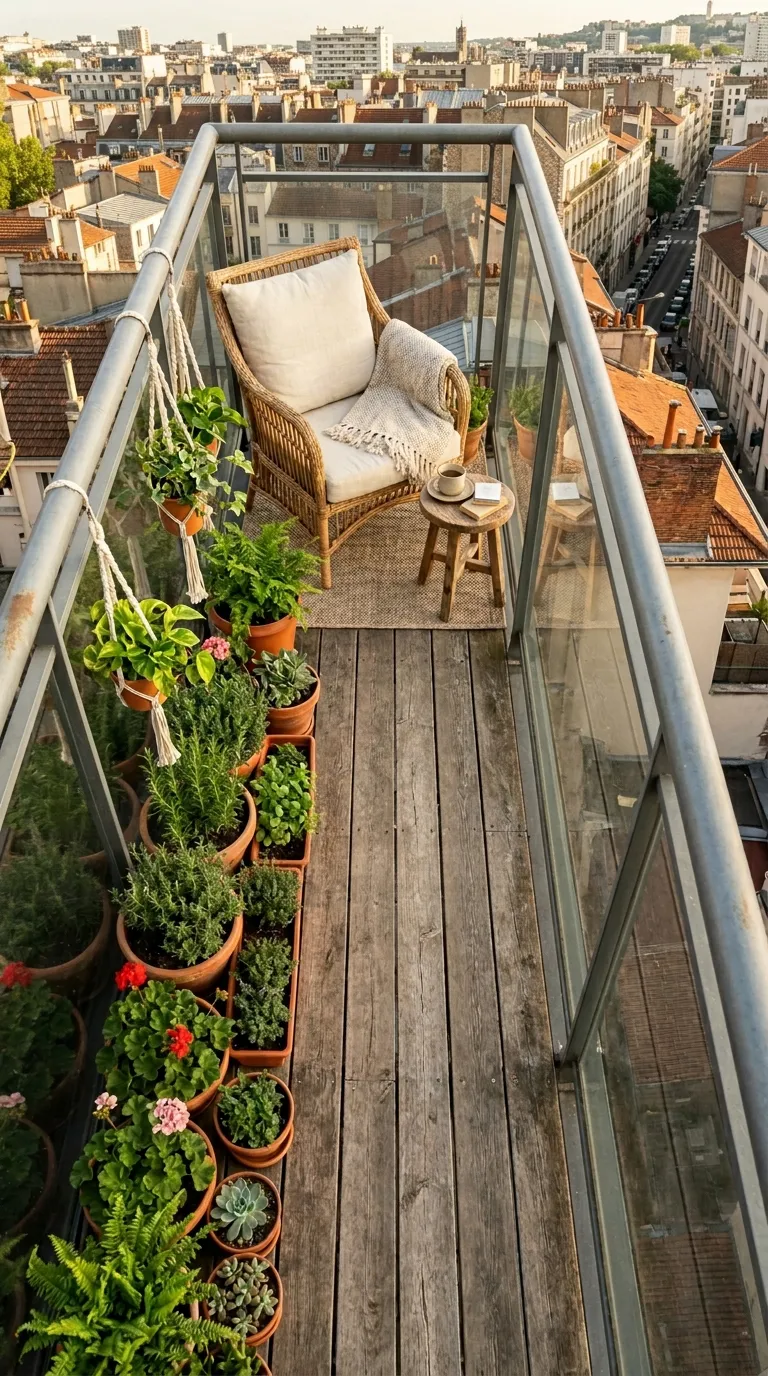
Follow the boards to the far end and notice what is not there. No pots in the centre, no table blocking the walk, no planting where feet need to go. The floor reads as one clear run, and that is why the space feels larger than its measurements suggest.
On a balcony the floor is the scarcest resource, and it is also the one that carries weight. Spreading pots across the middle puts load where the slab is most exposed and forces you to step around compost every time you carry a watering can. Keeping planting to the edges does two things at once: it leaves a usable passage and it keeps the heaviest objects near the wall, where the structure is generally stiffer.
Look at the line of terracotta along the left edge. Narrow rectangular troughs, repeated, roughly 40cm long, with herbs, ferns, geraniums and sedums tucked close. The same material repeated is deliberate. Varying the pots would have chopped the row into pieces; repeating one keeps it as a single border. Terracotta troughs of that size cost around £12 to £22 each in 2026, and the jute runner under the chair is typically £25 to £45 for a 70 by 140cm size in 2026.
The hanging planters on the rail add the second move. Two macramé hangers, each holding a pothos and a fern, give green at eye level for no floor area at all. Ready-made hangers run £10 to £18 in 2026, and a good pothos in a 12cm pot is £8 to £14. The mechanism is simple: foliage up high moves in the wind instead of fighting it, and it dries a little slower than the same plant sitting on a hot deck.
If this were your balcony, try this proportion: keep at least 600mm clear down the centre for walking, push the largest pots against the back wall, and let the railing carry the smallest. A balcony that keeps its centre open gets used. One that fills it tends to be looked at from the doorway.
Use the railing before the floor
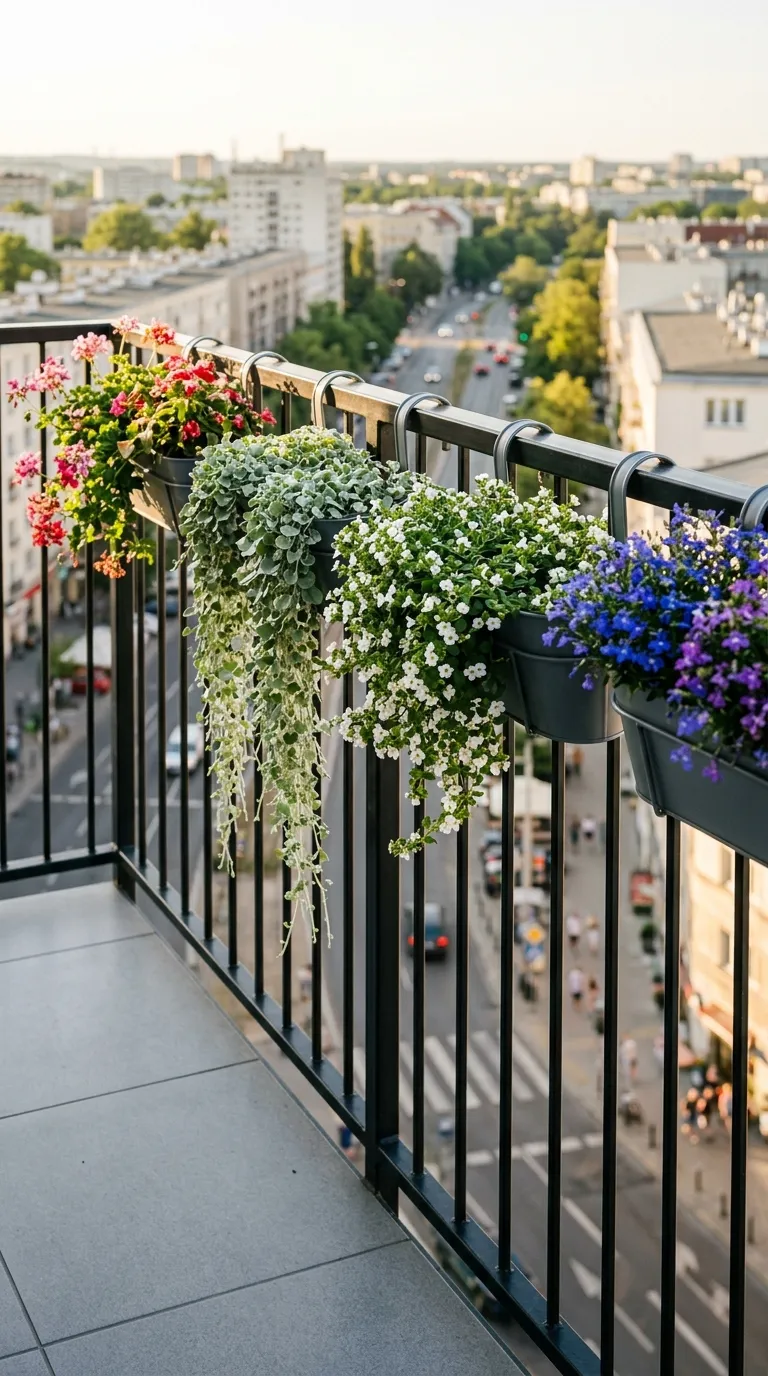
The planters tell the story before the flowers do. Four troughs, each clipped over the top rail on sturdy hooks, none touching the floor. That is the whole lesson, because a railing you plant is planting you have not had to find floor for, and on a narrow balcony that matters more than any other decision.
Look closer at what is actually thriving there. White bacopa spilling over the front, a silvery Dichondra argentea trailing a handswidth past the rail, deep blue lobelia tucked in at the corner, and red pelargoniums behind. Every one of them has small leaves that let wind pass. None has a large flat leaf that would shred or act as a sail. Where a balcony faces a road and the wind is constant, that choice is what separates a planter that still looks good in August from one that was cut back in July.
The hooks matter as much as the plants, and this is the place to be particular. A planted trough of this type holds about 12 to 15 litres of compost when full, so roughly 12 to 15kg per trough plus the container. Cheap over-rail hooks bend, and a trough that drops from height is not a gardening problem. Elho Barcelona and Lechuza Balconera troughs with their dedicated metal brackets are widely stocked and sit around £18 to £28 per trough and £12 to £20 for brackets in 2026. Check the bracket screws at the start of each season, and again after a storm.
If you copy the planting, keep the colour tight. Three colours plus green would have read as busy in a space this narrow; here it is really white and silver with a single blue accent and a small lift of red, which holds together when the plants move.
A wall pocket that adds green without floor space
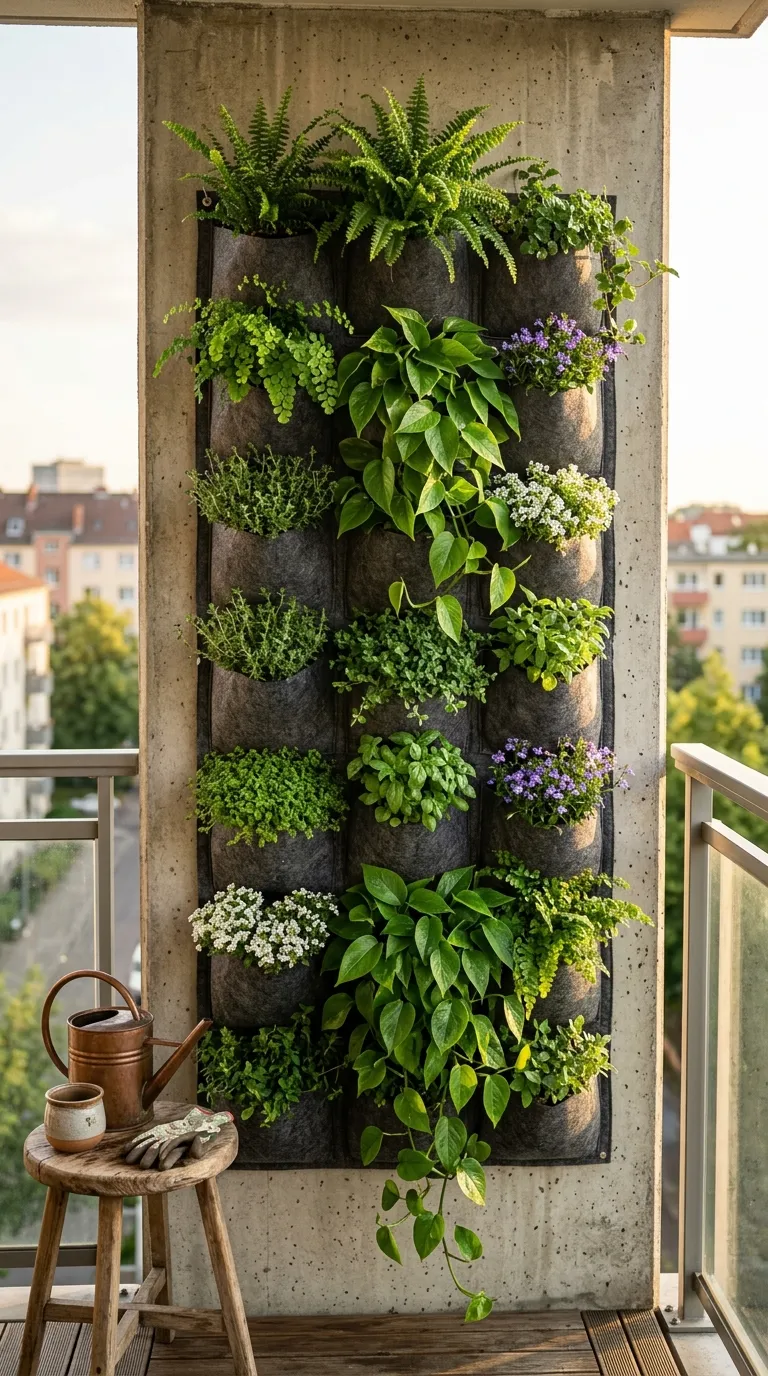
The concrete wall in this photograph has been turned into a garden without taking a single centimetre of floor. The pocket panel is fixed directly to the wall, divided into about twenty felt pouches, each holding a different plant. At the bottom, a copper watering can and a small stool tell you the scale, and the whole thing reads as a tapestry rather than a set of pots.
Notice where this panel sits. This is the solid wall, not the open glass side. Wind hits the glass and funnels along it; against the concrete it eddies and is slightly calmer. Small-leaved woodland plants near the top, where it is brighter and drier, and larger pothos cascading down the front where they are a little shaded, survive longer than they would strung along the rail. In most cases a vertical panel on the sheltered wall will outperform the same plants spread across the floor.
There is a watering mechanism to understand before buying. The top row dries first, because it catches more sun and wind, while the bottom row stays wetter longest. A single pour from a can does not even it out; water runs down the face of the felt. Systems that include an internal drip line along the top, such as Florafelt or Woolly Pocket 18-pocket panels, distribute more evenly and cost roughly £55 to £90 for the panel alone in 2026, plus a pressure regulator if you connect to a tap. The felt itself is usually recycled PET, which holds moisture while allowing air to the roots.
We do not really know how long felt pockets last in full sun. Manufacturers quote five to eight years; gardeners in coastal wind report closer to four before the upper pockets stretch. Treat it as a planting that can be re-lined, not as a permanent fixture, and do not use a living wall to hide a damp problem when fixing the damp is the job.
Count the sun for a day, not a guess
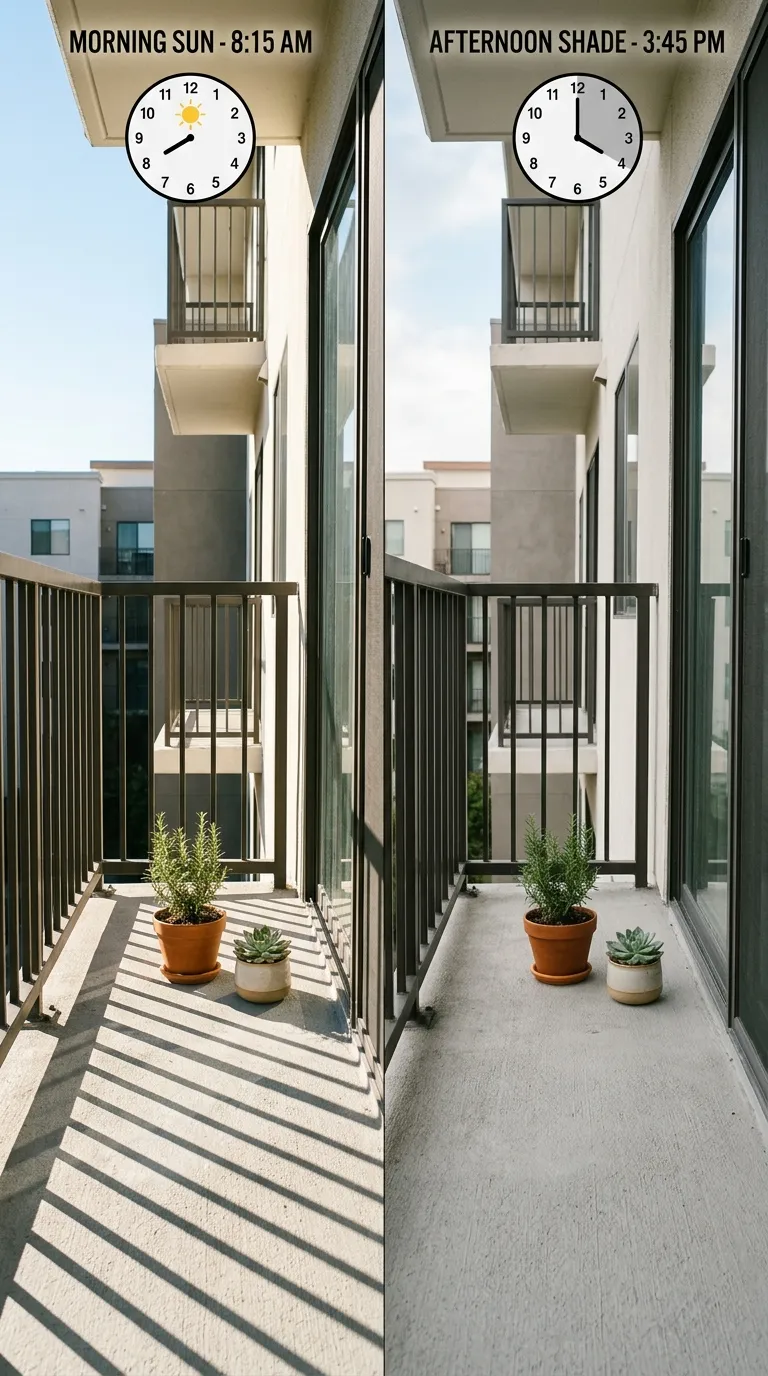
Two photographs of the same bare balcony, taken hours apart, and that is the point. On the left at 8.15 am the floor is striped with railing shadows and the rosemary pot sits in full sun. On the right at 3.45 pm the same floor is softly lit but direct sun has gone. Only the second picture tells you what that wall and that railing actually offer.
On a balcony, light is not a feeling. It is hours of direct sun on the compost, and it decides whether a plant merely survives or thrives. Rosemary, lavender and pelargoniums want six or more hours to flower well; ferns, hostas and ivy will sulk in that same place and prefer the two to three hours of the shady afternoon. The photograph makes the mechanism visible: building height opposite, railing orientation, and the overhang above all cut the sun before it reaches the floor, and that changes seasonally as the sun rises higher.
Two pots sit waiting for a decision. A rosemary in terracotta and a small echeveria in a pale pot, both sitting where the light is marginal after midday. Moving them a metre toward the glass would add an hour in most orientations; moving them to the other end of the balcony could add three. Light on a balcony is local, and a general statement such as north facing or south facing is less useful than sitting out there with a notebook.
A practical way to do it: on a day you are home, note when direct sun hits the floor and when it leaves, hour by hour. Two readings, morning and afternoon, catch most of the pattern, and a free compass app will tell you the aspect. If you consistently get under three hours, treat the balcony as shade and choose accordingly; that one decision avoids more replacements than any fertiliser. White walls, as shown here, bounce a little light back in, roughly ten to fifteen percent in measured trials, though the RHS notes the benefit is modest where the overhang is deep.
One chair that earns the space
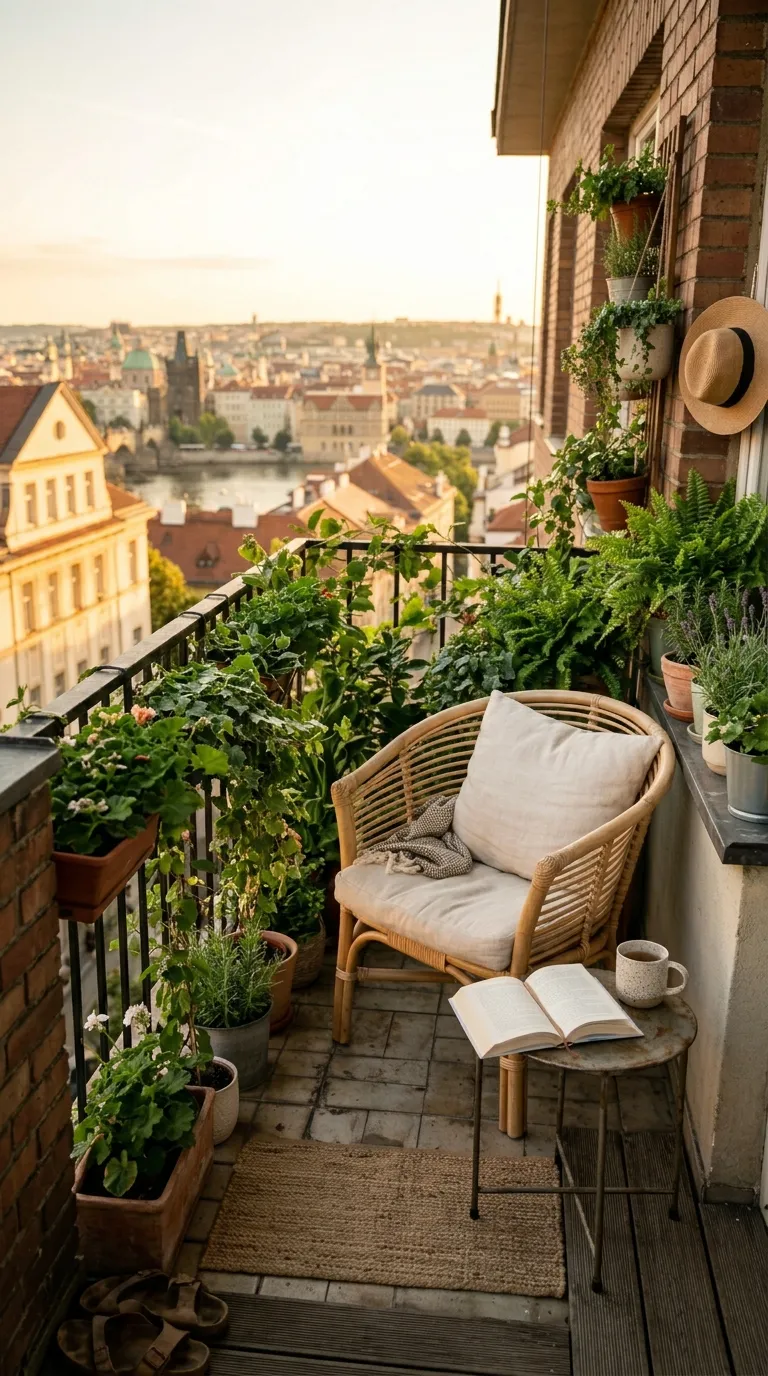
See how the chair sits, not in the middle but tucked where two walls meet, with planting on three sides. The book is open, the mug is still warm, and the chair is the reason anyone would step out here at all. Without a place to sit, a balcony remains a display you look at through glass.
There is a weight and wind logic to one good chair. Two chairs plus a table double the furniture footprint and double the number of times you have to move pots to pass. A single rattan tub chair with a small metal side table, as here, leaves the floor to breathing space while giving you somewhere you will actually stay. The chair in the photograph is a classic Lloyd Loom style, and decent copies run £120 to £250 in 2026, with a folding bistro table at £35 to £70.
Look at the pots around it. They are not balanced for show; they are denser on the windward side near the railing, where taller foliage breaks the draught before it reaches your shoulders. Ferns and pelargoniums near the back wall are slightly sheltered, while the lower herbs along the rail move but do not snap. That arrangement is not accidental; it follows what wind does on an exposed corner, where air accelerates around the edge of the building. Placing the chair in the lee of that planting buys you a degree or two of comfort and a little less drying on the leaves.
The rug underfoot is doing quiet work too. A woven jute or polypropylene runner softens the stone and stops pots grinding. An outdoor rug of this size typically costs £30 to £60 in 2026. Choose one rated for exterior use, because an indoor jute will hold water against the slab.
If you have room for only one seat, put it where you want to linger longest in the evening, not where it fits most neatly on a plan.
Warm light that brings you out after dark
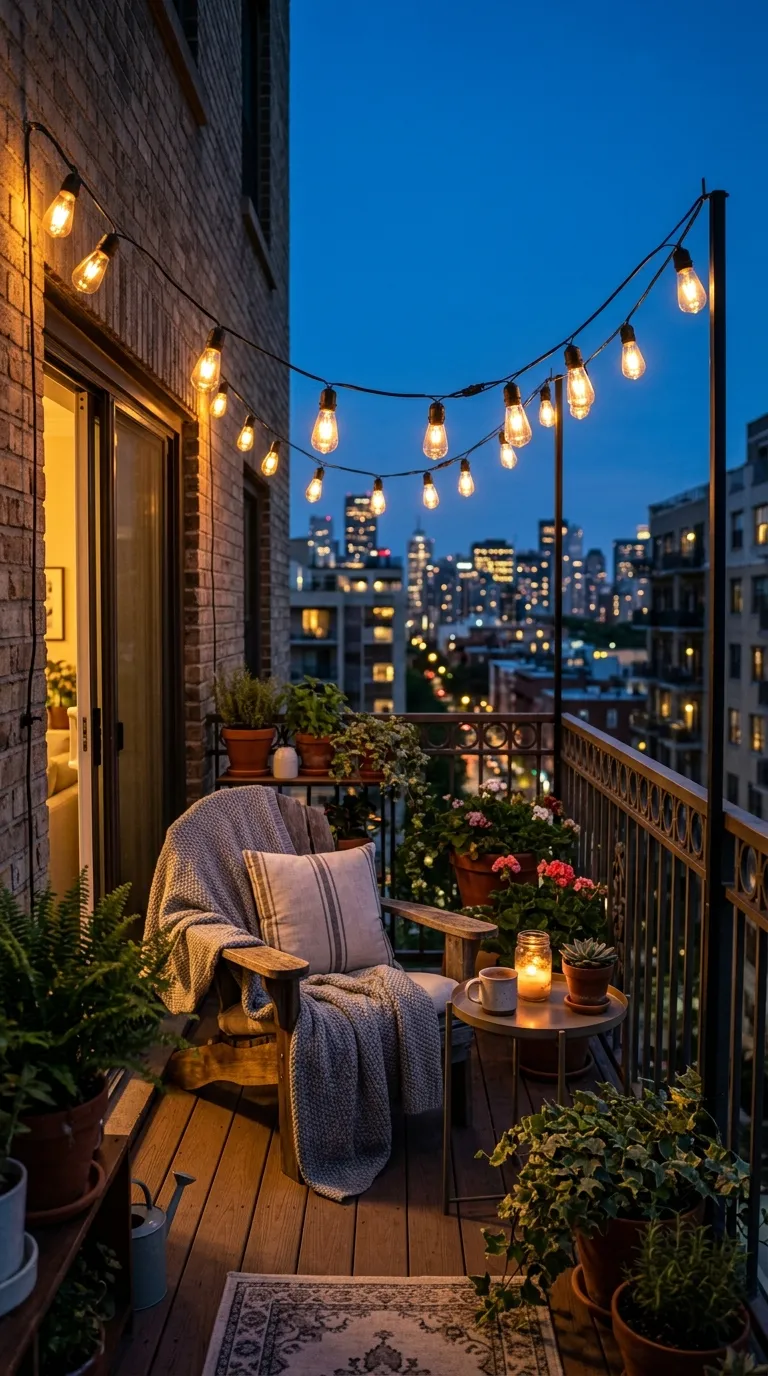
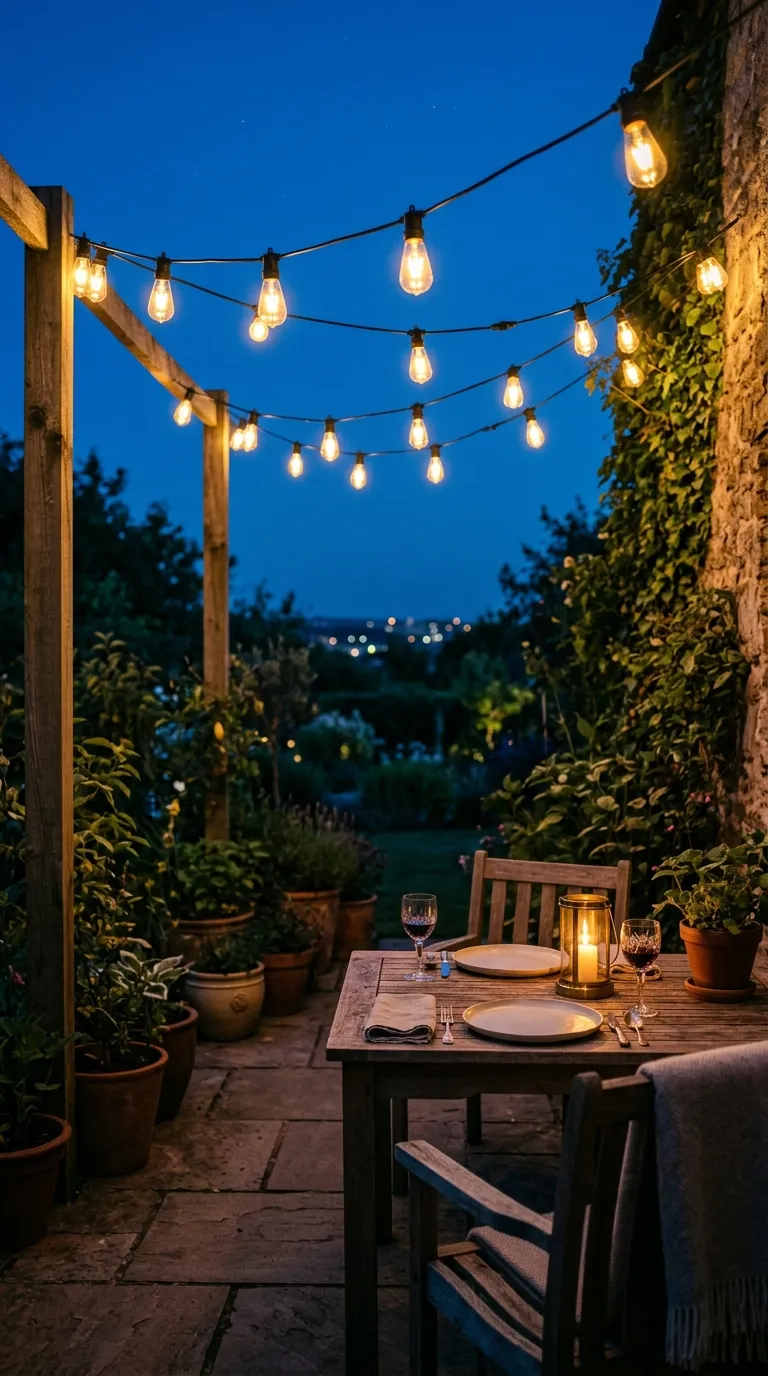
The bulbs are the subject here, even more than the plants. Warm white festoon lights strung in a gentle curve overhead, about two metres above the deck, throwing a pool of light that makes the brick warm and the city beyond go blue. At that colour temperature the foliage looks green rather than grey, and the chair looks like somewhere you would sit with a blanket even though the air has cooled.
A balcony at height has little natural shelter once the sun goes, and in Britain that is when you are most likely to use it in summer. Light changes the behaviour. Without it, an evening outside ends when the sky dims; with it, the space holds you for another hour. The mechanism is simple: light that is warm, low and at sitting height keeps the eye inside the balcony rather than sending it out to the dark skyline.
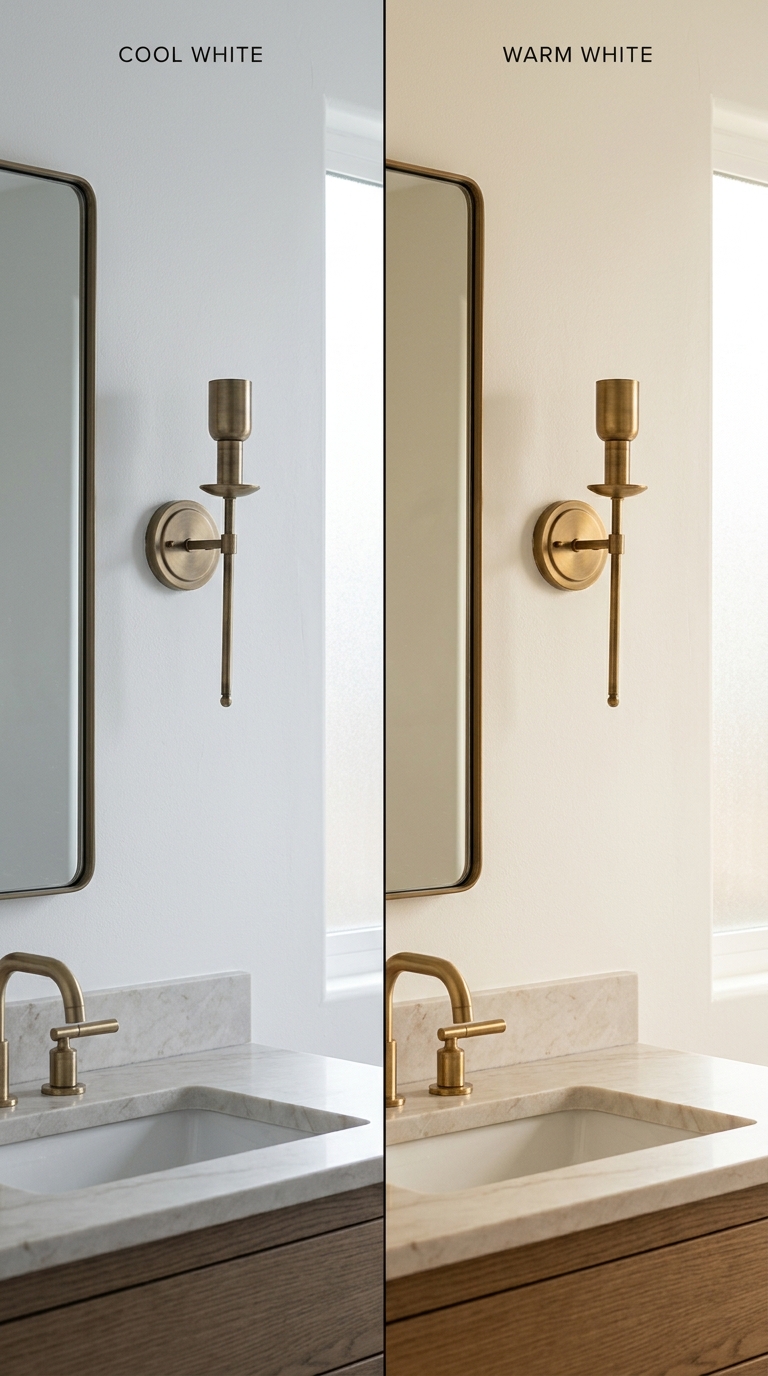
The particulars to get right matter outdoors. Choose festoon kits rated IP44 or better for splash, with warm white bulbs around 2700K, not cool white which reads as a shop. A 10m set with 20 bulbs sits around £22 to £40 in 2026, and a clip-on solar version with a small panel is similar. Run the cable with small hooks or a wire, keep the drop at about 2.1 to 2.3m so you do not brush it, and plug into an outdoor-rated socket or a battery pack. LED festoons draw very little; a 10m run uses roughly 5 to 10 watts, so weight and load are not a concern and wind is the only real risk.
What the frame leaves out is deliberate. No uplighters on the floor, no bright spots. One overhead line and a candle on the table is calmer than three sources competing, and the single colour lets the terracotta and the foliage do the rest.
A living screen that lets wind through
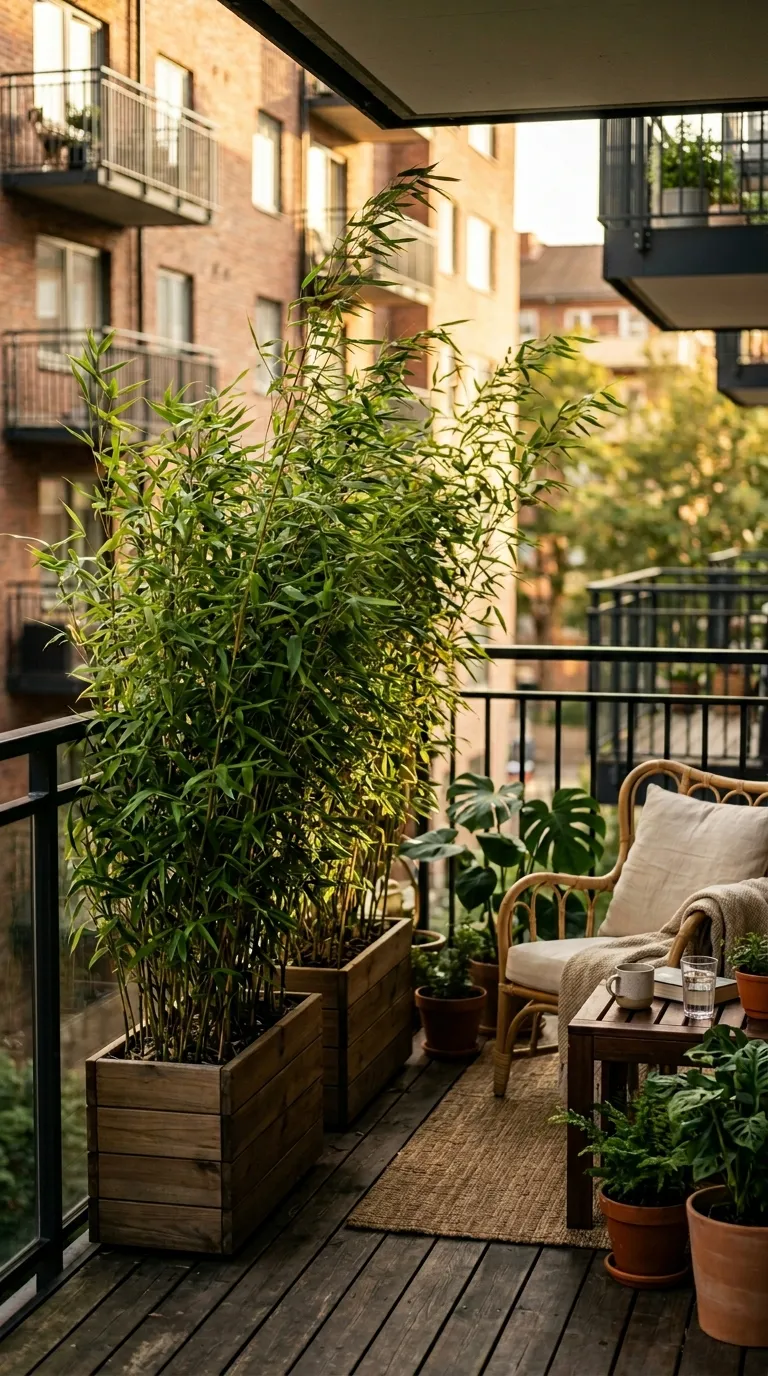
These two wooden troughs do not block the wind; they filter it, and that is exactly why they work. Each holds clumping bamboo that has grown well above head height, stems close together, leaves narrow enough to move without tearing. From the chair you still see sky and trees beyond, but the building opposite is softened and the draught is calmer.
A solid panel, a glass extension or a fabric screen would have given more privacy in one direction and more load in every other. Wind pressure on a solid surface rises with area, which is why boundary screens on balconies regularly fail at their fixings after a storm. A planting of bamboo or tall grasses lets air through, so the push is lower and the failure mode is a bent stem, not a torn bracket. If the screen were solid, the balcony would need to be rated for that wind load; with a planted screen the structure sees less.
Look at the containers. Long timber troughs, not round pots, sit hard against the wall side of the rail, spreading the weight along the slab edge. A planted trough of this scale holds about 60 to 80 litres of compost, so each one is roughly 60 to 80kg wet. Two of them is a meaningful load, and they are the reason the earlier weight note matters. Timber troughs of 80cm length cost around £80 to £140 each in 2026, and a clumping bamboo such as Fargesia murieliae or Fargesia robusta in a 5-litre pot is typically £35 to £60 in 2026. Fargesia forms a clump and stays where you put it, while Phyllostachys runs and will lift a trough within a season.
The chair tucked beside them shows the benefit. Move the bamboo a metre forward and you would have lost the most sheltered corner; keep it at the edge and the sheltered zone is where you sit.
A narrow shelf that gives three levels for one footprint
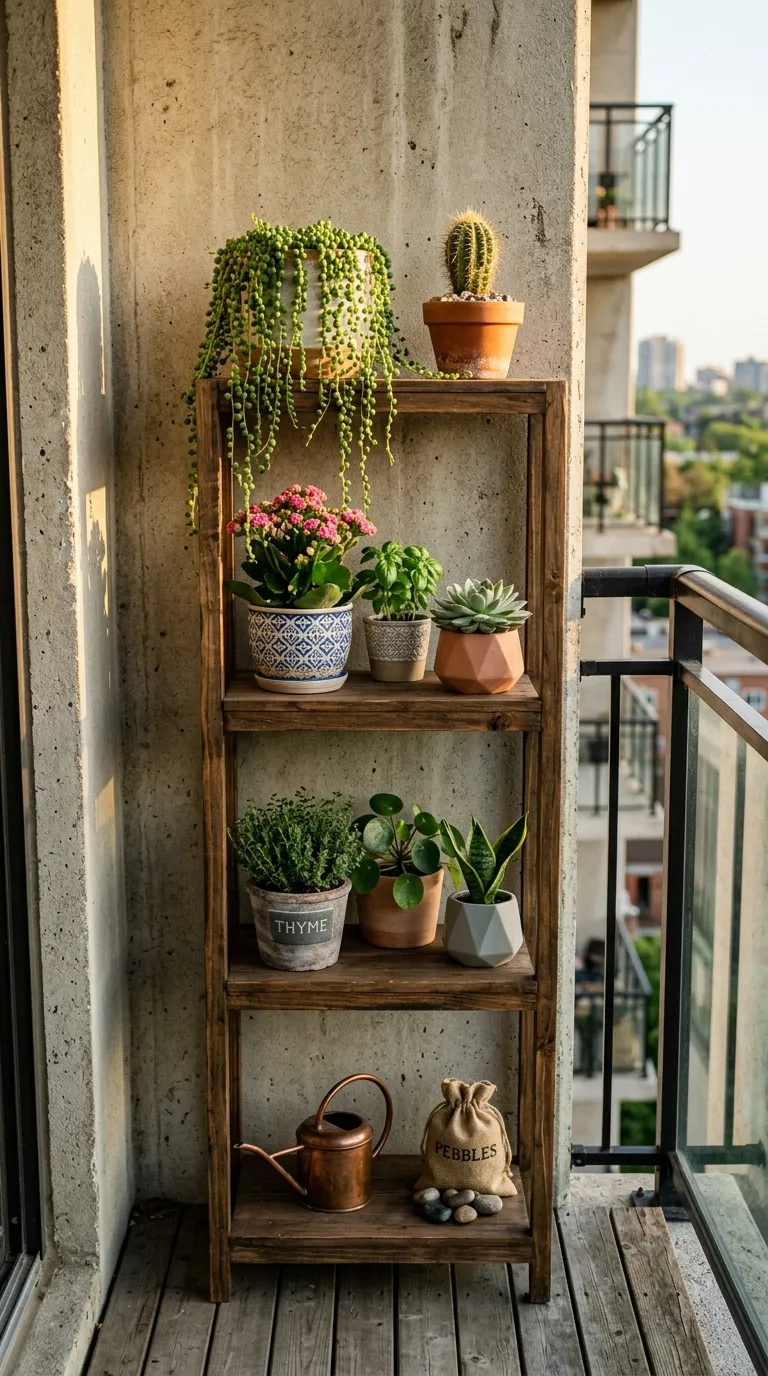
This is a straightforward piece of joinery doing outsized work. Four shelves on a simple wooden ladder, standing against the concrete wall, holding about a dozen small plants where one large pot would have stood. The top shelf carries a trailing Senecio rowleyanus, string of pearls, spilling over the front and a small cactus in terracotta; the middle shelves hold a pink kalanchoe, thyme, an echeveria and a pilea; the lower shelf a second thyme and a sansevieria. Nothing on it demands much water, which is sensible for a position that dries fast at height.
The advantage on a balcony is not just space. It is weight distribution and stability. A narrow shelf keeps mass vertical and against the wall, its centre of gravity low, and the pots are individually small so no single one is a 40kg problem. Follow the light in the photograph: the wall faces outward, catching morning sun, and the shelf itself casts only a narrow shadow, so the lower plants still see sky. What would not work here is a heavy stone pot at the top; it would raise the centre of gravity and in wind act as a top weight. Keep the heaviest pots low, the lightest and most trailing at the top, and fix the shelf to the wall with a single L bracket if you are on an exposed floor. A similar softwood ladder shelf costs £45 to £85 in 2026, and small succulents in 8 to 10cm pots are £4 to £12 each.
Also in the frame, a copper watering can and a hessian sack labelled pebbles on the bottom shelf. Both are hints at maintenance: top dress with grit to keep the crown dry over winter, and use a peat-free cactus compost that drains sharply, such as Westland Cacti and Succulent or Melcourt Sylvamix, typically £6 to £9 for 10 litres in 2026.
If you want one piece of furniture for a windy balcony garden, this is often it. It gives you variety, keeps the floor clear, and lets you edit one shelf at a time.
Three pots that feed you from the sunniest corner
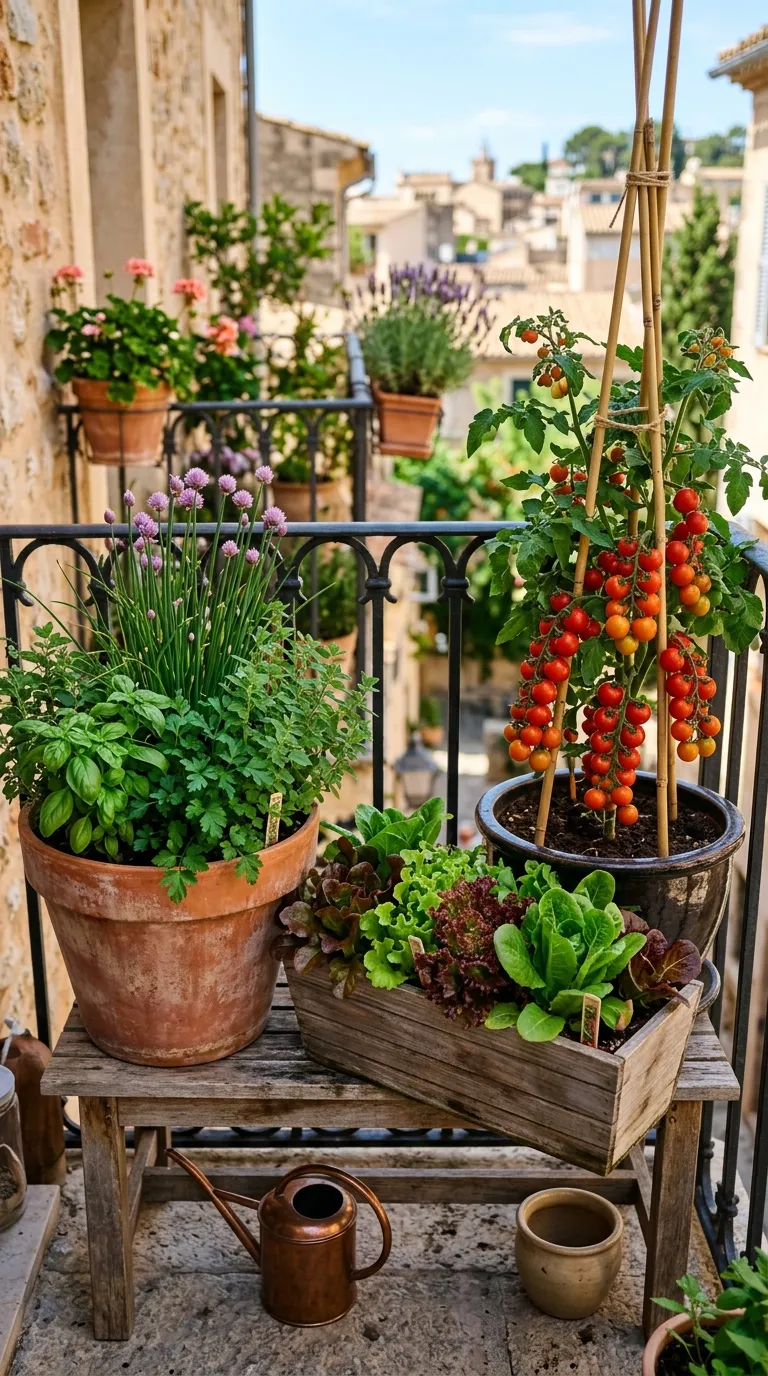
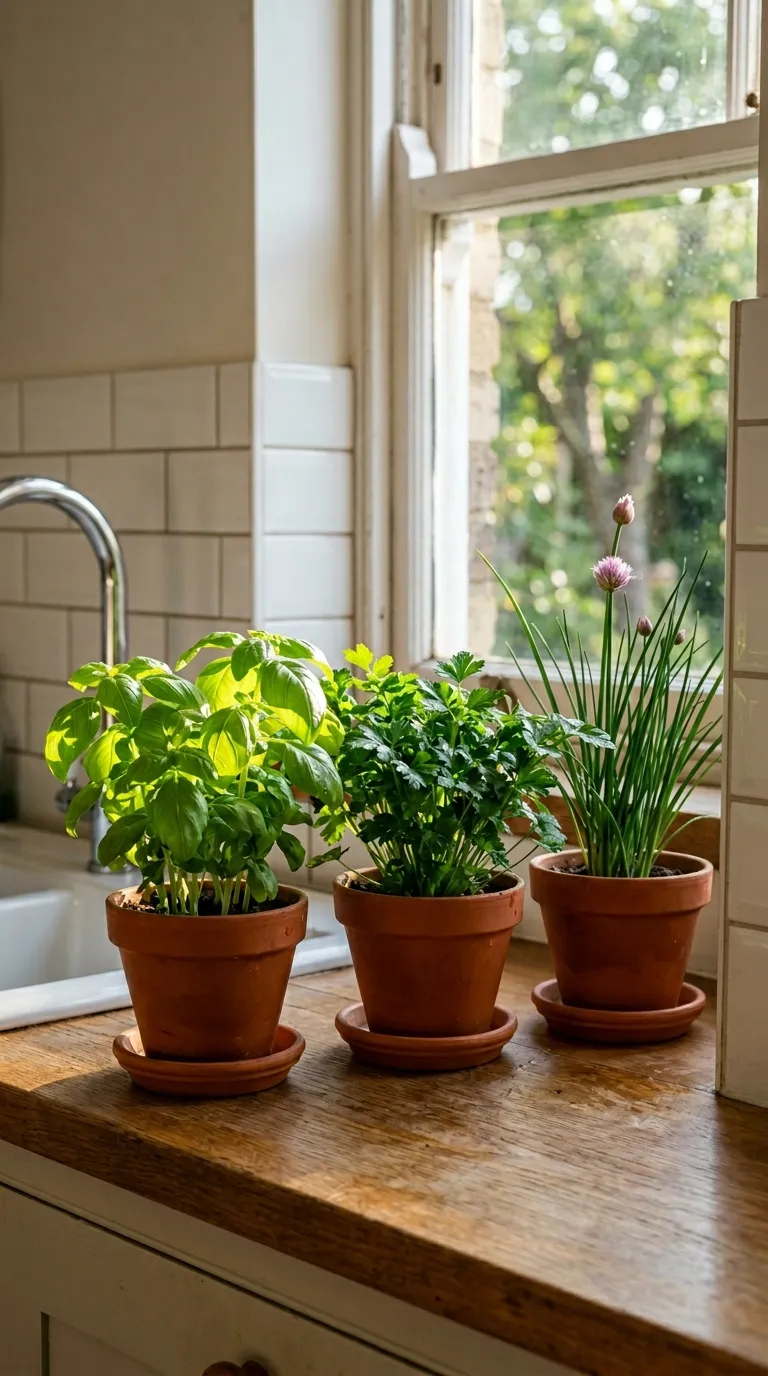
The bench position tells you the conditions before anything else. The cherry tomatoes are staked with four bamboo canes tied into a wigwam, leaves glossy, fruits ripening from green to red in clusters. The shallow wooden crate in front is full of cut-and-come-again lettuces, red and green, and beside it a deep terracotta holds basil, parsley, chives and a small chive flower at the top. All three sit on a low bench tight to the rail where the sun hits most of the day, and a copper can waits just below.
Food on a balcony lives or dies by two things above all else: hours of sun and consistency of water. Tomatoes and basil want the sunniest corner you have, six hours or more, and they will forgive wind that would tear a hosta. What they will not forgive is drying out between waterings while fruit is swelling, because that is when fruits split and basil bolts. The photograph shows the honest compromise: small productive pots grouped where sun is strongest, not scattered decoratively where they would get less.
Follow the weight again. The black tomato pot is probably 35 to 45 litres, so roughly 35 to 45kg wet, and it sits on a bench that spreads the load across four legs rather than one footprint. The lettuce crate is shallow, maybe 15 litres, and far lighter. If you were replicating this, keep the tomato against the wall side of the bench, not at the outer rail.
The plants themselves distinguish surviving from thriving in the way Fenella often means. Basil and chives will survive with three hours of sun and a sporadic water. They will not produce the soft, large-leaved growth that makes a balcony kitchen a pleasure. Give them six hours, a loam-based compost such as John Innes No.2 cut with coir for drainage, and a high-potash feed once fruits form, and they thrive. Gardeners’ Delight and Tumbling Tom tomatoes, and basil ‘Genovese’, all do well in this size of pot. Seed of each is £2.50 to £3.80 per packet in 2026, a 40cm terracotta pot around £18 to £30, and a small bottle of liquid tomato feed £5 to £8. A trough of cut-and-come lettuce will repay that in a fortnight if you pick the outer leaves and let the centre keep growing.
One practical note from the bench itself: two pots placed together shelter each other a little, dropping evaporation by a surprising amount compared with one pot alone on a hot slab. Group them and you water less.
One colour family that calms a narrow space
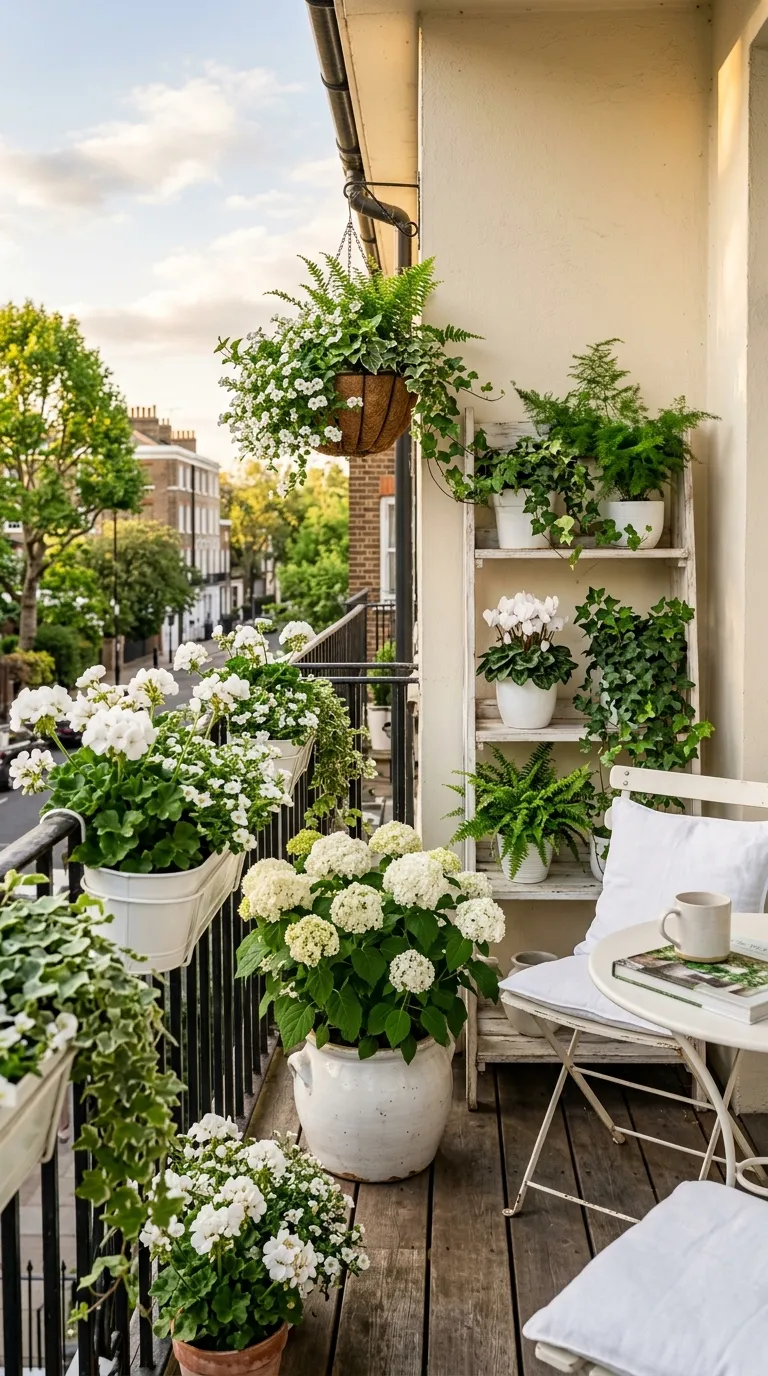
The first thing to count here is not flowers but colours. White, green, and the weathered wood of the deck. That is almost the entire palette, and the effect is calm where a more mixed planting would have felt busy in a space that is barely a metre wide.
Look along the rail. White geraniums in white troughs, white hydrangea mopheads in a large cream urn, white bacopa and variegated ivy trailing, even the hanging basket is white-flowered. The pots themselves are mostly white or off-white, which helps in shade: white containers bounce a little more light back into the foliage, perhaps five to ten percent in a narrow space, though the main reason they work is visual quiet. One family repeated makes the balcony read as a single garden and not a collection.
This is also where surviving versus thriving needs to be said plainly, because the photograph flatters the choice. The large hydrangea in the stone pot, Hydrangea macrophylla, wants consistently moist roots and will flag on a windy exposed balcony even when it is not hot. It will survive in that white urn, which is heavy and holds perhaps 50 litres, but it will not thrive there unless the balcony is at least partly sheltered and you water most evenings. In a genuinely exposed position the same colour story is better held by pelargoniums, echeveria and osteospermum, all of which want dry roots and cope with wind that would scorch a hydrangea leaf within a week.
If you want to keep this palette, repeat the same containers instead of mixing. Elho Corsica or Lechuza Cube planters in white in the 30 to 40cm range are £12 to £24 in 2026, and a white Hydrangea ‘Annabelle’ for a sheltered balcony is £15 to £25 for a 2-litre plant, while a white pelargonium such as ‘White Poly’ is £3 to £5 per plug. Using one colour family lets you spend less and get more effect, because three pots of the same white read as intentional and collected, while three different palettes read as leftovers.
Scent where you actually sit
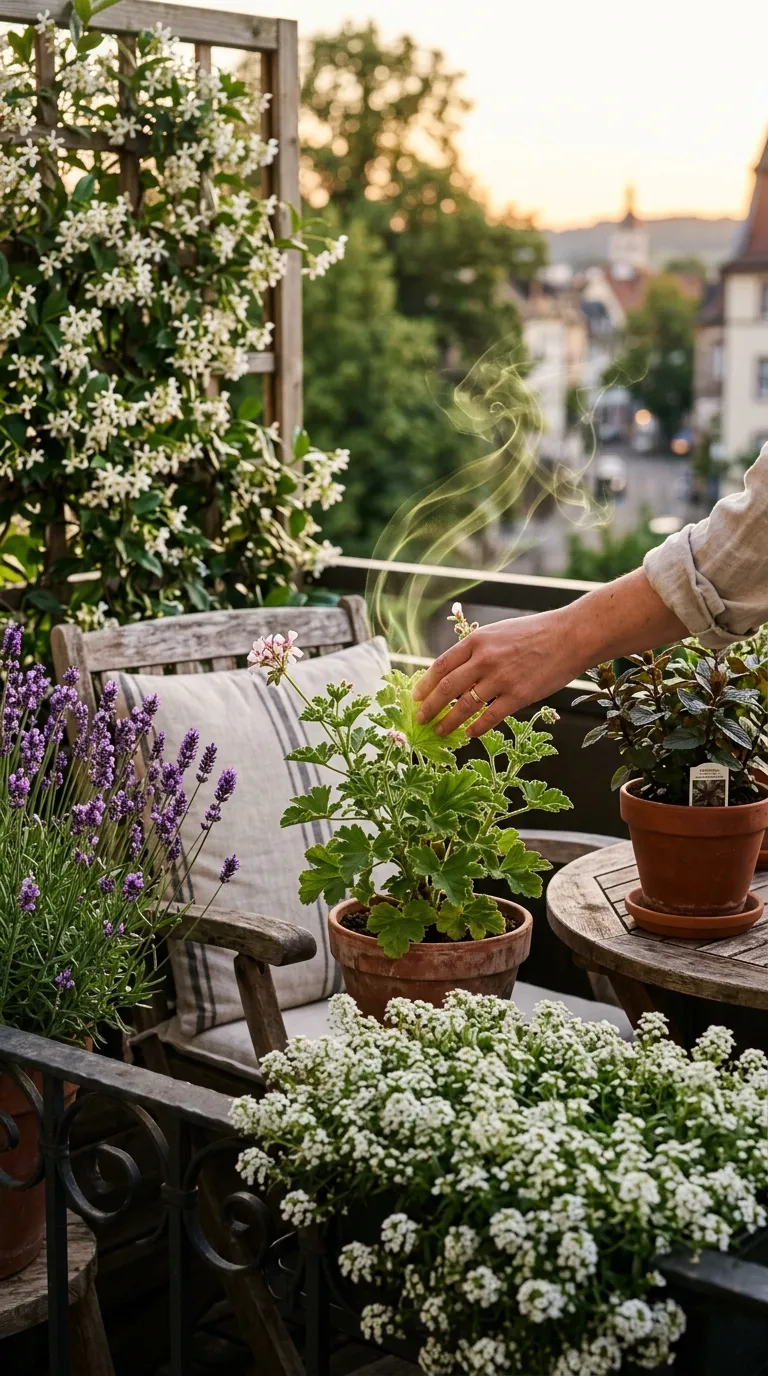
The hand in the photograph is doing exactly what the planting is for. Brushing the leaves of a scented pelargonium on the table so the oil lifts on the air. Behind, jasmine has covered a small trellis, lavender stands purple at the chair side, and a low drift of white alyssum spills over the rail. The faint green wisp painted over the scene points to what you cannot photograph: scent at sitting height, where wind would otherwise take it away.
On a small balcony you sit inside your planting, not in front of it, so fragrance is not an extra. It is one of the few effects that works after dark, in wind, and in a space that is otherwise dominated by hard surfaces. The mechanism is simple and a little humbling: aromatic leaves release oils when touched or warmed, and those oils are carried on the air currents that also dry the compost. Where the photograph places scent is not casual. Lavender at knee height where legs brush it, alyssum at the rail where the evening air runs over it, jasmine behind the chair where warmth off the building holds the flowers. Each is positioned to meet a small movement of air.
Each plant here is doing a job. Star jasmine, Trachelospermum jasminoides, gives the sweet, heavy scent in summer and is the right choice where the balcony is sheltered enough to stay above about -5°C in winter; it is typically £12 to £22 for a 2-litre pot in 2026. Lavender ‘Hidcote’ is tougher, bone hardy and quite happy in a 30cm pot at £6 to £10. White alyssum, Lobularia maritima, is an annual that will spill and scent a railing for a whole season from a £2.50 to £4.00 seed packet, and scented pelargonium such as ‘Attar of Roses’ gives the bruised-leaf effect shown, around £6 to £9. None of these demand the deep, constantly moist root run that a hydrangea would in the same spot, which is why they cope where larger scented shrubs would sulk.
One honest caveat: wind carries scent, but it also dilutes it. On a very exposed high floor the jasmine will flower and you will hardly smell it unless you sit close. In that position, put the scented leaf where your hand actually lands, as this table does, and let the jasmine be visual and not fragrant.
Frequently asked
Frequently Asked Questions
How much weight can a balcony take with compost and pots?
A litre of wet multipurpose compost is close to a kilogram, so a 35 to 45 litre container is roughly that many kilograms once watered. Keep heavy pots near the wall where the slab is better supported, and ask the building manager for the rated load if you plan more than a few modest containers.
Which plants stay handsome in constant wind?
Choose foliage that bends or stays compact: lavender, rosemary, thyme, sedum, sempervivum, pelargoniums, hebe, pittosporum and clumping bamboos such as Fargesia. Keep large-leaved hydrangeas, hostas and maples for sheltered corners or ground-level gardens.
How do I work out the sun on a narrow balcony?
Track when sun first touches the floor and when shadows return, over a full day at home. Under three hours is shade, three to five is part shade, six or more suits Mediterranean herbs and tomatoes. A white wall bounces a little extra light, but an overhang above cuts it more than most people expect.
Can I have a green wall without drilling into the building?
Use a freestanding ladder shelf or a balance-weighted trough screen if fixings are not allowed. Felt pocket panels give the densest coverage but need secure screws and regular watering, and the top pockets dry first so a drip line along the top helps even things out.
How do I keep pots from blowing over or staining?
Pick low, wide bases, set them on feet or trays, and tie a ladder shelf to the wall on exposed floors. A tray catches silt and water that would otherwise mark the slab below, and grouping pots together drops evaporation compared with one pot alone.
What herbs give the quickest return on a sunny balcony?
Basil, parsley and chive gathered in one 35cm terracotta, plus a shallow tray of cut-and-come-again lettuce. Sit them in the sunniest corner you have and water little and often while fruit swells, feeding tomatoes with a high potash feed once flowers set.
In order
- Watch the wind for a week before choosing plants, and treat the balcony as colder than the ground below.
- Assume roughly 1kg per litre of wet compost and check the balcony limit, keeping heavy pots near the wall.
- Choose small-leaved and flexible plants, and save large soft leaves for sheltered spots.
- Use the railing and a single wall before taking floor, leaving a clear centre to walk.
- Use low, wide, heavy-based containers with feet or trays, and clip railing troughs with proper brackets.
- Count direct sun over a day and plant to that, not to the aspect you guess from a compass.
- Put one good chair where you will actually sit, and add warm white light at sitting height for evenings.
- Plan watering honestly, and plant to the schedule you will keep, grouping pots to slow drying.
This article may contain affiliate links. We may earn a commission at no extra cost to you.