15 Small Bathroom Ideas: The Choices You Cannot Undo

Add us as a preferred source to see more stories on Google.
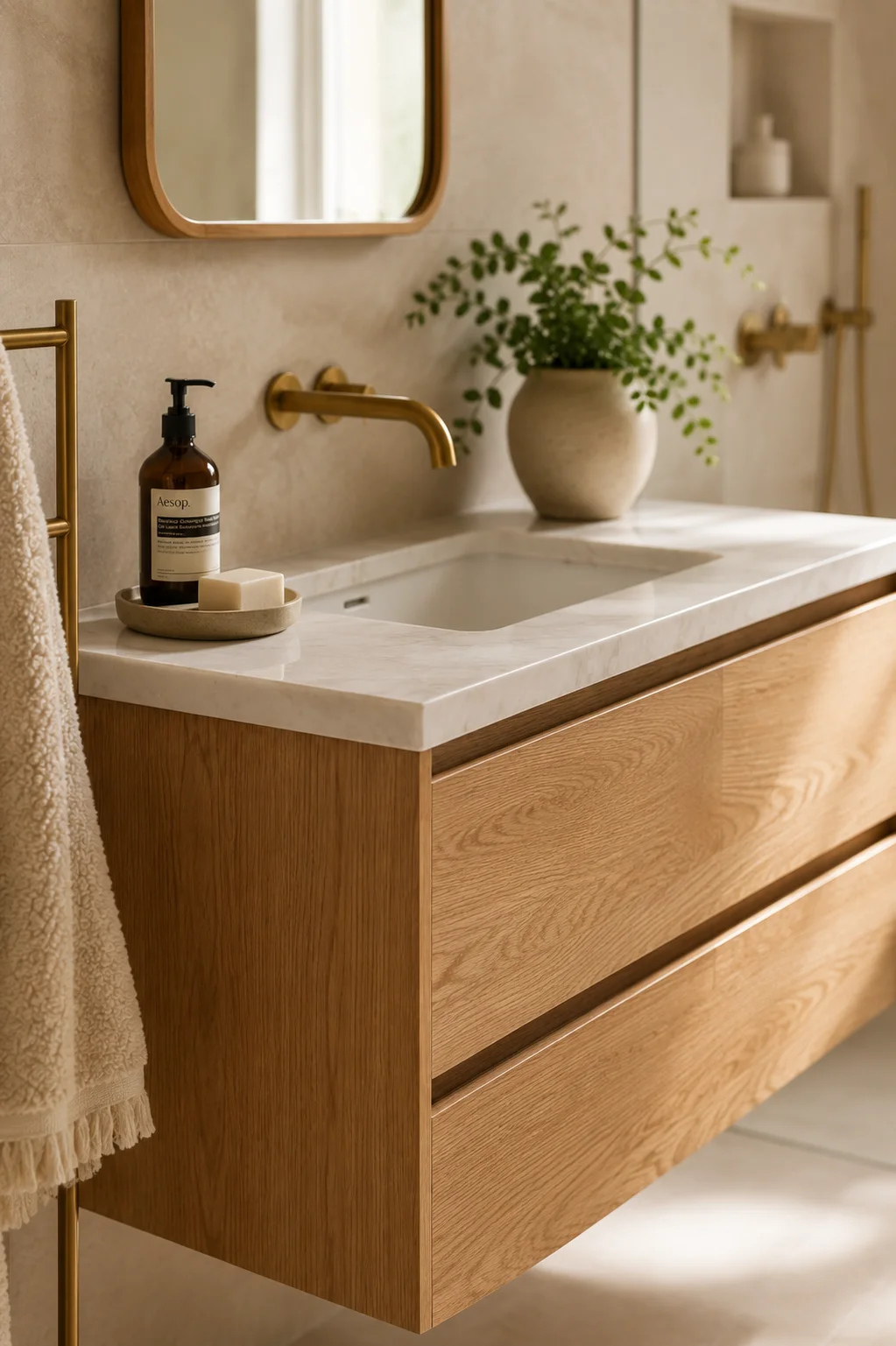
Three things in the photograph below are making that bathroom feel bigger than it is, and all three were decided before anyone picked up a paintbrush.
The vanity is hung off the wall, so the floor tile runs underneath it and out the other side. The tap comes out of the wall rather than standing on the counter, which frees the whole worktop and removes the ring of limescale that forms around a deck-mounted base. And there is a niche set into the wall on the right, holding what would otherwise be a shelf sticking into the room.
Each one needed pipework moved or timber added inside the wall. None can be added later without opening plaster.
Why visible floor changes the room
A room reads as large or small partly by how much uninterrupted floor the eye can travel across. A vanity that meets the floor stops it; one hung off the wall lets it continue.
The effect is stronger in a small room than a large one, because in a small room the vanity occupies a much higher proportion of the floor you can see. It is the same reason a bath panel that runs to the floor makes a room feel tighter than a freestanding bath on feet.
What this costs you is storage below, and a slightly fussier installation. What it gains, besides the look, is a floor you can actually clean under.
The structural point that catches people out: a wall-hung unit with a stone top is heavy, and heavy on plasterboard alone will eventually pull out. It needs timber noggins fixed between the studs at the right height, or a proper brace frame. That is a five-minute job while the wall is open and a serious job afterwards.
The wall-mounted tap
Look at how much clear counter there is in that photograph. A deck-mounted tap would take roughly a third of it and create the one part of a bathroom that is genuinely unpleasant to clean, which is the join between tap base and stone.
Wall-mounted taps need the valve body set into the wall before tiling, at the right height and the right projection for the basin you have chosen. That means the basin has to be decided first, which is the reverse of how most people shop.
Two practical cautions. The spout must reach far enough over the bowl, and manufacturers state this as projection; measure your basin and check. And the valve needs to remain accessible for servicing, usually through the vanity or a removable panel, so confirm that with whoever is fitting it instead of assuming.
Taps and vanities worth knowing
Wall-mounted mixers, which is the part with the buried valve:
| Budget | Where to look | Roughly in 2026 |
|---|---|---|
| Premium | Vola, Perrin & Rowe | £600 to £1,400 |
| Mid | Crosswater, Vado, Grohe Essence | £200 to £450 |
| Budget | Hudson Reed, Nes Home | £90 to £180 |
Buy the concealed valve and the spout as a matched set from one manufacturer. Mixing brands across a buried valve is the single most common way people end up opening a finished wall.
For wall-hung units, Duravit and Lusso Stone sit at the top, VitrA and Roper Rhodes in the middle at roughly £300 to £700 in 2026, and IKEA GODMORGON at £150 to £350 in 2026 with the caveat that the supplied fixings assume a solid wall.
The niche, and what to put in it
A recessed niche stores at zero cost to floor area, which in a small bathroom is the only free storage there is.
One tall niche looks calmer than three small ones, and is more useful, since bottles vary in height. Line it in the same material as the surrounding wall and it reads as part of the room; line it in a contrast and it becomes a feature, which is a decision instead of a default.
Build it between studs, which sets the width for you, and slope the base very slightly forward so water runs out instead of sitting. Add a strip light if the wiring is going in anyway.
What you can still change afterwards
Everything below can be done at any point, which is where the budget should go last instead of first.
| Change | Effect on perceived size | Reversible |
|---|---|---|
| Large-format tile, fewer grout lines | Noticeable | Difficult |
| Frameless glass screen instead of a curtain | Strong | Yes |
| Mirror the full width of the vanity | Strong | Yes |
| Warm layered lighting | Moderate | Yes |
| Clearing the counter to one tray | Larger than expected | Yes |
| Pale paint | Small, and often overrated | Yes |
That last row is worth saying plainly. Painting a small bathroom white does very little on its own, and a dark small bathroom with good lighting often feels better than a pale one, because the boundaries of the room stop announcing themselves.
The same room from the doorway
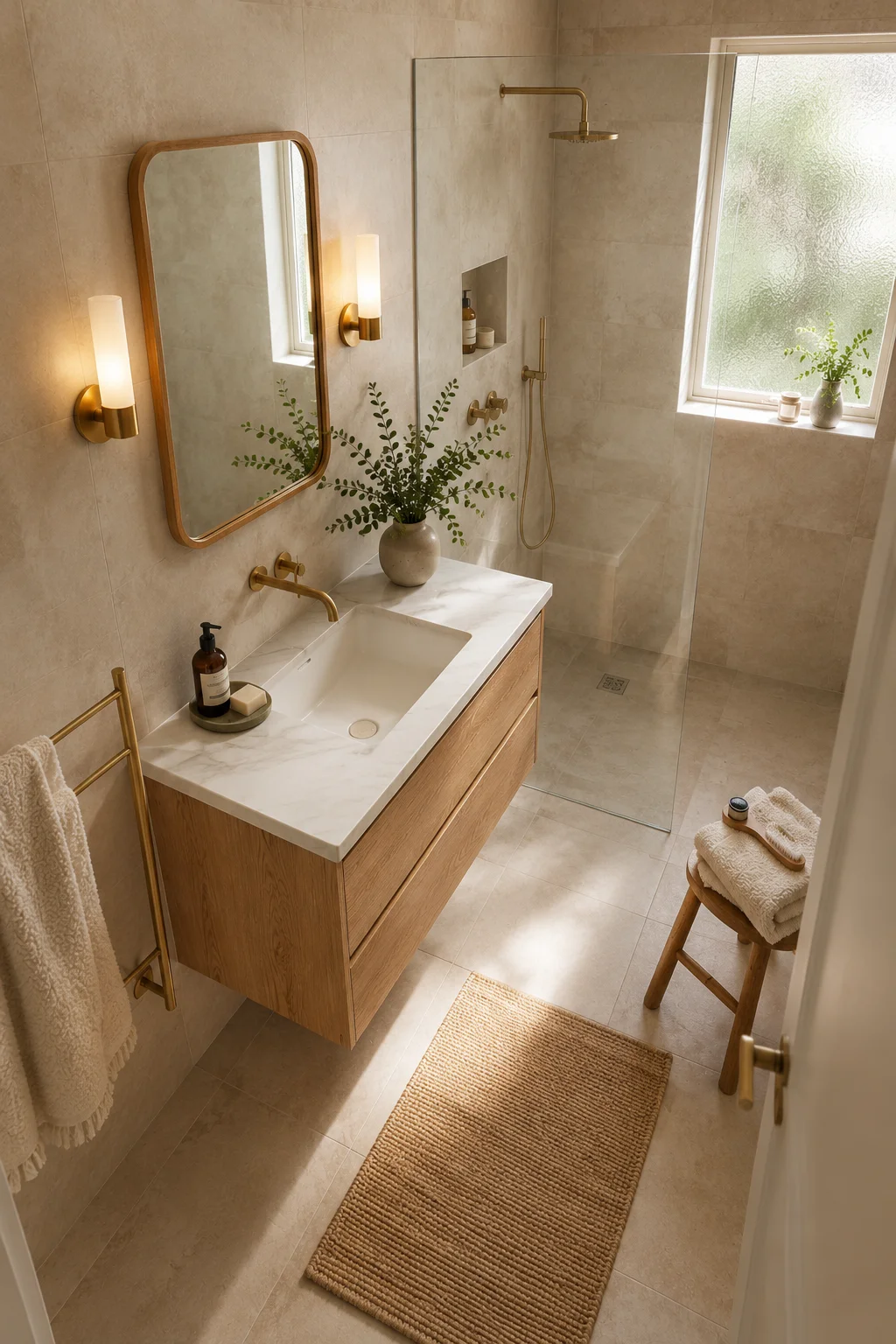
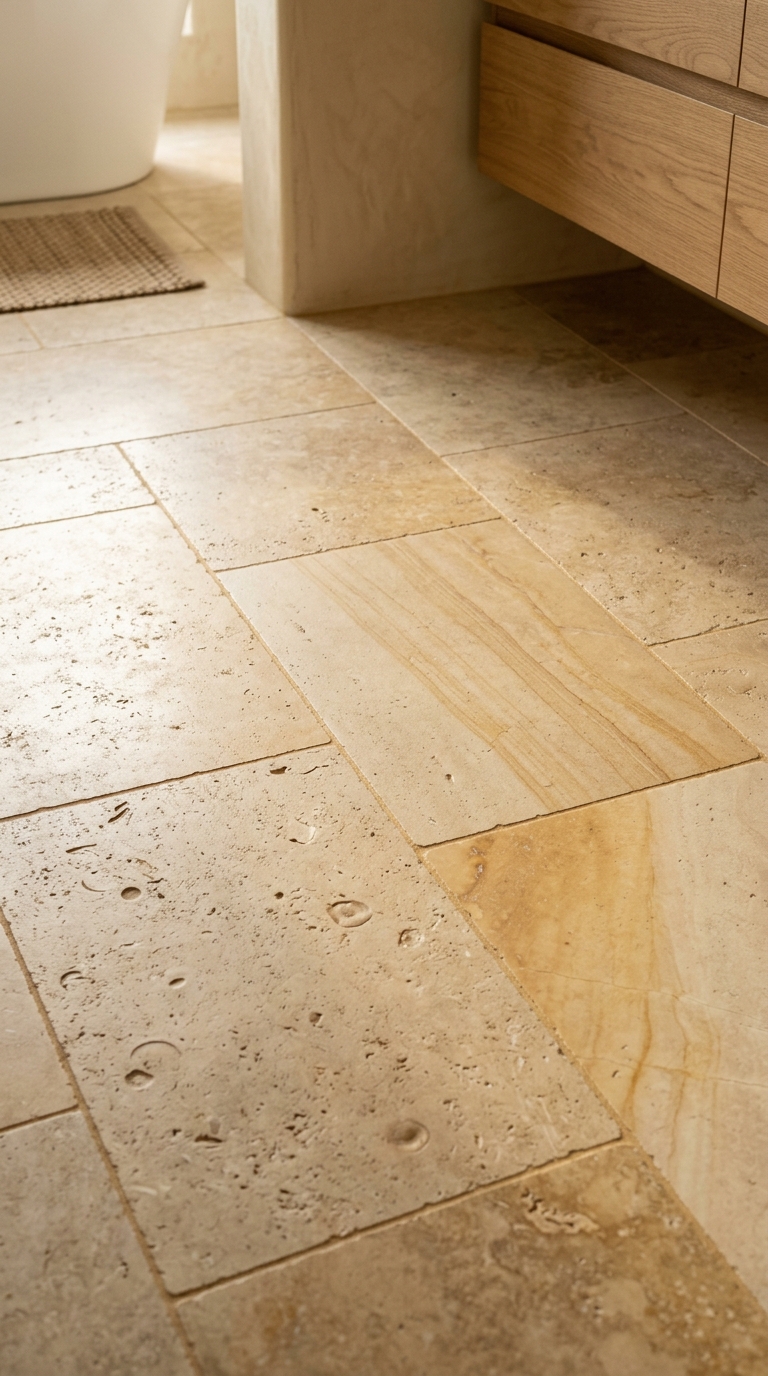
The photograph steps back to the doorway, and the same vanity from the opening image now reads as part of a whole. Floor tile runs from the threshold, under the vanity, and into the shower without a break. That unbroken run is doing most of the work.
The principle here is continuity. The eye measures a room by counting boundaries, because each threshold or trim line is somewhere the gaze has to stop. Fewer lines means a longer read. The frameless glass panel helps for the same reason, since it divides the shower from the room without drawing a line across it.
Two details carry the scheme. The brass mirror frame repeats the tap and the towel rail, which keeps the metal to one family. The woven rug warms the stone underfoot. A flatweave jute runner in this size runs £40 to £110 in 2026 from Dunelm or John Lewis, and cotton copies sit below that.
A lit niche, read closely
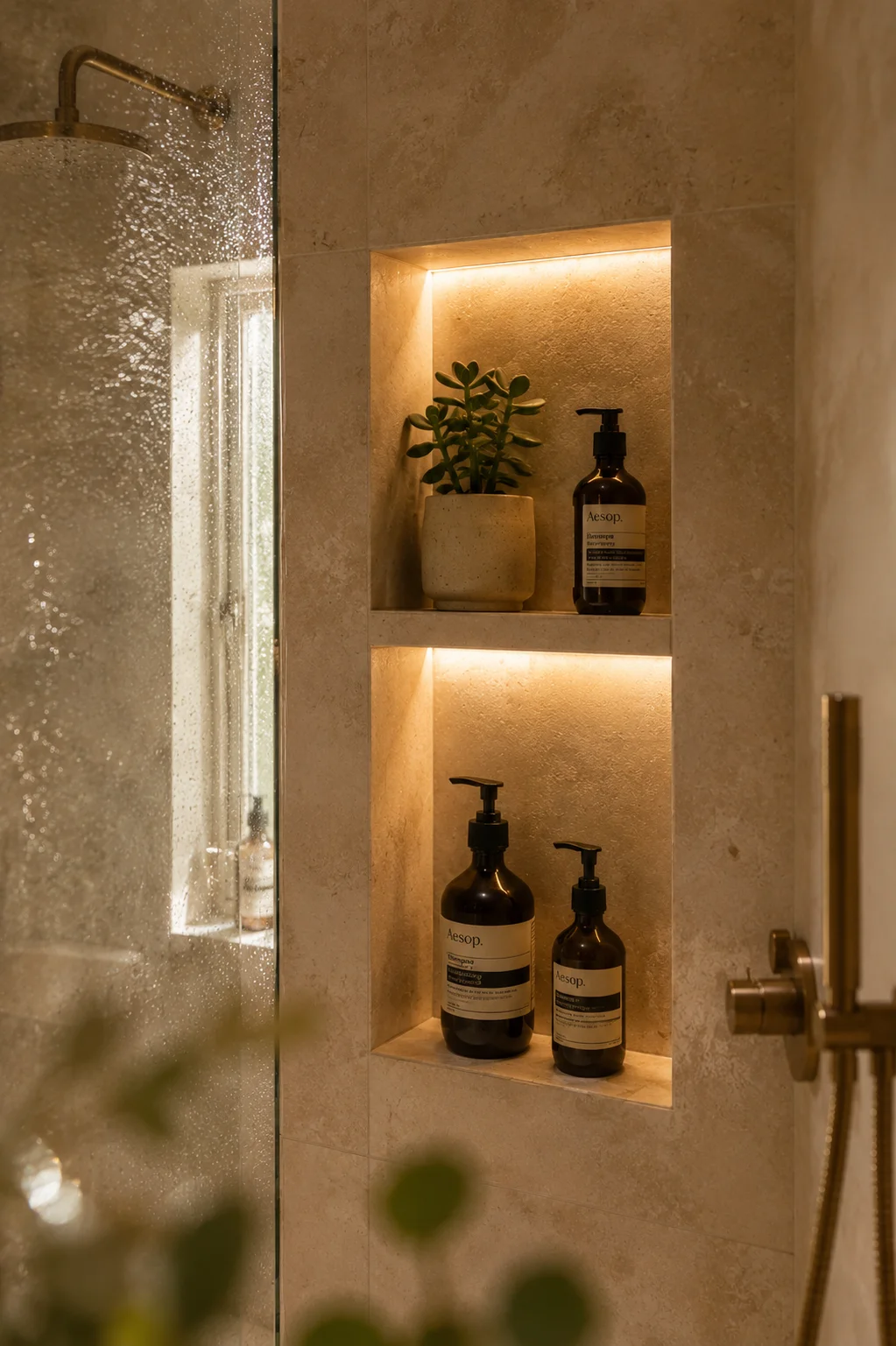
This is the niche from the plan, built and lit. Two stacked openings sit flush in the tiled wall, each with a warm strip set into the head so the light washes down the back. Bottles stand on stone, and a small succulent takes the top shelf.
The reason it succeeds is proportion. The openings are taller than they are wide, which suits bottles, and the shelf between them lands where a hand naturally reaches. A square niche at hand height collects clutter because everything placed in it sits at the same level; a tall one sorts itself, with daily bottles below and the rest above.
Wiring is the part to settle early. A 2700K strip on its own dimmer gives that amber wash, and the transformer needs somewhere accessible to sit. Retrofit LED profiles with a diffuser run £15 to £45 per metre in 2026, plus an electrician’s visit where the circuit is new.
Shelves that stay calm
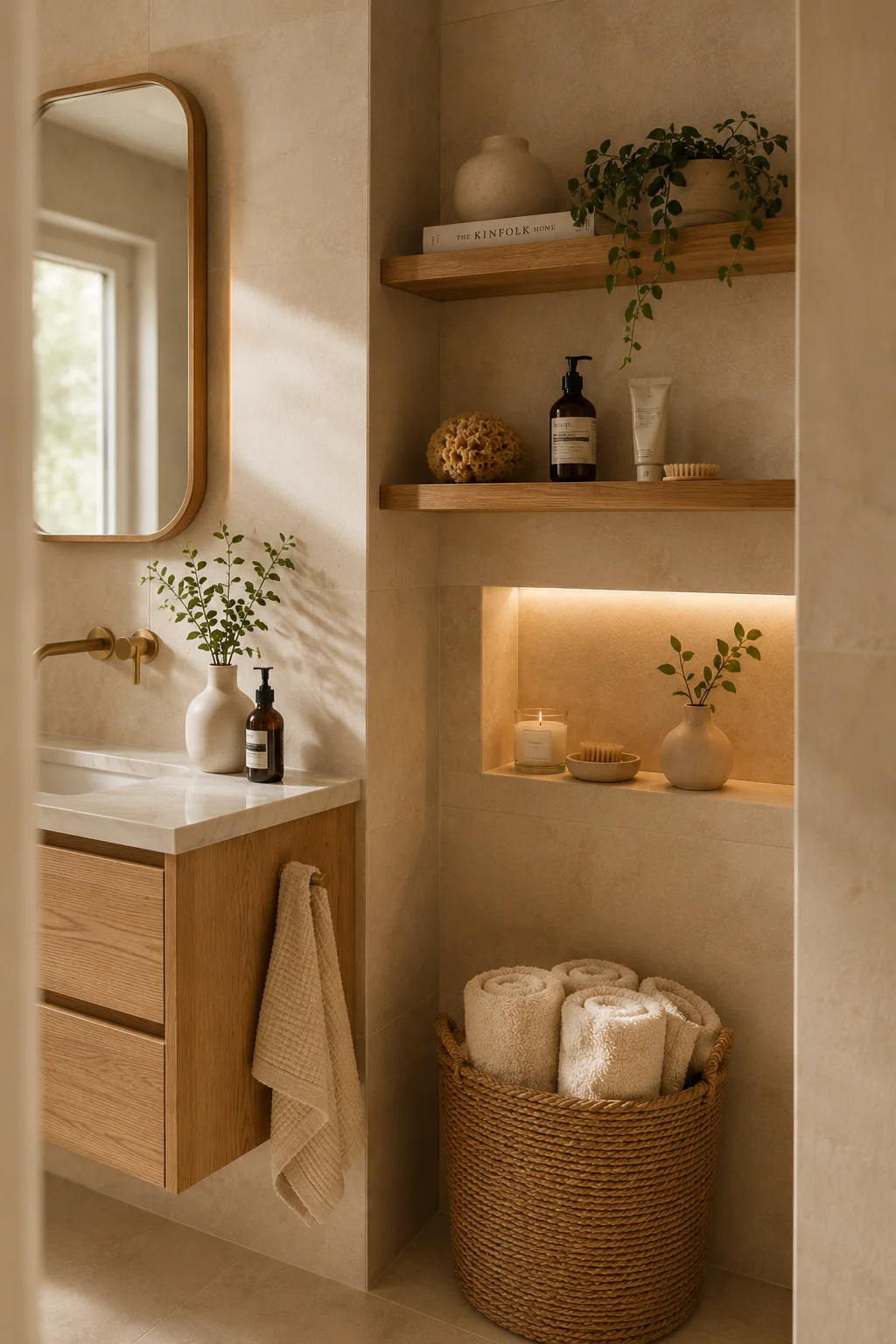
Oak shelves fill the wall beside the vanity, with the lit niche below them and a seagrass basket on the floor. Books, a sponge, pump bottles, and a trailing plant share the two boards, and rolled towels fill the basket.
The governing idea is restraint at the edges. Open shelves in a small bathroom fail when they become a second cupboard, because the eye then has two places to inventory. Here the shelves hold display and the basket holds stock, so each has one job. Rolled towels read as one texture from across the room instead of five separate objects.
Oak needs a finish in steam. Two coats of hardwax oil such as Osmo Polyx-Oil, around £25 to £45 a tin in 2026, seals the boards, and a refresh every couple of years stops the edges greying. Solid oak shelf boards on concealed fixings run £40 to £120 each in 2026 depending on length.
The gap beside the vanity
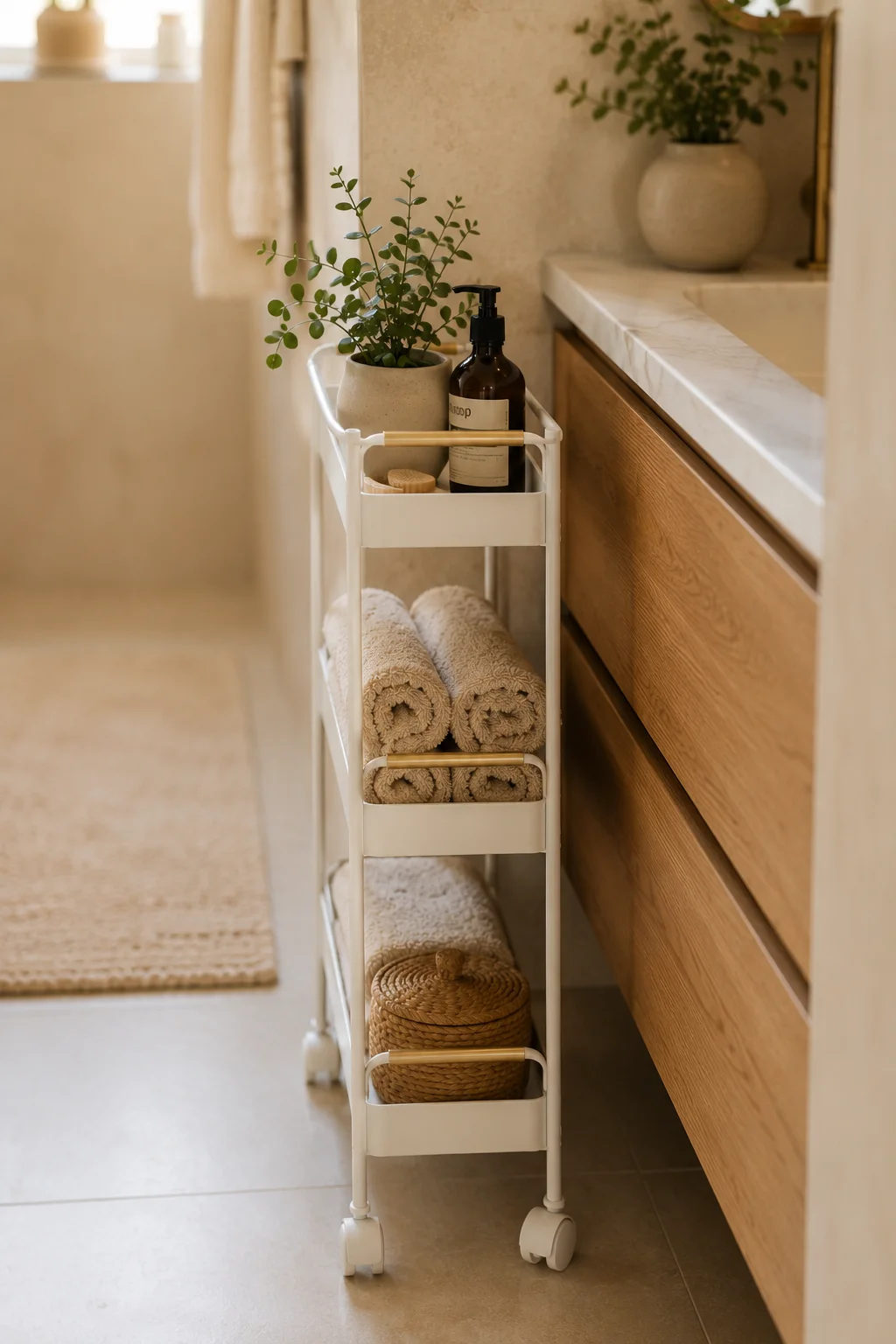
A narrow white cart on castors fills the shadow line between vanity and wall. Three tiers hold a plant and a pump bottle up top, rolled towels in the middle, and a lidded rattan box below.
Cressida’s rule for gaps is that they either get used properly or get cleaned properly, and a cart lets this one do both. It pulls out for the mop, which a fixed filler panel never does, and it carries the overflow that would otherwise colonise the counter. The timber handles repeat the vanity, so it reads as chosen instead of sneaked in.
This is also the honest answer for rented rooms, where none of the in-wall moves are available. Three-tier carts of this pattern run £25 to £65 in 2026, with IKEA RASKOG and NISSAFORS the standard versions, and the rattan boxes that fit the bottom shelf run £12 to £30 in 2026.
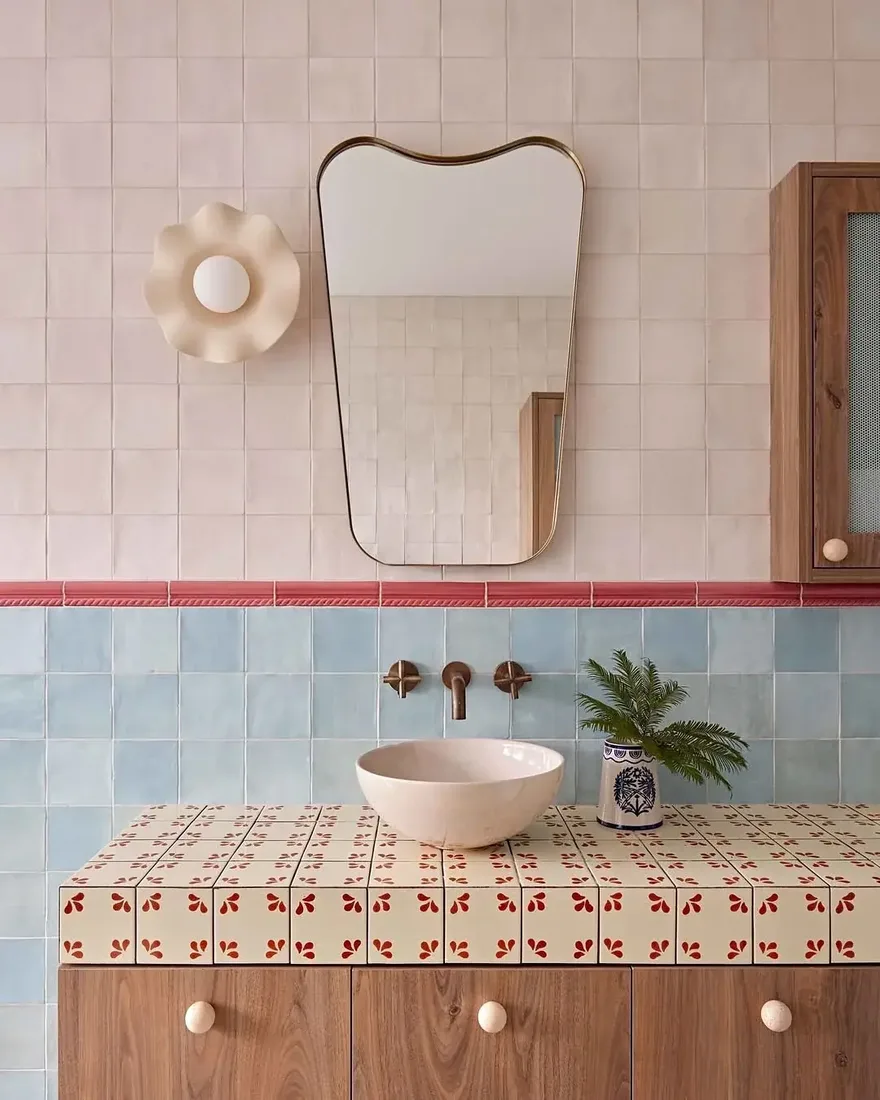
One coloured wall, everything else quiet
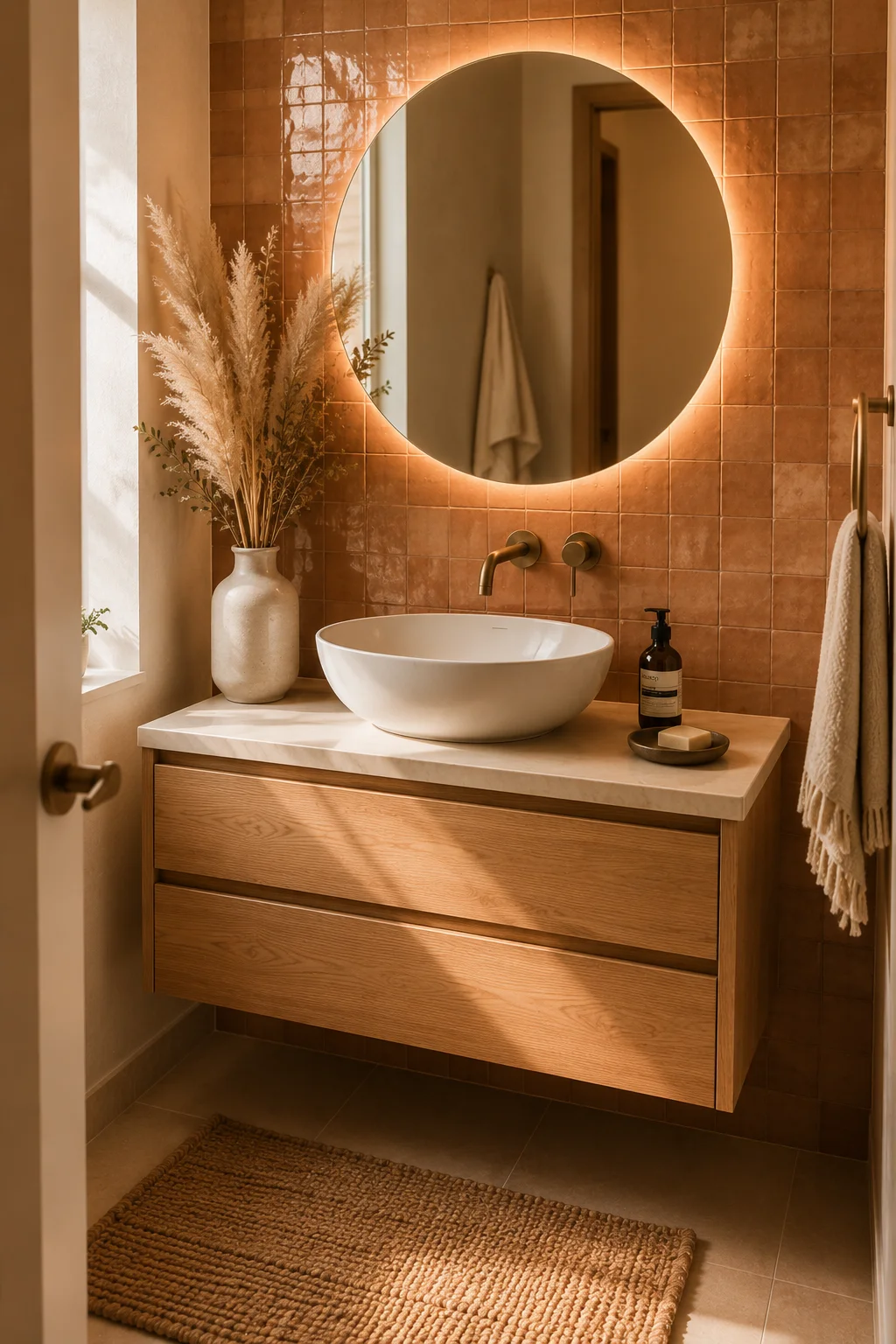
A wall of glossy terracotta squares sits behind a vessel basin and a round halo mirror. Sunlight crosses the glaze, and the wall-hung oak vanity floats clear of the floor below.
Colour works here because it is rationed. One wall carries the pattern and the variation, while the floor, the ceiling and the remaining walls stay pale and plain. The eye goes to the terracotta first and then rests, which is exactly the sequence a small room needs. When two walls compete, the room feels smaller, because the gaze keeps moving without settling.
Zellige brings real variation between tiles, so open several boxes and mix them across the wall before fixing. Handmade-look squares run £80 to £180 per square metre in 2026 from Topps Tiles or Otto Tiles, with Clé Tile higher. A vessel bowl in white ceramic runs £120 to £380 in 2026, and the wall-mounted tap behind it comes from the same budget lines named earlier.
A tray on the counter
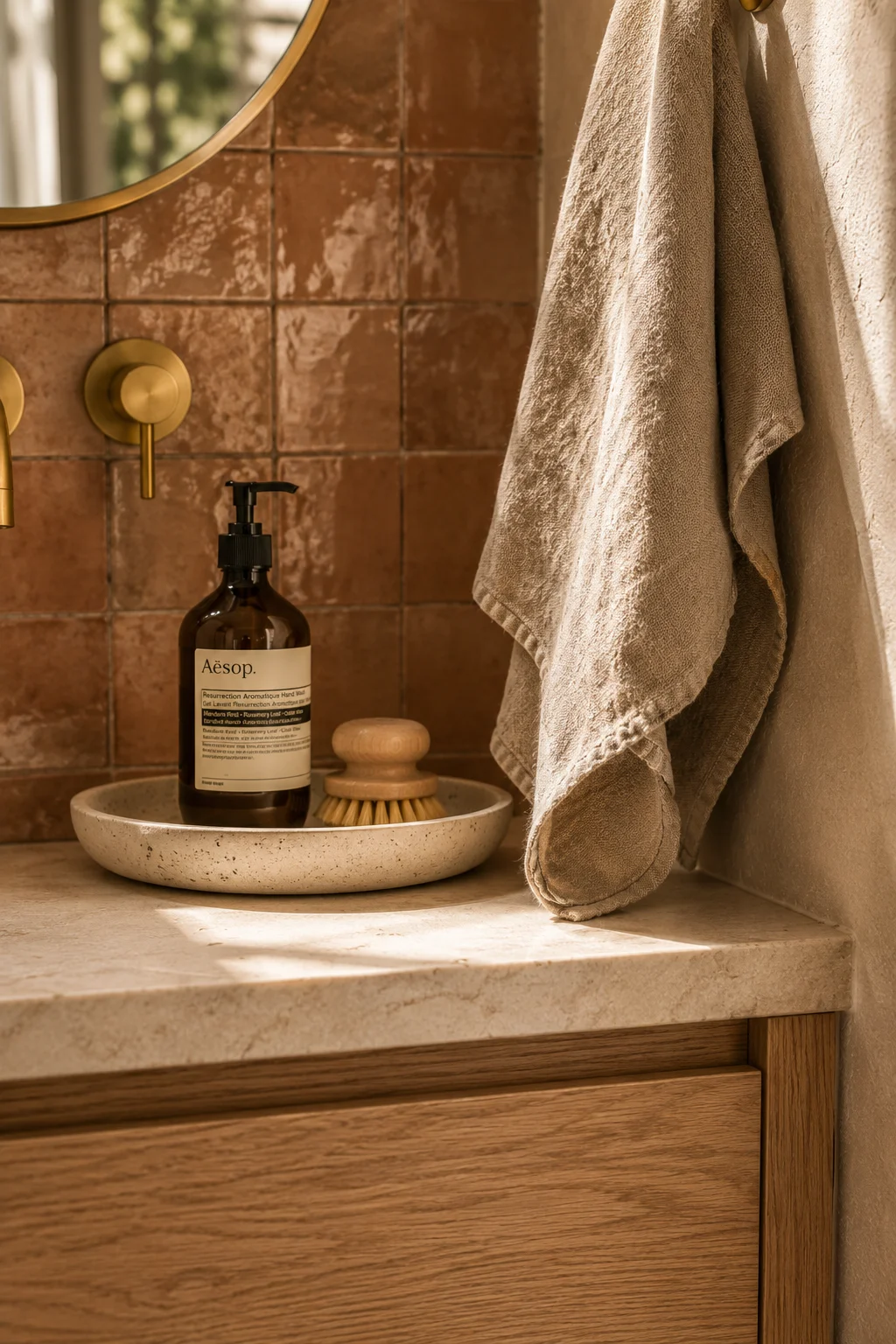
The frame tightens to the counter edge. A speckled stone tray holds a pump bottle and a wooden nail brush, and a heavy linen towel hangs alongside. Terracotta glaze and a brass valve sit just out of focus behind.
The tray is a visual frame, which is why it calms the counter out of proportion to its size. Loose objects read as clutter because each one claims its own territory; objects inside one boundary read as a group, and the group claims less. That is the whole mechanism, and it costs less than any other move on this page.
Stone and ceramic trays of this scale run £18 to £50 in 2026, with brass ones from £20 to £55. Linen hand towels in washed flax run £15 to £35 each in 2026, and they crease less obtrusively than cotton in a room that is always damp.
The palette at arm’s length
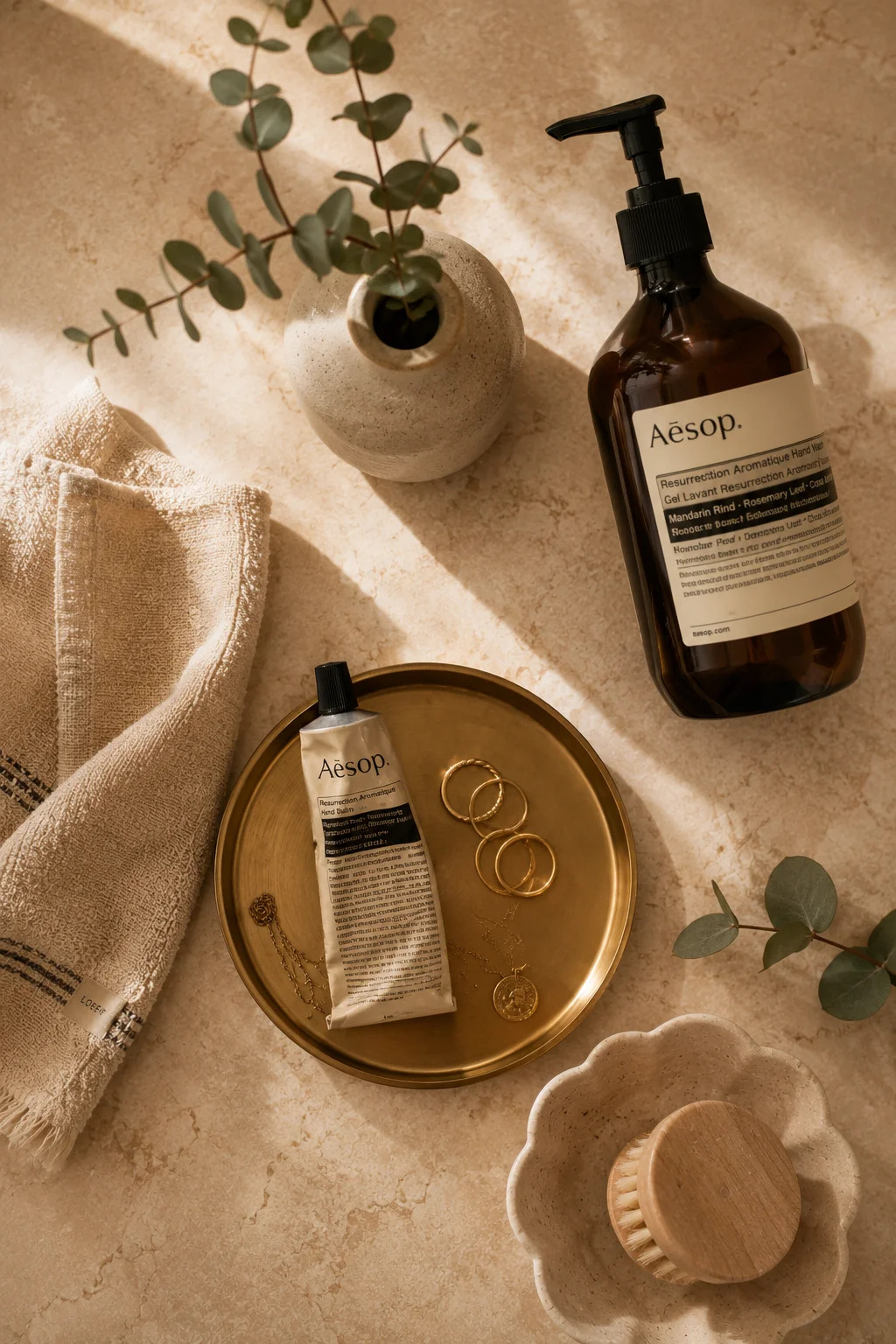
Laid flat on stone: a brass tray with hand cream and gold rings, a fold of striped linen, a bud vase with eucalyptus, and a scalloped dish holding a wooden brush.
This still life states the palette of the whole set of rooms, which is stone, brass, linen and leaf. Nothing in it is new or clever, and that is the point being made. Small bathrooms turn on material repetition, because three finishes repeated everywhere read as calm where six finishes read as busy. This still life states the palette as stone, brass, linen, and leaf.
Buy this layer last, once the fixed decisions are in. A solid brass dish of this size runs £20 to £55 in 2026, and plated copies sit under £15 but wear at the rim within a year or two of daily use.
A wet room under a skylight
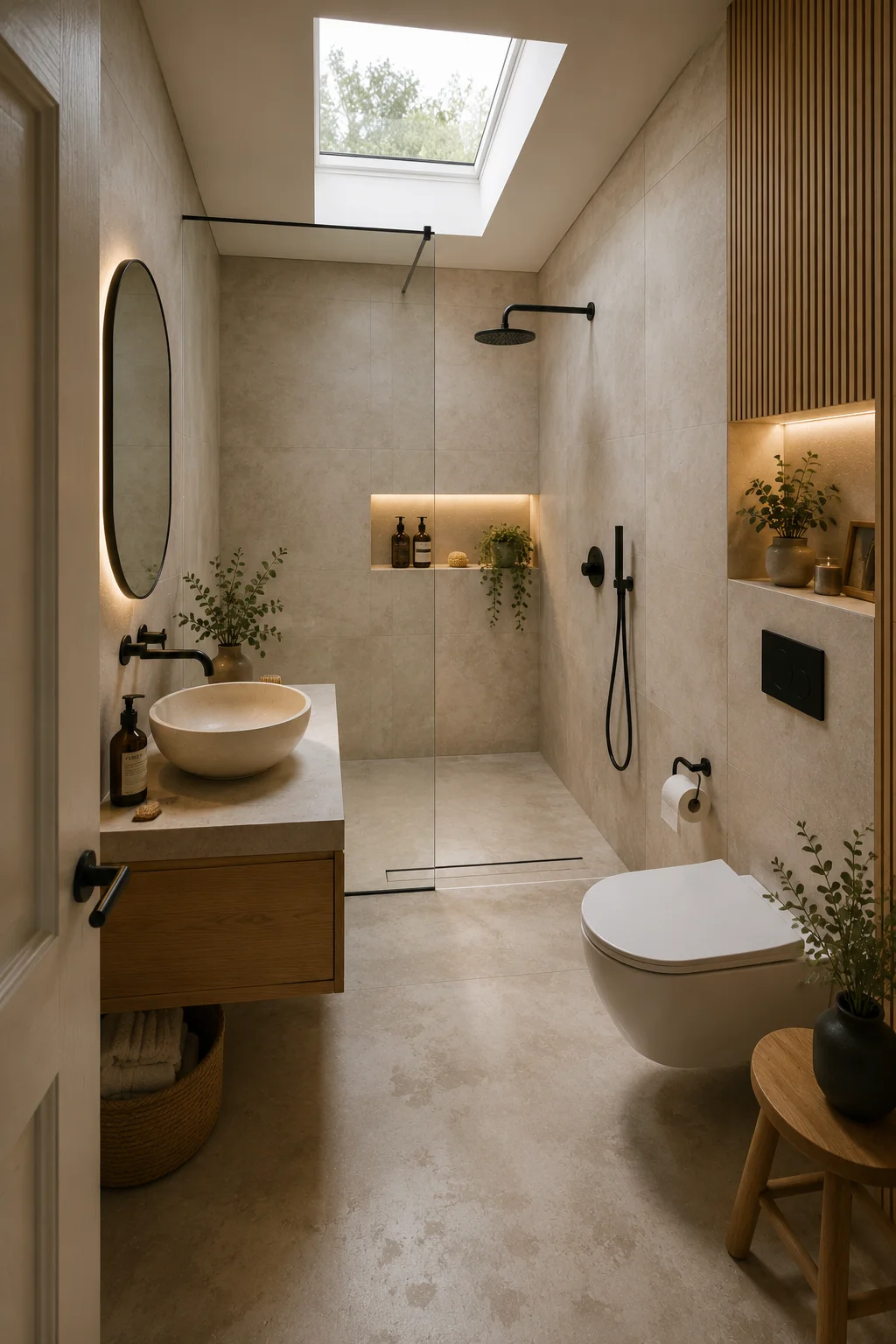
A long narrow room runs from door to shower under a rooflight. A wall-hung vanity and a wall-hung toilet float off opposite walls, black brassware crosses the stone, and a single glass panel separates the shower. Fluted timber boxing on the right hides the cistern and carries a lit shelf.
Removing the tray is the decision that releases this plan. Without a raised shower base or a framed enclosure, the floor becomes one continuous surface with a single fall to a linear drain, and the room reads as one space of full length. Daylight from above then does the rest, because a rooflight lights the stone evenly where a wall light would rake across it and show every mark.
Tank the floor properly and slope it to the drain before a single tile goes down. Concealed cistern frames such as Geberit Duofix run £250 to £450 in 2026, and black flush plates run £60 to £160 in the same year.
A corner basin that releases the centre
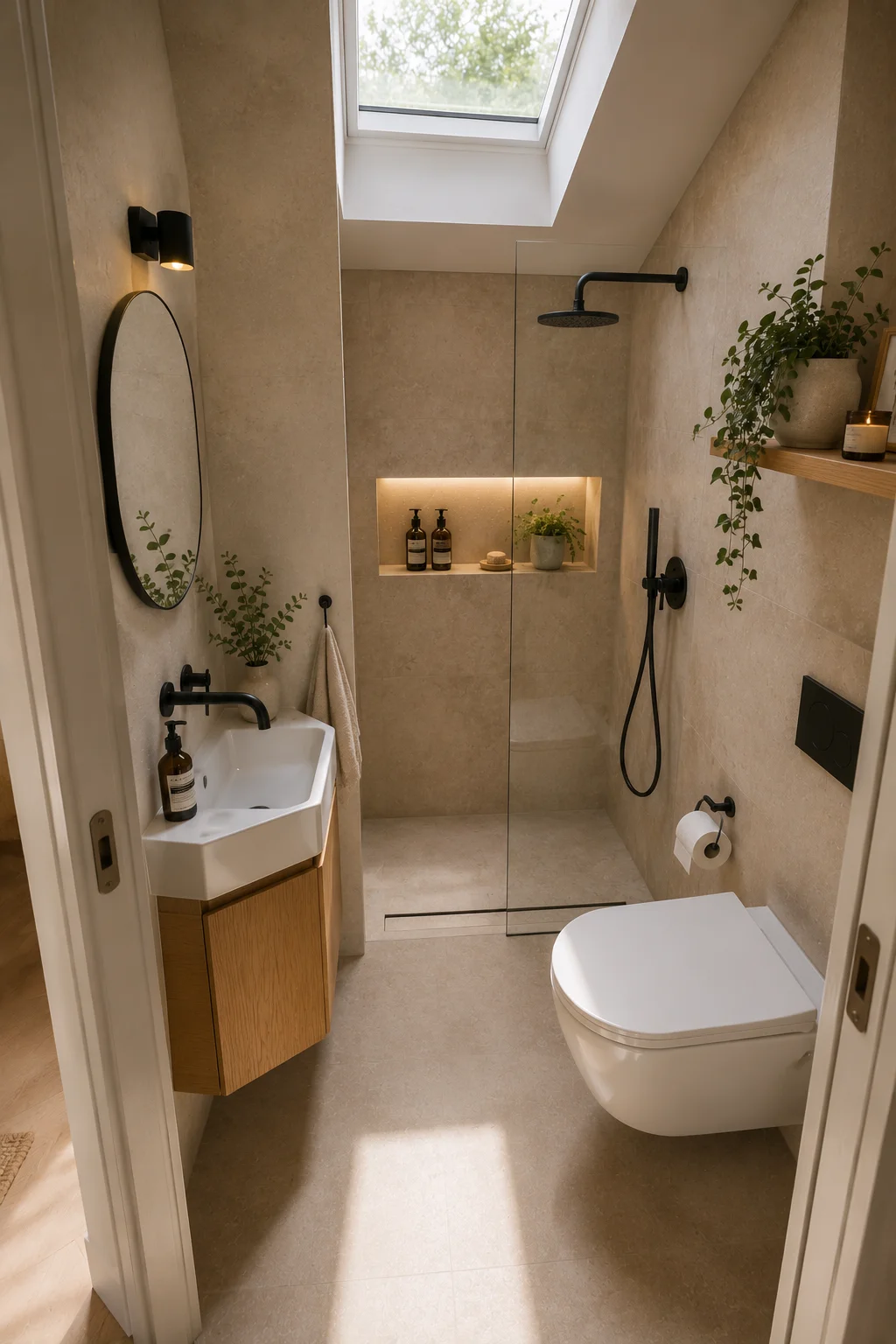
The twin of the previous room, planned tighter. The basin tucks into the corner by the door on a triangular oak base, the toilet hangs on the opposite wall, and the shower fills the far end under the skylight. An oak shelf above the toilet carries a trailing plant and a candle.
The principle is that the centre of a small bathroom is circulation, not furniture. A standard rectangular vanity projects into the walking line and the body turns sideways around it several times a day. The corner unit surrenders the bit of counter nobody uses and returns the bit of floor everybody uses, which the photograph shows as clear stone from door to drain.
Corner basins in ceramic run £90 to £260 in 2026 from VitrA or Roper Rhodes, with black wall-mounted taps from the mid lines named earlier. The room still needs the same tanking and the same linear drain as any wet room, so the saving is in comfort rather than cost.
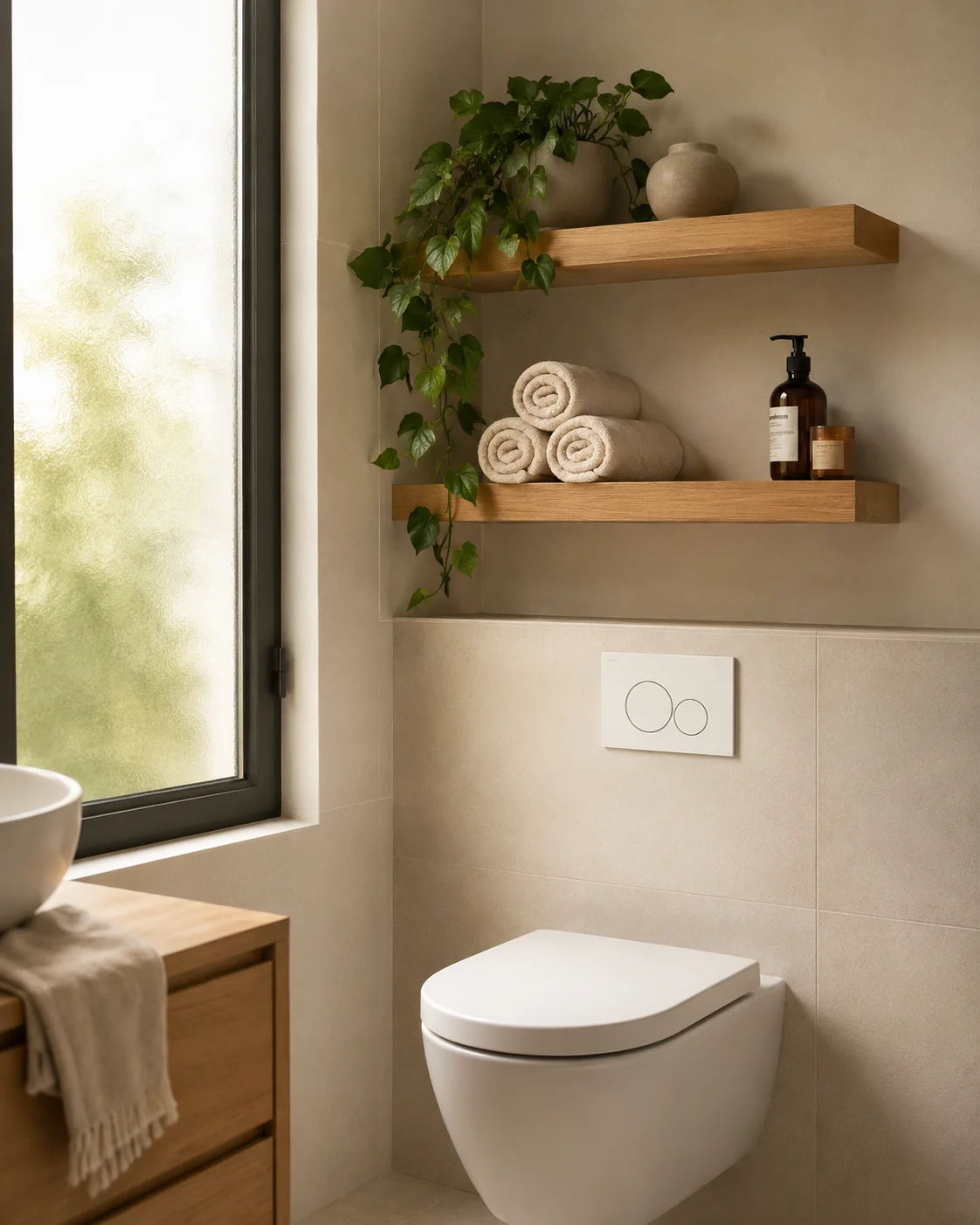
A toilet that leaves the floor alone
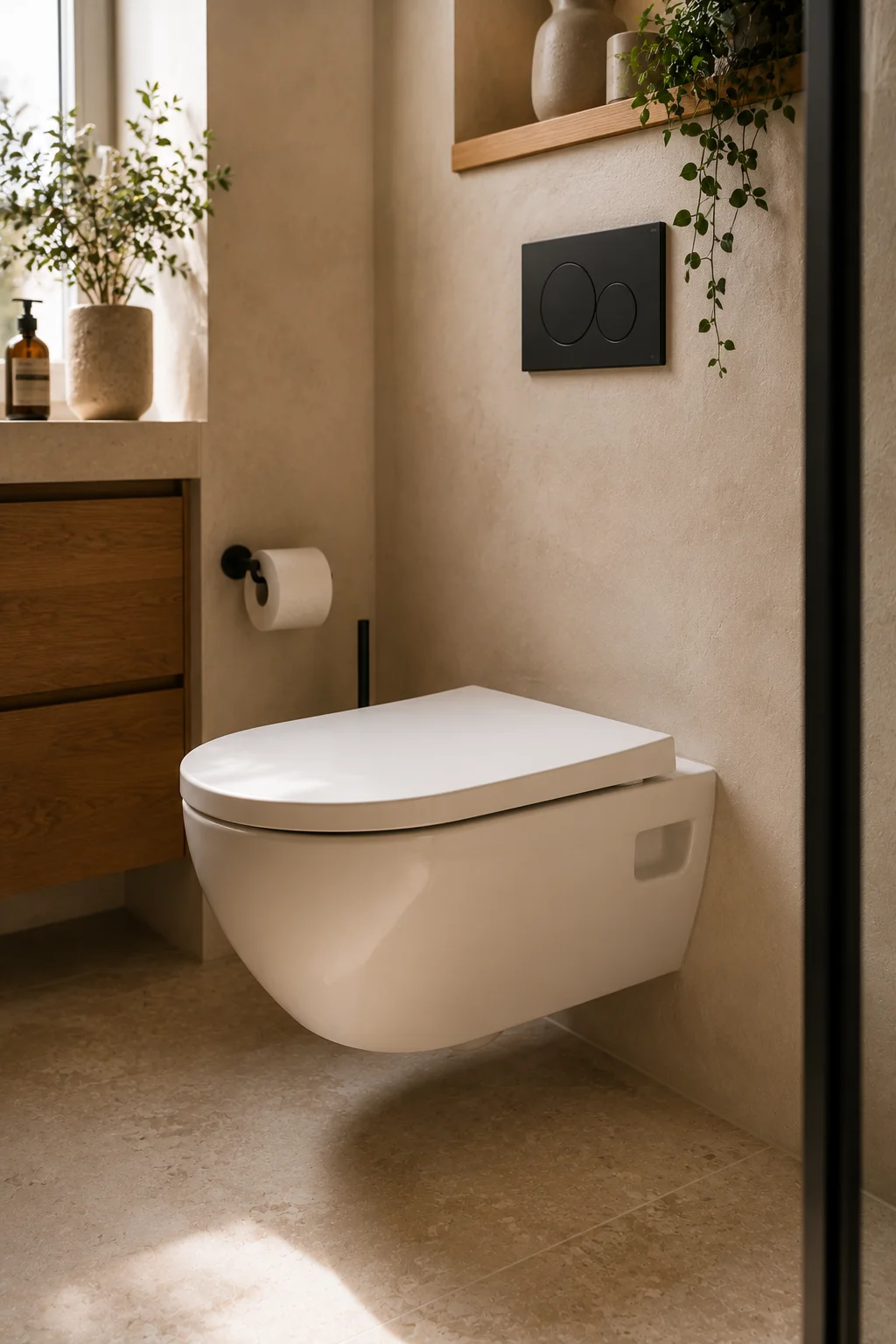
A wall-hung pan floats above the stone, with a black dual flush plate set into the plaster above it. Oak and trailing leaves enter from the edges of the frame.
The visual logic matches the vanity exactly, because both leave floor visible beneath them and both hide their workings inside the wall. The practical logic is cleaning, since the floor beneath a wall-hung pan mops in one pass where a pedestal needs cutting around. The flush plate in black repeats the shower brassware elsewhere, which stops the black reading as an afterthought.
This is the second of the three in-wall decisions, and it needs the same early commitment as the vanity. The frame, the waste position and the plate size all get fixed before plaster, and access for servicing runs through the plate opening or a removable panel. Ceramic wall-hung pans run £180 to £550 in 2026, with Duravit and VitrA the standard names.
Evening light from the mirror outwards
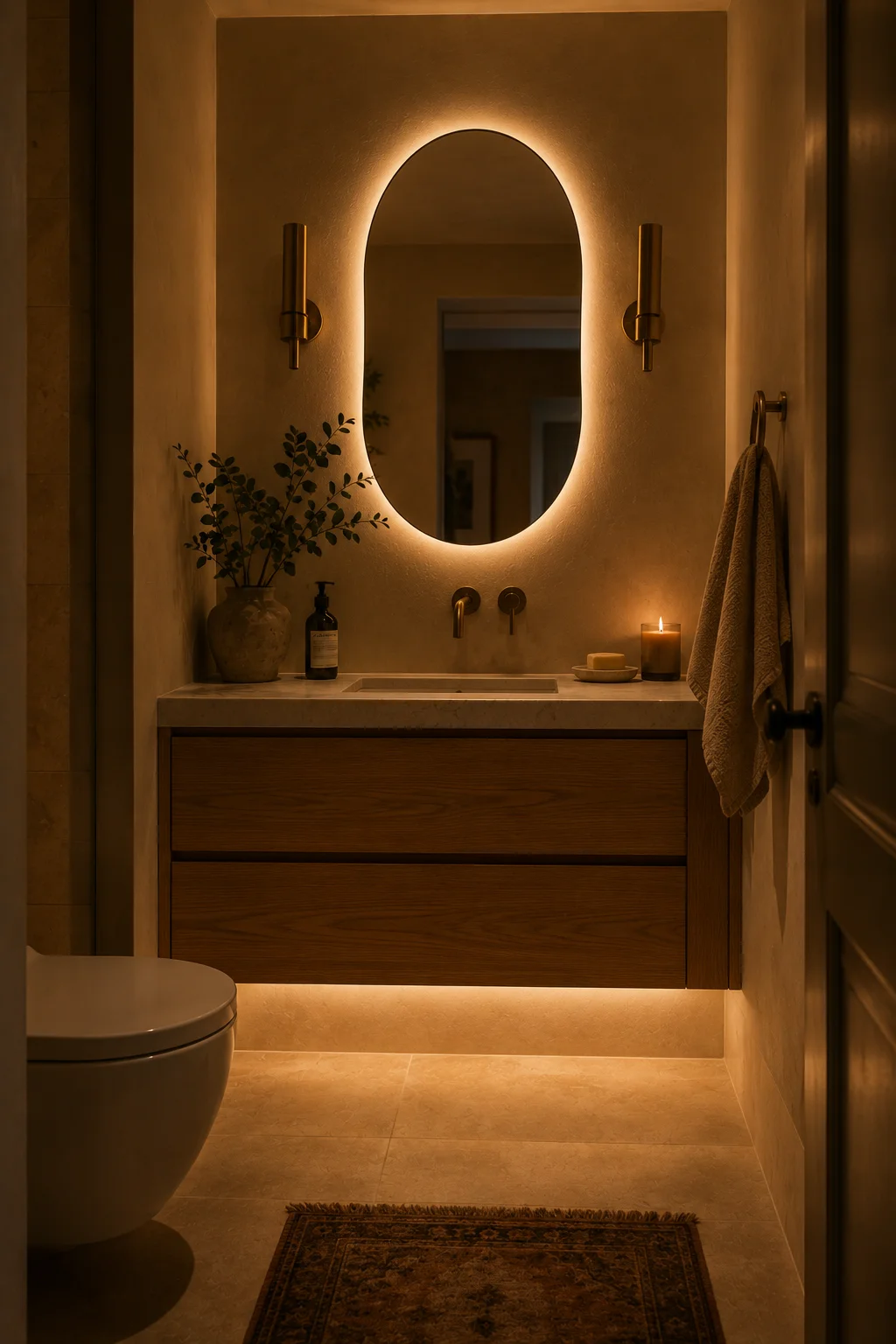
Night, and the room runs on three warm sources. The oval mirror throws a halo onto the plaster, two brass sconces stand each side of it, and a strip under the vanity washes the floor. A candle and a vase of eucalyptus sit on the stone.
Layering is the principle, because one ceiling light flattens a small bathroom while several low sources give it depth. The halo flatters the wall, the sconces put light at face height where shaving and make-up happen, and the floor wash lifts the vanity clear of the shadows. All of it sits near 2700K, which reads as candlelight instead of office.
Put each layer on its own dimmer while the wiring is open. Pill mirrors with integrated halo run £180 to £550 in 2026, brass tube sconces such as Astro Lighting’s run £70 to £160 each in the same year, and the under-vanity strip comes from the metre rates named earlier.
The same evening, closer in
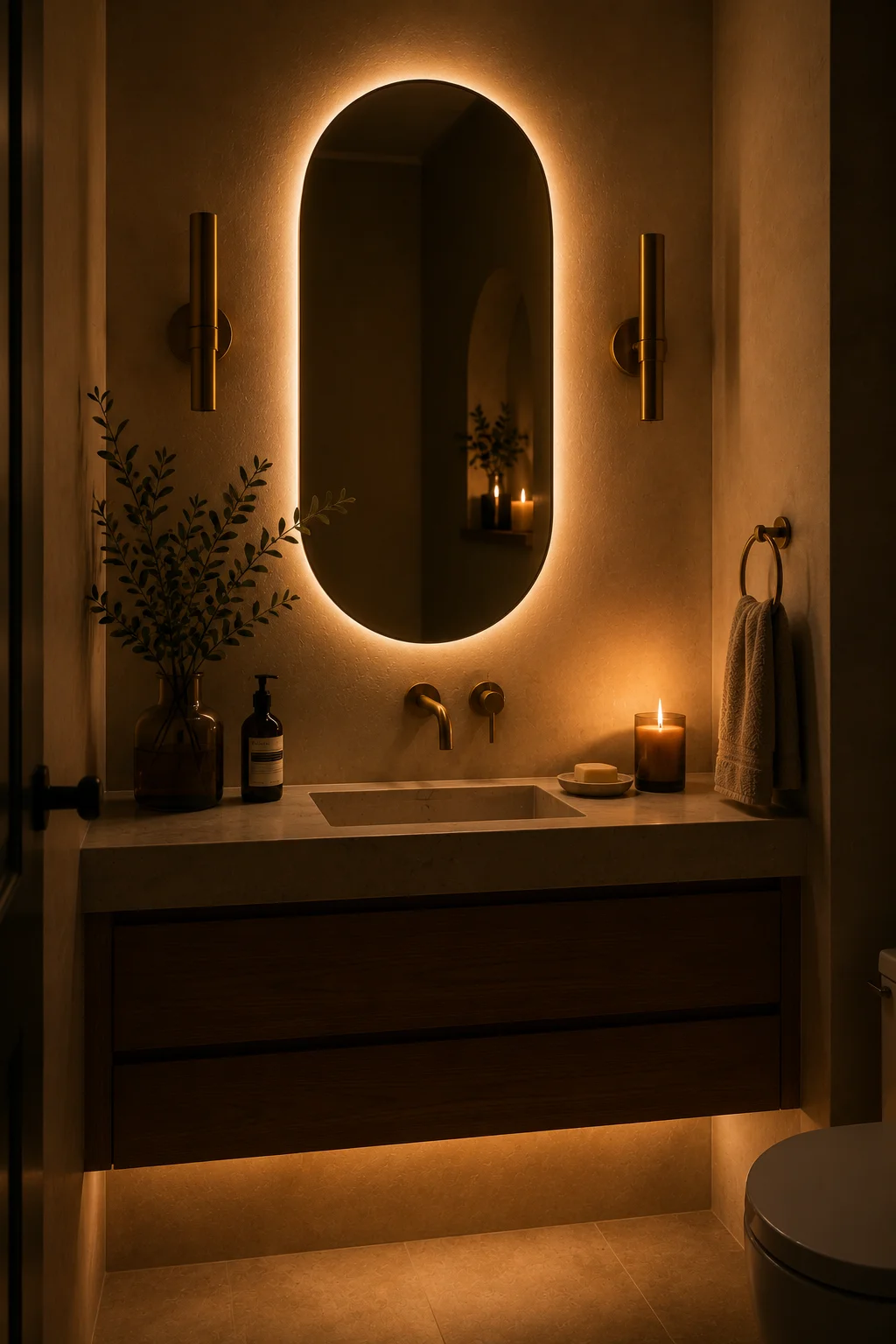
The same room as above, framed tighter. The halo mirror fills the wall, the two sconces stand closer in the frame, and the wall-mounted tap and candle sit on the counter below. The toilet edge just enters on the right, which gives the scale away.
This second frame earns its place because it shows what the wide shot cannot, which is where the light actually lands. The halo spreads across limewash or clay paint without a hard edge, and the sconce beams strike the wall at face height instead of from above. Downlights alone throw shadows under the brow and chin; light from each side of the mirror fills them, which is why faces look rested here and tired under a single ceiling spot.
Keep the colour temperature matched across all three sources. Mixed lamps, one halo at 3000K against sconces at 2700K, read as a mistake even when each fitting is good on its own.
Three things on a board
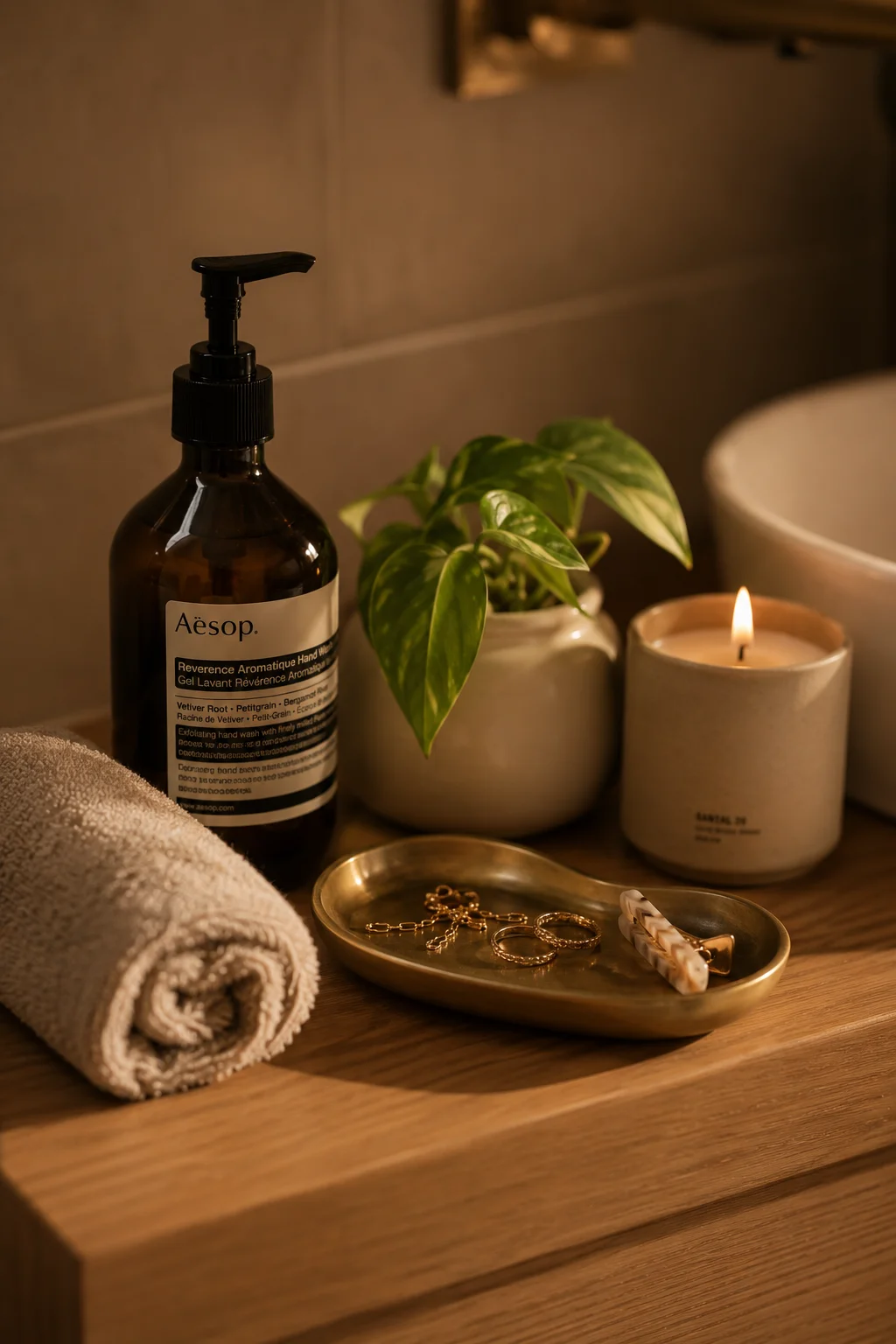
Candlelight on timber. A pump bottle, a potted pothos, and a lit candle stand behind a brass dish holding rings and a clip, with a rolled towel alongside.
The counter rule from earlier holds at night exactly as it does by day. Everything with a daily job earns its place, and everything sits on or beside one defined surface so the rest of the top stays clear. The living leaf matters more after dark than it does at noon, because it is the one shape in the frame that is not straight, and the eye settles on it.
Pothos tolerates steam and low light better than most indoor plants, and a small pot runs £8 to £20 in 2026 from garden centres. Keep it out of the direct splash zone, and expect slower growth through winter when daylight shortens.
Steam, brass and eucalyptus
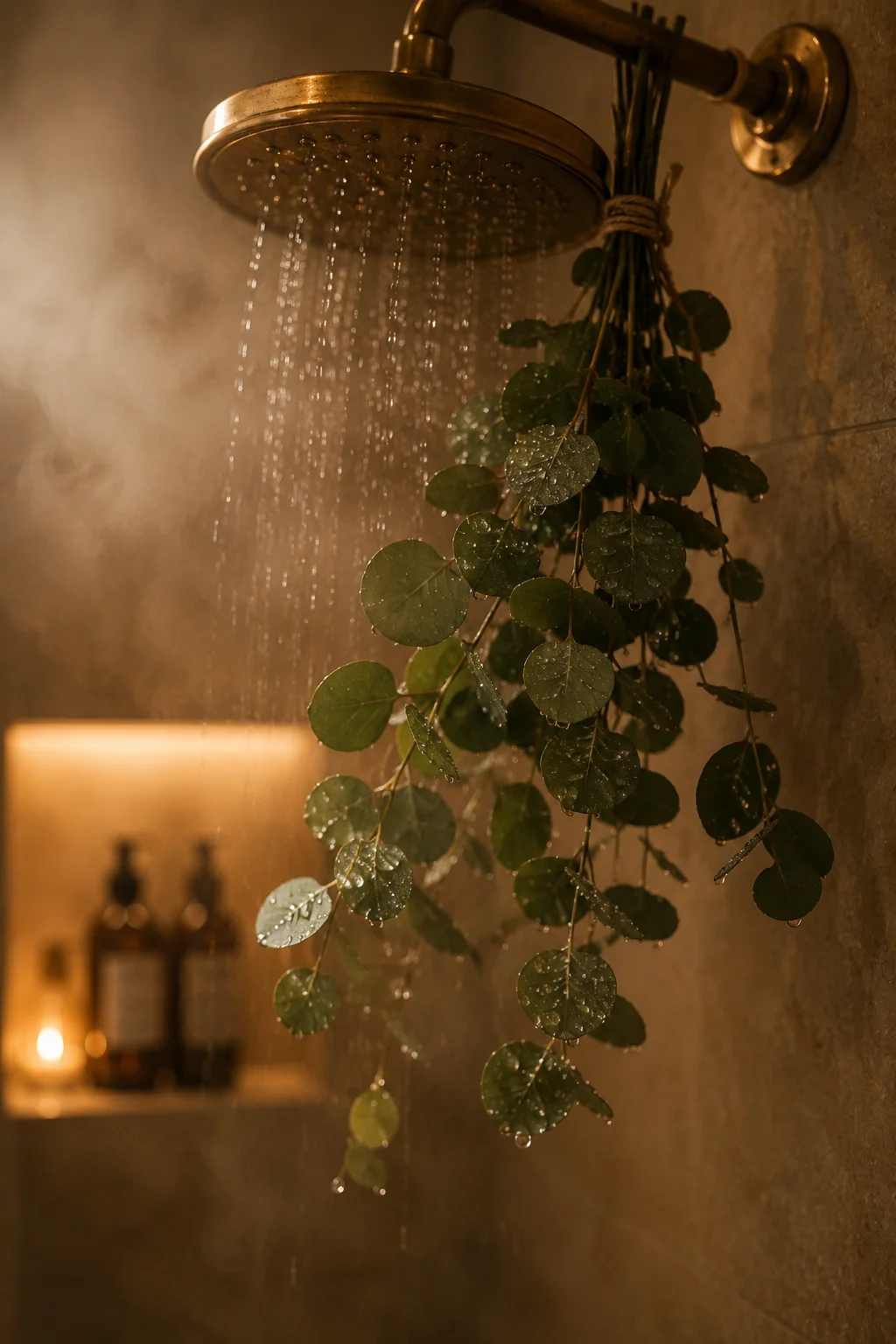
The last photograph moves into the shower. A brass head runs over a tied bunch of eucalyptus, steam softens the stone behind, and the lit niche glows out of focus with its bottles lined up.
The spray does two jobs at once here. It waters nothing, since cut stems only scent the steam for a week or two before fading, but it turns a daily wash into something deliberate for the price of a bunch of leaves. That is a fair trade in a room where every permanent change costs tiling.
Hang the bunch from the arm rather than the head, so it sits in steam without sitting in the water path, and replace it when the scent goes. Fresh eucalyptus bunches run £5 to £12 in 2026 from florists, and dried ones hold their shape longer while giving less scent. Brass shower arms in unlacquered finishes develop spots within months in hard water areas, which reads as patina to some eyes and neglect to others.
Where this does not apply
Rented flats, and any bathroom you are not taking back to the studs. None of the three main moves is available to you, and the honest advice is different: a slim rolling cart in the gap beside the vanity, an over-door rail, a mirror as wide as the wall allows, and warm bulbs. Those change a bathroom substantially for very little, and you can take them with you.
Frequently asked
Frequently Asked Questions
Can a wall-hung vanity go on a stud wall?
Only with timber fixed between the uprights first, or a manufactured brace, since plasterboard alone will not carry a stone-topped unit over time. Sort that support while the wall is open. Once tiled, the job becomes far larger.
What does a concealed tap cost to fit?
The mixer and spout in a matched set run from under £100 to over £1,000 in 2026, and the fitting labour exceeds a deck-mounted tap because the valve body is set and tested before tiling. Agree the basin model first so the projection and height are known.
Is a shower recess better than a shelf?
A recess keeps bottles flush with the wall and the floor fully clear, which matters most in tight rooms. It needs its position and lighting cable agreed before the wall closes. A shelf suits renters and anyone avoiding plasterwork.
Which mirror helps a tight room most?
The widest one the wall accepts, hung with its centre near eye level, since glass doubles whatever daylight and lamplight exists. A halo version adds evening mood but leaves faces in shadow unless sconces stand alongside it.
How do I keep towels from swamping the space?
Hold to one palette across bath sheets and hand towels, roll rather than fold for the basket, and let a single tray or rail define where they live. When each textile shares a colour family, the group reads as one calm block.
What planting survives steam and gloom?
Pothos and ferns cope with humidity and modest daylight, while cut eucalyptus scents the shower for a week or two and then fades. Keep pots clear of direct spray and expect slower growth in winter.
The order to decide in
- Choose the basin first, because it sets the tap projection and height.
- Specify noggins or a brace frame for the vanity while the wall is open.
- Set the niche between studs, sloped very slightly forward.
- Get the valve position confirmed and keep it accessible for servicing.
- Leave tile, mirror and lighting until last; they can change later.
This article may contain affiliate links. We may earn a commission at no extra cost to you.