10 Cozy Bedroom Ideas: Every Photo Has the Big Light Off

Add us as a preferred source to see more stories on Google.
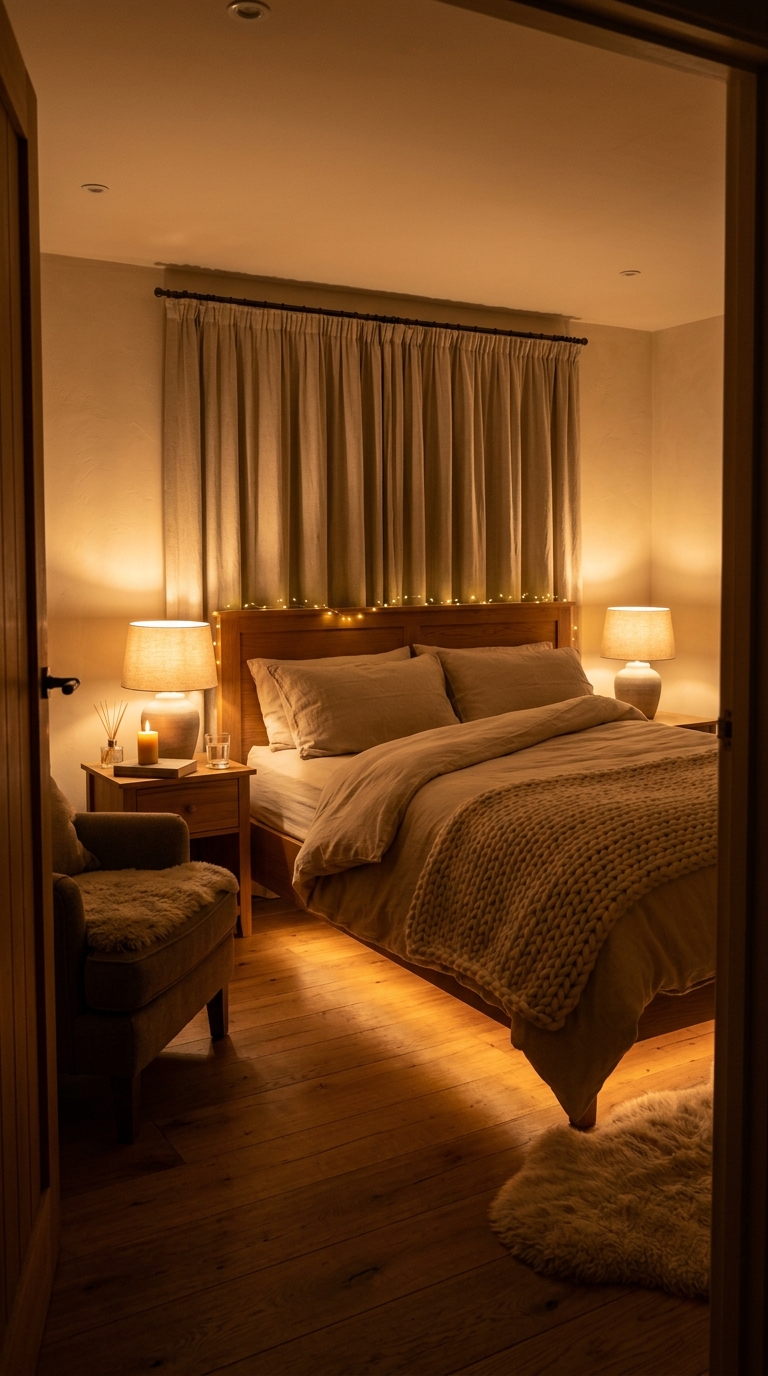
There are downlights in the ceiling of the bedroom below. You can see them, and not one of them is on.
Every light in that photograph is below eye level: two table lamps, a candle, a line of fairy lights along the headboard, and a glow coming from underneath the bed frame onto the floorboards.
That is the whole difference between the room in the picture and the same room at eleven at night with the ceiling light on. Not the throw, not the cushions, not the colour of the walls.
Why overhead light kills it
Light from directly above lands evenly on every upward-facing surface and leaves nothing in shadow. Texture is only visible because of the tiny shadows it casts, so overhead light flattens a knitted throw, a linen duvet and a sheepskin into the same smooth planes.
Light from the side, at a low angle, rakes across those same surfaces and every loop and fold casts a shadow. That is why the bedding in that photograph looks soft and why the same bedding under a downlight looks like bedding.
It is the same mechanism that makes late afternoon sun flattering and midday sun harsh, and it is entirely about angle rather than about brightness or warmth.
The four sources to put in
Two table lamps, matched, one each side. This is the base layer and the one most bedrooms already have. Shades in a pale fabric rather than a dark or opaque one, so they glow rather than casting a cone. Around 450 to 550mm tall on a standard nightstand, which puts the bottom of the shade near seated eye level.
Something at floor level. The glow under the bed in that photograph is an LED strip fixed to the underside of the frame, and it is the least obvious and most effective thing in the room. It lights the floor, it gives the bed the appearance of floating slightly, and at very low brightness it is enough to cross the room at night without waking properly.
Something behind the headboard. A string of warm fairy lights tucked along the top rail, or a strip behind a wall-mounted headboard. It throws light up the wall and gives the bed a halo.
Something with a flame, or that looks like one. A candle on the nightstand. It contributes almost nothing measurable and a great deal perceptually, because a moving light source reads as alive.
Get the temperature right
2700K at most, and 2200K is better in a bedroom. The bulbs in that photograph are clearly at the warmer end, which is why everything reads golden rather than merely lit.
Most bulbs sold as warm white are 2700K. Anything labelled 3000K and up is too cool for this, and 4000K in a bedroom is a genuinely unpleasant experience at seven in the morning.
Match every bulb in the room. A 2700K lamp beside a 3000K one makes the warmer of the two look yellow and dirty, and the eye reads the whole room as slightly off without being able to say why.
Dimmable if you can, and check the bulb and the dimmer are compatible before buying. LED flicker on a mismatched dimmer is the most common complaint and it is a pairing problem, not a fault.
Linen layers read deep because of shadow
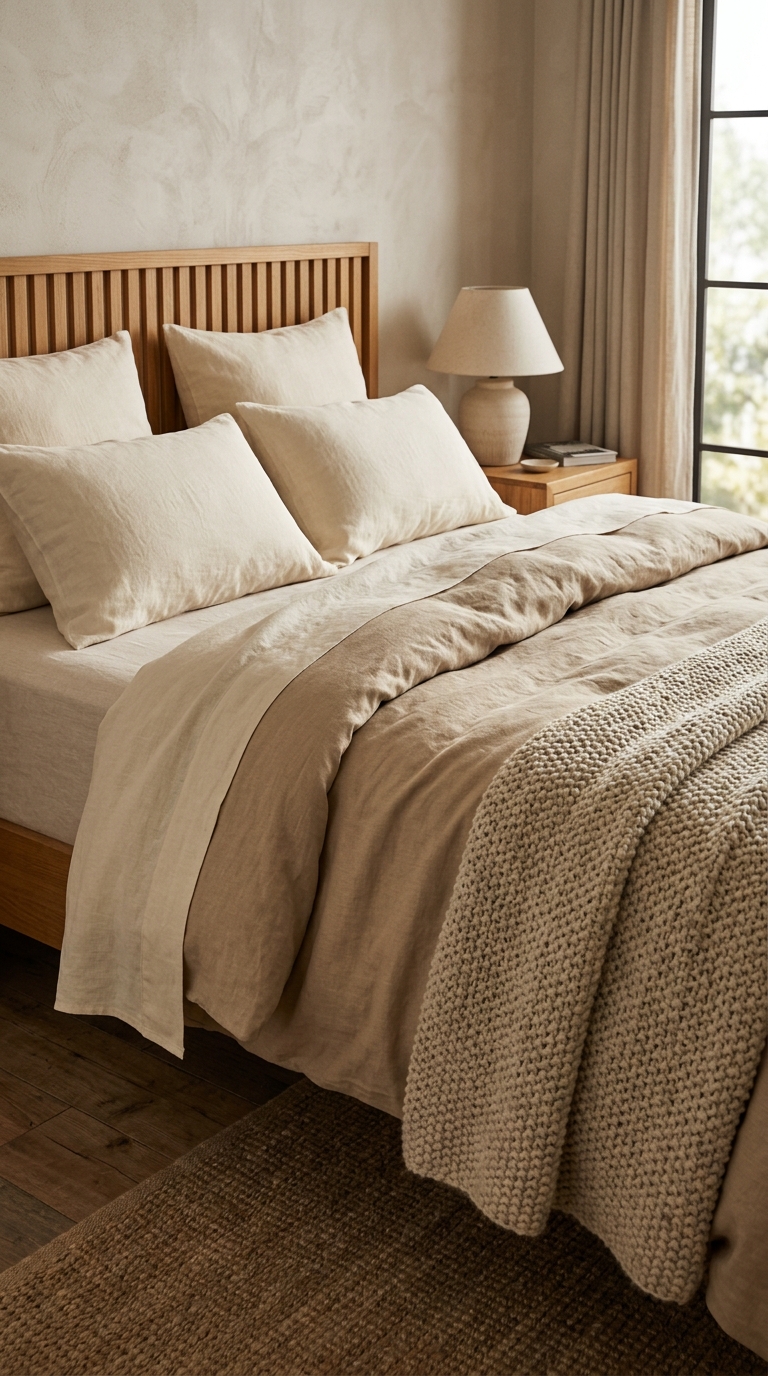
The bed in this picture carries four weights of cloth, and the eye counts them by shadow, not by colour. A fitted sheet pulls tight over the mattress, a flat sheet folds back in a soft roll, a linen duvet sags between the two, and a chunky knit lies across the foot. Because daylight arrives sideways from the tall window on the right, each fold throws a thin line of shade onto the next, which is why the whole pile looks deep enough to sink into.
The principle behind it is edge count. A single flat cover in the same oatmeal linen would photograph as one plane, however good the fibre, because low light would have nothing to rake across. Washed European flax helps here specifically because it refuses to lie flat. The crinkle that remains after pressing would remove holds across the duvet, and those creases become the texture that evening lamps model so kindly.
Piglet in Bed and The Secret Linen Store both sell washed linen duvet sets that rumple in this way, with double covers running £150 to £250 in 2026 and pillowcases £25 to £45 a pair. IKEA carries a cheaper flax blend at £60 to £110 for a double set, which softens less with washing but still creases honestly. Crisp cotton percale stays smooth under the same lamp and reads cool by comparison, which undoes the layering before it starts.
Slats stripe sun across oak
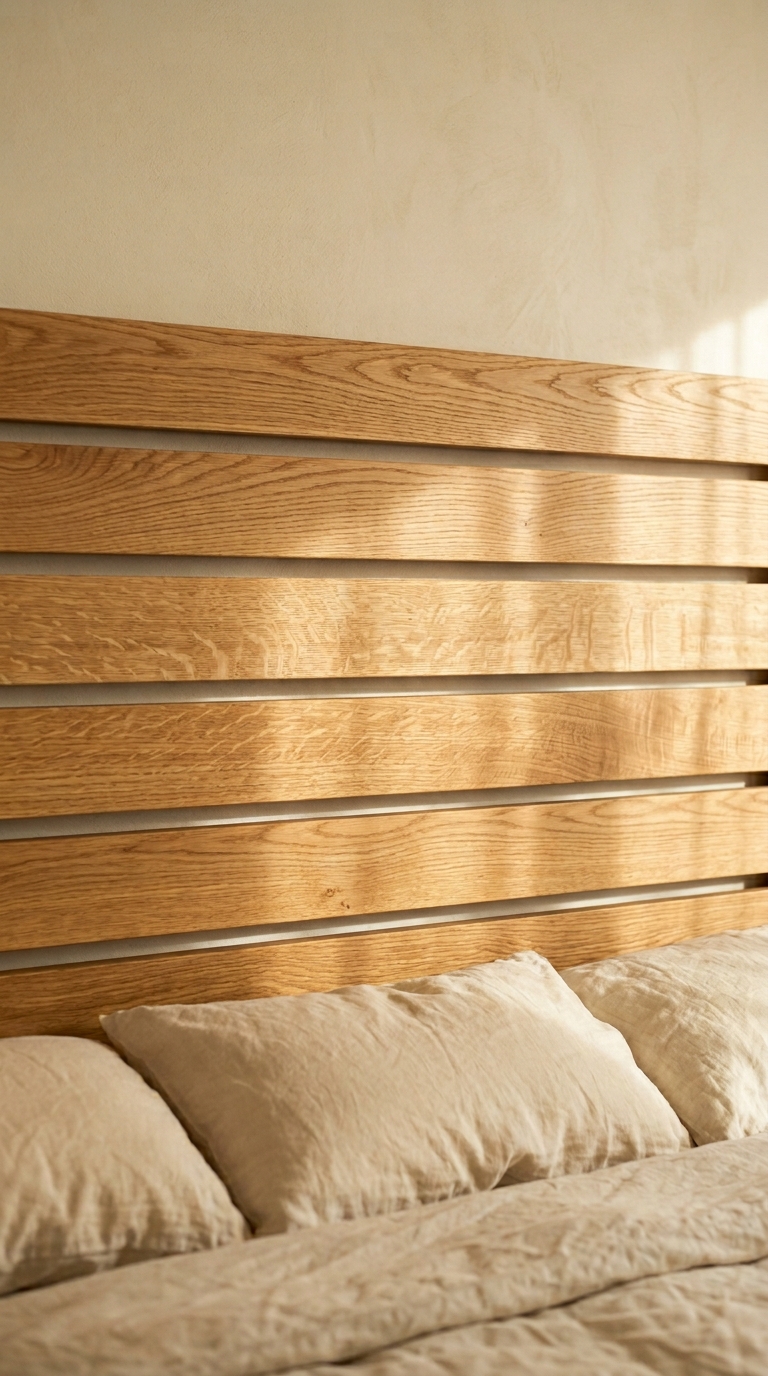
Look at the way morning sun lands on that headboard. Six horizontal oak boards run across the frame with narrow gaps between them, and a shaft from a side window stripes diagonally over the grain. The boards catch the light while the gaps hold darkness, so the whole surface flickers between honey and shade along its length.
That striping is the reason slatted timber suits low light. A solid upholstered panel in the same bedroom would absorb evening lamplight evenly and give little back, because there is no relief for the light to model. Oak slats do the opposite. Each board throws its own edge shadow, the grain shows medullary fleck where the cut quarters the log, and the wall colour glimpsed through the gaps keeps the mass from reading as a block.
The eye reads the timber as warm here because the light is warm. Under 2700K lamps the same oak glows amber, while under 4000K spots it turns grey and flat, which traces to the bulb, not the timber. Solid oak slatted headboards from Nkuku or Loaf run £300 to £700 in 2026 depending on width, with simpler pine versions from IKEA at £120 to £250. Oil the boards once a year with Osmo Polyx Oil. Dry timber under winter heating pales quickly when left unfed.
One low lamp makes its own pool
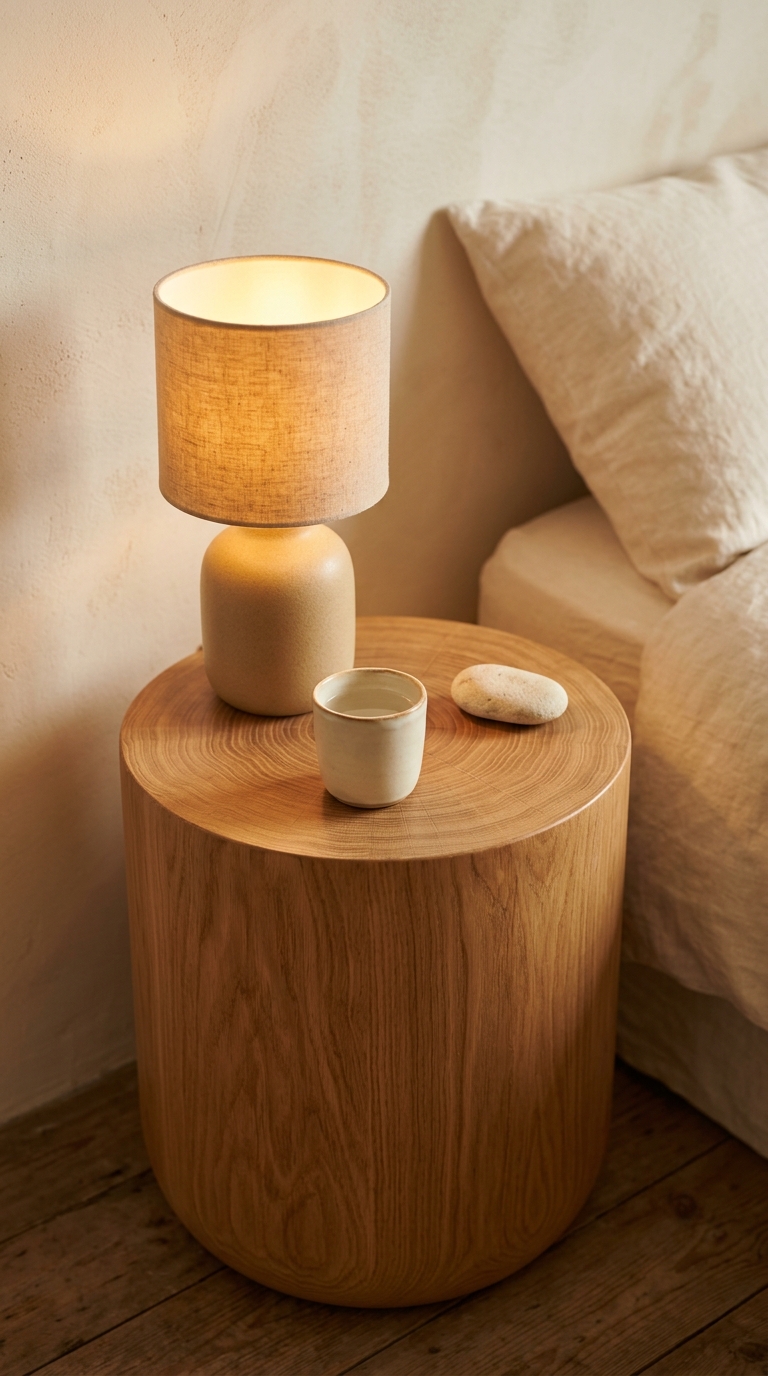
In this picture a single ceramic lamp does the work of the pair described earlier. A squat stoneware base in oatmeal stands on a round solid oak drum, with a straight linen shade that glows through its weave once lit. Beside it sit a small glazed cup and a smooth pebble, both half lit, both casting long soft shadows across the growth rings of the top.
The pool is the point. Because the shade is narrow and the bulb sits low, light falls downward onto the timber and outward onto the lime plaster behind, then fades within a metre. That fading edge is what makes the corner feel held. A taller shade with a wider mouth would throw more light onto the ceiling, which is precisely what this room is trying to avoid.
Ceramic bases of this shape run £40 to £80 from Zara Home in 2026, with linen drum shades from Pooky at £55 to £110. Tala Classic bulbs at 2700K cost £12 to £20 each, while Philips WarmGlow equivalents run £8 to £15. Check dimmer compatibility before buying, since mismatched LED dimmers buzz audibly in a quiet bedroom and the fault lies in the pairing.
The same bed under two lights
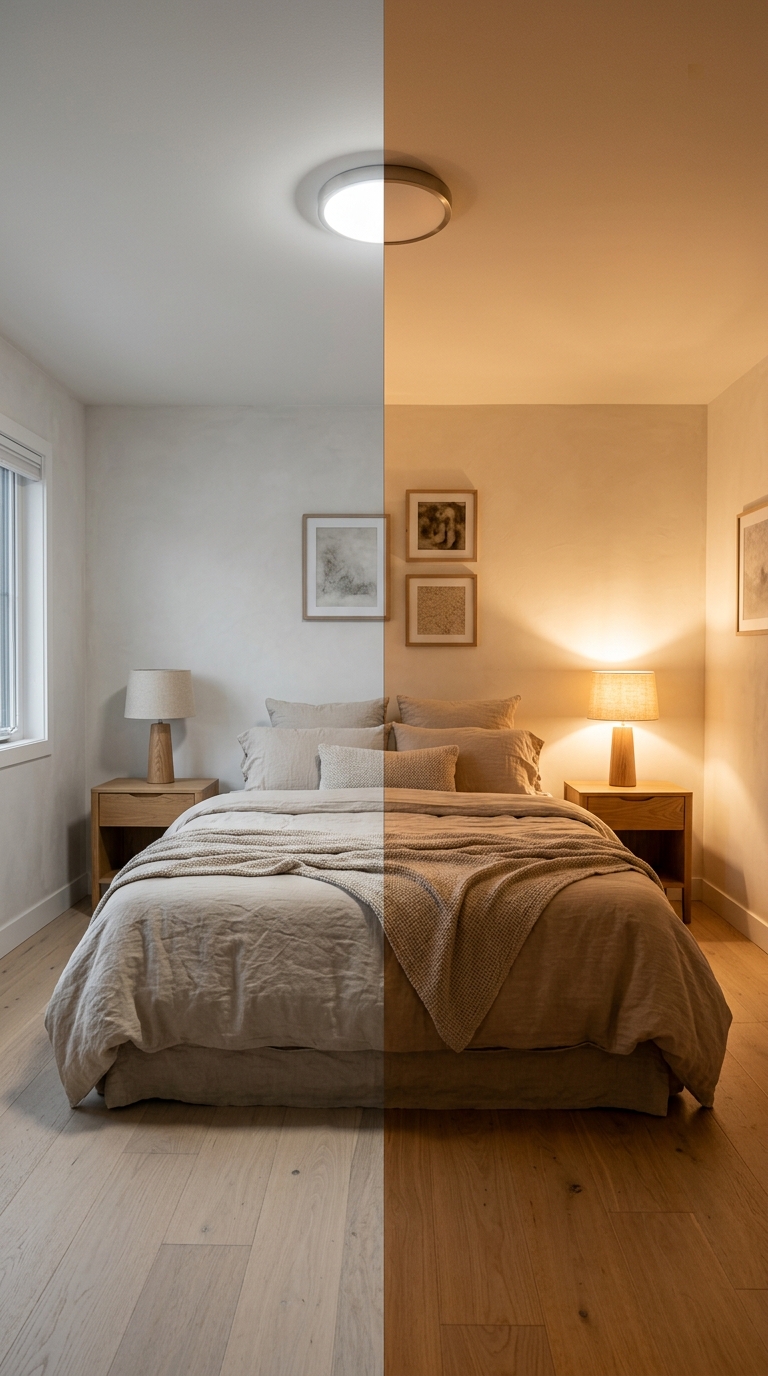
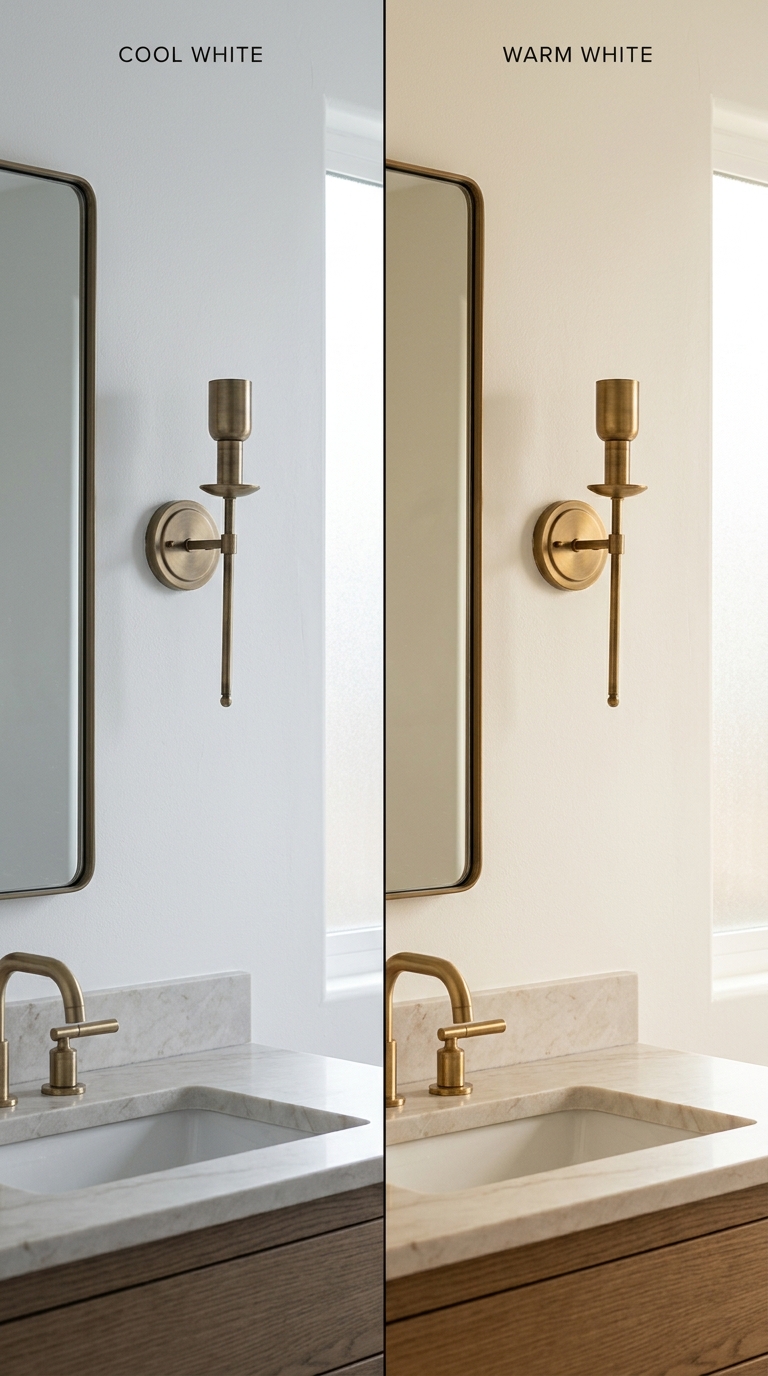
This split frame settles the argument in one glance. On the left the bedroom sits under a ceiling flush mount at something like 4000K. Boards read pale grey, walls read chalky, linen reads almost blue, and the knit at the foot lies flat. On the right the same bed glows under two bedside lamps. Boards turn honeyed, walls turn milky, the identical linen reads as oatmeal, and every fold in that throw casts a shadow.
Nothing structural differs between the halves. The change is position plus colour temperature, and it alters every surface at once, which repainting a single wall cannot do. Cool light from above renders timber grey and flattens weave, while light around 2200K to 2700K from the sides gilds the same materials. At 3000K the room reads neutral, which suits a hallway better than an evening bed.
The practical move costs little. Read the number printed on every bulb in the room, not the words like warm white on the box, replace the lot with matching 2700K dimmables, and switch the ceiling fitting off. Anyone renting gets the full benefit here without touching the walls, which is why light belongs ahead of textiles in the order of work.
Sheepskin reads soft because of shadow
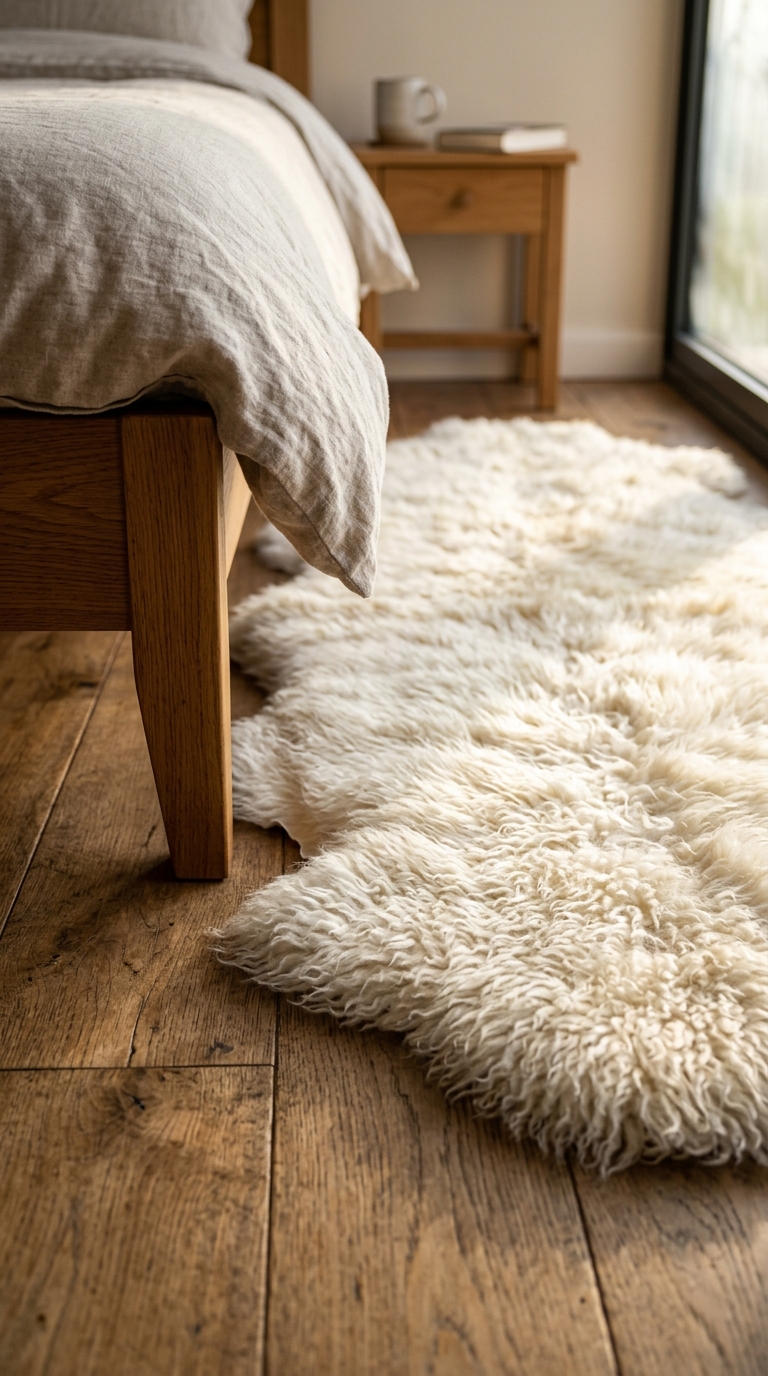
The rug in this picture looks soft before a foot touches it, and the reason is entirely optical. Thousands of long fibres stand at different angles, so side light from the bedside lamp catches some and leaves others in shade. That field of micro shadow is what the eye files as softness. A flat cotton rug in the same ivory would reflect evening light evenly and read as pale, not deep.
Placement matters as much as pile. The fleece lies where feet land on waking, half under the oak side rail and half on open boards, so the under bed glow described earlier would rake straight across it at night. The linen duvet hanging over the frame repeats the trick above. Its rumpled edge throws a soft line onto the floorboards, which links bed and rug into one continuous fall of texture.
Genuine single fleeces from IKEA cost £35 to £60 in 2026, with larger New Zealand fleeces at £80 to £150 from sheepskin specialists. Shake them outside monthly. Washing mats the fibres into felt, and felt reflects light evenly, which removes the very shadows that made the rug look inviting in the first place.
Chunky knit works as folded weight
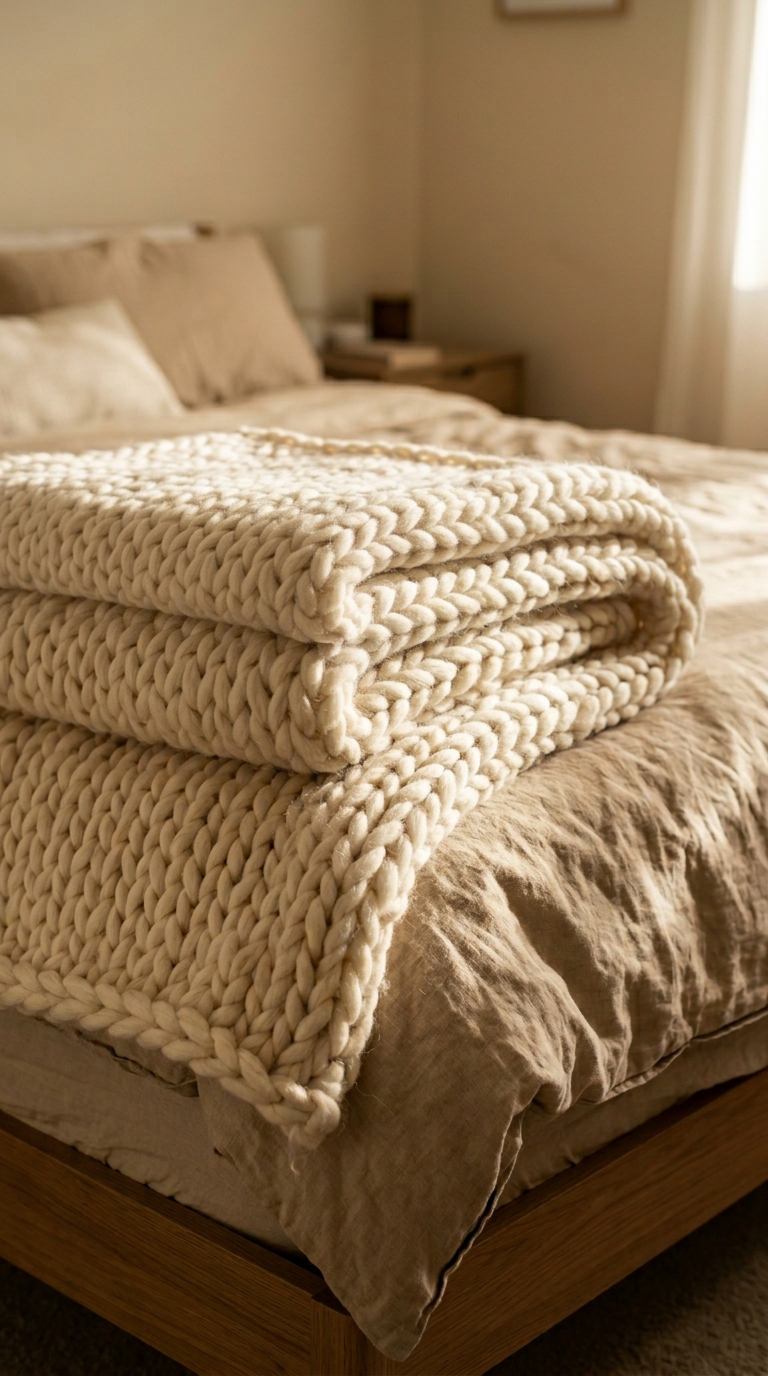
Shown here folded in thirds across rumpled linen, this throw earns its place by weight and relief, not by pattern. Each stitch stands proud by several millimetres, so low lamplight catches the crown of every loop and leaves the valleys dark. From across the room those alternating bands read as depth, which is why one heavy knit warms a bed more than two thin flat blankets in the same cream.
The fold is part of the mechanism. Laid flat the same throw would cover more area thinly and give less shadow. Folded, it triples its height where the eye lands first, at the foot of the bed, and the rolled edge throws its own broad band of shade onto the linen beneath. That deliberate bulk also serves use. It pulls up easily on a cold night without disturbing the duvet, then refolds in seconds.
Chunky wool throws of this type run £25 to £40 from H and M Home in 2026, £70 to £120 from Tolly McRae, and £150 and above from Begg and Co for undyed lambswool. Choose wool or a wool blend where possible. Acrylic copies look similar on day one and pill into hard bobbles within months, which reflect lamplight harshly instead of drinking it.
Limewash scatters low light
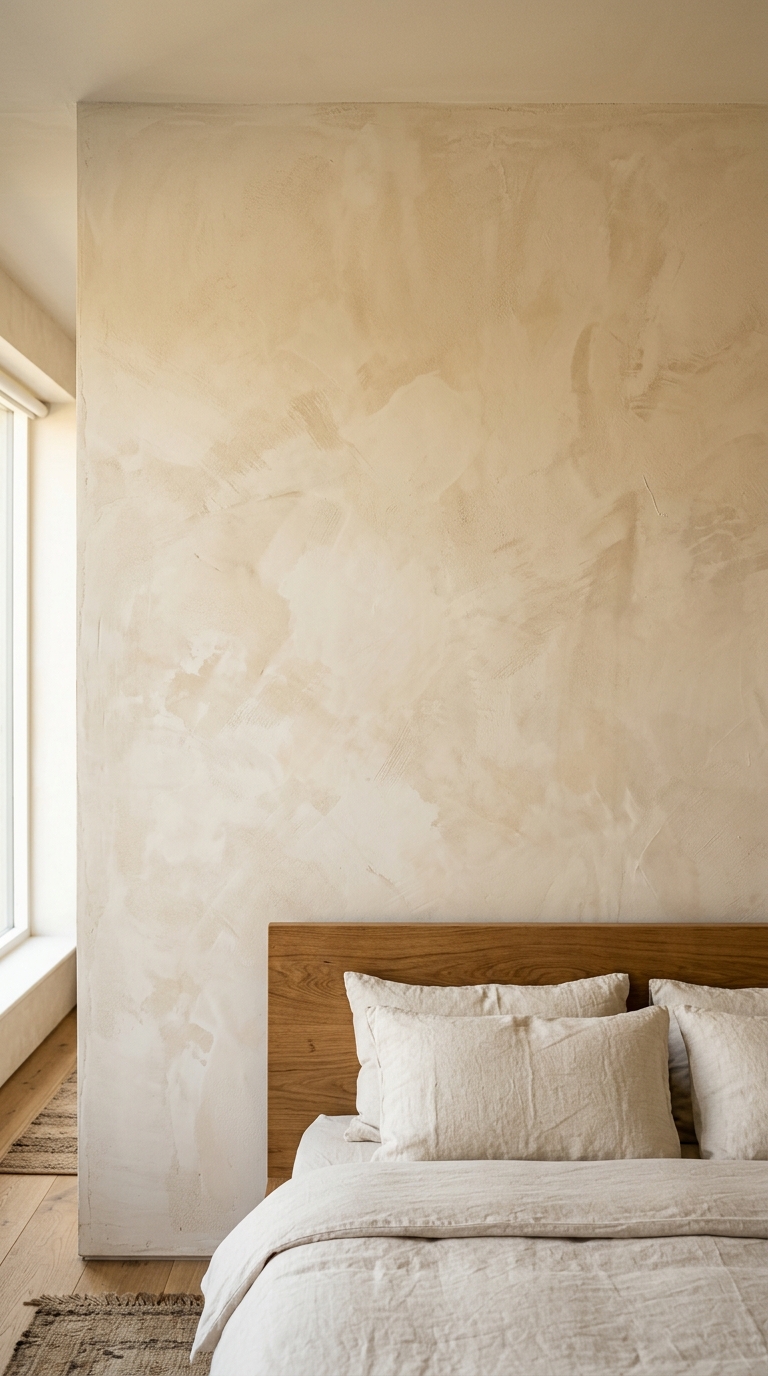
That wall looks cloudy in daylight, with paler drifts and deeper washes moving across it. In this picture the mottling comes from hand application, and it is doing quiet work after dark. When the bedside lamps come on, the uneven surface scatters their low beams in many directions at once, so the wall glows softly instead of bouncing a hard pool back. Flat emulsion in the same cream would return the light evenly and read as blank beside the rumpled linen.
The bed placement helps the effect. A low oak plank headboard sits against the texture without covering much of it, two linen pillows stand in front, and a jute rug runs beneath. Because the wall stays largely visible, its variation carries the whole end of the room, which means the bedding can stay plain. There is no need for pattern when the plaster itself supplies movement.
Real limewash from Bauwerk Colour costs around £50 to £80 for 4 litres in 2026, with Little Greene versions at £60 to £90. It needs a porous base and a wide brush, not a roller. It chalks to the touch and cannot be scrubbed, so it suits a bedroom wall behind the bed far better than a hallway where shoulders brush past.
Linen curtains turn sun into shade
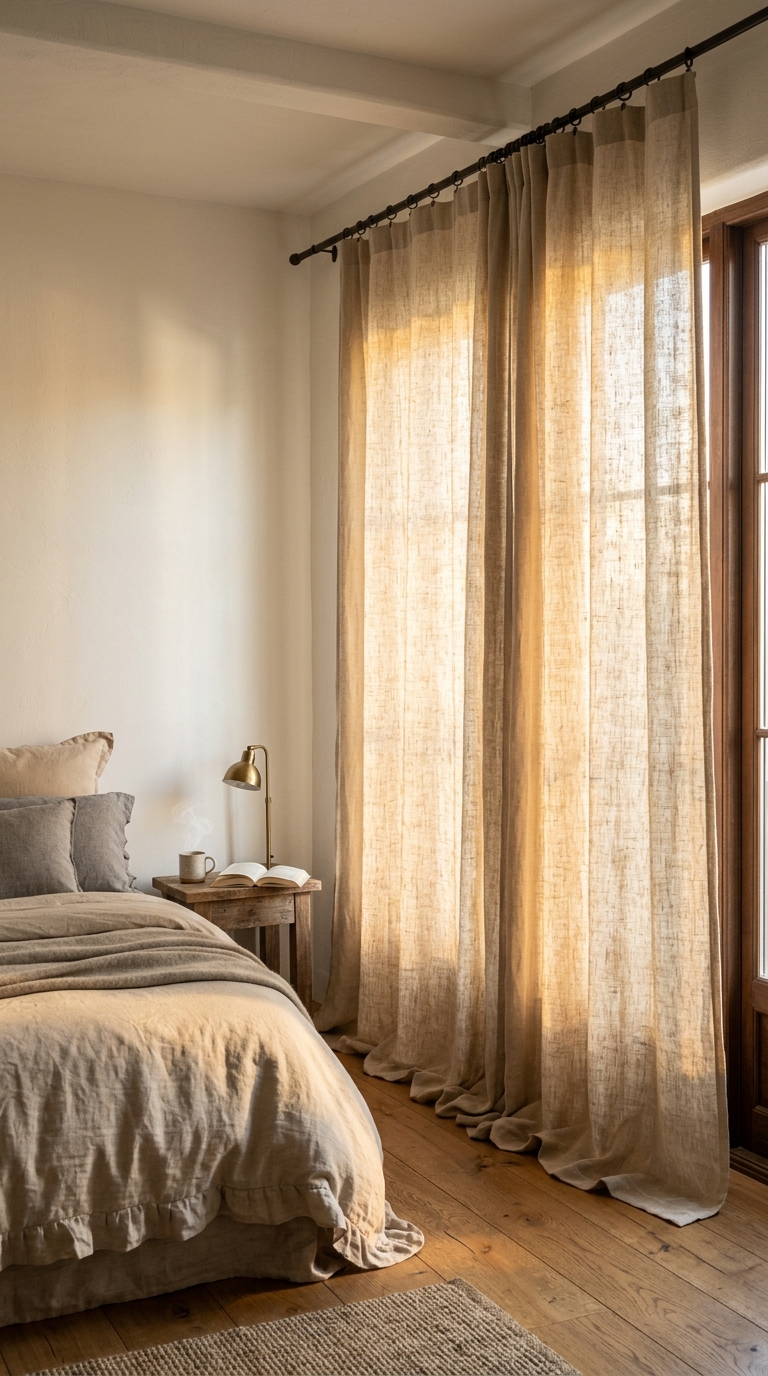
Evening sun pours through these curtains and arrives in the room changed. The loose linen weave filters the glare into a warm haze, the vertical folds throw soft stripes onto the boards, and the pooled length on the floor breaks the hard line where wall meets timber. Without that textile the same sun would land as a bright rectangle and bleach the boards. With it, the light spreads.
The hanging is doing as much as the fibre. The black rod runs near the ceiling and well past the glass on each side, so the curtains stack clear of the window by day and draw fully across it at night. That generous width means the linen never pulls taut. It hangs in deep folds even when closed, and folds are what give low light something to model.
Medium weight linen curtains of this type cost £50 to £90 a pair from IKEA AINA in 2026, £120 to £250 from Loaf or Nkuku, and £300 and above per pair from Volga Linen for made to measure. Hang them high and wide, let the hem kiss the floor or puddle slightly, and line them with nothing heavier than voile if blackout is needed elsewhere. A separate blind behind does that job without stiffening the linen.
One matte canvas steadies twin lamps
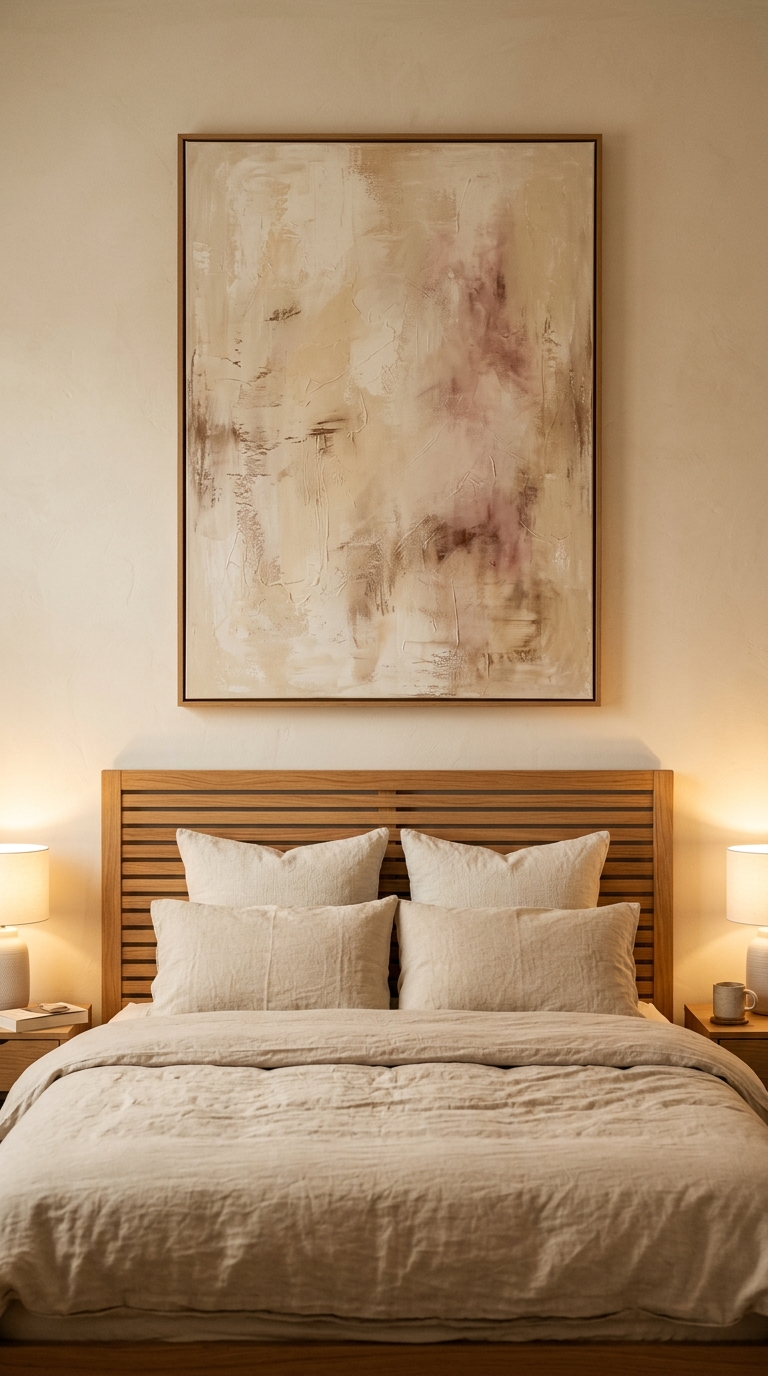
Symmetry rules this picture. Two linen shaded lamps burn at equal height on oak nightstands, four linen pillows stand in pairs, and a single large abstract hangs centred above the slatted headboard. The canvas itself is matte and chalky, in washes of ivory and sand with a faint rose drift, and its brushed surface drinks the side light instead of reflecting it.
That matte quality is why the arrangement holds. Twin lamps need something quiet between them or the wall becomes a corridor of glow with no anchor. Glass or gloss above the bed would throw hard highlights back at the pillows and compete with the shades. A flat matte canvas absorbs the overspill, lets the two pools sit separately, and gives the eye one place to rest.
Scale decides whether the trick works. The frame here spans roughly two thirds of the headboard width, with its lower edge a hand width above the top rail, which reads as one object with the bed, not as a separate picture. Framed giclee canvases of this scale cost £40 to £90 from high street framers in 2026, with originals on canvas from £200. Keep the palette inside the bedding family. One new pigment above the bed argues with the lamps instead of steadying them.
What this costs
Prices are rough bands for 2026.
| Item | Roughly |
|---|---|
| LED strip, warm white, 3m with transformer | £15 to £30 |
| Fairy lights, warm, mains powered | £10 to £20 |
| Plug-in remote socket | £10 to £15 |
| Pair of table lamps | £40 to £200 |
| Warm dimmable bulbs, Tala or Philips | £8 to £20 each |
Under £100 changes a bedroom more than several hundred spent on textiles, which is the honest ranking and the opposite of how most people approach it.
Where lamplight is settled, texture spend goes further because the light shows it properly.
| Layer | Budget | Mid | Premium |
|---|---|---|---|
| Washed linen duvet set, double | IKEA flax blend, £60 to £110 | Secret Linen Store, £120 to £200 | Piglet in Bed, £150 to £250 |
| Chunky wool throw | H and M Home, £25 to £40 | Tolly McRae, £70 to £120 | Begg and Co, £150 and above |
| Sheepskin, single fleece | IKEA, £35 to £60 | Dunelm, £50 to £90 | New Zealand specialist, £80 to £150 |
| Linen curtains, pair | IKEA AINA, £50 to £90 | Loaf or Nkuku, £120 to £250 | Volga Linen made to measure, £300 and above |
The rug and the curtains change the largest surfaces, so they repay first, while baskets and candles can wait until the base layers sit right.
The practical limitation
Light this low and this warm is lovely and almost useless for anything functional. Finding a specific jumper in a wardrobe by candlelight is not a pleasant experience.
The answer is not to abandon it but to keep one bright source you can switch on deliberately: the ceiling fitting on a dimmer, or a wardrobe light. The point is that it is a decision rather than a default, and that the switch by the door is not the one you reach for on the way to bed.
Frequently asked
Frequently Asked Questions
How low should bedside lamps sit for evening glow?
Keep shades near seated eye height with pale linen that lets light through. Low pools flatter folds in the bedding, while tall cool fittings wash those shadows away.
Why does washed flax look softer than smooth cotton?
Creases hold tiny shade lines that side lamps pick up. Smooth sateen reflects evenly and stays crisp, so it cools the bed even in a warm tint.
Can the ceiling fitting stay for getting dressed?
Retain it on a dimmer for mornings and cleaning, then leave it off after supper. Evening comfort comes from table lamps, a floor level strip, and a small flame.
Which coverlet adds the most depth to plain sheets?
A heavy looped wool folded at the foot gives triple height where eyes land first. One dense piece beats two thin flat layers in the same ivory tone.
Does a floor covering alter how warm the space feels?
A long pile fleece beside the mattress breaks the hard board and catches low beams. Feet meet softness on waking, and the whole bay reads deeper.
How do window drapes soften harsh sun?
Loose weave fabric diffuses glare into haze and throws fold shadows on boards. Hang panels high, wide, and pooled so pleats never pull taut.
To start
- Stop using the ceiling light in the evening; put it on a dimmer if it must stay.
- Add two matched table lamps with pale shades, one each side.
- Fit a warm LED strip under the bed frame and a string behind the headboard.
- Use 2700K or lower in every bulb in the room, matched.
- Put the low lighting on a remote socket you can reach from bed.
This article may contain affiliate links. We may earn a commission at no extra cost to you.